Cleopatra: A Life, by Stacy Schiff


2012 Book 99: Cleopatra: A Life, by Stacy Schiff (7/4/2012)

Reason for Reading: I needed to buff up my “Memoir and Biography” category in 12 in 12 group, and this book fit into the Reading Globally theme read for Middle Eastern literature since it took place in Egypt.

My Review: 3.5/5 stars
Cleopatra: A Life is a light biography which is appropriate for the popular reader…not so much for historians or people who have already read a lot on the subject. There is a lot of speculation (Schiff admits as much) because there is not a contemporary information on the topic. Schiff’s thesis is that Cleopatra is not the conniving seductress that historians have suggested. The first third of the book covers her early life and relationship with Julius Ceasar, but this part not well organized. Schiff’s narrative jumps from subject to subject and does not do a very good job of explaining the political background. In fact, this section focuses mainly on how rich Cleopatra was and dwells in great detail on opulence. The last two thirds of the book come together in a tighter, more interesting narrative, however. This is where Schiff discusses Cleopatra’s relationship with Antony and its political ramifications. This is a good book to read for the “popular” reader who does’t have a specific interest in the subject. However, I ‘m guessing there may be biographies that better describe her relationship with Ceasar and the political ongoings at that time.

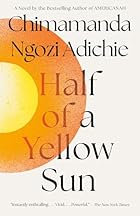
Half of a Yellow Sun, by Chimamanda Ngozi Adichie

Half of a Yellow Sun takes place in Nigeria during the Biafra War. The narrative follows 3 characters: Ugwu, a village boy who is taken in by some politically-inclined academics as a house boy; Olanna, Ugwu’s mistress and a rich heiress; and Richard, a British expat who desperately wants to be accepted by the Biafrans as one of them. The stories of these three characters are superbly and tragically woven together on a backdrop of war, racial hatred, and famine. This is one of the most impressive books I’ve read in quite a while. The characters were so deep that I felt I knew them. The events described had an eerie realism to them that comes from the author’s intimate knowledge of the history and people. This is one of those books that makes you feel like every incident described is important and well-planned. This is a story not only of war, but of people–their dreams, their loves, their fears, their strengths and weaknesses. Half of a Yellow Sun is a must-read for anyone interested in international literature.

The Bronze Bow, by Elizabeth George Speare

2012 Book 98: The Bronze Bow, by Elizabeth George Speare (6/30/2012)

Reason for Reading: I’m participating in the Middle Eastern literature theme read, and this book fits the theme because it takes place in Israel; however, I’m not sure they’re really interested in children’s literature, so this was really for my own edification.

My Review 5/5 stars
Daniel has been living for years as a member of a band of Zealots who wish to free the Israelis from Roman oppression. When he meets a preacher named Jesus, he realizes that perhaps his path of violence and thievery isn’t quite as logical as he’d thought it was. This is a fun book for kids, with adventure, interesting moral lessons, and new friendships. Although Jesus is a character in the book, he is only a minor one–the book is mainly historical fiction, and I think the lessons Daniel learns (violence, thievery, and hatred don’t accomplish anything good) are appropriate for kids of all religions or lack thereof. This is a must-read.

A controversial side-note: This book has been banned from many public school library on the following charges: 1) It’s too Christian, 2) It promotes bigotry against Jews, and 3) It suggests that Christianity is “right” and Judaism is “wrong.” I thought I’d address these issues. 

1)Too Christian: Kids are intelligent, we need to have more faith in them. They are not going to convert to Christianity just because they read one Christian fiction book. This book isn’t even Christian fiction, though it does get close. Kids will be better people in the end if they are introduced to all world religions, as well as many different cultural ways of looking at the world…it will make them LESS racist and more empathetic towards people with different beliefs. 

2) Hostile towards Jews: I’m not sure how? I’ve read a few arguments on this subject, and the people who claim that it promotes bigotry or that it is hostile towards Jews don’t provide examples. Or, when they do provide examples, they quote the book out of context to such extremes that it seems purposeful. But I’m going to assume that SOMEONE (who is actually honest) must have been insulted by this book at some point? I see only two reasons why that would be. 

First, the characters in the book are mostly Zealots who are angry about the oppressive Roman regime. It could be perceived as portraying Jews as angry or racist. However, the book did a good job of showing that this anger is rightfully aimed at an oppressive regime. People under oppressive regimes get angry. That’s a fact. So this book is both sociologically and historically accurate when it portrays some of its characters this way. Furthermore, the book is very sympathetic towards the characters and is rather more hostile towards Romans than Jews.

Second, there was a very short (maybe 3 sentence) passage in which it said that the priests from the synagogue were angry at Jesus and might try to get him killed. I understand that this pokes at the let’s-blame-the-Jews-for-the-death-of-Jesus wound that is still open and festering among some Jewish people (and some Christians???). I’m truly sorry about this open festering wound, but the passage in The Bronze Bow was very short and there’s no way it will encourage kids to blame currently living Jews for the death of Jesus. 

I grew up hearing these stories for my entire life, and I never realized this was an open, festering wound until I was 23 and talking to a rather onerous Israeli friend who (for reason still unknown to me) was trying to start an argument. He said to me: “You should hate me because, after all, I’m Jewish and we killed Jesus.” I was completely floored by this comment because the idea of blaming the Jews for Jesus’ death was foreign to me. I answered “But the Romans killed Jesus.” I had a Catholic education, heard all the stories from the Bible and still never considered the idea that Jewish people alive today could be blamed for the death of Jesus. It seemed preposterous. As far as I was concerned, Jesus was killed by Romans for political reasons that I didn’t quite understand. Though I know now that this is not just an issue with my Israeli friend…I came across the same idea in the book The Faith Club

I think that books like this with very short passages that reference well-known stories out of the New Testament aren’t going to encourage kids to be bigoted. It’s bigoted parents, teachers, and role models that will encourage kids to be bigots, not The Bronze Bow.

3) Christianity is right, Judaism is wrong: Well, it DOES imply that Christianity is right. That doesn’t mean that it implies Judaism is wrong. It never says that anywhere. There are scenes when the kids break rules, like washing hands before eating…but if kids breaking rules proves that they’re right to do so, then the Harry Potter books imply that kids are “right” and schools are “wrong.”
The Septembers of Shiraz, by Dalia Sofer

2012 Book 97: The Septembers of Shiraz, by Dalia Sofer (6/30/2012)

Categories: International Fiction (Iran), Award Winners (Orange Prize Longlist), Historical Fiction (Iranian Revolution)

Reason for Reading: I read this for Orange July as well as for the Middle Eastern literature theme read

My Review 3.5/5 stars
As an Iranian secular Jew, Isaac Amin’s life is swept off-course by the Iranian revolution when he is arrested on false charges of being a Zionist spy. Septembers of Shiraz follows the stories of Isaac, his wife Farnaz, and his two children. I should have really liked this story: the cultural setting is interesting and the frightening circumstances should be emotionally engaging. Unfortunately, I didn’t feel any emotion about the characters until the last third of the book. I’m not sure why this was…they just seemed distant. This fact is unfortunate since an emotional bond to the characters is really all this book had to offer me. I didn’t learn anything new about the Iranian revolution or the types of problems non-revolutionary citizens faced, since I’ve already read other books on the subject. Not that the story is boring or unoriginal, quite the contrary. I think it would be an excellent book for someone who hasn’t read much on the subject of the Iranian Revolution, or for someone who loves reading books on the subject.

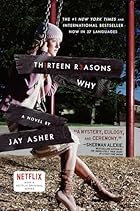
Thirteen Reasons Why, by Jay Asher

2012 Book 96: Thirteen Reasons Why, by Jay Asher (6/28/2012)

Reason for Reading: This has been one of my top 5 LT recommendations for a while now, so I thought I’d try it out.

My Review 4/5 stars

Upon returning home from school one afternoon, Clay Jenkins discovers a box of cassette tapes in which his crush Hannah Baker explains the thirteen reasons why she committed suicide. Over the course of one night, Clay’s perception of life morphs as he reacts to Hannah’s tragic story. I was prepared to be annoyed at this book–I thought it would glorify vengeful suicide. However, I was pleasantly surprised. I was immediately drawn in to Hannah’s story. I could hardly put it down. I was impressed that there was very little bitter vengefulness expressed. Mostly, she just wanted to be understood. Her story shows the reader in horrifying detail how the little not-so-nice things we do might have a huge impact on others. It’s a story that tells us to look at the way we treat other people…and to pay attention to the signals that they’re sending. It is a heartrending story, and was emotionally difficult for me to get through, but I think it has the potential to change the way teenagers view their own actions. It’s also an amazing hard-to-put-down story.