Hope in the Dark, by Rebecca Solnit

Hope in the Dark is a short book of essays about the importance of recognizing small victories in the face of what seems insurmountable challenge. Solnit is a radical activist who passionately protests many issues such as NAFTA, the destruction of the environment, and war. The book was beautifully written – Solnit surely knows how to compose a sentence. 


The reviews of this book seem overwhelmingly positive, and I, too, thought the book had an important point. However, I was not moved by the book as other people are. I think part of the problem is that many of the issues were older – it was originally published in 2004 and republished in 2016 with a new forward and afterward which address more timely issues. Unfortunately, I couldn’t get my hands on a 2016 copy since I was trying to get it read in time for the Social Justice bookclub (still time to sign up!) which will read it in January. (I have too many other books in January to be able to fit it in then.) 

Another issue I had with the book is it assumed prior knowledge of the issues such as why NAFTA is bad. I’ve never thought about NAFTA in the past – in fact, I only became aware of it being a controversial issue when Trump recently suggested nixing it. Perhaps that’s a lack of awareness on my part, but I would have appreciated more information. But explaining the issues was not what this book was about. This book was about hope, not about education. Because of this “flaw,” I found the book very boring in parts – I’m a fan of educational books more so than uplifting ones. 

That said, I totally understand why people are moved by this book, and I appreciate the timeliness of preaching hope in the appearances of failure. 


Merry Christmas to all who celebrate


Happy holidays to everyone! Personally, I celebrate Christmas as my seasonal holiday, and it happens to be Christmas, so Merry Christmas to all! 


I had a pretty average week here leading up to Christmas. Nothing exciting to report except that I went to dinner with my parents and boyfriend last night (steak!) and then he and I went to Rogue One. Which was awesome. And later today I will be headed out to celebrate Christmas with my boyfriend’s family. But first Christmas Mass with my parents. 

It’s a freezing drizzly Christmas here, with wind and rain all day long, followed by snow on Monday. Lovely driving weather for me, my sister, and my nephew who are planning on going up north to a lodge tomorrow to celebrate her 40th birthday. Hopefully everything will work out as planned! 

Currently Reading: Same books as last week. But I’m nearing the end of two of them. 🙂 

Completed: It’s been an uneventful week for reading, so I haven’t actually completed ANYTHING to report this week. 

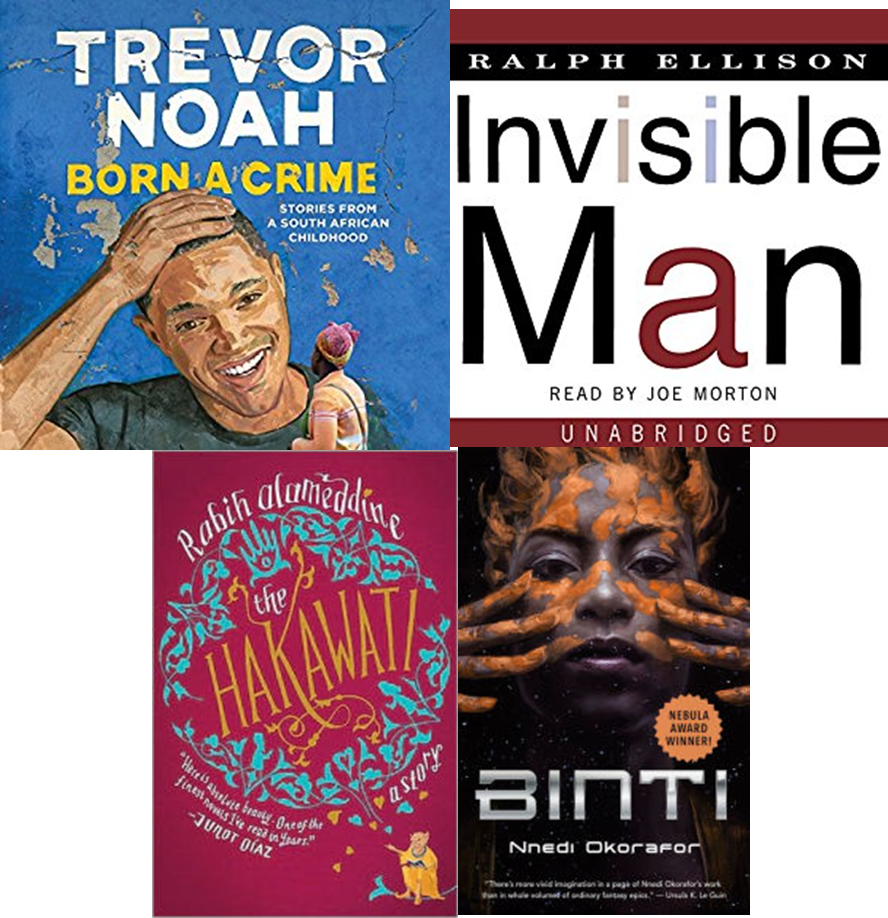
Acquired: I haven’t opened all my presents yet, so this isn’t my complete Christmas haul. I managed to get free copies of Trevor Noah’s Born a Crime and Ralph Ellison’s Invisible Man from Audible. And a friend on LibraryThing sent me two books I hadn’t heard of before: The Hakawati, by Rabith Alameddine and Binti, by Nnedi Okorafor. I’ll report the rest of my Christmas Haul next week. 🙂 

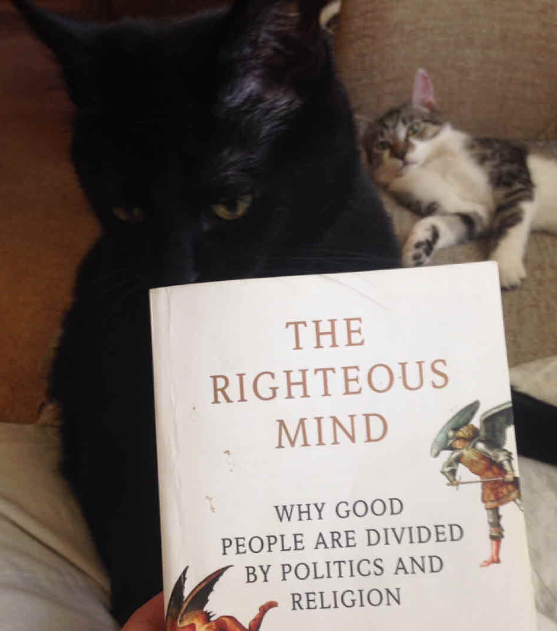
The Righteous Mind, by Jonathan Haidt

The Righteous Mind explores the polarization of American politics with a focus on the different moral foundations of conservatives versus liberals. He explores the question of why both conservatives and liberals tend to think they are morally in the right and that the other side is morally wrong. Haidt spends the first two chapters providing experimental evidence of why Hume was right to say that reason is the slave of passion. He suggests that you can’t make reasoned decisions without emotional backing. Haidt uses Damasio’s findings, presented in his book Descartes’ Error, to back this up. Damasio found that people who do not feel emotion due to brain damage are flummoxed by even small decisions like what brand of milk to buy or what order to perform a set of tasks. Haidt then references studies that suggest that people will use emotional intuition to come up with a point of view, and then look specifically at evidence that supports this intuition, ignoring evidence that contradicts their own views. 


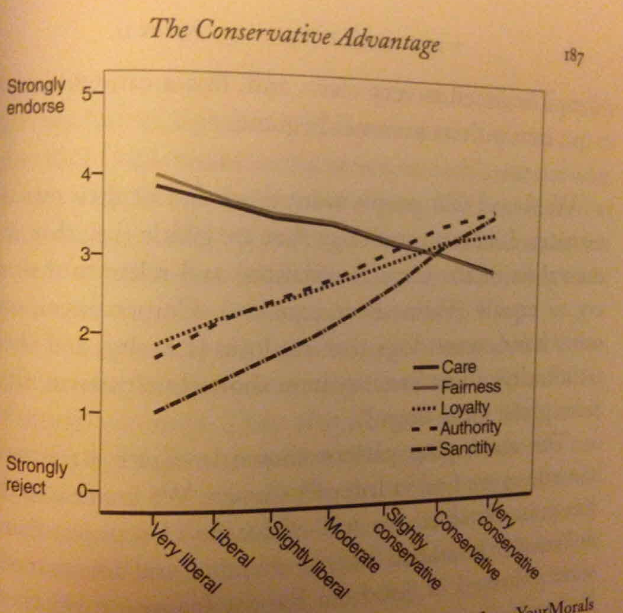
In his own studies (see figure below), Haidt breaks down people’s morals into categories: care about others, fairness, loyalty, authority, and sanctity. According to Haidt’s studies, liberals value caring about others and fairness much more than loyalty, authority, and sanctity. Conservatives value loyalty, authority, and sanctity more, and value care and fairness to a lesser degree. The interesting bit is that conservatives have a broader (more diverse) range of what they care about than liberals do. They care about their less important values more than liberals care about their less important values. Haidt suggests that this is why Republican candidates purposely apply to the emotional side of people more than Democrats do. And since people’s rational decisions are based on emotion, the Republican candidates have an advantage with moderate voters. 

Haidt goes on to answer the question: “Why do poor, rural, white folk vote against their economic best interests?” He suggests that they’re voting for their moral interests – loyalty, authority, and sanctity. 

The next part of the book is about evolutionary group selection. Many people believe that groupish behavior evolved in our species because a group of individuals was more successful at producing offspring than single individuals. But Haidt asks the question: how can such behavior evolve when selfish individuals within a group can take advantage of the group to be even more successful than the altruistic group members? Wouldn’t evolution then favor the selfish ones? He answers this question describing a situation breeding chickens. If the chickens who produce the most eggs are inbred, then the offspring end up laying more eggs. But they also end up more aggressive, which is a trait linked to high production of eggs. Because the chickens are more aggressive, they attack and kill each other, leading to lower egg production per cage. If you, instead, breed the cage that produces the most eggs compared to the other cages, the cages of offspring end up with more eggs. Thus, evolutionary group selection is about selecting an entire group, and not about breeding individuals within a group. Haidt suggests that this is why humans tend to break into groups. 

Haidt goes on to suggest that religious belief evolved as group selection (groups of religious people survive better than groups of nonreligious people) rather than as an evolutionary trait of individuals. So people not only have a tendency to break into groups, but to have a formal set of values within each group. In the end, we follow our values and tend not to understand that another group’s values may be founded in truth as well. 


#Readers’ Workouts: Issue 1

Despite my minimal-meme policy on my blog, I’ve decided to participate in Joy’s Readers’ Workouts meme to help me be held accountable in my workouts. As I said in my update this weekend, I have decided to get healthy again by training for a 100 mile bike ride in September. Part of that choice is just enjoyment in the accomplishment, but part of it is because I want to lose weight. Ever since I was diagnosed with bipolar disorder and went on medications, I have been gaining weight. I would like to lose that weight again and be back to the person I was. So I will eat healthier, exercise more, and mostly give up diet soda (not altogether – failed attempts in the past have taught me that giving up soda altogether only leads to relapse later). I’m giving up the diet soda because I’ve heard rumor that it negatively affects one’s metabolism so that people gain weight when drinking it. 


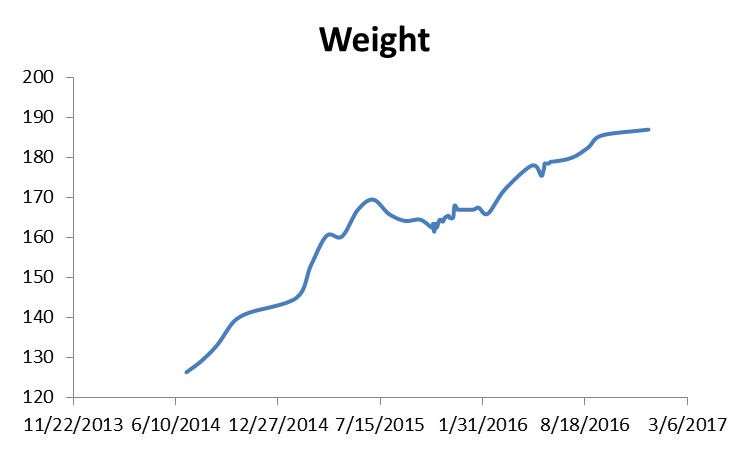
In case you’re interested, I have no shame: here’s a graph of my weight over the past few years: 

Impressive amount of weight gain, eh? The data starts shortly after I went on medications. 

Today I headed over to the fitness center try my first workout (yeah, I made it a whole 15 minutes of cycling – 4 miles) and to ask about a personal trainer. The PT would be a lot of money, which I expected, but I didn’t expect the 6 month contract. I’m going to have to think about whether the PT is worth it. But I might need one. We’ll see. I’ll update you next week!

Polar Vortex Baby

So Polar Vortex 2017 has hit Minnesota. And on top of that Winter Storm Decima is coming! We’re supposed to be pelted with ice and snow tonight and then have temperatures down to -23 degree Fahrenheit tomorrow. Mmmm. I look forward to going to work at 4:30am. At least I don’t have to drive far! 

My New Year Resolution is to start exercising more often. So in January I’m hoping I’ll have a lot more time to listen to audiobooks while I’m slaving away in the gym. I do better when I have a goal in mind, so I’ve decided to train for the Itascatur. It’s a 100 mile bike ride around Lake Itasca State Park (that’s where the headwaters to the Mississippi are). It’s in September, so that gives me plenty of time to get rid of the extra chubbiness and figure out how to train for the hills. Distance I can do. It’s the hills that kill me. I wish I had someone to accompany me on the ride, though!


Currently Reading: (Yup, same as last week)


Completed: 

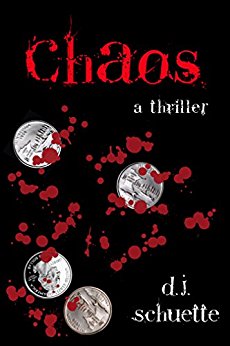
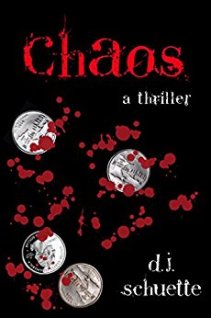
Chaos, by D. J. Schuette

Chaos, by D. J. Schuette

Special Agent Nicholas Keegan would like to spend more time with his wife, but he just can’t lay off his work as a forensic criminologist for the FBI. When he spearheads an update in the ineffective national criminal database ViCAP, collating previously unentered data, patterns start emerging and Keegan realizes that a brutal crime he’s investigating is really just one in a series of murders. 


I don’t read a lot of police procedurals, but when I do I like them to keep me glued to the book, worried about what happens next. Chaos didn’t disappoint. I was totally invested in what would happen when Keegan and his psychopathic adversary Zorin finally met. Keegan was an engaging character, and I cared about his troubles, but the real attention-winning character for me was Zorin. I wanted to know more about him, why he was the way he was, what he was going to do next. I admit to spending a lot of time reading Zorin’s blog posts on EnterTheMaelstrom.com before ever reading Chaos, so I already knew some of what Keegan was going to discover. But that just made the discoveries all that more exciting. I love Schuette’s idea of making a real-life blog for a fictional character. It gives potential readers a taste of what’s to come, or it can be left as a treat at the end for readers who worry about spoilers. It also gave the serial killer Zorin a life of his own – it showed both sides of the bloody quarter. 
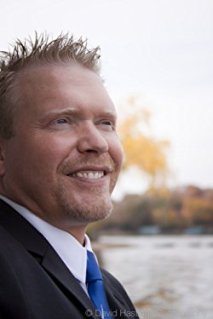


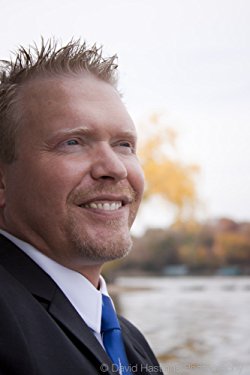
D. J. Schuette is a local author here in Minnesota, and I have the opportunity to present an interview with him: 

Tell us a little about yourself: 

Hi Rachel! First, thanks so much for this opportunity. I really appreciate you taking the time to read Chaos and providing feedback to me and to your audience. I’m currently a full-time author and editor from Minnesota. Prior to deciding to focus exclusively on writing, I spent many years in retail management, including about a decade working for Borders and Barnes & Noble, constantly indulging my passion for the written word. 

On the personal side, I’m married to a brilliant and gorgeous woman (who’s fortunately never figured out that she’s way out of my league). My wonderful twenty-four-year-old daughter is getting married next fall. And my Sheltie-Poo, Pogo, is the sweetest and cutest (and possibly the loudest) little dog around. 

What are your ambitions for your writing career?

In a perfect world, I’d get to tell stories for the rest of my days. Bestsellers would obviously be great, but really, I see that as more of a means to an end. I want to reach as many readers as I can—and not just in a “get a book in their hand” kind of way. I want to reach them. To get inside their heads and hearts and make ‘em feel stuff—be it terror or frustration or joy or wonder or hope or just an appreciation for the beauty of language. As a reader, I’ve been taken on some incredible journeys that will stay with me forever, and I hope to have the good fortune (and the skill) to pay that forward a little. 

Have you written any other books? 

Yes! Waiting in the wings for final edits is a Young Adult fantasy tentatively titled Aurix the Bold. I’d liken it to Eragon, or perhaps The Hobbit (albeit without nearly the literary brilliance). In it, a boy named Aurix sets out to face the merciless tyrant Ra Xu’ul, who slaughtered thousands (including Aurix’s parents) in a single blow with the sword of a god. Xu’ul seeks the remaining seven God-Forged relics, which will grant him the power to remake (or unmake) all of existence. With the help of Shlee, a crazy old coot who claims to be nearly 500 years old, and a shaggy, reeking mount named Nyx, Aurix navigates the treacherous continent of Valeria to avenge his parents and save his world from a madman. 

Hopefully, I’ll get to spend lots more time in Valeria in the near future.

Do you plan on writing more books? Of the same genre or different? 

Absolutely! There are currently several underway. One somewhat unique goal that I have is to write a book in all of the major fiction genres. Mystery and horror are personal favorites, but I’d love to give sci-fi and even romance a go. In my current queue, I’ve even got a humorous non-fiction guide to navigating the sometimes-treacherous winters of Minnesota. I keep a list of my current works in progress along with their statuses on my website with the goal of keeping me honest (and hopefully) productive. 

Which writers inspire you the most? 

Talk about a loaded question! Shakespeare and Poe probably most taught me the beautiful potential of words. Stephen King is an all-time favorite—every time I close one of his books, I’m absolutely compelled to write. Clive Barker showed me that there are no limits except those that we place upon ourselves. As far as inspiration for Chaos, I must give credit to Thomas Harris for giving me permission to root for the bad guy just a little, and to Cody McFadyen who forced me to go deeper into the abyss to find Aleksandr Zorin. If you enjoy Chaos, I can’t recommend McFadyen’s Smoky Barrett series enough- Shadow Man is like a sucker punch to the gut. You’re welcome. 

In addition to Chaos, you created a blog “written” by your serial killer. Where did you come up with this idea? What were you trying to do? Did you succeed? 

In many ways, Aleksey Zorin is the main character of Chaos. I couldn’t possibly explore his psyche enough in a mere few hundred pages. The Maelstrom (www.enterthemaelstrom.com) gave me a chance to plumb the depths of his history, mythology, and madness in rather more explicit detail. These first-person accounts of his oft-cruel adventures sometimes break the conventions that aren’t always considered acceptable in mainstream writing. But that’s often the stuff that is most real, most gripping, and most heart wrenching. It’s what the good guys have to endure and live with in their pursuit of the bad guys. I think it’s incumbent upon me to look that darkness in the eyes a little bit if I’m ever to write about it in a compelling, realistic way.

I see The Maelstrom as the horror to Chaos’s mystery. It’s not going to be for everyone, but I do think it has its place for those who want to descend deeper down the rabbit hole. And some of it is just plain fun. Zorin likes to play. There are even a few little hidden surprises there for those who care to look.

In Chaos, you introduce ViCAD – a nationwide database to help detect serial crime. How much of this database is based in truth? Please share your thoughts on the system. 

To the best of my knowledge and research, everything I share in Chaos about ViCAP (Violent Criminal Apprehension Program) is true. In a nutshell, it’s a warehouse of violent crime data. If Officer Jones in Montana has a strange case, he can enter the details about that case into ViCAP and it (with the help of Bureau analysts) will flag any potential “linkages” to other, similar crimes across the country. This is especially helpful when there’s a mobile offender committing crimes in different geographic areas. The problem is that ViCAP has historically been very cumbersome. Its use has always been discretionary, and the questionnaires were long and tedious—a deterrent to busy law enforcement officers already inundated with their own paperwork. Established in 1985, ViCAP houses information on about 90,000 violent crimes, which sounds great—but given there are nearly 100,000 or so qualifying ViCri cases every year, it’s woefully ineffective. 

The FBI has long said there are about 35-50 serial killers out there at any given time, but considering ViCAPs deficiencies, I have to wonder how many more linkages might be out there. ViCAD (Violent Crime Analysis Database) was borne of that curiosity. I wondered what we might find if we fed ViCAP all the data—those millions of missing cases. Would we discover another fifty serial offenders? A hundred? How many more predators are out there? I wanted that question to serve as a disturbing backdrop to Chaos and the subsequent books in the series.

You had a lot of very dark scenes in Chaos and the accompanying blog. How much trouble did you have writing these scenes? 

I’m not sure what it says about me, exactly, but frighteningly little. If anything, I have the hardest time deciding where (or if) I should draw the line. The better I know my characters, the more they tend to whisper in my ear. I’ve been developing Zorin for a number of years, and I’ve done quite a bit of deep research on psychopathy and killers, so I know him quite well. Perhaps unsurprisingly, he likes to visit me late at night before I fall asleep. Most often, I write him in the dark by the light of my phone. 
Maybe the only thing I can say in my defense is that the greatest heroes are born only in the face of the greatest evils. I need one to have the other!

Will there be a sequel to Chaos? If so, when will it release? 

Yes! Maelstrom is the second book in the series, and I’ve included a teaser of the first three chapters at the end of Chaos. My hope is that Maelstrom will be ready for release around this time next year, though that will depend somewhat on my workload, other projects, and demand.  

How can readers discover more about you and you work? 

My website is probably your best bet. Feel free to send me a message anytime. There’s a “contact me” button on every page, and I try to respond to every message.



Blog: my personal blog is also at djschuette.com, Zorin’s can be found at enterthemaelstrom.com

Facebook: D.J. Schuette (@djschuette.author)

Twitter: @djschuette

Amazon Author Page: D.J. Schuette
Goodreads: D.J. Schuette

Neurotribes, by Steve Silberman

Neurotribes, by Steve Silberman, read by William Hughes

Silberman explores the history of autism by weaving stories / case histories of autistic people in with stories of psychological and ideological leaps in the understanding of autism. He reveals a lot of details I didn’t know about researchers like Hans Asperger and the making of the movie Rainman. It was information that I was intrigued by, though I found his writing style to be a bit winding at times. In the end, I felt a little lost about what the thesis of Silberman’s book was – or if he had one at all. Before reading the book I expected to get a history of autism research with a lot of current information on the neurodiversity movement. But because there were so many stories of autistic people woven into the book, I didn’t really get what I expected. The information seemed a bit scattered. Not that I didn’t enjoy the book – I did. It was interesting reading about all those case histories – it gave the book a personal air. I just expected a more A-to-B-to-C historical account of the history of autism and the neurodiversity movement. 


Winter has come

Winter has come! It’s cold and windy outside, and supposed to drop even lower next week. I’ve gotten out my winter jacket, and still need to figure out what happened to my gloves. Nothing much happened this week worth noting. Hero has recovered splendidly from her surgery and everything is calm here at Casa Hibernator. 

On the blog I noted my plans for 2017 & reviewed The Price of Silence by Liza Long and A Confusion of Princes by Garth Nix. 

Currently Reading: Same as last week. 

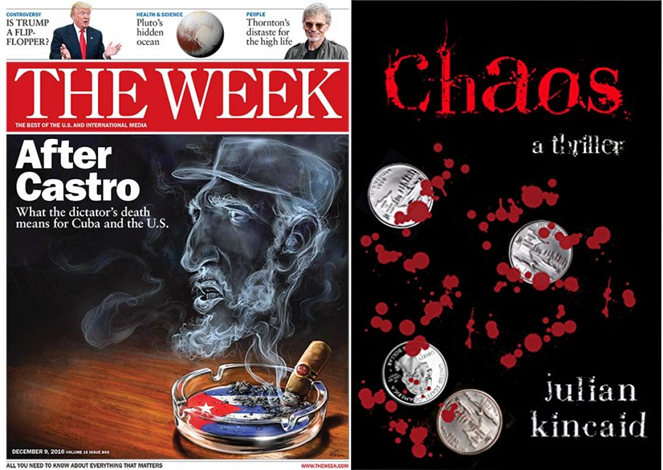
Completed: Finished this weeks The Week, and the indie novel Chaos, by Julian Kincaid (review and author interview upcoming)

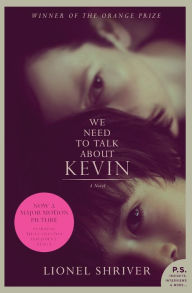
Acquired: My copy of We Need to Talk About Kevin has arrived!

A Confusion of Princes, by Garth Nix

A Confusion of Princes, by Garth Nix
Read by Michael Goldstrom
17yo Khemri has just become a prince of an intergalactic empire. But being a prince isn’t at all what he expected. There’s no cruising around the empire in his shiny new ship, having adventures and making his fortune. No, the Emperor will be retiring soon, and Khemri must prepare to compete for the status of new Emperor. 


I got this book because I loved the other Garth Nix books I’ve read, and I wanted a book my nephew would enjoy for a road trip. I was a little disappointed in this book. First of all, it wasn’t really age-appropriate for my nephew, who’s 12. I think it would be more appropriate for a 14 or 15 year old. Second, it was a bit boring. The plot had great potential, but it just fell flat for me. I enjoyed the world building, and thought so much more could have been done with it. He was limiting himself with the age range, I think. If he tried the same universe with a target audience of older teens to adults, then it would have been a splendid book. 

The Price of Silence, by Liza Long

The Price of Silence, by Liza Long
When, in December 2012, Adam Lanza rampaged Sandy Hook Elementary, killing 20 children and 6 adult staff members, people blamed the mother for not taking proper care of her child. But how was she supposed to care for her mentally ill son when the mental health system is so broken, argues Liza Long. Ms Long is also the mother of an unstable, mentally ill child who has violent outbursts. She can relate to Adam Lanza’s mother’s quandary. 

In The Price of Silence, Ms. Long outlines the problems with the mental healthcare system, focusing primarily on how it fails our children. It’s nearly impossible to find a school that will educate children prone to outbursts, and impossible to afford mental health care as a home-schooler. Parents often have to divorce and quit their jobs in order to apply for state assistance. Even when they have state assistance, there are very few safe residential facilities for minors who need more focused care. Thus, the children end up bursting into rages that get them arrested. Most minors in juvenile detention are mentally ill, in fact. Such minors cycle in and out of juvenile detention, where they get only minimal education or treatment for their mental disorders. The price we pay for housing these minors in juvenile detention is much higher than we would pay to house them in residential facilities,  and is much less effective, argues Ms. Long. 

This was a very interesting book which will unfortunately only be read by people who already appreciate how broken our mental health system is. It provides a lot of information, while staying personal because of Ms. Long’s biographical sections. It’s a very readable book. That said, I think she overstated her case a bit. This overstatement is probably partly due to her passion for the subject, and also because she lives in Idaho, a state which is less likely to provide social programs to care for the disabled. 

Despite the overstatments, however, I think this book is well-worth reading. It was a good supplement to The Fifth Child, which I read in October, and I plan on supplementing it further with We Need to Talk about Kevin soon.