On psychopaths – guestpost by Daniel Schuette

First of all, let me forewarn you: THIS GUEST POST WILL CONTAIN ADULT CONTENT.


When I was asked to write a post for Mental Health Awareness, my first thought was: “What on earth qualifies me to even do such a thing?” I mean, sure, I’m on medication for depression and anxiety, I was intimately involved with someone with bipolar disorder, and I’ve been called crazy plenty of times, but that hardly makes me some kind of expert. So allow me to preface this post by saying I am not a mental health professional and am in no way qualified to be writing this post, so feel free to take what I have to say with a whole shaker of salt.
With that disclaimer out of the way, let me explain what I might be able to contribute to the mental health topic and why I think your host asked me to be a part of the conversation. For the past several years, I’ve been developing a character for a series of novels named Aleksandr Zorin. Aleksey is not a nice guy. In fact, he’s a psychopath and a sadist and a serial killer. As much fun as it can be to create such a character, I’m one of those anal retentive types that finds it necessary (nay, imperative) to be as accurate as I possibly can about his motivations and behaviors, and therefore—by extension—his mental condition. And since I don’t have an anti-social personality disorder like sociopathy or psychopathy (as least insofar as anyone knows)—that requires lots and lots of research.
What I have found is that it’s rarely like what you see on TV. If programs like Hannibal and Criminal Minds and Profiler are to be believed, there is a virtually endless onslaught of sadistic psychopathic killers out there, and they will (almost without fail) be brought to justice in approximately 42 minutes. In reality (and though I personally question the accuracy of this statement), the FBI estimates that there are only thirty-five to fifty serial murderers active at any given time in the United States. With the abundance of crime dramas currently on TV, it would only take a few short weeks to declare society completely safe from a horrible demise at the hands of a violent psychopath. So let’s take a bit to separate fact from fiction.
Sociopath or Psychopath? There is much debate on what (if any) difference there is between sociopathy and psychopathy, even among mental health professionals. Both are classified as Anti-Social Personality Disorders. Both are primarily characterized by a profound lack of emotion, empathy, and fear. Some state that the classifications are two names for the same disorder and can be used interchangeably. Others believe that psychopaths are born with the deficiency, and sociopaths are more a product of their environment during early development. Some say psychopaths are charming, cunning and organized; some say those are actually the hallmarks of the sociopath. The Sociopath Next Door suggests that 4% of the population is sociopathic, yet Robert Hare—the foremost authority on psychopathy—estimates that 1% of the population are psychopaths. Considering that is a difference of roughly 9 million people, there must be a distinction between them, but no one really seems to know or define what that is. So, for the sake of this post, we’ll just have to say that between 3 million and 12 million people can be classified as psycho/sociopaths.
Those are astonishing numbers, though, wouldn’t you say? Think of that—at least three million people are psychopaths. They can do virtually anything with little or no fear of consequence, and have no internal moral compass to guide their actions. They frequently view the rest of us as either inferior prey or insignificant pieces to be manipulated in some grand game of their own design—a game we don’t even realize we’re playing.
Contrary to what many believe (and quite fortunately for the rest of us), only a very small percentage of those psychopaths will ever become violent. Many will instead find ways to harness their uncommon skillset by entering law enforcement or enlisting in the military, becoming politicians, surgeons, or successful CEO’s. One might, as you read this, be playing the stock market fast and loose with your money. Any role where a proclivity for risk-taking, fearlessness and emotional detachment are considered advantageous, the psychopath would most likely excel at it. Odds are, you’ve even known a few without recognizing them for what they were. In reality, psychopaths are rarely “monsters” and are much more likely to be the successful leaders that we look up to and even admire.
On the flip side of that coin, however, is something that can be truly terrible to behold. Some psychopaths will become violent rapists and murderers. But contrary to what popular media frequently depicts, they don’t look like creepy fuckers/scoundrels, nor are they all brilliant cannibals like Hannibal Lecter. They may be the quiet bloke that lives next door or your asshole/hardnosed/tyrant boss or the cute ripped guy at the gym. Like any other slice of the population, they are quite diverse. They can be any race or gender (but are predominantly male), come from any background, and will have varying degrees of intellect. What most of them do have in common is a frightening ability to blend in. They are the chameleons of our society. They learn to mimic behaviors that they don’t understand in order to fit in; they are often charming and disarming. They are the ones whose chain-smoking, muumuu-wearing neighbors wind up on the news exclaiming: “I just can’t believe it! He was such a nice, normal guy.” Well, no. He really wasn’t. He was actually a vicious predator that wore a very convincing mask.  
            The most asked and obvious question is “why?” What is it that causes one human being to revel in the agony of another? Psychopaths themselves can’t usually provide a clear, objective answer for that. They tend to place the blame squarely on their victims, or their upbringing. But there is some new research that seems to shed some light on the subject. Functional Magnetic Resonance Imaging (or fMRI) of the brains of known psychopaths has shown significant deficiencies in the areas that process emotion and fear. They also do not experience the same brain activity that “normal” people do when shown images or words with violent connotations. In short, the words table and rape elicit precisely the same emotional response in the psychopath—none. For them, hacking off someone’s limbs is no more or less remarkable than chopping wood. 
        Perhaps Aleksandr Zorin can provide us with another part of the answer: Imagine an existence without any feeling at all. A vast desert of nothing as far as the eye can see in every direction. It is an endless ocean of sand. Empty. Barren. Then one day you do something and find it to be… exhilarating. Suddenly within this existence of dust, there is a small oasis—a place that quenches the endless thirst of nothing. Not an emotion, per se, but a feeling. Something you’ve never experienced. Adrenalin flows. Your stomach knots. Your cock gets hard. Your heart races. Your senses become heightened. It may never be happiness or love but it is something where there once was naught. It is new. It is a stirring. It is enjoyable. It is purpose. It is life.” 
If Zorin is right, sociopaths and psychopaths eventually discover just a tiny spark of what the rest of us experience every minute of every day. It is a glowing ember in the void of their existence. And they like it. They are compelled to ignite it again and again—to feel again and again. Unfortunately, it is sometimes the suffering of others that provides the kindling for those feelings in the psychopath. 
           Are these broken individuals that need to be “fixed”, or are they a natural variant in the evolutionary process? Violent psychopaths are in direct opposition to the laws of civilized society, so they are hunted by law enforcement. They are often referred to as “evil” and punished to the fullest measure—by life in prison, and sometimes death. Still, they fascinate many of us, who perhaps see in them the boogeymen of our nightmares, or the monsters under our beds. But they are far scarier than any of our mythological constructs. They are human beings devoid of humanity, barely (and not always) held in check by our nebulous concepts of compassion and justice. 
         So how might this post relate to mental health awareness? First, understand that the portrayals of psychopaths and serial killers in the media are rarely accurate. Remember that one of every hundred people you meet is completely indifferent to your feelings, and they have a tendency to wreak hell and havoc on the lives of those around them. If someone you know is charming yet constantly takes advantage of those around them and then ultimately destroys those relationships, you may be dealing with a functional psychopath. Urge those that you care about to steer clear—there is zero hope of “fixing” them, or getting them to change. Transformation is impossible for the psychopath. And if the hairs on the back of your neck stand on end and you get a shiver when someone approaches, listen to your instincts—you are programmed to sense danger from predators and psychopaths are the equivalent of modern sabre-tooth tigers. 
           While I doubt many with Anti-Social Personality Disorder have read this post, and though I suspect you wouldn’t listen even if you had, I encourage you to seek help from therapists. There are cognitive therapies available that will help you channel your unique assets and minimize destructive behaviors. It is possible for you to lead extremely productive and successful lives, despite (or perhaps even because of) your lack of compassion for others. 
  
          Whether we view them as a different species entirely, or those saddled with an unmanageable mental “illness”, the three million psychopaths among us already own a link in the evolutionary chain. We must learn to adapt to—and accept—the reality that there are ruthless predators in our midst. We are sometimes hunted. We are sometimes stalked.
We are sometimes prey.
Paradise Lost – Book I Lines 1 – 191

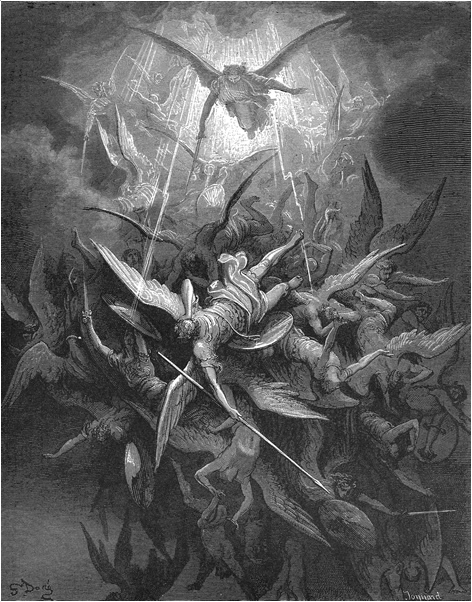
Him the Almighty Power
Hurled headlong flaming from th’ ethereal sky,
With hideous ruin and combustion, down
To bottomless perdition, there to dwell
In adamantine chains and penal fire,
Who durst defy th’ Omnipotent to arms.
Book 1, 44-49
Gustave Dore (Source)

Since I am having trouble interpreting Paradise Lost, I am painstakingly going through and interpreting it. I can then use these notes while I read it for deeper meaning later. 🙂 To see other posts about Paradise Lost, go to my master post

Rachel’s Notes on Lines 1 – 26 of Book I (Milton’s invocation)

Psalm 125.4 – “Do good, O Lord, unto those that be good, and to them that are upright in their hearts.” 


Milton is asking the Holy Spirit to guide him as he tells us about the disobedience of Adam and Eve. He invokes the Holy Spirit as the Heavenly Muse who inspired Moses on Sinai (lines 6-8) and then the spirit of God in the Temple on Mt. Zion (line 10). Milton believes that the Holy Spirit will help him soar above earlier poets, who invoked their muses from the oracle at Delphi (lines 11-16). He asks instruction from the Holy Spirit so that he may “justify the ways of God to men.” 

Rachel’s Notes on Lines 27 – 36 (What made Adam and Eve revolt?)

First, we will describe what caused Adam and Eve to fall from God’s favor by breaking the only law that God asked them to obey (i.e. not to eat the fruit of the Tree of Knowledge of Good and Evil). It was the Serpent who first seduced Adam and Eve to revolt. The Serpent’s guile was stirred up by envy and revenge, so he deceived Eve. 

Rachel’s Notes on Lines 36 – 83 (Satan and his minions have fallen from Heaven)

Isaiah 14:12 – “How art thou fallen from heaven, O Lucifer, son of the morning!” 

It happened after Satan’s pride had cast him and his rebel angels out of Heaven. Because Satan thought he was equal to his Lord God, he and his host of rebels had warred against Heaven in a vain attempt to place Satan above his peers. But God hurled Satan and his rebels from Heaven – headlong, like fiery meteors bound in unbreakable chains – to crash ruinously into Hell. [Much like the Titans thrown to the pits of Tartarus in Hesiod’s Theogeny (664 – 735)] the celestial demons spent nine days and nights lying vanquished in the fiery gulfs of Hell. Satan’s doom made him angrier, because he had not only lost the happiness of Heaven, but he now must endure eternal suffering instead. Pissed off, he looked around. Dismay and affliction, stubborn pride and steadfast hate were palpable in all he saw. Hell dismally stretched as far as his immortal eye could see. 

Hell was like a gigantic furnace with raging fires – but instead of giving off light, the flames emitted darkness visible. This palpable darkness illuminated sights of woe, regions of sorrow, and doleful shades. Hell was a place where peace and rest would never dwell. Hope would never come here, but instead came endless torture. The torment fed the flames, urging the fire on for eternity. Such was the place that Eternal Justice had prepared for the rebellious. Here, they would eternally remain in darkness, as far away from God and the light of Heaven as 3X the distance from Earth to the far reaches of the universe. [In other words, Hell was located in Chaos…beyond the universe. Milton’s Hell was not in the center of the Earth, like in Dante’s Inferno.] How unlike Hell was from Heaven, from whence they fell!

Satan saw his companions-in-arms overwhelmed by the tempestuous fires. Weltering in the tempestuous flames by his side, Satan saw Beelzebub – who was his peer in leading the host of fallen angels. Satan broke the horrible silence by saying: 

Rachel’s Notes on Lines 84 – 126 (Satan tells Beelzebub that he’s still pissed off and this war ain’t over yet)

[Satan speaks with obscure syntax to show that his passion overpowers reason. I’m trying to ruthlessly clarify it for the sake of my notes, though.]:

“If you are he! But how you have fallen! How changed from him who was so shiny in Heaven! If you are he who joined with me in glorious enterprise…now we join in misery and ruin. Into what pit have we been thrown? How far have we fallen? God has proven himself much stronger than we. Who knew the strength of that mighty arm?! But despite what those powerful arms and His mighty rage can further inflict on us, I do not repent.

“My pride had been injured, so I fought God with my innumerable army of spirits who  preferred me as their leader. We fought a battle on the planes of Heaven and shook His throne. So what if we lost that battle? All is not lost! We have not lost our vengeful natures, our immortal hate, or our courage to never yield! What else is there to live for, besides the will to succeed? 

“He’ll never get me to bow to him and deify his power! We had Him worried…He was afraid he would lose against my powerful army. Fate has given us immortal bodies, so our army will be just as strong as before. But now we know our Foe better! Now, we can wage a more successful war – an eternal war that is irreconcilable to our Foe…that Foe who now joyfully reigns as tyrant in Heaven.”

Though he was in pain and wracked with deep despair, Satan boasted. Beelzebub answered:

Rachel’s Notes Lines 127 – 156 (Beelzebub is concerned that they are now thralls of God)


“Oh powerful prince, you led the embattled angels to war; your deeds endangered Heaven’s perpetual king, and made him defend his supremacy (whether that supremacy was upheld by strength or chance or fate…). I regret our army’s defeat. We have lost our place in Heaven. The entire army has come as close to dying as our immortal bodies are capable. Our minds and spirits will return to us soon, but we will suffer for eternity in Hell. What if God (who I now believe is almighty, since He could not have overpowered our army otherwise) has left us our spirits and strength intact only so that we can better endure our sufferings? Or perhaps he will use us as his slaves? What good does it do us to have our strength if we are only to endure eternal punishment?”

Satan answered:

Rachel’s Notes Lines 157 – 191

“Well, Fallen Cherub, to be weak is miserable, whether we’re active or not. But be sure of this: Our acts will never be for good. Our sole delight will always be to do ill! We will always resist His wishes! If he wishes to bring good out of our evil acts, then we shall pervert His wishes and use good acts for evil. We will pervert His plan! 

“Do you see that God has called our vengeful pursuers back to the gates of Heaven?  The storm of sulfurous hail that He shot at us has abated. And the raging lightening and thunder has perhaps spent its wrath and will cease to bellow through the vast and bottomless deep. Let us not miss our chance if God’s fury has been satiated. 

“Look at the dreary plains of Hell, illuminated by the darkness of Hellfire. Let’s sail these fiery waves over there, and we can rest (if rest is possible). After we have gathered our strength, we’ll discuss how we can offend our enemy, repair our losses, and overcome this dire calamity. We will either gain reinforcement from hope, or resolution from despair.”  

August Sunday Salon

I’ve decided to try out posting for The Sunday Salon, only I’m going to limit these posts to summaries of last month’s reading. I’m starting a little late, but this will be my August round-up. 

In August, I participated in The Middle Eastern Literature theme read on LibraryThing, it ran July through September and I’ve read quite a few Middle Eastern-themed books over the past few months. In August, I finished The Lemon Tree, by Sandy Tolan. 

I have also been taking the a free internet course Fantasy and Science Fiction: The Human Mind, Our Modern World from Coursera. It’s a fun little class (notwithstanding some growing pains for the system and the persistence of mean “anonymous” people on the forum). For that, I read: Alice in Wonderland, by Lewis Carroll; Dracula, by Bram Stoker; and The Bells and The Philosophy of Composition, by Edgar Allan Poe. 

As group reads for the 1001 Books You Must Read Before You Die group on LibraryThing, I read Agnes Grey, by Anne Bronte; and attempted to read White Teeth, by Zadie Smith. I gave up on White Teeth because it had too much crudity and obscenities, though I thought it was a rather witty book. 

I read Beauty, by Robin McKinley as a group read with The Green Dragon on LibraryThing. The Embittered Ruby, by Nicole O’Dell for a group read at a Christian Fiction group ACFW…I’m leading the discussion for it in October. Skios, by Michael Fryan for the Booker 2012 longlist. 

And, finally, I read Inheritance, by Christopher Paolini; Al Capone Shines My Shoes, by  Gennifer Choldenko;  and Riptide, by Douglas Preston & Lincoln Child just for fun. 

I finished only one issue of The Economist and one issue of New Scientist. 

I’ve been preparing to read Paradise Lost, by John Milton, and have made a few new posts on my blog. 

In September, my plans are to participate in the R.eaders I.mbibing P.eril VII challenge, I’ll continue with the Fantasy and Science fiction class on Coursera, I’ll continue reading Booker longlisted books (at least those that are available in the US), I’ll START reading the Wellcome Trust Book Prize longlist (at least those that are available in the US), and at the end of the month I’ll start another Coursera class in Greek and Roman Mythology. So I’ll have a busy month ahead! 🙂

Milton and Paradise Lost: A Quest to Understand


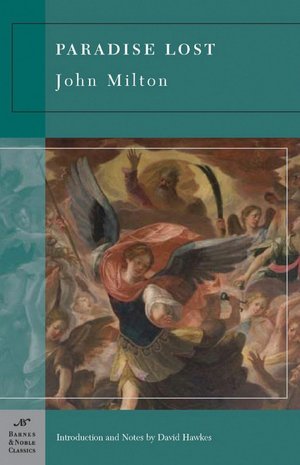
Today, I am beginning yet again on my quest to understand Milton’s epic Paradise Lost. I have already listened to it on audio and read it once through using the Barnes and Noble edition. Now, I have purchased the Norton Critical Edition. I will read AND listen to the Norton Critical edition, and compare to the footnotes in the Barnes and Noble edition. I will read supplementary materials. I will record my quest here, because I know everyone who reads my blog is raring to hear follow me on my quest. 🙂

My first notes will be on David Hawkes’ introduction in the Barnes and Noble edition:


NOTES ON THE INTRODUCTION BY DAVID HAWKES (in Barnes and Noble edition)

During the time building up to the writing of Paradise Lost, the “free market” concept was emerging. In this system, land was being taken away from peasants and their labor was being exchanged for money. This emerging free market system seemed like objectification of labor, as if the laborers were “signs” or “symbols.” This system seemed idolatrous to Milton. 

Henry VIII separated from the Roman Catholic Church so he could get a divorce, but he disliked many of the Protestant ways, so the Anglican church was more similar to the Roman Catholic Church than Puritans were comfortable with. They wanted to be free of religious practices they viewed as idolatrous. 

Meanwhile, the new market economy provided a means for non-gentlemen to get money, so the long-established structure of the English society was breaking apart. Charles I kept trying to get Parliament’s consent to raise taxes, but Parliament insisted on economic or religious reformation as stipulations. Therefore, Charles I increased taxes without Parliament’s consent (around 1640). In 1642, Charles I needed to raise an army to quell the rebellion in Ireland, but Parliament no longer trusted him. Charles I left London and raised his army in Oxford, which initiated civil war. This is when Milton emerged into history. He considered the “free market” and legitimization of usury to be idolatrous. He wrote many political pamphlets about his views.

Paradise Lost is about Satan’s idolotry. It could even be viewed as a prophecy of today’s world, in which everything is represented as a symbol (think of virtual reality and the internet). To Milton, even viewing our perception of the world as reality was idolatrous. We forget that, through the filters of our human minds, we can not perceive the truth as it really is. Therefore, when we view our perceptions as reality, we are idolatrous.

…At least, so says Hawkes. I find this an interesting opinion and will look more into Milton’s political writings to see if I agree that Milton’s view of the political and economic state of affairs was idolatrous and consider how this may be represented in his epic allegory.


(TO SEE MORE INFO ABOUT PARADISE LOST, GO TO MY MASTER POST)