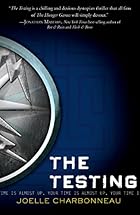
The Testing, by Joelle Charbonneau

The Testing, by Joelle Charbonneau

Reason for Reading: This book was provided by the publisher through Netgalley in exchange for an honest review. This book will be released in June 2013.

Genre: Young Adult Dystopia

Review
Cia wishes more than anything that she will be chosen for the testing procedure – leading to a university education. But the testing procedure turns out to be more than she’d bargained for. The other kids are literally cut-throat competitors, and the testing officials are cruel and calculating. Will Cia be able to hang on to the person she is and still pass the test? Does she even want to pass the test anymore? What dire consequences really do follow failure?

This book was a fantastic addition to the popular young adult dystopia genre. It took me a little while to get in to the story because there was little to distinguish it from all the other YA dystopias I’ve read lately, but after about 50 pages I was really sucked in and wanted to know where Charbaonneau was taking the story. I had an inkling what might happen in the end – sort of a “wow, I hope it goes in this direction, because that would make the next two books really interesting.” And it DID go in that direction. So, the ending wasn’t unpredictable, but it was unique, and I was in suspense for the entire book which way it would go. I hope she really works that aspect in the second and third books. To me, that’s the aspect that will make this trilogy stand out from the crowd. Another thing I liked is that although there’s potential for a love triangle, that aspect wasn’t focused on. As I’m really tired of the triangle, the lack thereof was very refreshing. I hope the trilogy stays that way. The violence might be a bit off-putting to some young readers, but I’d say it’s about the same as The Hunger Games – maybe a little less.

Overall, a fun quick read. I hope this trilogy is popular. 🙂

How the Catholic Church Built Western Civilization, by Thomas E. Woods

How the Catholic Church Built Western Civilization

Written by Thomas E. Woods, Narrated by Barrett Whitener

Reason for Reading: I have an interest in Church history and history of religion. 

Review
How the Catholic Church Built Western Civilization is an apologetics treatise about how the Catholic Church contributed to the development of science, philosophy, art, and culture. For someone who has not read a lot of books on the subject – who wishes to be disabused of the belief that the Catholic Church shunned science and tried to halt the progression of culture – this book is an excellent introduction. It covers a wide variety of topics in a superficial survey of how the Church changed and promoted civilization. On the other hand, if you’re like myself and are well-read on the subject, this book lacks depth. Although there was a wide variety of information discussed, there was very little that it discussed in greater detail than I already knew. Therefore, I would highly recommend this text to someone who’d like an introduction to the topic – it’s well-written, well-researched, and interesting. But if you’re looking for depth and detail, this may be worth just a quick read. 

This audiobook was well-narrated by Barrett Whitener. No complaints there! 🙂

Interview with Elizabeth Camden


Hi everyone! I’ll be leading a discussion of Against the Tide by Elizabeth Camden for this month’s ACFW Bookclub. The discussion will take place from May 27 – 31st on a Yahoo groups email list. Everyone is welcome to join, and there’s plenty of time to read the book! Elizabeth will be participating in the discussion as well. I’ve included an interview with Elizabeth to entice you. 


Please tell us about Against the Tide.

The book is set in Boston, where Lydia Pallas has become a trusted assistant to an Admiral in the U.S. Navy. Fluent in seven languages, she spends her days translating documents from all over the world.  Her remarkable language skills bring her to the attention of Alexander Banebridge, a mysterious man who needs her rare language skills to advance his cause. Bane is a coolly analytical man who never bargained on falling in love with Lydia. As he battles the irresistible attraction growing between them, Bane’s mission will take Lydia away from everything—and everyone—she ever held dear.

What were your goals writing Against the Tide?

I wanted to write a romantic suspense story that hinges on the heroine’s ingenuity to help dig her out of some dicey situations.  I also wanted her intelligence to be the basis for the hero’s initial flare of attraction for her.

Although I did my best to weave themes of forgiveness and redemption into the book, what I really hope is that people simply enjoy reading a thrilling love story.  The characters in this book have huge dreams and are willing to risk everything in order to make them happen.  Whenever the drama gets a little heavy, I try to inject some glimpses of wit and joy into the mix.  This is a deeply romantic story, despite the sometimes weighty themes.

When writing in the romance genre, it seems the success of a book hinges on whether readers accept or agree with the love story in the book. Why do you think this is?

What a great question!  Romance readers will always judge the success of the book by the love story.   Although I love crafting evocative, richly drawn settings, I put most of my effort into creating the chemistry between the hero and heroine.  I want it to dazzle, sparkle.  They must complement one another’s personality at the same time they challenge each other.

The author of a romance novel has to walk a fine line in seeding the characters with enough flaws to prevent the romance from resolving too early, without alienating the reader by having them delve into silly choices merely to drive the plot forward.

Have you ever read a novel where the conflict between the hero and heroine could be solved by a simple honest conversation?  There is no way I am going to let my characters off the hook so easily!  I love a good turbulent story with love, betrayal, heartbreak, all punctuated with periods of soaring joy and utter delight.  That is what I aimed for with Against the Tide.

What are the lessons of that era that are still relevant to readers today?

A huge theme in the book is the power of resilience. Both the hero and heroine have survived devastating childhoods, but are still naturally optimistic people who refuse to let obstacles stand in their way.  Have you ever met people who wither at the first hint of trouble, while others who are repeatedly clobbered by the tragedies of life can still maintain an optimistic outlook?  This is a choice.  Trusting in the Lord’s plan for us is one element of adopting a resilient sprit and I wove that theme throughout the book.   It is a sense of resilience that allows ordinary people to power through obstacles and accomplish amazing things.

I’m thrilled you folks have picked Against the Tide for the May discussion, and look forward to dropping by to participate!

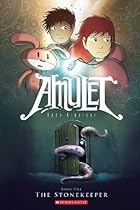
The Stonekeeper, by Kazu Kibuishi

The Stonekeeper (Amulet Book 1), by Kazu Kibuishi

Reason for Reading: Helping my nephew with his book report.

Review
When their father dies, Emily and Navin must move with their mother to a run-down house in the middle of nowhere – an inheritance from a great uncle they’ve never met. On their first night in the disturbing old house, their mother is  kidnapped by a gigantic squid-thing and the kids must rescue her with the help of a talking amulet that they’ve found in a dusty room. 

I read this because my nephew really loved it, and he’s a very reluctant reader. I can see why he liked it – there’s lots of pretty pictures and very few words. It’s a book appropriate for middle-graders both in vocabulary and in plot. It was a cute, fast read, and I’m sure I’ll read the rest in the series. However, it’s not a book that would appeal to me for any other reason than bonding with my nephew. The premise and plot are simply too unsophisticated to be of much interest to most older kids or adults. On the other hand, the book seems to be VERY popular with the younger crowd, and I highly recommend The Stonekeeper for reluctant readers. 

Harry Potter and the Half-Blood Prince, by J. K. Rowling

Harry Potter and the Half-Blood Prince

Written by J. K. Rowling, Narrated by Jim Dale

Reason for Reading: Re-reading the Harry Potter series in audio format. 


Review

(Contains spoilers from earlier books in series)

The Ministry of Magic has finally admitted that Voldemort has returned, and Dumbledore has returned as Hogwarts Headmaster. Furthermore, Dumbledore has realized that it was a huge mistake to leave Harry in the dark for so long. He and Harry become much closer in Harry’s sixth year at Hogwarts, as Dumbledore reveals much of what he knows of Voldemort’s history and motivations to Harry. Harry is also kept busy with his new obsession that Draco Malfoy is up to new levels of “no good.” Ron and Hermione poo-poo his suspicions and keep themselves busy with escalating romantic tension. 

Altogether, this book has a LOT going on, yet it’s more compact than the previous two books. Overall, I think this is Rowling’s best written book in the series, even if my favorites are the first four. I really enjoyed this re-read of the 6th book in the Harry Potter series – it’s only my second time reading this book, and I had forgotten a lot of it. The romantic tension between Ron and Hermione is my favorite part of the book, since it’d been building for SO long and was finally let loose terrifically. 🙂 

Jim Dale’s reading, as usual, is excellent. It took some getting used to, but after the first or second book it really grew on me. I know all his voices for the characters, and that really ads to my enjoyment of the story. 

Song of the Vikings, by Nancy Marie Brown

Song of the Vikings: Snorri and the Making of Norse Myths

Written by Nancy Marie Brown

Reason for Reading: This book was provided by the LibraryThing Early Reviewers program in exchange for an honest review. 

Review
This engaging biography describes the life of Snorri Sturluson, a powerful 12th-century Icelandic chieftain and the author of the poetic Edda – one of the oldest surviving documents of Norse mythology. As a novice of Viking history, I found this book fascinating and informative – though I suspect that there is much speculation and Brown isn’t always clear when she is speculating and when she has hard evidence for her claims. As such, I think this biography would be enjoyed by people who are interested in learning a bit about the Vikings, but not experts on the subject. 

Brown started each chapter out with a legend out of Snorri’s Edda. Often, she told how this legend differs from other known versions and/or how it has affected modern culture. The rest of the book describes Snorri’s life – his youth in the household of “the uncrowned King of Iceland,” his marriage, his rise to political power, and his downfall. She seemed to get most of her hard evidence from a few primary documents and an outwardly biased biography written by Snorri’s nephew, so often she had to fill in the gaps by saying “it’s possible it happened more like this, since his nephew’s story doesn’t really jive with Snorri’s personality.” Of course, that makes me wonder if she had just as much positive bias towards Snorri as his nephew had negative bias. 🙂 Overall, though, I’d say this biography was a success. When there is so little information available, and when the book is intended for a popular crowd rather than an academic one, such speculation is necessary – it makes the book more fun. 

Deadly Offer, by Caroline B. Cooney

Deadly Offer, by Caroline B. Cooney

Reason for Reading: This book was provided by the publisher through Netgalley in exchange for an honest review. When I was a teenager, I read the second book in this trilogy, and I was curious what I would think of the first.

Review
Althea craves popularity. She wants to be a cheerleader – swooned over by all the jocks and the envy of all the girls. When, against custom, she opens the shuttered tower room in her house, she releases a vampire who makes a deal with her: If she brings him victims, he will give her popularity. Althea finds herself spiraling out of control as the vampire asks for more and more – and she feels she has to give it to him or suffer public humiliation. 

Looked at from a superficial point of view, there’s really not much to this book. It’s barely 200 pages long, and has little plot or character development. It’s pretty standard for those Point Horror books that were being pumped out in the ’90s. Teen readers should be wary – this is a quick, fluffy read with a (how dare Ms. Cooney?!) BAD vampire. Yes. That’s right. His skin looks and smells like soggy mushrooms. He feeds on the weakness of teenagers. And he doesn’t sparkle. He is in no way, shape, or form romantic. It was SUCH a wonderful change. 🙂 As long as bad vampires don’t insult your intelligence, you’ll enjoy this book if you’re 11-14ish. Or you might enjoy it if you’re older and enjoy exploring ideas.

What I liked about this book was that it was more meaningful on a deeper level. There were hints all along that Althea could have made herself popular on her own – that her own attitude ensured her unpopularity. She assumed no one knew she existed, so she hid from everyone. Result – nobody paid her any attention. This is also a story about how far some people are willing to go in order to gain what they want. She sacrificed her morals and trampled on other people in order to achieve her goals – and then she was dissatisfied with the results. It’s a story about being true to yourself and how your goals will be more lasting when you achieve them through hard work instead of back-stabbing. Any book that makes me think earns points with me! 🙂 

Another thing that made me think: where the heck were her parents through all of this?! They weren’t mentioned even once! Did Cooney mean to do that? I read the second book in the trilogy many years ago, and I remember THAT protagonist had parents…

The Aviary, by Kathleen O’Dell

The Aviary, by Kathleen O’Dell

Reason for Reading: Real life book club

Review
Clara Dooley has lived her whole life in the decrepit Glendoveer mansion, where her mother is the care-taker of the elderly Mrs Glendoveer. Clara’s mother keeps her hidden away from the outside world, claiming that Clara’s health is fragile. At 12, Clara has come to an age where she wants to test her boundaries –  and just such an opportunity arrives when her elderly patron passes away, a new girl moves into the neighborhood, and the birds in the aviary begin to speak to her. With her new friend, Clara must discover the secrets of the Glendoveer mansion, and decide whether the birds are friends or foes.

This was a cute little ghost story / mystery for children (probably girls) ages 9-12. It used the basic adults-don’t-want-to-share-secrets format, while keeping the adults likable and intelligent. The two little girls were adorable and fun. And the birds, once they started developing characters, were a very interesting twist. I found this book an engaging and quick read. Highly recommended for lovers of middle-grade ghost stories / mysteries.

The Fairest Beauty, by Melanie Dickerson

The Fairest Beauty, by Melanie Dickerson

Reason for Reading: I led the book discussion for ACFW this month.

Review
When Gabe Gerstenberg learns that his brother’s fiance – who everyone thought had died – was very much alive and being held hostage by an evil duchess. Gabe’s brother is down with a broken leg, and his father is busy, so he decides to rescue her himself. He bites off more than he can chew with this rash act, and ends up running desperately from the duchesses men – with a woman that he finds very attractive and very unavailable. 

This sweet Christian historical fiction retelling of Snow White, has all the recognizable elements of the fairy tale, but is set in a realistic world. There were a few really creative twists – like the “seven dwarves” that made this story a fun creation. There were a lot of ethical questions brought to light – the main theme was: when do you know you’re following God’s wishes rather than your own? This is a good book for readers of fluffy/sweet romance, fairy tale retellings, or Christian historical fiction. Personally, I found Sophie’s character to be just a little too sweet and perfect, but I think that’s the nature of the snow white fairy tale. As far as I’m concerned, that was the only flaw in this cute retelling.

Pride and Prejudice Movie Comparison

Pride and Prejudice (1995)
Jennifer Ehle and Colin Firth

Funny thing about these movies is that of the more recent two, I have pretty much the same comments to make as I did about the Sense and Sensibility movies last month. The beloved-by-many 1995 version with Colin Firth hits the literal nail on the head. The dialog from the miniseries is taken directly from the book, EVERY important scene is included, the characters are spot-on, and the humor comes through in-tact. Bonus, there’re those lovely scenes with Colin Firth in the bathtub and later playing wet-shirt-contest. 🙂 Perfecto! But a little long for a one-sitting viewing. 🙂


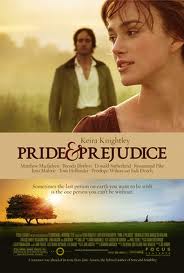
Pride and Prejudice (2005)
Keira Knightly and Matthew MacFadyen

The 2005 movie, on the other hand, makes the story into a romance and removes almost all of the humor. The romance gets to be a bit melodramatic at times, but it is a good romance. I’m not sure if the purpose was to reduce the length/complexity of the story or if the director simply wanted to remove all the humor, but the characters of Mr. and Mrs. Bennet are completely changed in this version. I don’t particularly mind, but it’s enough to piss off a purist. I rather liked the new Mr. and Mrs. Bennet. 😉 

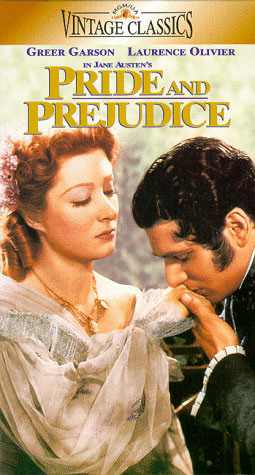
Pride and Prejudice (1940)
Greer Garson and Laurence Olivier

The classic 1940 version of Pride and Prejudice is short-and-sweet. The humor and the main story line between Darcy and Elizabeth is intact, but all the other characters have changed dramatically. Especially Darcy’s aunt. Definitely not a movie for purists. But frankly, I think this one’s cute. After all, what’s more shocking than a surprise ending in your best-known novel? 😉 

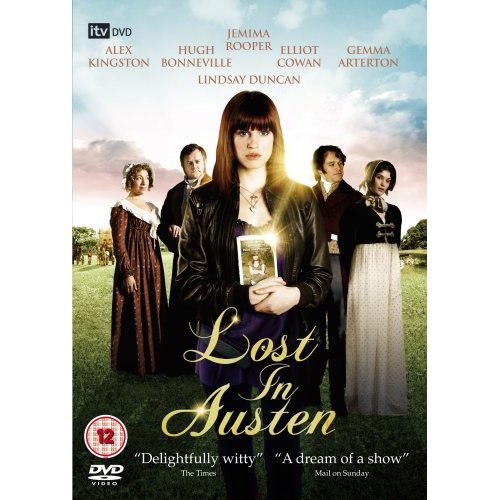
Lost in Austen (2008)
Jemima Cooper and Elliot Cowan

As a bonus, I’ll mention my favorite film retelling of Pride and Prejudice – Lost in Austen. In this silly little fantasy, Amanda Price is a modern young Brittish woman who can’t settle down in life because she’s in love with Mr. Darcy’s character. When her boyfriend botches a proposal, Amanda runs away and, out of sheer need, somehow opens a doorway into the story. She trades places with Elizabeth (who has to figure out how to survive in modern London). Unfortunately, Amanda isn’t able to keep her modern manners to herself, and she throws the whole story out of whack. Furthermore, many characters turn out to be very different in “real life” than they were perceived to be by the narrator of Pride and Prejudice. What this story lacked in originality, it made up for with well-aimed British humor. 🙂

Does anybody else have a favorite Austen retelling (book or film)?