

2012 Book 111: Wildflowers from Winter, by Katie Ganshert (7/23/2012)
Reason for Reading: It’s the ACFW bookclub pick for August. I’m leading the discussion so had to read it a bit in advance to prepare my discussion questions.
My Review 
Bethany Quinn is voraciously pushing her way to the top of an architect career in Chicago when she gets an unexpected call from her estranged mother. Bethany’s childhood friend (also estranged) has a family emergency, and Bethany’s grandfather has heart problems. Bethany reluctantly takes time off work to visit her hometown—a place she hoped to never see again. There, with the help of a renewed friendship and a rather grumpy, but handsome, man she learns that the world isn’t as dreary as she once thought it was. I loved this book. I could easily relate to Bethany’s problems and personality, so she seemed so real and personal to me. Evan, the handsome farmer, was annoying and endearing at the same time; therefore, the budding romance had a realistic tension. Bethany’s religious epiphany was a little sudden, granted, but it was set up well. I would recommend this book to anybody who likes Christian romance.
Scientific Funding: Where do we draw the line?
Tall, Dark and Stable*, an article in the science and technology section of The Economist ed. July 14 – 20, 2012, discusses a study by David Kille, Amanda Forest, and Joanne Wood at the University of Waterloo, Canada. This team took 47 romantically unattached undergraduates and set half of them on a slightly unstable chair next to a slightly unstable table; the other half sat at identical, though stable, furnishings. They were then given a survey evaluating the perceived stability of various celebrity relationships. The wonky-chaired students perceived others’ relationships as less stable than the straight-chaired students did. Furthermore, the wonky-chaired students valued “stable” qualities in potential partners (like being funny or trustworthy) more than “unstable” qualities (like spontaneity and adventurousness). So, apparently, sitting on wonky furniture makes you value stability while enhancing paranoia (i.e. reducing their perception of stability)?
I was unfortunately unable to find this study in Psychological Science, the journal it will be published in, so I can’t evaluate their scientific methods. But I CAN say that I am generally pretty skeptical of such experiments. I’m sure their data turned out exactly as they said it did, but is it repeatable with another set of students from another place? Is it repeatable with non-student volunteers? Did they balance people’s opinions out by giving the survey before and after placement on the wonky chair?
Furthermore, this article in The Economist mentions (without reference to the actual study) that people who are sitting in chairs leaning slightly to the left tend to be more receptive to liberal ideas. REALLY?! You mean Obama could rig the election by sending out his supporters on “night patrol” to break into people’s homes and sandpaper off a couple millimeters on the left of their chairs? Do right-leaning chairs make people more conservative? I see a huge scandal in the making.
In my search for Kille’s study in Psychology Today, I found another study by him: When Social Networking is Not Working (Psychological Science March 2012 vol. 23 no. 3 295-302). In this study, they were trying to determine whether social networks like Facebook were generally beneficial to people with low self-esteem–people who normally feel inhibited about providing personal information, and who therefore have unfulfilled social lives. They found that people with low self esteems generally posted comments with low positivity or high negativity, eliciting “undesirable responses.”
I found this interesting, because I have just finished a discussion about “real life” persona versus internet persona on a social network for book-lovers called LibraryThing. One of my online friends on LibraryThing is a very active member of the group and is well-liked. However, he doesn’t hide the fact that in “real life” he is anxious in society and is horribly shy. So, again, I have to wonder about the study…how meaningful is it? Certainly, I can see how the study’s conclusions would be true of some people, and not of others…but how much should we really trust psychology studies like this? Do they really add something helpful our sociological table? How much of our tax money is going in to paying for these studies?
The House has passed an amendment to cut the NSF funding to political science because they feel that political scientists are generally unsuccessful in predicting huge political changes in the world. (There’s a recent New York Times opinion article by Jacqueline Stevens on this subject.) And I’m sort of starting to agree…perhaps we DO need to be a little more careful about what kind of studies our tax money is going towards. Perhaps we should use some of our money to create a study to determine criteria for potentially useful areas of research, versus potential dead ends.
It hurts me to say that, because I know the pain of trying to get funding for a project that has no immediate medical value. (I DID work in hibernation research for 4 years!) And I certainly don’t think huge cuts in scientific funding is what our economy needs right now. And I TOTALLY understand that sometimes studies that don’t have much potential (as gauged by the critical eye) serendipitously stumble upon the world’s greatest breakthroughs. So where do we draw the line? I don’t know, because I’m not an economist. I’m a scientist who really WANTS everyone to be funded…but is that really for the best?
Ah! The torture of ambivalence! 😦
*I can’t get the link to work, but you can find it on The Economist’s webpage. Just search for the title Tall, Dark and Stable.
Coursera–Fantasy and Science Fiction: The Human Mind, Our Modern World

Tomorrow, I will start a 10 week free internet course on Science Fiction and Fantasy literature offered by Coursera. This will be a fantastic opportunity to interact with people around the world and discuss the importance of speculative fiction for portraying certain types of ideas. The class dovetails nicely with the book I just finished, Fantasy Media in the Classroom, edited by Emily Dial-Driver. Although I already knew that fantasy and science fiction could be rich with portrayals of the human state–in the past, present, and possible future, I was really impressed at some of the ideas in that book.
I was particularly impressed by a fusion class described in one of Dial-Driver’s essays. She included serious literature such as Frankl’s Man’s Search for Meaning and Zimbardo’s Lucifer Effect—books which describe motives for unsavory behavior. She supplemented those with fantasy media such as Dr. Jekyll and Mr. Hyde, the BBC miniseries Jekyll, the short video Dr. Horrible’s Sing-Along Blog and Wells’ The Invisible Man. All of these fantasy works are about grey moral choices, reasons behind these choices, and consequences of these choices. The professor incorporated lessons learned from Frankl and Zimbardo while studying these fantasy works.
As I was reading that, I wished that I could have taken such an interesting class. Just as I was finishing up that book, I found out about this Coursera course, so I decided to give it a try. (If I want, I can always add some fusion on my own.) 🙂 I am not allowed to post “solutions to homework and quizzes,” but I find nothing wrong with posting my own short essays on my blog for your reading pleasure–so I will be including commentary on the course materials as I proceed. In the end, I will receive a letter grade (participation based) and a certificate signed by the instructor (yea!), Eric S. Rabkin.
Milton and Paradise Lost: A Quest to Understand
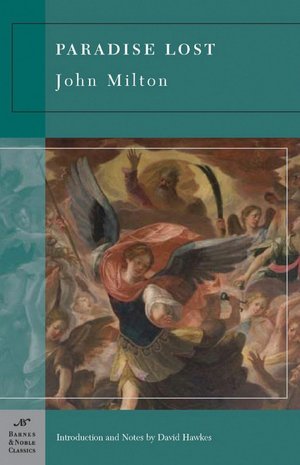
Today, I am beginning yet again on my quest to understand Milton’s epic Paradise Lost. I have already listened to it on audio and read it once through using the Barnes and Noble edition. Now, I have purchased the Norton Critical Edition. I will read AND listen to the Norton Critical edition, and compare to the footnotes in the Barnes and Noble edition. I will read supplementary materials. I will record my quest here, because I know everyone who reads my blog is raring to hear follow me on my quest. 🙂
My first notes will be on David Hawkes’ introduction in the Barnes and Noble edition:
NOTES ON THE INTRODUCTION BY DAVID HAWKES (in Barnes and Noble edition)
During the time building up to the writing of Paradise Lost, the “free market” concept was emerging. In this system, land was being taken away from peasants and their labor was being exchanged for money. This emerging free market system seemed like objectification of labor, as if the laborers were “signs” or “symbols.” This system seemed idolatrous to Milton.
Henry VIII separated from the Roman Catholic Church so he could get a divorce, but he disliked many of the Protestant ways, so the Anglican church was more similar to the Roman Catholic Church than Puritans were comfortable with. They wanted to be free of religious practices they viewed as idolatrous.
Meanwhile, the new market economy provided a means for non-gentlemen to get money, so the long-established structure of the English society was breaking apart. Charles I kept trying to get Parliament’s consent to raise taxes, but Parliament insisted on economic or religious reformation as stipulations. Therefore, Charles I increased taxes without Parliament’s consent (around 1640). In 1642, Charles I needed to raise an army to quell the rebellion in Ireland, but Parliament no longer trusted him. Charles I left London and raised his army in Oxford, which initiated civil war. This is when Milton emerged into history. He considered the “free market” and legitimization of usury to be idolatrous. He wrote many political pamphlets about his views.
Paradise Lost is about Satan’s idolotry. It could even be viewed as a prophecy of today’s world, in which everything is represented as a symbol (think of virtual reality and the internet). To Milton, even viewing our perception of the world as reality was idolatrous. We forget that, through the filters of our human minds, we can not perceive the truth as it really is. Therefore, when we view our perceptions as reality, we are idolatrous.
…At least, so says Hawkes. I find this an interesting opinion and will look more into Milton’s political writings to see if I agree that Milton’s view of the political and economic state of affairs was idolatrous and consider how this may be represented in his epic allegory.
(TO SEE MORE INFO ABOUT PARADISE LOST, GO TO MY MASTER POST)
The Amber Spyglass, by Philip Pullman

2012 Book 109: The Amber Spyglass, by Philip Pullman (7/19/2012)
Reason for Reading: I was interested to see where Pullman was taking the Paradise Lost allegory
My Review
Lyra and Will finish up their journey (started in The Golden Compass) while desperately trying to dodge enemies and make the right choices. I enjoyed this book even less than the second book, The Subtle Knife, though The Golden Compass was in the “ok” range. I just didn’t feel attached to the characters of Lyra and Will, and I didn’t care what decisions they made. There was WAY too much Buddha-on-the-mountaintop both in the narrative and in the dialogue. I realize Pullman had a message he was trying to portray, and it wasn’t a bad message (if you ignore all the hateful representations of organized religion)–he wanted to say that you should enjoy and live life here on Earth. What is happening in the present is what is important. Build the “Kingdom of Heaven” here on Earth instead of always denying our fleshy bodies as we look to our afterlife. This is a reasonable message, but I felt as if I was pounded over the head with it–to the point that it was distracting from the action. Furthermore, the action seemed to stop half-way through the book, followed by a long philosophical denouement. I WAS interested in his message, and that’s why I continued the book after I didn’t like the second…but it was a long haul for me. I don’t really understand why this series is as popular as it is? But that’s just my opinion. *shrug*
A note on Pullman’s Message
In his 1998 article in The Guardian, The Darkside of Narnia, Pullman stated his opinion about the Narnia series: “there is no doubt in my mind that it is one of the most ugly and poisonous things I’ve ever read.”
He didn’t like Narnia because of Lewis’ blatant Message. The ironic thing is, Pullman’s message is JUST as blatant, and in many ways just as hateful as he considers Narnia’s message to be (his representation of organized religion is very hateful). It is difficult for me to like the Pullman’s trilogy when I can’t help but see his Message and feel the full impact of its irony. It’s probably good that there are people out there who are able to ignore it! 🙂
In case you’re interested, there’s also a 2005 New Yorker article on Pullman’s inspirations for His Dark Materials. It touches on his views on C. S. Lewis and J. R. R. Tolkien. Far From Narnia, by Laura Miller.
Translation of the Bones, by Francesca Kay

2012 Book 108: Translation of the Bones, by Francesca Kay (7/17/2012)
Reason for Reading: This book was longlisted for the Orange Prize this year, and it peaked my curiosity so I decided to give it a try.
My Review
When Mary-Margaret, a well-meaning but slow young woman, sees a vision of Jesus’ blood in a Roman Catholic Church, she stimulates a miracle-craze which compels many people to question the meaning of faith. This is a very difficult book for me to review because I’m rather ambivalent about it. It is deep with meaning—but would mean something different to the “faithful” than it would to the “faithless.” This is a quality that few books attain, and I believe this is why it deserved to be nominated for the Orange Prize. However, this story is also very sad…it took me in a direction I didn’t expect. There were a lot of negative messages mixed in with the positive messages, which, I suppose, represents life perfectly. But still…some of it was hard for me to read. I would recommend this book to anybody who wants to explore faith and the meaning of mother-child relationships more deeply, and with an open mind.
Fantasy Media in the Classroom, ed. Emily Dial-Driver

2012 Book 107: Fantasy Media in the Classroom, ed. Emily Dial-Driver (7/12/2012)
Categories: Other
Reason for Reading: Early Reviewer’s Book.
My Review 4/5 stars
Fantasy Media in the Classroom is a collection of essays which describe why fantasy media and popular culture are useful in the classroom. For instance students can learn the same techniques using popular fiction as they can with an old-school class, but they feel more confident in their analyses because they already feel like they are experts on popular culture. These lessons and confidence can then be extrapolated on to classical literature. Fantasy Media in the Classroom also gives examples of how popular culture can be used to design lessons. This book was written mostly from the perspective of teaching college students, but a few essays talk about high school students. It’s possible these lessons could also be changed a bit and used for younger students, as well. I think this book would be useful to teachers, even if they don’t plan on fully incorporating popular culture in their classrooms, because it may help them to see the benefit of popular culture references their students make during class…and how such references could be embraced as an interesting interpretation rather than brushed off. I am not a teacher, but I found this book interesting because it helped me to better understand what fantasy media says about psychology/sociology/politics.
Saving Hope, by Margaret Daley

Reason for Reading: It’s this month’s pick for the American Christian Fiction Writer’s association bookclub.
My Review 4/5 stars
Kate Winslow is the director of the Beacon of Hope school, which shelters girls who have been rescued from prostitution rings. When one of her students disappears under dangerous circumstances, she teams up with Texas Ranger Wyatt Sheridan to rescue the girl. In midst of all the stress and horror following the girl’s disappearance, Kate and Wyatt unexpectedly (to them) fall in love. I am a HUGE fan of books that point out that juvenile offenders are more often than not victims of their situation, and that they have to withstand finger pointing and prejudice of their neighbors and employers while they’re struggling to get their lives back on track. Saving Hope does an excellent job of showing this to the reader without lecturing. The romance is sweet. The action is engaging. The suspense is high (or would be if the blurb didn’t give away more information than it should!!!). There were a few moments of awkward internal monologues in the first couple of chapters, but they were fleeting. Overall, I was very impressed.
Abraham, by Bruce Feiler

2012 Book 105: Abraham: A Journey to the Heart of Three Faiths, by Bruce Feiler (7/11/2012)
Reason for Reading: It fit into Reading Globally’s Middle Eastern literature theme.
My Review 3.5 stars
In this short work, Feiler reviews the Biblical story of Abraham and then describes how the myth of Abraham has changed over time and between the Abrahamic religions. It is well-written and interesting, and its length is well-suited for the amount of information Feiler wishes to convey. (There were no lengthy speculations in order to add bulk!) I enjoyed it and learned a little bit, too!
Infidel, by Ted Dekker

2012 Book 103: Infidel, by Ted Dekker (7/9/2012)
Reason for Reading: Second book in the Lost Books of History series
My Review 
May contain spoilers for the first book, Chosen
Johnis has discovered that his mother is still living. He risks his life to follow his heart–which tells him to rescue his mother from the Horde. This second book in the Books of History series follows directly on the footsteps of the first book, Chosen. Since the world is less new to the readers, this second book spends more time developing action and suspense and less time describing the world. Thus, it is a more enjoyable read. It ends, of course, with a cliffhanger, leaving the reader wanting to read the third book.
 Hibernator's Library