You Were Here, by Cori McCarthy

You Were Here, by Cori McCarthy
Release date March 1st, 2016
This book was given to me by the publisher
through NetGalley in exchange for a fair and honest review

In order to deal with the psychological grief of her brother dying, Jaycee is on a quest to rediscover him by reliving his dangerous stunts. When a group of erstwhile friends gets sucked into her antics, Jaycee learns love and forgiveness. 


Let me start out by saying this is the best fiction work on grief that I have ever experienced. McCarthy is clearly someone who understands the power of grief. It seems like everyone in the story is experiencing grief, yet they are all coping in different ways. What’s more most of the characters are incredibly wise (perhaps a little too wise to be real). At one point, Jaycee demands of her new old friend whether she should change her grieving process to not weird people out – how many adults understand that their grief is a personal process, and that it is not wrong to cope the way they do, even if it emotionally or physically healthy for them at that moment (i.e. it is not wrong to experience grief, though sometimes they must be protected from themselves). 

This book is gritty, and at times brutally honest. I would recommend this book to any teenager who wants to understand others’ pain, though I would suggest caution to people who are depressed or going through grief at the moment. There were times while reading this book that I reexperienced difficult moments for myself; however, that is what made the book so powerful to me. This book deserves 6 stars, but my rating system doesn’t go that far up. 

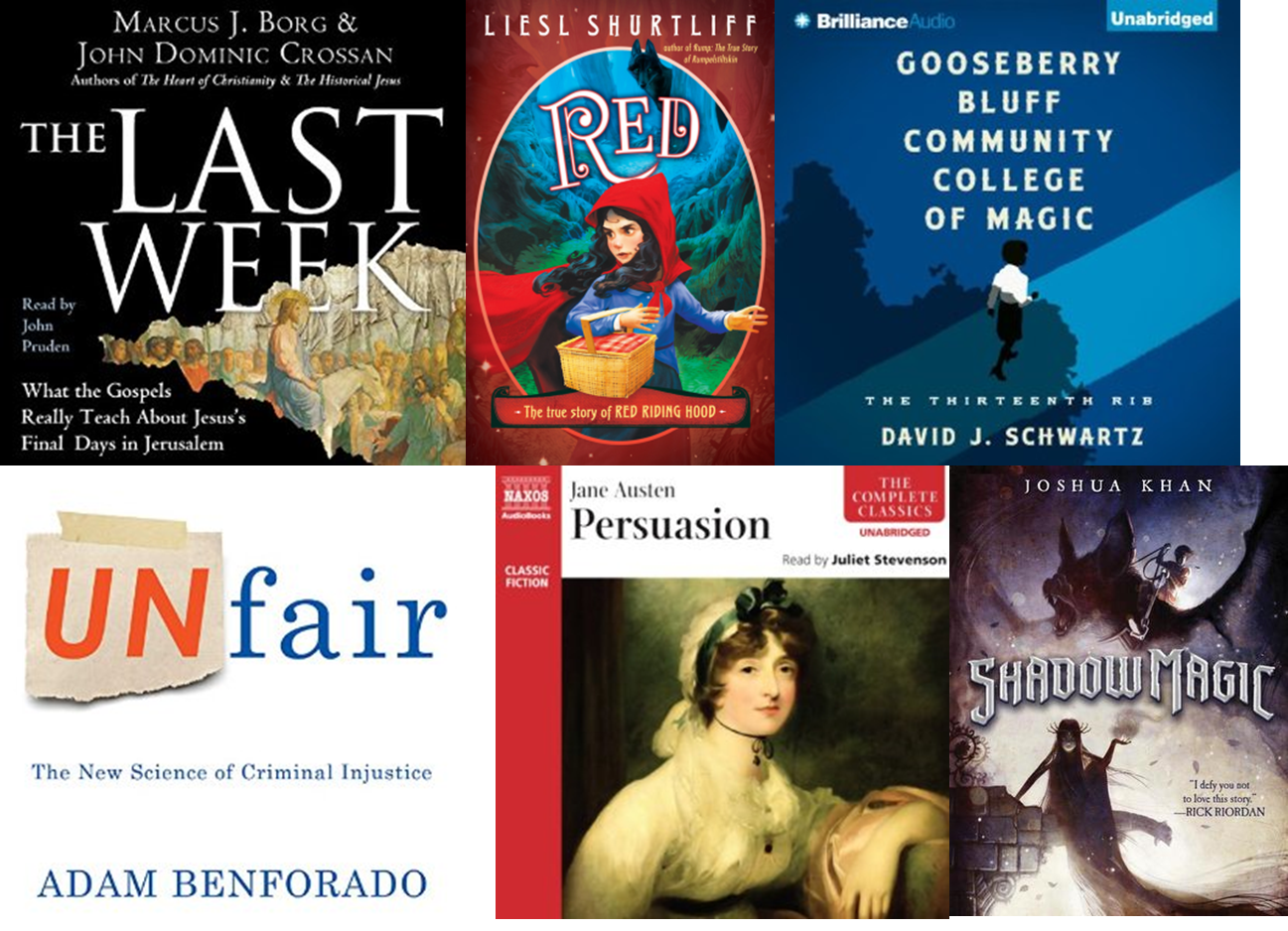
Among Murderers, by Sabine Heinlein

Among Murderers: Life After Prison
written by Sabine Heinlein
narrated by Cassandra Campbell

In Among Murderers, Heinlein follows three convicted murders in the years immediately after their release. The blurb describes it as: 

What is it like for a convicted murderer who has spent decades behind bars to suddenly find himself released into a world he barely recognizes? What is it like to start over from nothing? To answer these questions Sabine Heinlein followed the everyday lives and emotional struggles of Angel Ramos and his friends Bruce and Adam – three men convicted of some of society’s most heinous crimes – as they return to the free world.


However, this isn’t only a book about the difficulties of reintegrating – like finding a job, finding a home, dating, and figuring out how to live in a world that has matured 30 years while you were locked away – it is mainly comprised of doing research into the murderers’ backgrounds in order to give an adequate description of their crimes, who they were, who they have become, and what factors have influenced their lives. This gives the book a personal flavor – it encourages compassion and understanding for the three men and their troubles, without totally discouraging your caution in dealing with such men. 

I’m going to soon be volunteering with people recently paroled, helping them to reintegrate and to reduce their chance of recidivism. I thought this book would be helpful and interesting. Although it spent a little less time focusing on current troubles of the three men, this book was incredibly helpful. 

Genghis Khan and the Making of the Modern World, by Jack Weatherford

Genghis Khan and the Making of the Modern World,
written by Jack Weatherford
narrated by Jonathan Davis
This book wasn’t quite what I expected – I figured it would be about Genghis Khan’s life, but it was actually just as much about how his legacy formed the modern world. Which, I must say, was a delightful surprise. 


The first half of the book chronicled Genghis Khan’s life, starting with a very interesting childhood. I loved how much detail was included about Genghis Khan’s strong-willed mother. She was kidnapped from her first husband soon after their marriage, and was awarded to her captor, Genghis Khan’s father. But she didn’t just submit. She helped her first husband escape by letting herself be captured. Then, when Genghis Kahn’s father suddenly died, the whole family was left to die by the rest of their group. But Genghis Kahn’s mother had different plans. She kept the family alive against all odds. She was even willing to marry her step-son (only one year older than her own son) to make the family cohesive. But this is when Genghis Kahn’s conquering spirit fired up – he didn’t want his mother marrying his brother, because then his brother’s place as head-of-household would be solidified. Instead, he encouraged his younger brother to shoot the elder. Interestingly, when he formed universal laws for his empire later in his life, such intra-family killings were outlawed. 

After the incident with his brother, the narrative began to follow Genghis Khan rather than his parents. What I found interesting about this part of the book was that he was not portrayed as a conquering tyrant as he generally is in modern media. He was portrayed as cunning and wise. His laws were fair, reasonable, and well-thought-out. There was only very a little talk of battle strategy and history in this book. I had wished to have more of such information, but I can always read a different biography of Genghis Kahn. The purpose of Weatherford’s book was not to chronicle a history of Genghis Khan’s wars but to give a previously unseen glimpse into Genghis’ private life, personality, and how his legacy changed the world.

One thing that I found particularly wise about Genghis Kahn was his realization that nepotism does not necessarily lead to the most devoted followers. Promoting one’s family first was common among his people, so Genghis Kahn was breaking cultural norms when he promoted by loyalty first. And it was amazing what kind of loyalty he inspired. He must have been a very charismatic man. 

The final part of the book was about Genghis Kahn’s legacy. How his universal laws shaped the area even after they were neglected by his descendants. How his descendants spread around the world and made their own little kingdoms. How the trade routes he created became the major East-to-West connection for centuries – a connection that Columbus was trying to rebuild when he attempted to sail around the world to India. 

Truly a fascinating read. 


In Which Rachel Has her Last Day of Work

Yay! Friday was my last day of being a manager. I just can’t wait to taste the freedom of not having to tell people what to do anymore! And I’m really looking forward to the spare time with which to study. Otherwise this week was uneventful. We had a snowstorm which made the drive home 3 times the length it should have been, and I had to shovel knee-high snow out of my driveway in the morning, but at least it was light snow. Sunday I’m looking forward to the Super Bowl. My nephew really wanted to go to a party, so I hunted one down and we’ll have a good time. I’m rooting for the Panthers. Not because I know what I’m talking about, but because I’m a cat-person. And panthers are cool. I don’t know who my 12 year old nephew is rooting for yet. 

P. S. I know the Panthers lost. I wrote this on Friday.


Lectures


Posts


Currently Reading


Completed


Watched


Acquired
This update is posted to Stacking the Shelves @Tynga’sReviewsSunday Salon, Sunday Post @CaffeinatedBookReviewer,   and It’s Monday What are You Reading @BookDate

Mrs. Dalloway, by Virginia Woolf

Mrs. Dalloway, by Virginia Woolf
Narrated by Juliet Stevenson

Spoilers below.

This experimental book takes place in one day in June 1923, as Clarissa Dalloway prepares for and then gives a very successful high society party. In parallel, we follow the story of Septimus Smith, who has shell shock after witnessing the death of his friend during the war.

This was a very difficult book to listen to in audio, and I suspect it is equally difficult to read. The problem is that it is omniscient stream-of-thought and since it jumps around from character to character it is not always clear who is doing the thinking. You have to guess from context which person is thinking, and even after you’ve guessed that it’s not always clear (due to pronouns without antecedents) whether one character is thinking, or the other character is thinking about the first character. I had to read a description of the plot before I was able to get a clear version of the story, and after that my listening went much more smoothly, and I was able to understand what was going on.

There are a lot of ways to analyze this book. I could analyze the (paleo)modernist philosophy which rejects realism and rewrites, parodies, and incorporates ancient classical literature. (For a definition of paleomodernism, check out lecture 1 summary of the Literary Modernist Teaching Company course).  But I’m not yet comfortable enough with the philosophy to give an accurate interpretation. (This month is dedicated to modernist literature for the Reluctant Romantic Challenge, hosted by Katie at Doing Dewey; however, I have not yet learned enough about the genre. This is my first modernist review.)

Another way of analyzing Mrs. Dalloway is more straightforward. Clarissa and Septimus are parallel characters who respond to their predicament with opposite actions. They are both very lonely and isolated people. Clarissa is lonely despite being surrounded by people. She recognizes the false sincerity of the friends she invites to her party. Her husband is unable to tell her he loves her. Her daughter is being “stolen away” by a religious fanatic. (That’s one thing I do know about modernism, they often reject religion.) During the course of the day, three former flames, all rejected by her, appear – seemingly out of nowhere. She spends a lot of time thinking about why she rejected them. In fact, she seems quite obsessed with the past and ignores the present. 

Septimus, on the other hand, feels isolated because he is suffering from a severe form of “shell shock” (now called PTSD) after losing a friend in the war. He, likewise focuses more on the past than on the present. Unlike Clarissa, who rejected people who could have been too consuming or controlling and thus ended up with insipid people in her life, Septimus is surrounded by control – mainly by his doctors who don’t understand what is wrong with him. Another difference is that Septimus commits suicide at the end. Although Clarissa has contemplated suicide, when she hears about the suicide of this young stranger, she realizes how much she loves life despite the loneliness. 

I imagine this contrast of parallel characters appears frequently in ancient classical literature, though I can’t think of specific examples since this, too, is a genre I am woefully under-read in. 

The Nine Lives of Jacob Tibbs, by Cylin Busby

The Nine Lives of Jacob Tibbs, by Cylin Busby
Disclaimer: I received a copy of this book from the publisher
via NetGalley in exchange for a fair and honest review
Jacob Tibbs is the runt of his litter. He watches as, one-by-one, sailors buy and bear away his brothers and sisters to be ship cats on other ships – leaving only him and his mother. The captain’s daughter begs her father to save Jacob despite his small size and his white paws (that are glow-in-the-dark beacons to the ship rats). And it’s a good thing the captain saves Jacob, because he has his mother’s talent for predicting weather…and a huge storm is brewing. 

I know I bragged about how awesome my last NetGalley book was, but this book was equally awesome for different reasons. This was just an adorable and fun book to read. I actually learned some interesting tidbits about ships from this book – Busby must have done a lot of research. I’m a cat person, and I loved the way Jacob always explained his actions with cat-like anthropomorphic reasoning (instead of just sounding like a human mind in a cat). I was surprised at how much action could be packed into a book this short. There was always something going on that made me want to read the next chapter. This book was so sweet and fun! I wish I had an appropriately-aged kid to read it to. 

I highly recommend this book for middle grade readers starting with precocious third graders. While you’re getting it for your child, read it yourself. You won’t regret it. 

Burning Midnight, by Will McIntosh

Burning Midnight, by Will McIntosh
Disclaimer: I received this book from the publisher
via NetGalley in exchange for a fair and honest review 
This book takes place in the not-so-distant future – a future in which magical spheres have inexplicably appeared all over the world. These spheres can be burned by one person, and that person receives an extraordinary gift. 

In order to make enough money to help his mother pay the rent, Sully sells spheres at a flea market. When an edgy girl with an attitude and great spheres walks in, they make a deal to start hunting together. 

This is by far the best YA science fiction / fantasy novel  I’ve read in years. I knew it would be as soon as I started reading. The story pretty much starts out as a near-future mystery. Who is this girl Hunter and what’s her story? Where’d the spheres come from, and why? The action starts out slow and then steadily rises throughout the book until an adrenaline-pumped end. And the end is where this book went up from 4 stars to 5 stars. McIntosh has achieved the unthinkable: he’s wrapped up all of his loose threads in one book. It’s so nice to read a reasonably non-violent, non-sexual standalone book once in a while. And this one was exceptional, with its mixture of mystery, adventure, and action. 

I’d recommend this book to people anywhere from about 5th grade on up, and it’s appropriate for all ages. 

War of the Worlds, by H. G. Wells

The War of the Worlds, by H. G. Wells
Narrated by Greg Wagland
Spoiler alert!

When a pod crashes just outside London, our intrepid observer (unnamed protagonist) is at first curious. He watches as a lid slowly unscrews itself, and an alien crawls out. He only makes a run for it when green lightening chases down the watching crowd, scorching them all to death. He runs home, takes his wife to an out-of-the-way town, and for some idiotic reason heads back home. The rest of the book is his adventures on the way back to his wife. It also contains a short couple of chapters about the adventures of his brother in London – just to add some greater perspective of the story. 


Despite the name of this story, War of the Worlds is about three pods that land in the London area it is not an en masse invasion. I think it’s interesting that yet again Wells wrote a book where the characters remain completely unnamed. Perhaps that’s meant to make the story more “autobiographical” or simply to say that events, not names, matter when something like this happens. I like to think of it as the second choice. 

If you’ve read past my spoiler alert, then you don’t mind if I mention that in the end of the book all of the aliens died from bacterial infection because they were not immune to disease on Earth. I think this ending was quite creative and forward thinking at the time. It also gives the reader a feeling of no control. No. We didn’t destroy the aliens with our brains and technology and sheer will to live. They were going to destroy us, and that’s that. But something completely out of our control is what saved us in the end. 

I thought this ending was quite fascinating when I read the book as a teenager. Then, when the Tom Cruise movie came out one of my friends told me “don’t see it, it has the stupidest ending, I’ve heard.” So I expected something really darned stupid to happen at the ending. When it ended, she turned to me to say “I told you so” when I pointed out that this is exactly how the book ended. She was like “it was based on a book?” That gave me a perspective that perhaps an ending outside of our control is too philosophical for most readers/movie watchers of the day? Perhaps we just want to see ourselves be in control of our own fate? 

I think it’s interesting to note that the ending to Independence Day also had a similar ending – a virus killed the aliens, but in this case it was technological warfare and not a biological infection that we had no control over. So metaphorical disease was there, just as in War of the Worlds, but the power was in our hands. 

I’m trying to think of some modern books (besides outwardly religious ones) where a similarly dire situation is turned around by something outside of our control. If I recall, there’s a very popular Stephen King novel that ends in a deus ex machina sort of way. 


In which Rachel wraps up January 2016

Well, it’s been an eventful month for me. I started my EMT class and training for a new volunteer opportunity. And I put in my 2-weeks’ notice at work (next week will be my last). I didn’t set out to make the New Year a mini-rebirth, but I feel like a lot of good changes are coming for me soon.

My week was uneventful (thankfully). I  had my first exam for the EMT class and got a suitable grade. Below are my blogging & reading achievements for the week. 

Lectures


Posts


Currently Reading


Completed 


Watched


Acquired

February Plans


For next month month many of my books will be modernist for the Reluctant Romantic challenge over at Doing Dewey. 


This update is posted to Stacking the Shelves @Tynga’sReviewsSunday Salon, Sunday Post @CaffeinatedBookReviewer,   @MailboxMonday, It’s Monday What are You Reading @BookDate

Devil in the Grove, by Gilbert King

Devil in the Grove:
Thurgood Marshall, The Groveland Boys, and the Dawn of a New America
by Gilbert King, narrated by Peter Francis James
In this 2013 winner of the Pulitzer Prize for General Nonfiction, Devil in the Grove is about Thurgood Marshall’s (“Mr Civil Rights” and arguably one of the best lawyers of the 20th century) work to save three black men accused of gang raping a 17 year old girl.

Gilbert King did an amazing amount of research for this book including reading the FBI’s Groveland case files and the NAACP’s legal defense files – and this research really shone through. His prose was acerbic at times, and it flowed smoothly keeping my interest the whole way through. Devil in the Grove gave a lot of background information on Thurgood Marshall’s life outside of the of the trial, thus bringing a personal light to the story. Gilbert also included stories about KKK activities against lawyers who defended black people accused of rape, which was terrifying and disgusting. 

Overall, a fantastic book. Read it.