The Fairest Beauty, by Melanie Dickerson
Reason for Reading: I led the book discussion for ACFW this month.
Review
When Gabe Gerstenberg learns that his brother’s fiance – who everyone thought had died – was very much alive and being held hostage by an evil duchess. Gabe’s brother is down with a broken leg, and his father is busy, so he decides to rescue her himself. He bites off more than he can chew with this rash act, and ends up running desperately from the duchesses men – with a woman that he finds very attractive and very unavailable.
This sweet Christian historical fiction retelling of Snow White, has all the recognizable elements of the fairy tale, but is set in a realistic world. There were a few really creative twists – like the “seven dwarves” that made this story a fun creation. There were a lot of ethical questions brought to light – the main theme was: when do you know you’re following God’s wishes rather than your own? This is a good book for readers of fluffy/sweet romance, fairy tale retellings, or Christian historical fiction. Personally, I found Sophie’s character to be just a little too sweet and perfect, but I think that’s the nature of the snow white fairy tale. As far as I’m concerned, that was the only flaw in this cute retelling.
Author: hibernatorslibrary
Pride and Prejudice Movie Comparison
![]() |
| Pride and Prejudice (1995) Jennifer Ehle and Colin Firth |
Funny thing about these movies is that of the more recent two, I have pretty much the same comments to make as I did about the Sense and Sensibility movies last month. The beloved-by-many 1995 version with Colin Firth hits the literal nail on the head. The dialog from the miniseries is taken directly from the book, EVERY important scene is included, the characters are spot-on, and the humor comes through in-tact. Bonus, there’re those lovely scenes with Colin Firth in the bathtub and later playing wet-shirt-contest. 🙂 Perfecto! But a little long for a one-sitting viewing. 🙂
![]() |
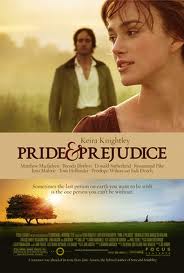
| Pride and Prejudice (2005) Keira Knightly and Matthew MacFadyen |
The 2005 movie, on the other hand, makes the story into a romance and removes almost all of the humor. The romance gets to be a bit melodramatic at times, but it is a good romance. I’m not sure if the purpose was to reduce the length/complexity of the story or if the director simply wanted to remove all the humor, but the characters of Mr. and Mrs. Bennet are completely changed in this version. I don’t particularly mind, but it’s enough to piss off a purist. I rather liked the new Mr. and Mrs. Bennet. 😉
![]() |
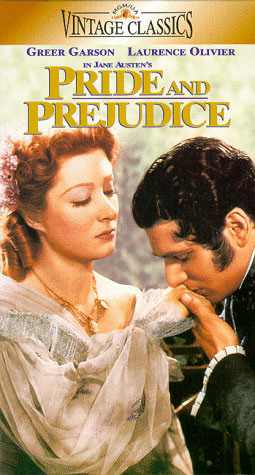
| Pride and Prejudice (1940) Greer Garson and Laurence Olivier |
The classic 1940 version of Pride and Prejudice is short-and-sweet. The humor and the main story line between Darcy and Elizabeth is intact, but all the other characters have changed dramatically. Especially Darcy’s aunt. Definitely not a movie for purists. But frankly, I think this one’s cute. After all, what’s more shocking than a surprise ending in your best-known novel? 😉
![]() |
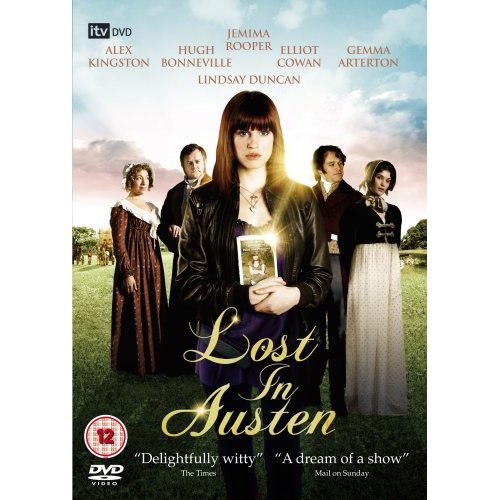
| Lost in Austen (2008) Jemima Cooper and Elliot Cowan |
As a bonus, I’ll mention my favorite film retelling of Pride and Prejudice – Lost in Austen. In this silly little fantasy, Amanda Price is a modern young Brittish woman who can’t settle down in life because she’s in love with Mr. Darcy’s character. When her boyfriend botches a proposal, Amanda runs away and, out of sheer need, somehow opens a doorway into the story. She trades places with Elizabeth (who has to figure out how to survive in modern London). Unfortunately, Amanda isn’t able to keep her modern manners to herself, and she throws the whole story out of whack. Furthermore, many characters turn out to be very different in “real life” than they were perceived to be by the narrator of Pride and Prejudice. What this story lacked in originality, it made up for with well-aimed British humor. 🙂
Does anybody else have a favorite Austen retelling (book or film)?
Something Rotten, by Alan M. Gratz
Something Rotten
Written by Alan M. Gratz, narrated by Erik Davies
Reason for Reading: I plan on reading a few Hamlet retellings, and this is the first I picked up. (Now if only I would pick Hamlet up again – what’s with me?! I still have two more acts!)
Review
In this hard-boiled teen retelling of Hamlet, Horatio Wilkes spends a summer in the small-town home of his buddy Hamilton Prince. The Prince family runs a paper plant which is currently undergoing scrutiny for pollution. On top of that controversy, Hamilton’s father has just passed away, and his mother just married her dead husband’s brother. When Hamilton gets a video from his dead father claiming that he’d been poisoned, Horatio promises to root out the murderer. Something is rotten in the town of Denmark, Tennessee. 🙂
This little mystery was funny (though neo-noir isn’t my usual type of humor, I still got a few chuckles). The plot is pretty straight-forward if you already know the story of Hamlet, so I felt very little suspense – on the other hand, it was interesting to see how Gratz played around with the story to make it more appropriate to younger audiences. He managed to stay true to the events in the play, but made it more realistic and less tragic. There are a few Shakespeare quotes thrown in which made me roll my eyes and groan, but in a “good” way. 🙂 I’d say this book is appropriate for 11-15 year olds.
Wanted! by Caroline B. Cooney
Wanted! by Caroline B. CooneyReason for Reading: This book was provided by the publisher through Netgalley in exchange for an honest review
Review
When Ally gets a phone call from her dad asking her to grab a couple of discs and drive (without a license!) in his corvette to “the place where she gets ice cream,” she knows something is wrong. But when someone breaks into the house while she’s in it, Ally makes a run for it – only to find out that her dad has been murdered and she’s the prime suspect. Will she be able to evade the police AND prove her innocence?
This was a fun, fluffy, and clean teen thriller published back in the late ’90s and recently re-released. I read it practically in one sitting. There are certain aspects of the book that didn’t translate well to the 21st century. For example, this was written in a day when most people didn’t have a cellphone – is that something today’s teenager can even fathom? 🙂 Ally made some stupid choices in this book (let’s face it, it’s hard to prove you’re innocent when you’re running away!), but in the end she managed to stay true to herself. This book would be appropriate for 11-14 year olds, and could be enjoyed by either boys or girls (i.e. it’s high on suspense and low on romance). In fact, it made me miss the day in which the love triangle wasn’t a required plot device for YA. Oh, those were the days!
Lamb, by Bonnie Nadzam
LambWritten by Bonnie Nadzam and Narrated by Tavia Gilbert
Reason for Reading: This was long-listed for the Prize Formerly Known as Orange.
Review

Lamb hits a mid-life crisis when his wife divorces him for infidelity and his father passes away. Just after his father’s funeral, he meets Tommie – an 11-year-old girl who desperately needs guidance. Lamb is strangely attracted to the girl – he wants to help her seize life, he wants to buy her presents and make her happy. Then, with Tommie’s consent, he abducts her.
I had a really hard time deciding how to rate Lamb. The narrative was intriguing – almost addictive – but the subject matter was very disturbing. I had a hard time putting it down because I wanted to know how it would end. I felt compelled to keep reading despite a deepening sense of unease. From the subject, I should have known it would make me feel that way, but I thought it would be a book with more hope in it. I respect the way Nadzam kept the details subtle. There were no highly disturbing scenes (well, there was ONE scene that was a bit disturbing, but it could have been much, much worse). My recommendation – read this book if you would enjoy looking at pedophilia from another perspective, but avoid it if this is a sensitive topic for you.
Spoilerish Discussion
Before deciding how to rate the book, I took a look at what other people had said about it. There are, predictably, people who loved the book and people who hated it. In the interest of proving to myself that I’m not narrow-minded, I want to have a spoilerish discussion to address some issues that came up in the positive reviews.
First of all, one review pointed out that it was unclear who the narrator of this book was. To me, it seemed that the book was in the third person subjective, focusing on Lamb. There were a few scenes where it seemed to be from the POV of Tommie, but even that could have been in Lamb’s head. So that’s how I’m interpreting the book – our narrator is telling us what Lamb is thinking, and sometimes Lamb thinks about what Tommie is thinking, and sometimes he thinks about what might be happening back in Chicago as Tommie’s parents look for her, but we’re always inside Lamb’s head. That is very important for how I interpreted the book.
Another thing that affects the way I perceive Lamb – I despised him from the beginning. Even before he abducted Tommie. Even when his intentions seemed kind. I despised him because of how he treated his girlfriend. He was manipulative and creepy and a liar. All he wanted was sex, and although he claimed to have qualms of conscience about his behavior, that’s ALL he had. Small qualms. These qualms didn’t stop him from manipulating her, did they? Qualms of conscience don’t make someone a “good” person. Listening to qualms makes a person “good.” Behavior is what I’m interested in, not whether a person feels guilt or not. The fact that he feels guilt proves that he’s not a sociopath, but he’s still a jerk. Just because he rationalizes his behavior, does not mean his rationalizations are justification. We need to interpret his rationalizations with skepticism.
Yes, he rationalized his original interest in Tommie as helpfulness. But let’s think about it. The very first time he met Tommie, he grabbed her arm and threw her in his truck so hard that her head hit the window. She was terrified. Yes, he rationalized that he was helping her to see what could have happened. She shouldn’t have approached him – a stranger – because he could have been dangerous. He rationalized that he taught her a lesson. But the fact that he was willing to frighten her like that was the first hint that his behavior towards her was driven by darker urges. Yes, perhaps this time around his rationalization had some grain of truth in it. Perhaps she did learn a lesson. But was that lesson his to teach?
Lamb’s rationalizations continued throughout the entire book. I never interpreted them as anything but rationalizations. So I was rather surprised when I read in some reviews that they interpreted his intentions as good. Let’s think about this.
Rationalization 1) Abducting her in front of her friends taught her a lesson about approaching strangers and about shallow friends. – We discussed this above.
Rationalization 2) Encouraging her to skip school and lie to her parents in order to hang out with him didn’t corrupt her, because she was already doing those things. – Well, if he really cared, he wouldn’t encourage her to skip school and keep secrets. That’s sleazy, creepy behavior.
Rationalization 3) Abducting her and teaching her to be a woman was helpful, because she needed that experience…it would help her break out of that awkward phase in life and burst into the world with new confidence. She’d look back with fondness on him. – Now this is where the rationalization gets sticky. I interpreted these flash-forwards to be rationalizations taking place in Lamb’s head. BUT, if you interpret these flash-forwards to be accurate or from the point of view of Tommie, I can see where you might (as some people apparently do!) think that Lamb helped Tommie. In the interest of not being narrow-minded, I tried to look at it from that point of view. But, no. The story simply makes more sense to me if I interpret these flash-forwards as rationalizations in the head of Lamb. And Lamb is rationalizing because he knows he’s hurting her. In fact, it’s clear he knows he’s hurting her, because there are other scenes in which he’s crying and telling Tommie that if she ever hates him, she should kick his balls in. Doesn’t that show us that he knows he’s doing wrong?
Some reviews actually suggested that Lamb loved Tommie, and that his intentions were good. But he knew he was hurting her (or else he wouldn’t break down into tears and tell her to kick his balls in, and he wouldn’t rationalize). He was consciously lying and manipulating her. (It’s clear that these were conscious acts, because in one scene he pointed out to his girlfriend that he makes people say and do things.) So, I’m convinced that Lamb knew he was hurting her – why would he act that way if he loved her? That’s not love. Love is selfless. That’s a darker sort of obsession. That’s acting on urges. Love can be an obsession, but we shouldn’t assume that obsession is love.
Finally, some people questioned whether Lamb had actually slept with Tommie. There was nothing that directly said he did, but I felt it was implied. He definitely kissed her, saw her naked, and slept in the same bed as her. Furthermore he got kicks out of letting Tommie watch him having sex with his girlfriend, which is a form of molestation in itself. So, yes, how far he went is still a question, and I’m glad I didn’t have to read that one last detail. But I made my own conclusion about the issue – and it wasn’t good.

Malcolm X: A Life of Reinvention, by Manning Marable
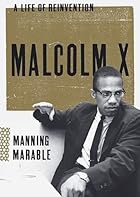
Malcolm X: A Life of ReinventionWritten by Manning Marable, Narrated by G. Valmont Thomas
Reason for Reading: This was one of the books I’d listed as potential reading for my Social Justice Theme Read in February. I chose it because it won the Pulitzer Prize for History in 2012 and was a finalist in the National Book Award.
Review

In Malcolm X: A Life of Reinvention, Manning Marable set out to honestly portray a man and to humanize an icon. Marable intended on filling in holes left by truth-bending and necessary lack-of-future-knowledge in The Autobiography of Malcolm X. Since I am not an expert on the subject, I have to say that Marable’s book seemed very thorough and well-researched. It was also an engrossing narrative. I feel it well-deserves its Pulitzer Prize. My only complaint was towards the beginning of the novel, Marable inserted some innuendo about Malcolm X’s sexuality – which was unnecessary, and rather rude since he didn’t have any hard evidence to support his claims. That innuendo was referenced obliquely a few times in the first quarter of the book. Luckily, those references stopped for the last three quarters of the book, or I would have been left with a very bad taste in my mouth.
The only reason I bring up that complaint is because I was looking for hints to why there’s a controversy about this book. I was wondering if there was anything I, personally, could pick up. I’m not very familiar with what the controversy is about – and I haven’t seen any controversial reference to the innuendo that bothered me. Mostly, the controversy seems to be about Marable’s lack of respect for the impact Malcolm X had on the Black Liberation Movement. If you’re interested, here’s an interesting article on the topic. There’s also a book entitled A Lie of Reinvention: Correcting Manning Marable’s Malcolm X, if you really want to delve into the issue. However, I am satisfied that Marable did a lot of really good research, and wrote an interesting and informative book. The issue of exactly what long-term impact Malcolm X had on the Civil Rights Movement and the country as a whole is an opinion, in my opinion.
G. Valmont Thomas did an excellent job of narrating this book. Quite enjoyable. 🙂
Kira-Kira, by Cynthia Kadohata
Kira-Kira,
Written by Cynthia Kadohata, Narrated by Elaina Erika Davis
Reason for Reading: This book won the Newbery Medal in 2005
Review
In this endearing book, the Takeshima family moves to Georgia so that Katie’s parents can work in the chicken factory. There, young Katie learns about Southern racism and the practically-slave-labor conditions of factory workers. But when Katie’s older sister Lynn becomes sick, Katie learns the hardest lesson of all…This is a sweet story – and pretty typical for Newbery winners. (Newbery judges certainly like bereavement, racism, and Southern settings!) The character in the book ranges from about 5-7, I’d say, but I think the subject and reading level is more appropriate for a 10-12 year old.
Let the Circle Be Unbroken, by Mildred D. Taylor
Let the Circle be Unbroken, by Mildred D. Taylor
Reason for Reading: This was one of the books that I planned on reading in my February Social Justice Theme Read and decided I would have to read later this year. (I really WILL read them all, I’m determined!)
Review
Cassie and her brothers are sent reeling by a shockingly racist trial – the culmination of events from the first book in the series, Roar of Thunder Hear My Cry. In addition, Cassie’s growing up, so she learns a lot about inter-race relations and the often humiliating effects. This is a heart-rending (though sometimes slow-moving) children’s historical fiction. The story deals with complex issues and is character-driven, so even though the reading level is approximately 5th-7th grade, this is not a book for reluctant readers unless they have a particular interest in race relations. It’s a book for children who love to read – and to absorb ideas. It’s definitely a good addition to the Roll of Thunder Series, and I find myself curious to follow the family’s saga to the end. 🙂
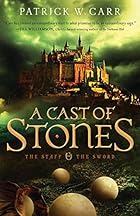
A Cast of Stones, by Patrick W. Carr
A Cast of Stones, by Patrick W. CarrReason for Reading: Review copy was provided by publisher through Net Galley for an honest review.
Review

Errol Stone has grown to manhood as the town-drunk in an out-of-the way village. When a messenger from the capital city comes for a reclusive monk, Errol offers to help deliver the message in exchange for enough money to keep him in drink for a week. But he is attacked while trying to deliver the message, and is consequently swept up into an intrigue that he’d rather ignore. He and the monk must travel to the capital city, for it appears that the childless King might soon be on his deathbed, and corrupt politicians are vying for the throne. This story also throws hints about an evil force more powerful than man which might overthrow the land if the King dies without an heir.
I really enjoyed this story. I was sucked in from the beginning, and I could easily empathize to poor Errol’s feelings that events were circling outside of his control. He was a very real character to me, which is rare in YA fantasy. The world-building was also impressive in this book. The world was built upon foundations expected for Christian Fiction, but it had the right ratio of realistic to fantastical elements to make it a fun and easy read. My one complaint is that the book ended in a cliff-hanger. The basic quest that was begun in this book was completed, thankfully, but it left many threads dangling for the next book. Luckily, that book will be published later this year. This story is suitable for young teens and up.
Skellig, by David Almond
Skellig, written and narrated by David AlmondReason for Reading: It was there
Review

Soon after Michael’s family moves to a new home, his sister is born prematurely. While his parents are ferrying the newborn back and forth to the hospital, Michael deals with his stress by exploring their dilapidated garage. There, he finds a strange owl-like man. As Michael and the girl-next-door nurse the winged man back to health, he learns a lesson about love. This was a sweet little book. It was quite short, so there wasn’t a lot of plot, but the characters and premise was quite adorable. This book would be appropriate for 7-9 year olds who enjoy reading magical realism.
Almond did a fantastic job of narrating his own book. He has an engaging reading voice and had all the rhythms and intonations flowing well. 🙂