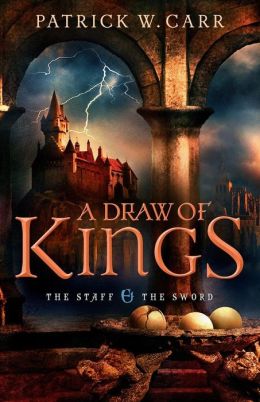
A Draw of Kings, by Patrick W. Carr
Genre: Teen / Christian Fiction / Fantasy
Reason for Reading: This was a galley copy provided by the publisher through Netgalley in exchange for an honest review. This is the third book in a trilogy that I have been enjoying.
Synopsis (May contain slight spoilers for previous books in the trilogy): In this third, and final, book of the Staff and Sword trilogy, the war for Illustra begins. In order to maintain order within the Judica, Errol must retrieve The Book that was left behind in Merakh. Meanwhile, Adora and Liam must journey to the Shadowlands to make a pact with these newly discovered allies. A feeling of dread descends upon everyone, as the people of Illustra realize they are surrounded by vast armies of enemies and demon spawn. They must discover who their king and savior is – or else the barrier will never be restored and the demons will destroy Illustra.
My Thoughts: This book was every bit as good as the previous two – and it tied off most of the loose ends quite well. For fantasy fans, this book was packed with battles, intrigue, foreign lands, and ranging demon-spawn. I was also quite impressed with Carr’s ability to write religious allegory. He deftly got his message across by showing it within the story instead of writing lectures into the dialog as many authors do. In fact, I bumped this book up an extra half a star (something I rarely do) because I admire how much finesse it takes to write a good allegory without sermonizing.
One of the allegorical issues presented is the fallibility of humans (as well as the organizations that we create). The church, in Carr’s world, was composed of many good men (as well as a few villains) who often made mistakes and were suffering under misunderstandings of God which had accumulated after the loss of their religious book. This is the message that I originally interpreted as criticisms of the Catholic Church in my review of Hero’s Lot, though after reading this book the criticism feels more forgiving. The message is: no one is perfect, we are all human, and we’re going to make mistakes. We can’t judge everyone in a group based upon the mistakes of some of its leaders. I’m not sure if this is the message that Carr intended, but it is how I felt when I read A Draw of Kings.
The other allegorical message that I felt was done tremendously well related to faith and doubt. There was a moment when Adora as climbing a cliff and Liam was behind her, and even though she knew Liam was there to catch her if she fell, she suddenly doubted that he was there at all – that he had ever been there. And then he carried her. I’m sorry if that is a spoiler, but I couldn’t help but point out the beauty of that moment. Because it’s so true, isn’t it? It’s so easy to lose faith – even though this loss of faith is irrational when viewed from the outside-the-moment.
My interpretation of this story has evolved so much while reading this third book, that I feel I ought to go back and revise some of the criticisms I made about the second book. Of course, I always have to include criticisms, but…. Which brings me around to my criticisms of A Draw of Kings. My first complaint is how violent it was. I felt that the good guys (Adora especially) were sometimes more violent than they ought to have been. Of course, this could simply be another way in which we are only human – and therefore fallible. So this is only a small criticism. The other criticism is that I felt threads were dropped in relation to the countries other than Merakh. There needed to be a little more tie-up after that much build-up. But that, too, is only a minor issue since the major threads were tied up wonderfully.
Overall I was greatly pleased with this book, and I will recommend it to all of my friends who read books of this genre. In fact, I’m hoping it wins some awards – it’s well-deserving of the Christy Award for Young Adult literature.
Category: Book Review
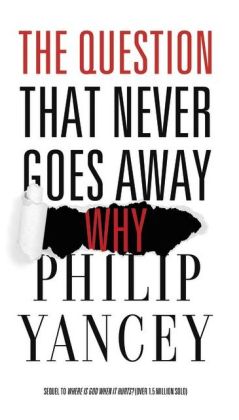
The Question that Never Goes Away, by Philip Yancy
Genre: Christian Living
Reason for Reading: A galley copy of this book was provided by Netgalley in exchange for an honest review. I wanted to read this book because I’m interested in theodicy, and I’ve been pretty impressed with the bits of Yancy’s writing that I’ve seen.
Synopsis: After over a decade of traveling the world giving lectures on Where is God When it Hurts, Philip Yancy has decided to revisit this subject in his most recent book The Question That Never Goes Away. I have not read his earlier book, so I can’t compare the messages of each, but I assume the newer book has a similar message to the older, with recent examples and insights that he has gathered since writing the first book.
He starts by describing two different types of disaster: the devastating 2011 tsunami in Japan and the horrifying 4-year seige of Sarajevo in 1992. The first example is a natural disaster, but the second is man-made. Such disasters beg the question “Why?” Why would a God who loves us allow such destruction?
Yancy points out that atheists have a field day with such calamity – using it as evidence that God doesn’t exist. For, clearly, a loving God wouldn’t allow such things to happen; therefore it is erroneous to believe in God. But Yancy counters: if, indeed, this is an impersonal universe of random indifference, why are the atheists so shocked and upset about someone else’s tragedy? Clearly, their morals are shaped by the philosophical framework of Christianity.
My thoughts: I don’t really think this is an adequate counter to the claim that God doesn’t exist. First of all, Christianity is not the only religion which is founded on the power of love. Second, there is no evidence that God created our revulsion to other peoples’ tragedy. Such revulsion can be explained by evolution of social behavior. Humans might simply have an instinct to protect our neighbors because we are better able to survive in a group than alone. On the other hand, I don’t think asking the age-old question “Why?” proves God doesn’t exist, either. To think so is a bit naive.
Yancy continues by explaining that there’s nothing wrong with asking the question “Why?” In fact, it is a question asked over and over again in the Bible. God expects such questions, and he understands our grief and frustration at getting no answer. BUT, He still doesn’t provide an answer. Not in the Bible. And not in the world.
Ours is not to reason why. Ours is but to do and die.
Yancy suggests that we shift our focus from cause to response. When disaster strikes, we should appreciate the outpouring of humanitarian aide that comes from individuals, communities, and countries. Yes – some of this humanitarian aide can be poorly planned, but notice what lies at the heart: love. We, as human beings, want to reach out and help those who are suffering. So where is God when it hurts? He is in those friends, neighbors, and complete strangers who reach out to help the suffering. God hates our suffering as much as we do – but he loves us so much that he sent his own son to suffer among us. Because we can relate to a suffering God.
Finally, Yancy criticizes the claim that God sends suffering in order to build character. He points out that Jesus healed the afflicted. He never once said to them “But think of how character-building this experience is!” Yancy points out that God has promised to redeem our suffering. This does not mean that God sends suffering, but that when tragedy occurs, He inspires and directs good to result from the evil. Thus, we do gain character from suffering.
My thoughts: Well, I know for a fact that good often comes out of bad situations in my life. I don’t know if that is only because I like to be optimistic and think of how I’ve learned from an experience, or become stronger, or had a good experience that otherwise never would have happened. I could just as easily dwell on the tragedy and what good that might have happened if tragedy hadn’t occurred. If I did so, I would certainly live a more miserable life. But would I be any more right or wrong? Regardless, it makes me happy to think that God redeems my suffering. I’d rather not be miserable, thanks.
My thoughts: This is a very difficult book to read because Yancy dwells on quite a few tragic events in detail. However, the book has a strong message and is written with a very humble and personal air. Yancy impresses me with his intelligent observations and powerful examples. I highly recommend this book to anyone interested in the question of why God allows suffering. I am eager to read more of Yancy’s work.
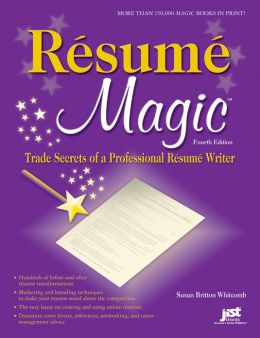
Resume Magic, by Susan Britton Whitcomb
Genre: Self-Improvement – Job Hunt
Reason for Reading: Trying to buff up my resume so that I feel more presentable.
Synopsis: This book contains a lot of information about content and format of resumes. It starts by encouraging the reader to find his or her own personal brand, so that it can shine through on the resume. Then, Whitcomb discusses the differences between a chronological resume and a functional resume and provides suggestions about when each type of resume would be helpful. She helps the reader create an outline of the resume, later fleshing it out with helpful tips about content. She emphasizes the importance of listing accomplishments. Finally, she dwells on proof-reading. She provides a guide of the basic grammar and punctuation mistakes people make while writing resumes. The final few chapters outline her thought on job search through social media and on cover letters. These sections, of course, aren’t as thorough as the chapters about resumes, but I think she’s trying to whet our appetites for her other books..which I hear are just as thorough.
My thoughts: First. DON’T get the ebook! Get a hard-copy, because the figures and tables are really tiny in ebook format. Second, this book did not really have a lot of information that was relevant to writing a CV, for those of us who have a PhD. Although Whitcomb provided examples of resumes for a large variety of job types, she focused primarily on business, sales, and marketing. Sometimes I wondered if her tips applied to me or not. However, the book DID provide enough information for me to make my resume more presentable. Third, the title. Ouch. I almost didn’t buy this book because the title was too pretentious. Fourth, Whitcomb was a bit heavy-handed with her self-marketing: Resume Magic often read like an advertisement for Whitcomb’s webpage and other books.
And now I see that my thoughts are rather top-heavy in criticism. I hadn’t intended my review to be negative. Resume Magic is loaded with information and tips, and I’m much happier with my CV now than I was before reading this book. Resumes and job hunting have changed dramatically in the last few years, and books like these are very helpful for catching up on what employers are expecting. Because, let’s face it, first impressions are a LOT about presentation. And don’t we all want to make a good first impression?
I haven’t read any other resume books, and I don’t have the time to do so right now, so I can’t very easily compare this to other books on the market. I have been reading Joyce Lain Kennedy’s Job Interviews for Dummies and Job Search Letters for Dummies, though, so I can make a guess at what her Resumes for Dummies is like. My guess is that Whitcomb’s book is more heavy in specific tips, and Kennedy’s books tend to be more general. They both provide a lot of good examples, and they both explain what makes those examples stand out. But Whitcomb’s style is more self-aggrandizing and opinionated. Kennedy recommends books by authors other than herself (including Whitcomb!), which makes her advice seem more sincere and approachable. So I guess if you’re trying to choose between the two – pick Whitcomb if you want a book heavy in information, and Kennedy if you want more general advice from someone who’s willing to reference opinions other than her own (even when they do not exactly coincide with her own).
Tips that most helped me in my resume redesign:
Content
- I am applying to several different types of jobs, mostly branching out from my degree in science. Each job type requires a different set of basic skills, so I prepared a few basic resume types, each arranged in a way that accentuated the traits requested by each job type.
- In order to determine the what skills to emphasize in each resume type, I searched the internet for job listings and company mission statements to determine what is required for a good candidate in each job type.
- Each time I apply for a job, I change my “qualifications” section, so that it directly reflects the skills requested by the job listing as well as the mission statement of the employer.
- I emphasized numbers-based accomplishments for each job that I listed.
- I did not include affiliations or bio, since this information made my resume way too long. So I’ve decided to include a link to my blog bio (which I am currently re-writing). Thus, my potential employers can get a sense of my “personal brand.”
- I put my strongest attributes / qualifications in the visual center of the first page (just below the name and contact information), drawing further attention by setting this section off with lines.
- I included a keyword section for electronically submitted resumes.
- I created two versions of the resume – one for printing off, and one for submitting on the internet. The one for submitting on the internet must have very common fonts, and minimal fancy formatting (avoid tables, for instance).
- Although I certainly hope that whatever job I find will be long-term, I am going to start a file of all accomplishments, evaluations, letters / memos of approval, etc. This information might come in handy in the future. I’d never thought of collecting it before!
The Drowning Girl, by Caitlin R Kiernan
The Drowning Girl, Written by Caitlin R. Kiernan, Narrated by Suzy Jackson
Genre: Dark Fantasy
Reason for Reading: This was one of the nominations last year for the World Fantasy Awards
Synopsis: In The Drowning Girl a young schizophrenic woman, Imp, tells the story of her meetings with Eva Canning – a ghost? a mermaid? a werewolf? a normal, disturbed young woman? As Imp’s mind roils in schizophrenic fantasy, the readers are left wondering how much of the story is reality and how much is fantasy.
My thoughts: I’m having a hard time coming up with viable thoughts about this book. I just don’t know what to think! I was interested throughout; I always cared about Imp – and about her girlfriend Abalyn – but I never knew quite what to think. Which, I suppose, is the point of the book? Kiernan did a fantastic job of spiraling Imp’s writing in and out of control, and the pacing of the spirals was quite amazing. This is a skilled bit of writing. Likewise, Jackson was a superb narrator for this role. Her inflections were perfect for hinting at whether Imp was “in control” or “out of control” when certain passages were read. I would recommend this book to people who enjoy open-ended stories, especially those stories with an aura of unreality.
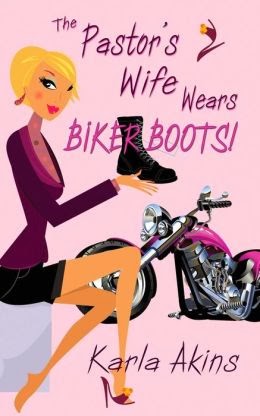
The Pastor’s Wife Wears Biker Boots, by Karla Akins
Genre: Christian Fiction / Women’s Fiction
Reason for reading: I’m leading a discussion on this book from February 24th through 28th on the American Christian Fiction Writer’s Association book club. You can join the email discussion group if you wish! Just click on the link, and subscribe to the yahoo group. There’s still plenty of time to read the book!
Synopsis: Kirstie is stressed out trying to maintain the image of the perfect pastor’s wife. She’d really just like to relax and not worry about what everyone in her congregation thinks. On top of that, she has a severely autistic son, and another rebellious teenage son – both of whom lead to a lot of sideways looks from her conservative neighbors. When she realizes that riding a motorcycle releases her built up tension and makes her love life again, she has to deal with the prejudices of small-town gossips.
My Thoughts: This is not the type of book that I usually read, so I was surprised when, after about 30-or-so pages, I became really attached to the characters and their issues. This was a sweet, funny book about finding friends in unexpected places, letting go of preconceived notions, forgiving those who gossip about you, and putting your family above work and social image. I got lots of good laughs over the antics of our “biker chicks.”
I was a little concerned at the beginning of the book when the subject of autism was first brought up: Kirstie called it an “ugly disease” and her “enemy.” It is possible that some people will find this portrayal of autism to be offensive. However, I was glad to see Kirstie grow throughout the rest of the book. As she released her woes on the road, Kirstie became less depressed and was better able to cope with the difficulties of autism. Hidden here is a fantastic message that we can not give fully to loved ones unless we take care of ourselves too.
I don’t want to drop any spoilers, but I have to say that the ending of the book was not only the most exciting part, it was the funniest as well. Wow. Way to pack it in at the end! 🙂 Fantastic finish.
The Many-Colored Land, by Julian May
Genre: Science Fiction / Fantasy Mesh (Adult)
Reason for reading: I read this book a long time ago and always intended on picking up the rest of the series. This year, I convinced my real-life book club to read it. So hopefully I’ll get to the rest of the series soon!
Synopsis: In the near future, an alien federation called the Galactic Milieu has intervened on Earth, and welcomed humans into the its fold. For most of humanity, the Milieu is a blessing. Long life, health, an ethical law system, the adventure of space travel – these are the perks that humans enjoy. But some feel confined by the rules of the Milieu and yearn for a simpler life. And some are too sociopathic to be accepted in the Milieu’s society. These people can go into Exile – they are sent back in time to the Earth’s Pliocene epoch. The Many-Colored Land follows the story of one group of exiles as they discover what lies on the other end of the time-portal. Life isn’t as simple as they expect, and they are soon swept up in a world of war and conspiracy.
My thoughts: I must have read a lot more hard-core science fiction when I was a teenager, because I don’t remember this book being as heavy as it felt this time around. All the descriptions of futuristic technologies / cultures slowed me down because I don’t read enough science fiction to be used to the terminology. It may have been slow reading for me, but I felt refreshed by the newness of the plot. This is a very complex book, with many layers of hidden foundation. Superficially, I think the characters could have used a little more development – but I’m sure they grow throughout the series. This first book in the Pliocene quartet was mainly world-building. We were introduced to the alien cultures – both the good and the bad aspects. We got a hefty background on the Pliocene epoch. And we got some hints of how these events in the Pliocene might have impacted humanity’s development millions of years later. It’s a fascinating set-up, and I’m eager to see how the rest of the series plays out. I’ve heard so many good things about it.
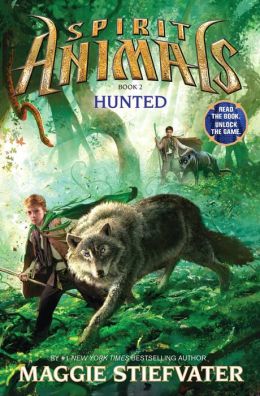
Hunted, by Maggie Stiefvater
Hunted: Spirit Animals Book 2, by Maggie Stiefvater
Genre: Middle School Fantasy / Adventure
Reason for Reading: This is the second book in a so-far excellent series
Synopsis: (May contain slight spoilers for book 1). Conor, Abeke, Meilin, and Rollan hike across Eura on quest to capture the talisman of the Great Boar before the Conquerors get their hands on it. But the Conquerors have a few surprises up their sleeves – they are now able to force an unnatural bond between humans and animals! They now have the advantage of superior numbers of bonded warriors. In order for our heroes to survive, they must learn to trust one another and fight as a team.
My Thoughts: This was an excellent follow-up to Brandon Mull’s Wild Born (reviewed here). The characters are developing – and so is the philosophy. In this book, our heroes struggle with trust. It’s a story of strengthening ones bond with friends – how such a bond can never fully be broken, even when trust fails. It’s a story about following your heart, even when your heart leads you astray from logic (a fitting theme given my thoughts on doubt last month!) I’m eagerly awaiting the third book in this series, Blood Ties, which comes out in March.
This is my first book by Maggie Stiefvater, and I’m eager to pick up some more now! I like the way this series is designed – with a different author for each book. That way, I am introduced to authors that I might otherwise never gotten around to reading. 🙂
Wool, by Hugh Howey
The Mark of Athena, by Rick Riordan
Genre: Middle School fantasy / adventure
Reason for Reading: This is the third book in a series that I’ve already started.
Synopsis: In this third book of the Heroes of Olympus series, 7 heroes – Percy, Hazel, Frank, Jason, Piper, Leo, and Annabeth – set out on a dangerous quest to Rome. The Romans and the Greeks must cooperate if they are to quell the rise of Gaia, but war is brewing between the two camps. Our heroes must try to postpone war while saving Rome from apocalypse-hungry giants and following the Mark of Athena – an ancient clue that only Annabeth can decipher.
My Thoughts: I’m not a huge fan of Riordan’s writing, though I think this series is a heck of a lot better than the Percy Jackson series. While reading this book, I finally figured out what it is about Riordan’s writing that bothers me – the audience is too childish. All the adults in these books talk as if they were kids. That grates on me. I guess I prefer kids books where adults sound like adults – even if they sound like silly or disinterested adults (which is often the case in middle school books). Despite my dislike of the style, though, I found this book well-researched and interesting. The plot isn’t very complex, but there’s a lot of action and some good humor. I’m not rushing to Barnes and Noble to buy a copy of the next book, but I’m planning on reading it “some day.” (Which probably means I’ll wait until the NEXT book comes out and reminds me that I still haven’t read House of Hades…which is what happened with Mark of Athena.) One thoughtful question about this book – and maybe this will be answered in House of Hades – is why did Riordan only write first person narrative from the Greek heroes’ points of view? Is he hiding something about the Romans?
The Yellow Wall Paper, by Charlotte Perkins Gilman
I decided that since I’m reading Herland, by Charlotte Perkins Gilman, I would read Gilman’s best-known piece of fiction, the short story “The Yellow Wallpaper.” This is one of the few short stories included in the list of 1001 Books You Must Read Before You Die (the others mostly being by Edgar Allan Poe).