Old Curiosity Shop, by Charles Dickens

The Old Curiosity Shop, 

Written by Charles Dickens, Narrated by George Hagan

Reason for Reading: I’m making a point of reading all of Dickens’ major works. This month, Caroline from Beauty is a Sleeping Cat and Delia from Postcards from Asia hosted Dickens in December, a month dedicated to Charles Dickens. This will also count for the 7th completed book in my Classics Club list

Review 
When Little Nell’s grandfather drives himself into gambling debt (in hopes of raising money for Nell’s future), they must take to the streets to escape the malicious designs of more than one nasty character. Nell’s grandfather increasingly becomes a doddering old fool, and Nell is left to her own devices in finding refuge from the cold, the hunger, and the devious people-of-the-streets. Unbeknownst to them, their good friend (and former servant) Kit is desperately looking for them – praying for their safety and not knowing why they have left. I think this is my least favorite Dickens book so far. Generally, I am able to get involved in the complex narrative and the variety of character in a Dickens novel, but kit was the only character I really cared much about. Nell and her grandfather were so melodramatically pathetic that, although I felt sorry for their situation, I couldn’t get myself to really care about the outcome. Perhaps this was just timing – maybe I’d have liked the book better in another mood. But I can’t say I’ll ever try reading it again to find out. Not a bad book – but Dickens can do better.


A Christmas Carol, by Charles Dickens

2012 Book 172: A Christmas Carol

Written by Charles Dickens, Narrated by Tim Curry

Reason for Reading: I read this for a Dickens in December readalong hosted by Beauty is a Sleeping Cat and Postcards from Asia. Unfortunately, I’m a day behind on my post! This is also one of the 1001 Books You Must Read Before You Die (sign-up for Team 1001 here).

Review (contains spoilers :p)
When grumpy and miserly Ebeneezer Scrooge is visited by the ghost of his long-deceased business partner, he gets the shock of his life. Apparently, a person’s job on earth is to walk among his fellow men and help them. For those who were too selfish to help during life, they are doomed to an eternity of walking among men while desiring to help, but not being able to. Scrooge is about to be given a chance at redemption. He will be visited by three ghosts. The Ghost of Christmas Past will remind him that although he’d had a rather dreary childhood, he’d had plenty of chances to make people (rather than wealth) his passion. The Ghost of Christmas Present will show him how happy people can be when they are surrounded by the people they love at Christmas. And the Ghost of Christmas Future will reveal a dreary future which may come to pass if Scrooge continues on his miserly path. On Christmas morning, Scrooge will awaken a new man – someone who knows how important it is to love one’s neighbors and to rejoice in their friendship. This is such a great story because it reminds us that wealth does not necessarily make us happy. It reminds us to look at the world through a different perspective. And, it’s pretty darned funny. 🙂 

This well-known story was excellently narrated by Tim Curry…and I’m SO glad I decided to pay the extra couple of dollars for the Curry narration! His voice is soothing yet engaging at the same time. His voices for each character are spot on. And his delivery of the humor was so well-timed! 

Three Men in a Boat, by Jerome K. Jerome

2012 Book 168: Three Men in a Boat (To Say Nothing of the Dog)

Written by Jerome K. Jerome, Narrated by Frederick Davidson

Reason for Reading: This was my “monthly random pick” which took me two months to get to. 🙂 My next “monthly random pick” is The Passage, by Justin Cronin. This book is a classic, so it fits in my Classics Club list. 🙂 

Review
In this classic novel of humor, three men (to say nothing of the dog) decide to cure their hypochondriac ailments by getting fresh air and exercise. They decide to travel down the Thames in a boat. The narrator jumps back and forth between humorous description of their preparations/trip and silly reminiscences of loosely connected incidents about the characters. This is the type of book where, at the end, you’re not sure if there was any story in there at all, but you certainly enjoyed the trip regardless. It was a good-natured, happy sort of humor. This is a short book, and certainly worth reading if you like the classics. 🙂


Hamlet Act II

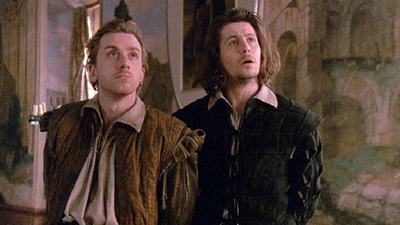
Rosencrantz and Guildenstern
Rosencrantz and Guildenstern are Dead (1990)
Directed by Tom Stoppard
Clearly some time has passed since the first act. Enough time that Ophelia has been able to rebuff Hamlet’s attentions, for Hamlet to “go insane,” and for his royal parents to send off for Rosencrantz and Guildenstern to come from abroad. Maybe a few weeks? A couple months? Hamlet still hasn’t done anything to avenge his father’s death, and he’s starting to feel worthless. He’s not quite sure whether his father’s ghost is a demon sent to tempt Hamlet into a wrongful act, but he feels like he ought to believe the ghost’s story. And he ought to have acted on it. When the troupe of actors arrives, Hamlet thinks this is his chance to throw a wrench in Claudius’ gears – to make him betray his guilty conscience in an unguarded moment. Hamlet admonishes himself for his weakness – he ought to act on his vengeful instincts, but he lacks the courage. 

Some questions that I’m thinking about while reading this: 

First, I wanted to see for myself whether I thought Ophelia was a virgin or not. (Remember in my notes on the introduction by Harold Jenkins I said that Jenkins believed Ophelia died a virgin.) During Hamlet’s discussion with Polonius, Hamlet first compares Polonius to a fishmonger. According to Jenkins, the daughters of fishmongers are seen as having more than ordinary propensity to breed. Hamlet then says: “Let her not walk i’th’ sun. Conception is a blessing, / but as your daughter may conceive – friend, look to’t.” Now, outwardly, Hamlet referred “conception” to the breeding of maggots under the sun (from an earlier line), but how can there be any question that Hamlet meant also to suggest that Ophelia might conceive a child? But does Hamlet mean “Don’t let her out, or something bad might happen to her.” Or does he mean “Don’t let her out, because everyone will soon be able to see she’s pregnant.” I guess that’s open to interpretation. Later in the scene, Hamlet compares Polonius to the Hebrew judge Jephthah, who sacrificed his virgin daughter. That might be a hint that she’s still a virgin, and that Polonius is endangering her.

My second question was whether Hamlet is feigning madness or was really mad. I can see why many people believe he was only feigning madness – his “mad” ranting during this act was calculated to mock Polonius, Rosencrantz, and Guildenstern. There was a method to his madness. 🙂 But, as far as I’m concerned, the phrase “fake it till you make it” applies in Hamlet’s case. He certainly had enough to go mad over…

(TO SEE MORE ABOUT HAMLET GO TO MY MASTER POST)
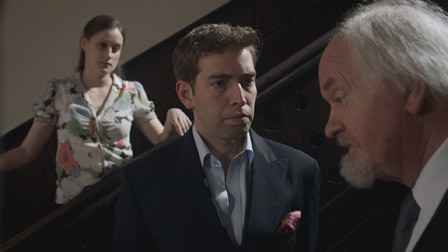
Polonius and Reynaldo
The Royal Shakespeare Production 2009
Directed by Gregory Doran
Act II, Scene i: The act starts with Polonius instructing his man Reynaldo to spy on Laertes. A very untrusting father, is Polonius. As soon as that important business is through, Ophelia dashes in to tell her father about a shocking encounter with Hamlet. The prince has apparently entered her chamber uninvited, grabbed Ophelia by the arm and creepily stared at her. Then he turned and left the room – eyes cast over his shoulder to gaze fixedly upon the distraught maiden. Polonius gets excited…not only has he discovered the reason for Hamlet’s madness (which the King and Queen want to know), but he now has the opportunity to say “Look! I did everything I could to discourage this mis-match, but the Prince is still in love with my daughter…perhaps they ought to marry?” *gleeful aspirations shine in eyes*

Rosencrantz and Guildenstern 
Rosencrantz and Guildenstern are Dead (1990)
Directed by Tom Stoppard
Act II, Scene ii: Hamlet’s friends Rosencrantz and Guildenstern have arrived in from abroad, and Claudius and Gertrude are asking them to check on Hamlet – to discover the reasons for his madness and perhaps soothe the melancholy prince. When they leave in search of Hamlet, Polonius comes with their messengers, newly arrived from Norway. The messengers tell Claudius that Fortinbras’ uncle has admonished the prince for threatening war with Denmark, but upon Fortinbras’ apology, his uncle has furnished the prince with more money for his army and told him to attack Poland instead. They now ask Claudius’ permission for Fortinbras’ army to cross through Denmark on the way to Poland.


Hmmm. Does someone smell a ploy? They’re just going to allow Fortinbras’ army to cross through Denmark? Oh well, it’s their kingdom. 

After the messengers have been thanked and sent away, Polonius tells the royal couple that Hamlet has gone mad with love for Ophelia. They decide to test this theory later by setting Ophelia loose on Hamlet. (Poor Ophelia.) Then Hamlet walks in. Polonius has a rather nonsensical conversation with Hamlet, partly because Polonius isn’t very clever and partly because Hamlet is playing with Polonius’ mind. Rosencrantz and Guildenstern walk in. The nonsensical conversation continues with them (and for the same reasons). *Why do Claudius and Gertrude keep sicing idiots on Hamlet? What do they hope to achieve?* Finally, a troupe of actors arrives, and Hamlet decides to use them as bait for Claudius’ guilty conscience.

Hamlet, Act I

In the first act of Shakespeare’s Hamlet, the scene is set. We meet the mournful young prince Hamlet who feels wronged by his mother’s hasty marriage to her deceased husband’s brother…and by their incessant partying in a time of sorrow. We meet Ophelia, admired by Hamlet, her brother Laertes and father Polonius. Finally, we are handed a juicy bit of gossip (adultery and murder!), which give Hamlet his excuse to vent his rage against the tyrant King Claudius. (For a more detailed summary, look below.)

This is my first time reading Hamlet since I was in high school, and I’m looking at it through very different eyes this time around. For instance, I’ve always been under the impression that Polonius was ridiculous. But this time, he appeared long-winded, but his advice seemed sound enough. Is he really ridiculous, or just verbose? I was gratified upon reading Harold Jenkins’ endnotes, where he suggests that Polonius was not meant to be ridiculous but paternal. Emphasizing Polonius’ fatherly relationship develops Laertes’ role as an avenger against Hamlet later in the play. 

A phrase that jumped out at me on this reading was when the ghost told Hamlet (I.v): “Taint not thy mind nor let thy soul contrive against thy mother aught.” Interesting. Because I recall Hamlet being very lusty in his anger against the Queen later in the play. Do I remember wrongly? Or is Hamlet disobeying the ghost? I will have to read on and see. Also, what did the ghost mean by “taint not thy mind”? Was the it admonishing Hamlet to keep his mind clear? Because Hamlet either feigns madness or actually goes mad later in the play. Again, did Hamlet disobey the ghost? 

The final thing that struck me in Act I was the questionable nature of the ghost. If Horatio (a clear-headed scholar) hadn’t believed in the ghost, I would suspect that Hamlet had hallucinated it in a fit of psychotic rage. Hamlet does incoherently rant during the scenes with the ghost. In his endnotes, Harold Jenkins suggests another alternative – perhaps Shakespeare meant the ghost to be a devil – an evil apparition sent to drive young Hamlet to vengeful madness. After all, the ghost has gone below stage, which represents Hell in classical theater. In a later scene (II.ii), Hamlet even questions the nature of the ghost: “The spirit that I have seen May be a devil.” However, based on all the swearing which closes Act I, Hamlet does seem to believe the ghost’s story, even if the ghost’s nature is questionable.

Perhaps I’ll be able to answer these questions as I read on…

(TO SEE MY OTHER POSTS ABOUT HAMLET, GO TO MY MASTER POST)

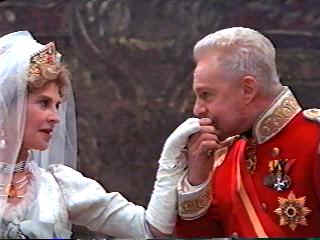
Claudius and Gertrude
Kenneth Branagh’s 1996 film

Act I, Scene ii: Only months after King Hamlet’s death, his brother Claudius has married the Queen, and wrested the throne Denmark. Claudius scolds Hamlet mourning the  dead King and then leaves to continue reveling in his new-found power. Left behind, Hamlet bemoans the disgraceful marriage…How could his mother have married so quickly? And to such a man?! Horatio then rushes in to tell Hamlet about the king’s ghost. Hamlet decides that he MUST see this for himself.


Ophelia, Laertes, and Polonius
The Royal Shakespeare Production 2009
Directed by Gregory Doran

Act I, Scene iii: Ophelia believes that Hamlet loves her, but her brother Laertes and her father Polonius both caution her against the young prince. Laertes believes that Hamlet, as heir to the throne, will not choose Ophelia for future Queen. Polonius agrees. “Hamlet is young!” he says. “Don’t set your heart on him.” Despite her assertions that Hamlet is courting her in a gentlemanly manner, Ophelia agrees to be cautious. After a long-winded speech from Polonius, Laertes departs for France.

Plate XLIV from Volume II
of 
Boydell’s Shakespeare Prints
Image taken from Emory’s Shakespeare Illustrated

Act I, Scene iv and v: It’s night, and Hamlet, Horatio, and Marcellus are looking for the ghost. When the apparition appears, it beckons Hamlet to follow. Hamlet desperately tries to follow, while his friends hold him back. Finally, he orders them to let him be.

Once alone, the ghost demands that Hamlet avenge his death. But it admonishes: “Taint not thy mind nor let thy soul contrive against thy mother aught.” Hamlet swears to avenge his father’s death, and then forces Horatio and Marcellus swear an oath of silence.

The Nose, by Nikolai Gogol

Major Kovalev, a Caucus-made collegiate assessor (in other words, a minor official who has been elevated by his connections rather than his intelligence), awakens on March 25th to discover that his nose is missing. To his dismay, he later sees his nose masquarading around town in the guise of a state councilor (equivalent rank of general). Kovalev absurdly tries to put his nose in its place.

Nikolai Gogol’s “The Nose” is a satirical short story written around 1835. It is one of Gogol’s well-known Petersburg tales. Gogol is the father of Russian modernism and strongly influenced writers like Dostoevsky. Most literary critics consider Gogol to be a social satirist and protector of the little man; though Richard Pevear, in his introduction to The Collected Tales of Nikolai Gogol claimed: “Whatever semblance of social criticism or satire there may be in the Petersburg Tales is secondary and incidental.” (1) He feels that  Gogol included elements of social satire in his stories, but the satire so quickly dissolves into the absurd that this fantastic element should be considered the primary point of Gogol’s stories. While reading “The Nose” I was struck by the social satire, but I DO agree that, as quickly as it came, the satire faded and absurdity reigned.

My thoughts/summary (may contain middle-of-story spoilers)

Major Kovalev was a stupid, self-important, vain, name-dropping minor official, but as he desperately tried to regain his lost nose I couldn’t help feeling sorry for him. Imagine the horror he felt when he awoke to find his nose missing. What would all his important friends think? Would he ever be able to flirt again? This blow was clearly below the belt. He rushed out into the world, impotently searching for his nose when lo! He saw the nose! It was so finely dressed that even Kovalev had trouble recognizing it. At first, he felt chagrin – he wasn’t even sure how to address the clearly-high-ranking nose. But it was his nose, after all, and he mustered up the courage to politely suggest that the nose re-join his face. But the nose politely refused to understand Kovalev. Finally, he blurted out: “It seems you ought to know where you belong, and where do I find you?” The nose blithely answered: “Judging by your dress, there can’t possibly have been close relations between us.” (2)

I had to laugh at that quote. The nose, which had formerly been very intimate with Kovalev, but which is now an elevated rank, pretended that it couldn’t possibly have ever known him. 🙂 Remind you of anyone?

Kovalev then tried to put out a notification in the newspaper saying that his nose was masquerading as a high official, don’t let it fool you…and don’t let it leave town! But the newspaper office was much more interested in lost dogs and bicycles for sale than the heinous nose-theft. They didn’t want the responsibility of such an advert, and so they simply denied that they could do anything about it and suggested another office Kovalev should try. (That reminds me of a time when I called up the customer service of [un-named corporation] and spent a couple hours transferring back and forth from office to office – often the the same office multiple times – to fix a problem that (as it turns out) was an easy fix on the internet.)

The police commissioner was also dramatically unhelpful. The indolent police commissioner had been about to take a nice long post-lunch nap when Kovalev came with his complaint. He should not be expected to start an investigation on a full stomach, the commissioner claimed. “Moreover, they don’t tear noses off decent citizens’ faces.” (2) The police commissioner excused his laziness by blaming the victim for the crime, which, as far as I’m concerned, is crime in itself. A crime that still happens to this day. Whenever we hear “she was asking to be raped – the way she was dressed,” the speaker is excusing his inability to do anything useful about a problem by blaming the victim. 

I adored this story. I got a good laugh while nodding in emphatic agreement with Gogol’s still-relevant criticisms of society. But there are so many other ways of interpreting this work. In his introduction to The Collected Tales of Nikolai Gogol, Richard Pevear says “Gogol was made uneasy by his works. They detached themselves from him and lived on their own, producing effects he had not forseen and that sometimes dismayed him.” Although this statement was not in reference specifically to “The Nose,” it is clear that Pevear (perhaps unconsciously) views the story as an allegory for Gogol’s dismay at the unintentional social impact of his stories. 


(1) Gogol, Nikolai. The Collected Tales of Nikolai Gogol, translated by Richard Pevear and Larissa Volokhonsky. Knopf  Doubleday Publishing Group. 2001. ISBN-13: 9780307803368.
(2) Dialog is taken (sometimes paraphrased) from Gogol, Nikolai. The Diary of a Madman and Other Stories, translated by Andrew MacAndrew. Penguin Group. 1960. ISBN 0451524039.

Hamlet: Act I, Scene i

BBC’s Dramatic Works of Shakespeare Collection
Image taken from Hyperion to a Satyr

Act I Scene i: 


Setting: Sentinels stand on the battlements of the castle

Characters

  • Barnardo, Marcellus, and Francisco of the King’s guard. 
  • Horatio, an educated gentleman, skeptical of ghosts, friend of Hamlet

Summary:

Twice recently, Barnardo and Marcellus have had their watch interrupted on the stroke of 1AM by an apparition in the form of the recently deceased King Hamlet. Fearing to speak to the ghost themselves, they had invited the skeptical scholar Horatio. Upon the tolling of the hour, the ghost appears, and Horatio calls out, charging it to speak. But the ghost stalks silently away. Our skeptical scholar (and therefore our audience) is now convinced that the ghost is not a fantasy. Aggrieved, Horatio suggests that the ghost is an ill omen. 

The three men then begin gossiping about an upcoming war, for which the ghost might be a portent. Thus, the audience is educated: Many years before, the late King Hamlet had slain in battle Fortinbras, the King of Norway. King Hamlet had confiscated some treasures and lands in that battle, which were given to young Hamlet upon his father’s death. The son of the late King Fortinbras, also named Fortinbras, has decided (after brooding for 30 years) to avenge his father’s death and seize the lands back from young Hamlet. He’s been gathering a band of misfits to wage war on Denmark. (This band of misfits apparently morphs into a well-organized army by the end of the play…nice to have footnotes to point out all the inconsistencies!) 

Gossip-fest complete, the ghost reappears and Horatio calls out, commanding it to speak. The ghost is about to answer when the cock crows. The ghost starts, and fades away as on a dreadful summons. Horatio decides that perhaps the ghost didn’t speak because it wants young Hamlet. The men resolve to tell Hamlet about the ghost.

My thoughts: Suspenseful first scene. I think it’s fascinating the way Shakespeare has managed to introduce several very important points into the scene, without distracting from the ghost. We now know that Horatio is a skeptical scholar, that the ghost is likely the spirit of the dead king, and that Denmark is about to be attacked by the vengeful young King of Norway. All that information flowed so smoothly into the dialog that the audience wouldn’t even realize they were being educated. I also like the suspense. What does the ghost want to say? We’ll have to wait and see.

See all my posts about Hamlet on my Hamlet Master Post.

Shakespeare’s Hamlet – Notes on Introduction by Harold Jenkins


I’m reading the Arden Shakespeare version of Hamlet, edited by Harold Jenkins. Harold Jenkins’ Introduction had a LOT of information, and I highly recommend it to someone who’s serious about reading this play. Jenkins started by discussing the date of original release. Apparently there is some controversy among scholars about when the play first came out. There’s about 2-3 years wiggle room of uncertainty. Apparently, this is an important question since there is a play that was released around the same time called Antonio’s Revenge. Either Hamlet or Antonio’s Revenge was plagiarized. We’re talking the plot, the circumstances, and some of the dialog–all copied. Jenkins comes to the conclusion from his three-paged discussion about dates that Hamlet was released first. Originally, it was generally accepted that Antonio’s Revenge was released first and that it was used as “source material” for Hamlet. I wasn’t entirely convinced by Jenkins’ argument, and am not certain whether most scholars today agree with him or accept the original conclusions that Hamlet was the later play (though I suspect the former). After so much time has passed, and considering that plagiarism wasn’t as big a deal in the 16th century as it is now, I hesitate to give Shakespeare all the credit simply because he’s Shakespeare. However, Jenkins did provide one argument that I found convincing. Shakespeare was basing his play on a well-known Danish tale. He shouldn’t have had any use for an unrelated secondary source like Antonio’s Revenge. On the other hand, Marston would have been searching for ideas for a sequel to his earlier play, Antonio and Mellida, and would have had more need for source material.

Jenkins then spends a good deal of space discussing the publication of Hamlet and the differences between existing manuscripts. I skipped that section, but it certainly contained a good deal of information that a serious scholar would find interesting.

The sources of Shakespeare’s Hamlet are then discussed. Apparently, it is generally accepted that the major source of Shakespeare’s Hamlet was a contemporary play dubbed by today’s scholars as Ur-Hamlet. This play was never printed, so we can’t compare it to Shakespeare’s work, but Shakespeare would certainly have been familiar with the play since it was put out by his own company. The story that we now call Hamlet was first published in Saxo’s Historiae Danicae, written at the end of the twelfth century and published in 1514. The story was then retold by the Frenchman Belleforest–translations (or the original French version) were probably what the author of Ur-Hamlet used when writing his play. It is clear that Belleforest was the source material, rather than Saxo’s original work, because that Belleforest introduced some dramatic elements to the story which were present in Hamlet. For instance, the adultery of Amleth’s mother was Belleforest’s idea. Although it is clear that Belleforest is the source of Hamlet, it is unclear whether Shakespeare read Belleforest himself, or simply inherited the allusions from Ur-Hamlet


There were, of course, elements in Hamlet that were not evident in Belleforest’s work. For instance, the complexity of Hamlet’s character was Shakespeare’s doing. Also, the ghost of Hamlet’s father is only hinted at in Belleforest. During the revenge scene in his tale, Belleforest made passing reference to the shade of Amleth’s father–that it may now rest in peace. The leap between a metaphorical shade and a full-fledged haunting was made somewhere between Belleforest and Shakespeare. Jenkins’ introduction contains a lot more information about the little differences between Belleforest and Shakespeare with some speculation about Ur-Hamlet, but I’ll leave all of that unsummarized so you have a reason to read the Introduction yourself. 😉


Finally, the Introduction ends with a critical analysis of Hamlet. It has been so long since I’ve read Hamlet, that I feel I need to go back and read this critical analysis after re-reading the play. I’ll post more detailed comments on it later. The only thing that really jumped out at me during this first perusal of Jenkins’ critique is that he believes that Ophelia died a virgin. I’d always heard that Ophelia and Hamlet had had relations at some point before the action commenced. The difference between these two interpretations changes Ophelia’s character immensely. I’ll read very carefully this time and come to my own conclusions.

Another thing that struck me while I was reading the introduction (though it wasn’t directly discussed by Jenkins) is that when I first read Hamlet as a teen, I never questioned the reason why people considered the relationship between Gertrude and Claudius to be incestuous. But now I wonder. Why is it incestuous to marry your brother’s widow?


This subject also came up in Wolf Hall, by Hilary Mantel. There was much discussion about Henry VIII’s relationship with Catherine being incestuous because Catherine MIGHT have consummated her marriage to Henry’s brother Prince Arthur. I don’t recall which Bible passages were quoted in those discussions, but I remember thinking it odd that such a marriage would be considered incestuous. 

I wondered at what point did it become incestuous in Christian culture for a man to marry his brother’s widow? If I recall correctly the Hebrew Bible says that thou shalt not have relations with the wife of your father, but thou must marry the widow of thy brother. Well. Maybe it was phrased differently…but I’m pretty sure that was the general idea. I don’t recall anything in the New Testament saying that a man shouldn’t marry his brother’s widow, so where did this idea of incestuousness come from? 

I asked this question on my LibraryThing thread, and my father came up with this answer: 

Complex subject. First off, reference Leviticus 25:5

“If brethren dwell together, and one of them die, and have no child, the wife of the dead shall not marry without unto a stranger: her husband’s brother shall go in unto her, and take her to him to wife, and perform the duty of an husband’s brother unto her.


The duty of a surviving brother to carry on his brother’s family was very important–but the issue would be his late brother’s child and not his own. Thus the story of Onan in Genesis 36. Onan went to Tamar, the late Er’s wife. But he withdrew early and “cast his seed upon the ground.” For that, Yahweh decreed capital punishment, so Onan died as well. But the brother did not strictly marry his sister-in-law. He just got her pregnant, and it was known as a Levirate marriage. Many readers considered Onan’s crime as masturbation (aka Onanism) and considered masturbation a serious sin for centuries.


As to marriage to a mother-in-law, sister-in-law, etc., these people were considered part of a household, especially if they lived in the same manor. Marriages to such always had overtones of incest, but such overtones were easily overridden among the aristocracy. But then as now, there were strict conservatives, many who held places in the hierarchy who pronounced dire consequences for everyone who did not follow the conservatives’ conscience. Especially if the conservative was opposed to the marriage for politiical or economic (his own economy) reasons. Monks and priests who vowed celibacy (whether they kept their vows or now) tended to look down their Pecksniffian noses at people who did not remain celibate. 

I also wonder (maybe there are some Shakespeare scholars reading this?)…if Shakespeare had strong feelings about the incestuous nature of marrying your brother’s widow, does that imply that he questioned the legitimacy of his king, James I, who was grandson to Henry VIII’s “incestuous” marriage to Catherine?

Things that make you go “hmmmm.”

Edited to add that Alex (in comments below) has pointed out that James I was not the grandson of Henry VIII. That just shows you what I know.
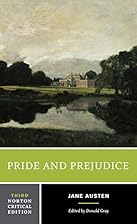
Pride and Prejudice, by Jane Austen (NCE; WLC)

2012 Book 148: Pride and Prejudice (A Norton Critical Edition)
written by Jane Austen, edited by Donald J. Gray
My Review

The Bennet household is in a bit of a financial bind. They have five unmarried daughters with almost no dowry, and the estate is to be inherited by a mysterious cousin that no one’s met yet. But things get exciting when a rich bachelor moves to town and brings is even richer bachelor friend. Every young lady in the area is ready to throw themselves at these men. Except, of course, for Elizabeth Bennet. She instantly decides that the rich bachelor is perfect for her sister, Jane, and his richer friend is the most detestable man on the planet. Thus starts one of the best-loved romances in Western literature. And, like most everyone else, I loved this story. Even on the nth reading of it. 🙂

This book is also a social satire, which is a fact unfortunately ignored by many readers. I think many of the people who hate the book (mostly men) see it simply as a romance and don’t look any further. This failing to see the humor was one of the reasons I so loathed Seth Graham-Smith’s Pride and Prejudice and Zombies. I had high hopes that he had managed to weave Austen’s sense of humor (i.e. a wry, witty social satire) with zombie-whacking humor. I would have eaten such a book alive. 😀 But, alas, Graham-Smith clearly didn’t understand the humor in P&P…I wasted a couple hours of my life on that book that I will NEVER get back again.

Since there’s not much else I can say in a mini-review of the story that hasn’t been said over and over, I’ll discuss the supplementary material in the Norton Critical Edition. There wasn’t a LOT of supplementary information in the book, but it was generally of good quality. It started with a biography of Austen, punctuated with letters written by the author. This part would be helpful to someone who isn’t familiar with Austen’s life, but wouldn’t be particularly new to anyone who’s read a biography of her. Additionally, there were several critical analyses of Pride and Prejudice, both contemporary and modern. I enjoyed most of these–though I admit I got bored with the Freudian one and moved on to the next. The piece I found most surprising was the interview with Colin Firth. I really didn’t think that this interview belonged in a critical edition of P&P and wasn’t expecting much from it. But I was very wrong. Colin Firth had a strong understanding of Darcy’s character (of course! how could I doubt? It IS his job!). It was fascinating to read his thoughts about how he incorporated his understanding of Darcy’s motivations in the most powerful scenes (such as the first ball, the drawing room discussion when Lizzy was at Netherfield, the dance at Netherfield, and the proposal). It gave me a completely new impression of Darcy’s character and made me want to watch the whole miniseries again.

I found the excerpt by Marilyn Butler Jane Austen and the War of Ideas: Pride and Prejudice, quite helpful…I feel encouraged to read Butler’s entire book (after I finish re-reading the rest of Austen’s novels). In this excerpt, Butler shows how Darcy and Elizabeth have elements of both pride and prejudice in their personalities. I had always thought about Darcy being proud and Elizabeth being prejudiced…but now I see that it is not that simple. Darcy was proud of his lineage and wealth, and he was prejudiced against people who had less wealth and less sophistication than himself. Elizabeth was prejudiced against Darcy because of his initial bad impression, but she was too proud to allow for the possibility that she might be mistaken in her first impressions.

SPOILERS START HERE
She stubbornly liked Wickham, despite the fact that he said he wouldn’t speak ill of Darcy, and yet gossiped about Darcy till the cows came home…despite the fact that he said he had no reason to avoid Darcy, and yet ran off when the ball came ’round…despite the fact that he was clearly a fortune hunter. Furthermore, Elizabeth stubbornly detested Darcy, even though she was warned by Jane and Miss Bingley that there might be more to the story than Wickham acknowledged….despite the fact that Darcy made clear efforts to be more polite to her as he got to know her better….despite the fact that he politely asked her not to “sketch his character” at the present moment because it would do neither of them any justice.

I had never before thought of the flaws of Elizabeth’s character. But, indeed, she had to have flaws so that she could develop throughout the book. One of her most amusing flaws was that she was judgmental and critical of everyone–and THAT is exactly the complaint she had of Mr. Darcy’s character! It is quite common, I suppose, to detest your own flaws when you see them in other people. 🙂

I think this is an interesting time to insert the Jane Austen Character Quiz. I was a little annoyed at question 7 which asks which actress would play me in a movie, because if I said I’d be played by Gwenneth Paltrow, isn’t that just ASKING to be Emma? So I decided to take the quiz several times, and see what answer I got for EACH of the actresses. It turns out that I would be Elizabeth Bennet for five of the seven actress choices, and I would be Elinor Dashwood if played by Emma Thompson, and Anne Elliot if played by Amanda Root. I took that to mean that I COULD be Elinor if I really wanted to be, but really I was Elizabeth.
I was a little put out at first. I really wanted to be Elinor. But, then again, I am really NONE of the Austen characters, am I? I did some thinking about this issue, though. And I considered: Elizabeth Bennet’s most outstanding characteristics are that she’s witty/sarcastic and fun-loving. I don’t know if I’m particularly witty, but I am a bit sarcastic, and I think I’m fun-loving as well. Her characteristic that drives the plot of Pride and Prejudice, however, is that she tends to be critical of her fellow humans, makes strong and lasting immediate impressions, and stubbornly sticks to these first impressions despite contradictory evidence. I don’t really want to be those things. But you know what? I don’t think those are good characteristics, but, as I said above, we tend to detest our own flaws when we see them in other people. 😉 I have been writing a lot of letters to my cousin Steve lately, and it made me realize that I spend an awful lot of time criticizing other people. Not that I feel I’m BETTER than those other people…but, still, I was surprised that I must seem (to Steve) to be rather judgmental. This was a side of my personality that I hadn’t seen before, because I’d never had the chance to talk so freely as I do in those prolific letters. So…perhaps the quiz knows what it’s talking about after all?

The Great Courses: Western Literary Canon

Lecture 24: Pride and Prejudice, Women in the Canon
SPOILERS CONTINUED
I’ll just finish up with some comments on Lecture 24 in the Western Literary Canon course. Professor Bowers begins by pointing out that, unlike many other canonical works, Jane Austen’s books are generally read for pure pleasure. I found similar opinions in the Norton Critical Edition. Apparently, one really shouldn’t look for a “deeper meaning” in Austen’s books–they’re simply not that deep. They’re meant to entertain, not to educate. I suppose I can understand this point of view, as Pride and Prejudice is certainly less deep than Candide, by Voltaire (for example). They are both social satires, but Austen is much lighter. 🙂 Professor Bowers claims that the charm of Austen’s books is that she portrayed humanity accurately and honestly. I think this is true in that her books portray human folly. However, I feel many of her characters satirize human folly to (humorous) extremes.
Jane Austen was one of the first women authors who was accepted into the “Western literary canon.” Mostly, the great critics-on-high chose books by deeply educated male authors. However, once Austen was accepted, critics opened to the idea of women canonical authors ,and efforts were made to retreat into history and rescue women authors who deserve canonical status like Sappho, Marie deFrance, and Christine de Pizan. Professor Bowers didn’t point this out, but another impact that I think Austen had is that she is the mother of “regency romance.” Most regency romances today are thematically copied from Austen’s style. Regency romances, ranging from Christian to erotica, abound in today’s market.
Bowers makes the interesting point that Mrs. Bennet is the protagonist of Pride and Prejudice by Aristotelian view–she is the one who schemes to get her daughters married, and she is the one whose dreams come true. Margaret Drabble, in her introduction to Pride and Prejudice [1], even suggests that Mrs. Bennet may be simply misunderstood by modern readers. Due to the circumstances and time, her life revolves around finding suitable husbands for her daughters to ensure that they don’t end up poverty-stricken old maids. She is, perhaps, a bit over-zealous and foolish in her attempts at matchmaking…but her intentions are very maternal. This is an interpretation of Mrs. Bennet that I have never considered, and I found it refreshing.

On this reading, I wasn’t any less impressed by the silliness of Mrs. Bennet than I had previously been; but I was surprised at a new opinion of Mr. Bennet. I had always considered him to be a sensible man with a delightfully sarcastic edge. But he wasn’t at all sensible. He SHOULD have laid aside money over the years instead of assuming he’d eventually have a son. When he realized he wasn’t going to have a son, he should have made more efforts to keep Mrs. Bennet from overspending. Instead of laughing at the folly of his daughters and wife, he should have spoken some sense into them–at the very least into his daughters. By laughing at their folly, he allowed them to expose themselves both to ridicule and to the preying eyes of ungentlemanly men. He shouldn’t have encouraged his daughters to laugh at his wife. He is just as much at fault for the ridiculousness of the family as his wife is.

[1] Austen, Jane. Pride and Prejudice. New York: Penguin Group 2008. ISBN: 1-101-08421-98

Texts that I have read for this lesson:
Jane Austen: Pride and Prejudice (Norton Critical Edition) (required reading)

Surprised by Joy, by C. S. Lewis

2012 Book 144: Surprised by Joy

Written by C. S. Lewis, Narrated by Geoffrey Howard

Reason for Reading: I’m slowly working through the books of C. S. Lewis out of curiosity for his theology. 


Reveiw

In this short memoir, C. S. Lewis describes his spiritual journey from youthful atheist to firm and faithful believer. This isn’t really a memoir of Lewis’ life, although it does contain some interesting anecdotes about his school years. Mostly, he only focuses on incidents in his life that impacted his spiritual development. I have read many spiritual development memoirs, and this one is like the others…only it stands out because it is a classic. It was written when these types of journeys were not as commonly shared in memoirs. (In fact, I suspect that this book was one of the ones that inspired so many of the spiritual-journey memoirs that we see today.) One thing I found interesting about this book is it explained to me why so many people retro-diagnose Lewis with Asperger’s syndrome. He talked about his difficulties dealing with other students…not knowing how to respond in social situations and being told to “take that look off [his] face” when he was trying very hard to keep an appropriate facial expression. I think it is important to recognize that we can’t accurately retro-diagnose people with today’s syndromes, but it IS interesting to see how such personality traits were present in Lewis’ day, and how he excused them with stories about how childhood events affected his social interactions. It was definitely an interesting read…and anyone who likes to hear about others’ spiritual journeys really should start with C. S. Lewis.