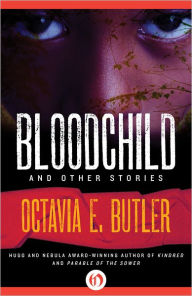
Bloodchild and Other Stories, by Octavia E. Butler

Bloodchild and Other Stories, by Octavia E. Butler

This is a book of horror / dark fantasy stories by the amazing author Ocativa E. Butler. Believe it or not, this is the first book by Butler that I have ever read, and I was amazed at her brilliance. 

Her stories were incredibly creative. They covered important issues like race, slavery, sexuality, and identity, all in the guise of alien occupation or dystopic disease and other dark fantasy themes. Her prose was smooth and eloquent.

The most interesting of the stories was her novella Bloodchild, which is about a child that is about to be “sexually” adopted by some alien worm-thing. The story encompassed the feelings of the boy, his mother, and the alien – providing some very startling insight. 


After each story, Butler included a short essay of what she intended the story to mean or background in her life when the story was written. These brought further understanding to the story, though I was a little skeptical when she insisted that she hadn’t intended Bloodchild to be about slavery. But, I guess, sometimes meanings creep in there unintended. And there’s also something to say for the readers’ interpretation regardless of intended meaning. To me, slavery was one of the many underlying themes of the story. 

At the end of the book, Butler included a couple of essays about what it was like being an African American science fiction author, and encouraged young people to follow their dreams and become authors. Finally, there were a couple of never-before-published stories. 

This little book is well worth your time if you are interested in deeper cultural issues of race, slavery, and sexuality – possibly even if you are not specifically interested in science fiction and fantasy.

For pure brilliance


This post is for R. I. P. X @TheEstellaSociety and the 2015 Halloween Reading Challenge @ReadingEverySeason. It is also for #Diversiverse, @BookLust, which is all about reading books by people of a variety of ethnic/racial backgrounds, so I will provide tell you a little about the author, Octavia E. Butler.

Octavia E. Butler was born in 1947 into an impoverished African American community to a 14-year-old girl. Despite struggling with dyslexia, she had a passion for reading and writing ever since she was very young. As a teenager, she started attempting to publish her stories, despite the extreme difficulty for African Americans publishing science fiction / fantasy. At the time she was one of only a couple African American sci-fi writers. Despite being taken advantage of by money-hungry agents, she finally published Patternmaster in 1976. This book was praised for its powerful prose, and she ended up writing four prequels. She finally became mainstream upon publication of Kindred in 1979. Butler died outside of her home in 2006.

Girl of Nightmares, by Kendare Blake

Girl of Nightmares, by Kendare Blake

After listening to the audio version of Anna Dressed in Blood, by Kendare Blake (and disliking the narrator), I decided to pick up an old-fashioned copy its sequel Girl of Nightmares

Cass Lowood has now become used to life in Thunder Bay. He’s finished a school year in the same school for the first time in years. He has friends: the beautiful and popular Carmel Jones and nerdy voodoo teenage witch Thomas Sabin. The three have tried to move on from the devastating events in Anna Dressed in Blood. They’ve been going to school by day and killing ghosts by night. But when Anna starts haunting Cass, he becomes obsessed with saving her from whatever hell she is suffering. His quest to save her drives a wedge between him and his friends, and leads him across the ocean to follow ominous clues sent by anonymous people.


I enjoyed Girl of Nightmares even more than Anna Dressed in Blood. I began the book with an attachment to all the characters, and was genuinely concerned about Anna’s fate. Cass, Carmel, and Thomas begin to develop more rounded personalities in this book – showing sides of themselves that weren’t obvious in the first book. Girl of Nightmares had a good mixture of action and intrigue, which kept me turning the pages. I’m hoping there will be another book coming up soon. 

4 stars for fluffy YA fun

The Hobbit, by J. R. R. Tolkien

The Hobbit, by J. R. R. Tolkien, narrated by Inglis
Caution: There will be spoilers!

A couple of months ago I had the immense pleasure of listening to the Rob Inglis narrations of The Hobbit and Lord of the Rings. If you ever have the slightest wish to listen to these books, just do it. Inglis’ voices are fantastic; he even sings the songs! It was a true delight. 

A humble hobbit named Bilbo Baggins is unwillingly thrown into a “nasty adventure” when the wizard Gandalf thrusts himself into Bilbo’s home, a troop of dwarves in his wake. Gandalf has misinformed the dwarves that Bilbo is a burglar – the dwarves want Bilbo to burgle a gigantic horde of treasure from the dragon Smaug, who had stolen the treasure (with their mountain kingdom) from the dwarves’ ancestors decades before. This is a strange coming-of-age story, since the character is 50 years old already (which is youngish for a hobbit, but still firmly in the adult range). But as the story progresses, Bilbo recognizes that he is a brave hobbit, an adventuresome hobbit, and a very sneaky burglar. 


The Hobbit was Tolkien’s first major work about Middle Earth, and although it is an excellent book on its own, it is unfortunately overshadowed by his later work The Lord of the Rings. Although LOTR is a sequel to The Hobbit, these two books are very different styles. The Hobbit was intended for children, and therefore has a light-hearted, almost silly air to it. The songs tend to be funny and childish rather than somber and chilling, as in LOTR. An example is when the dwarves are teasing Bilbo with the song: 

Chip the glasses and crack the plates!
Blunt the knives and bend the forks!
That’s what Bilbo Baggins hates—
Smash the bottles and burn the corks!

Cut the cloth and tread on the fat! 
Pour the milk on the pantry floor!
Leave the bones on the bedroom mat!
Splash the wine on every door!

Dump the crocks in a boiling bowl;
Pound them up with a thumping pole;
And when you’ve finished if any are whole,
Send them down the hall to roll!

That’s what Bilbo Baggins hates!
So, carefully! carefully with the plates!


Another factor of the young audience is that the characters in the book are much more silly than they are in the live-action movies. (I will discuss the movies in a later post.) A striking example is of Thorin’s character, who in the book is silly and long-winded, but who in the movie is dark and romantic (not to mention quite handsome). 

The spider scene in the movie is dark and scary. Bilbo is heroic and rescues his friends through cleverness and brave swordsmanship. In the book, he swings through the trees singing a silly song that diverts the spiders’ attention. 

Old fat spider spinning in a tree!
Old fat spider can’t see me!
Attercop! Attercop!
Won’t you stop,
Stop your spinning and look at me!
Old Tomnoddy, all big body,
Old Tomnoddy can’t spy me!
Attercop! Attercop!
Down you drop!

You’ll never catch me up your tree!

After dragging the spiders off on a wild goose chase, Bilbo is able to return to his friends and cut them down from the webs. 


The themes in The Hobbit also tend to be a bit black and white – probably for the sake of the young audience. There is a clear good and evil. The good characters always end up choosing mercy and righteousness over power and wealth. (Though, there is a bit of wealth to go around!) As in any good book, there are momentary shades of grey. Thorin, who is otherwise quite honorable, is temporarily blinded by greed – though he eventually redeems himself. 


An interesting fact that I found out while researching this review is that J. R. R. Tolkien changed The Hobbit after writing LOTR in order to better fit with the dark purpose of the One Ring. Originally, Gollum willingly bet the ring in the riddle contest. Gollum was dismayed when he found out that he could not keep his promise of the ring, and he instead bargained to lead Bilbo out of the cave. They parted on good terms. 

In LOTR, the ring changed from a helpful charm to a powerful device that would suck the soul out of the wearer. Because of this change in the ring’s nature, The Hobbit‘s Gollum had to turn murderous when he discovered the ring was missing. 

Overall, this story was quite enjoyable, and I’m glad that I decided to “re-read” it as an adult. I got a lot more out of it this time around than I did when a child. 

4.5 snowflakes for originality, adventure, humor, morals, and fun

Reason for reading: Interest, TBR Pile, Classics Club List
Format: Audiobook

The Coldest Girl in Coldtown, by Holly Black


2015 Media #6 / Book #3: The Coldest Girl in Coldtown, by Holly Black 

Reason for reading: This was the January pick for my bookclub.

Summary: In this near-future book, vampires have emerged into the public eye due to an outbreak started by a sloppy newly-made vampire who left his victims living instead of completely draining them. Vampires, and the Cold (people infected with the vampirism disease, but who haven’t yet tasted the blood of humans and so haven’t turned) are forced to live in ghettos called Coldtowns. In this setting, the story starts out with Tana waking up to a vampire-related disaster, which begins both a physical journey away from the disaster and a spiritual journey of self-discovery.

What I thought: This book was fast-paced and difficult to put down. It asked some interesting philosophical questions. Do we all have monsters within us? Do we crave immortality and beauty at the price of humanity? If not, why are so many people attracted to paranormal romances? Is it because we want the ultimate bad-boy? Or, in the opposite line of questioning, why do so many people seek good in what seems evil?T

Storm Thief, by Chris Wooding

The Storm Thief, by Chris Wooding

Genre: Young Adult Dystopia, Science Fiction, Ages 11-14

Reason for Reading: This was my bookclub book for this month. 

Summary: The island city of Orokos has been trapped in isolation for so long that the idea of a “world outside Orokos” had become a dream for only the naive and the fanatics. There is nothing outside of Orokos, and Orokos is nothing but city, ghetto, and the ruling Protectorate. Chaos storms wreak havoc upon Orokos and its inhabitants – picking people up and dropping them elsewhere; crippling some people while giving life to others. Even eyeshadow isn’t too small to be overlooked by the probability storms.

When Rail and Moa make a snap decision to hide an expensive artifact from their Thief Mistress, they must flee with an assassin hot on their trail. While running, they come across a golem, Vago, who’d been misplaced by a probability storm before he had any idea of who he was, where he was from, or why he was made. Where can these refugees go when the Protectorate rules with an iron fist – keeping ghetto-folk away from the city? Their path is simply a series of coincidences strung together…leading, where?

My Thoughts: I really enjoyed this book. The characters were simple enough to flow well in a book for young teens, but each character had an interesting mixture of strengths and weaknesses. My favorite character was Vago, the Golem, whose process of self-discovery throughout the story made him intriguing. 

I loved the philosophical underpinnings of this story. It reminded us that the random power of entropy will always win. It always destroys what we have worked to build. Entropy is a non-stoppable machine. So why do we continue fighting it? Why do we continue dreaming of that “other world” when we have so much evidence that it doesn’t exist? Why do we clutch hopefully to mere coincidences and use them to fuel our dreams? 

Slight spoilerish material
This is a book about hope as well as one about chaos. One character, who was “fanatically” willing to risk the lives of her people in pursuit of a seemingly impossible dream said: “We can stay here with our dreams just out of reach, or we can risk everything to reach them.” Even after having finished the book, I’m still not certain which was the right thing to do – was it better for her people to risk everything in pursuit of their dreams? Or was it foolish? Is it better to keep yourself safe by being cynically aware of the brutality of the world, or is it better to hope, dream, or love?

To me, the lasting message of the book is: your life might be nothing more than a series of coincidences that are out of your control, but how you respond to the world defines who you are – and YOU decide how you respond. I’m not sure whether I agree with this philosophy or not. Lately, I’ve had a bit of a faith crisis – which makes the life-is-a-random-string-of-coincidences theory sound rather rational. But I know what everyone expects me to say is that God is in control, it’s not a string of coincidences. 😉 


Blood Ties, by Garth Nix and Sean Williams

Blood Ties, by Garth Nix and Sean Williams

Genre: Middle Grade Fantasy / Adventure Series

Reason for Reading: I’m already reading this series, of course, but I was happy that Scholastic provided an ARC through Netgalley in exchange for an honest review. 

Synopsis (May contain some light spoilers for earlier books in the series): Meilen has run away from the Greencloaks to search for her father in her homeland of Zhong. Conor, Abeke, and Rollan quickly follow – they hope to recover their friend and get the Slate Elephant talisman from Dinesh, the Great Elephant. But Zhong has been conquered, so the kids must fight through armies of enemies to find what they seek. The Devourer is gaining power, and he will stop at nothing to take over all of Erdas with his nature-defiling bile. 

My thoughts: Another great installment of the series. And they just keep getting better and better! (Not, of course, because the authors are changing, but because the plot and characters are developing as the series progresses.) Like in the earlier books, Blood Ties shows the power friendship – of working with your team rather than trying to fight evil alone. It encourages trust – of your partners, your friends, and the power of Good to conquer Evil. Most of all, the story is fun. It’s a delight to watch as the kids’ distinct characters develop, and how each character adds to the dynamics of the team. The world-building is also a lot of fun – it has both a familiar and a novel taste. For instance, Zhong is the Erdas-equivalent of Asia. The comparison is undeniable, and yet Zhong’s culture and scenery are also delightfully unique. And, of course, this book is filled with adventures, intrigue, and battles – which any lover of middle grade fantasy / adventure books craves. I’m looking forward to the release of the next book in the series, Fire and Ice, in July.

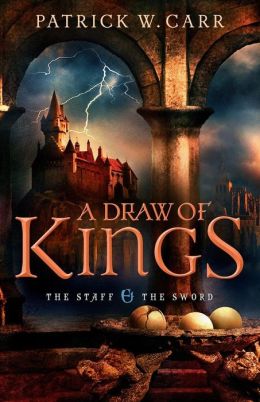
A Draw of Kings, by Patrick W. Carr

A Draw of Kings, by Patrick W. Carr 

Genre: Teen / Christian Fiction / Fantasy

Reason for Reading: This was a galley copy provided by the publisher through Netgalley in exchange for an honest review. This is the third book in a trilogy that I have been enjoying. 

Synopsis (May contain slight spoilers for previous books in the trilogy): In this third, and final, book of the Staff and Sword trilogy, the war for Illustra begins. In order to maintain order within the Judica, Errol must retrieve The Book that was left behind in Merakh. Meanwhile, Adora and Liam must journey to the Shadowlands to make a pact with these newly discovered allies. A feeling of dread descends upon everyone, as the people of Illustra realize they are surrounded by vast armies of enemies and demon spawn. They must discover who their king and savior is – or else the barrier will never be restored and the demons will destroy Illustra.

My Thoughts: This book was every bit as good as the previous two – and it tied off most of the loose ends quite well. For fantasy fans, this book was packed with battles, intrigue, foreign lands, and ranging demon-spawn. I was also quite impressed with Carr’s ability to write religious allegory. He deftly got his message across by showing it within the story instead of writing lectures into the dialog as many authors do. In fact, I bumped this book up an extra half a star (something I rarely do) because I admire how much finesse it takes to write a good allegory without sermonizing. 

One of the allegorical issues presented is the fallibility of humans (as well as the organizations that we create). The church, in Carr’s world, was composed of many good men (as well as a few villains) who often made mistakes and were suffering under misunderstandings of God which had accumulated after the loss of their religious book. This is the message that I originally interpreted as criticisms of the Catholic Church in my review of Hero’s Lot, though after reading this book the criticism feels more forgiving. The message is: no one is perfect, we are all human, and we’re going to make mistakes. We can’t judge everyone in a group based upon the mistakes of some of its leaders. I’m not sure if this is the message that Carr intended, but it is how I felt when I read A Draw of Kings

The other allegorical message that I felt was done tremendously well related to faith and doubt. There was a moment when Adora as climbing a cliff and Liam was behind her, and even though she knew Liam was there to catch her if she fell, she suddenly doubted that he was there at all – that he had ever been there. And then he carried her. I’m sorry if that is a spoiler, but I couldn’t help but point out the beauty of that moment. Because it’s so true, isn’t it? It’s so easy to lose faith – even though this loss of faith is irrational when viewed from the outside-the-moment.

My interpretation of this story has evolved so much while reading this third book, that I feel I ought to go back and revise some of the criticisms I made about the second book. Of course, I always have to include criticisms, but…. Which brings me around to my criticisms of A Draw of Kings. My first complaint is how violent it was. I felt that the good guys (Adora especially) were sometimes more violent than they ought to have been. Of course, this could simply be another way in which we are only human – and therefore fallible. So this is only a small criticism. The other criticism is that I felt threads were dropped in relation to the countries other than Merakh. There needed to be a little more tie-up after that much build-up. But that, too, is only a minor issue since the major threads were tied up wonderfully.

Overall I was greatly pleased with this book, and I will recommend it to all of my friends who read books of this genre. In fact, I’m hoping it wins some awards – it’s well-deserving of the Christy Award for Young Adult literature.

The Drowning Girl, by Caitlin R Kiernan

The Drowning Girl, Written by Caitlin R. Kiernan, Narrated by Suzy Jackson

Genre: Dark Fantasy

Reason for Reading: This was one of the nominations last year for the World Fantasy Awards

Synopsis: In The Drowning Girl a young schizophrenic woman, Imp, tells the story of her meetings with Eva Canning – a ghost? a mermaid? a werewolf? a normal, disturbed young woman? As Imp’s mind roils in schizophrenic fantasy, the readers are left wondering how much of the story is reality and how much is fantasy. 

My thoughts: I’m having a hard time coming up with viable thoughts about this book. I just don’t know what to think! I was interested throughout; I always cared about Imp – and about her girlfriend Abalyn – but I never knew quite what to think. Which, I suppose, is the point of the book? Kiernan did a fantastic job of spiraling Imp’s writing in and out of control, and the pacing of the spirals was quite amazing. This is a skilled bit of writing. Likewise, Jackson was a superb narrator for this role. Her inflections were perfect for hinting at whether Imp was “in control” or “out of control” when certain passages were read. I would recommend this book to people who enjoy open-ended stories, especially those stories with an aura of unreality. 

The Many-Colored Land, by Julian May

The Many-Colored Land, by Julian May

Genre: Science Fiction / Fantasy Mesh (Adult)

Reason for reading: I read this book a long time ago and always intended on picking up the rest of the series. This year, I convinced my real-life book club to read it. So hopefully I’ll get to the rest of the series soon!

Synopsis: In the near future, an alien federation called the Galactic Milieu has intervened on Earth, and welcomed humans into the its fold. For most of humanity, the Milieu is a blessing. Long life, health, an ethical law system, the adventure of space travel – these are the perks that humans enjoy. But some feel confined by the rules of the Milieu and yearn for a simpler life. And some are too sociopathic to be accepted in the Milieu’s society. These people can go into Exile – they are sent back in time to the Earth’s Pliocene epoch. The Many-Colored Land follows the story of one group of exiles as they discover what lies on the other end of the time-portal. Life isn’t as simple as they expect, and they are soon swept up in a world of war and conspiracy. 

My thoughts: I must have read a lot more hard-core science fiction when I was a teenager, because I don’t remember this book being as heavy as it felt this time around. All the descriptions of futuristic technologies / cultures slowed me down because I don’t read enough science fiction to be used to the terminology. It may have been slow reading for me, but I felt refreshed by the newness of the plot. This is a very complex book, with many layers of hidden foundation. Superficially, I think the characters could have used a little more development – but I’m sure they grow throughout the series. This first book in the Pliocene quartet was mainly world-building. We were introduced to the alien cultures – both the good and the bad aspects. We got a hefty background on the Pliocene epoch. And we got some hints of how these events in the Pliocene might have impacted humanity’s development millions of years later. It’s a fascinating set-up, and I’m eager to see how the rest of the series plays out. I’ve heard so many good things about it.

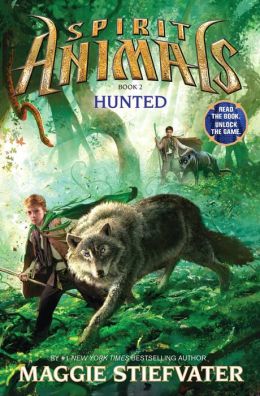
Hunted, by Maggie Stiefvater


Hunted: Spirit Animals Book 2, by Maggie Stiefvater

Genre: Middle School Fantasy / Adventure

Reason for Reading: This is the second book in a so-far excellent series

Synopsis: (May contain slight spoilers for book 1). Conor, Abeke, Meilin, and Rollan hike across Eura on quest to capture the talisman of the Great Boar before the Conquerors get their hands on it. But the Conquerors have a few surprises up their sleeves – they are now able to force an unnatural bond between humans and animals! They now have the advantage of superior numbers of bonded warriors. In order for our heroes to survive, they must learn to trust one another and fight as a team. 

My Thoughts: This was an excellent follow-up to Brandon Mull’s Wild Born (reviewed here). The characters are developing – and so is the philosophy. In this book, our heroes struggle with trust. It’s a story of strengthening ones bond with friends – how such a bond can never fully be broken, even when trust fails. It’s a story about following your heart, even when your heart leads you astray from logic (a fitting theme given my thoughts on doubt last month!) I’m eagerly awaiting the third book in this series, Blood Ties, which comes out in March.

This is my first book by Maggie Stiefvater, and I’m eager to pick up some more now! I like the way this series is designed – with a different author for each book. That way, I am introduced to authors that I might otherwise never gotten around to reading. 🙂