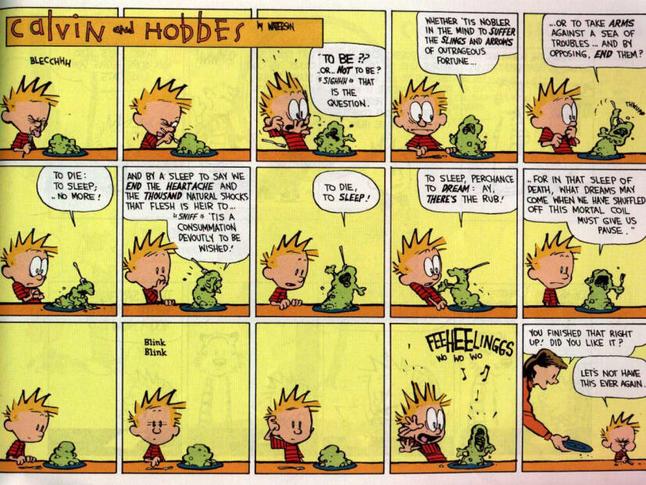
Hamlet, Act III


Act III is the pivotal act in Hamlet. The Prince had been dragging his feet for months trying to force himself to avenge his father’s death. At one time, he’d be certain that the ghost was truly the restless spirit of his father seeking revenge; another time he’d fret that the ghost may be a demon sent to tempt the Prince into a fatal and condemning act. In scene i, he had his famous “get thee to a nunnery” fight with Ophelia. Frustrated with his own impotence, he extended the blame of his mother’s inconstancy to all women. Maddened at the thought of Ophelia’s future marriage to someone else; maddened at what he saw as her certain inconstancy in the future, he demanded that she commit herself to a convent. His interaction with Ophelia was observed by Polonius and Claudius, who decided that he was dangerously addled and must be sent away to England (presumably with hopes that the distraction would clear his mind). 

In scene ii Hamlet made pointed remarks during a play, hoping to draw out Claudius’ guilty response. Hamlet succeeded in drawing out Claudius, who angrily retorted at the content of the play and stomped out of the room. In the immediate rush of  fear at Hamlet’s knowledge, Claudius suddenly felt his own guilt. He regreted killing his brother – not because it was a treacherous act in itself, but because he had been found out and might suffer consequences. He knelt down and prayed that God help him; he asked forgiveness while simultaneously acknowledging that he’s not really sorry that he got the Crown and the Queen, but he was very sorry that Hamlet found out about the murder. The Prince discovered Claudius praying and at first set his mind upon killing the King here (when the royal back is turned). But then Hamlet worried: if he killed Claudius now, while praying, the King’s soul would be clean and he would be dispatched to heaven. Hamlet wanted Claudius to be damned, like the late King Hamlet. The prince decided to wait.

In the final scene, Hamlet was summoned to the Queen’s chambers, where she tried to talk sense into him. There, Hamlet swelled again into his accusatory rage at the inconstancy of women. Polonius, who had hidden himself behind the curtains upon Hamlet’s entry, thought to rescue the Queen from her raving son – but when he called out, the infuriated prince stabbed at the curtains and slayed Polonius. With this act, Hamlet’s path of revenge was cemented. He had killed once, he had no choice but to continue with his revenge quickly or fail entirely. Shakespeare punctuated this pivotal act with the ghost of dead King Hamlet – who only the prince can see. Prince Hamlet’s shock at the escalation of events and the sudden appearance of the ghost muddled his already maddened state, and he ranted wildly while the terrified Queen tried to calm him. The act ends with Hamlet lugging the body of Polonius off stage.

(TO SEE MORE ABOUT HAMLET GO TO MY MASTER POST)
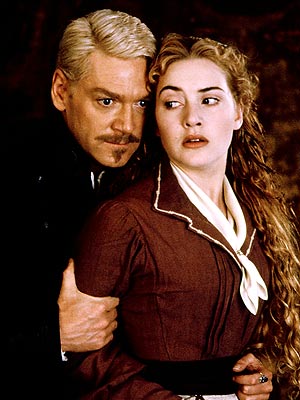
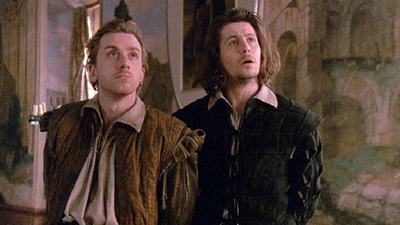
Hamlet and Ophelia
Hamlet (1996)
Directed by Kenneth Branagh

Act III, Scene i: The King and Polonius decided to observe Hamlet as he interacted with Ophelia. They told Ophelia to linger where she was sure to meet Hamlet, and the two men hid. Before noticing Ophelia, Hamlet was deep in his own meditations. To be or not to be? Apparently, Hamlet was considering suicide. Did he know the King was watching? Or was his doubt genuine? There is no indication that he knew the King was near. Personally, I think Hamlet was genuinely considering suicide. He’d experienced some terrible blows in the last few months – his father died unexpectedly, his mother married her brother-in-law, and Hamlet was being haunted by the ghost of his father who was making shocking demands of the Prince. Hamlet was tortured by a feeling of failure that he hadn’t avenged his father, stress at the idea of killing the King, and doubt about the nature and intentions of the ghost. That’s enough to make any sane person consider suicide. The sudden appearance of Ophelia reminded him of yet another failure in his life. 

Like Claudius and Polonius, I observed Hamlet very closely in this scene because I wanted to consider the age-old question: was Hamlet mad or was he faking it? I saw no signs of actual insanity, despite Hamlet’s nonsensical word-play and his irrational anger at Ophelia. He seemed genuinely enraged at Ophelia’s perceived inconstancy, and he blamed her for future inconstancies which she had not yet committed; but sane lovers can also be irrational in this way. 

Another question I pondered during this scene was whether Hamlet meant to imply that Ophelia wasn’t a virgin (since Harold Jenkins, the editor of my edition, claims that there is no evidence that Ophelia and Hamlet had any pre-action action). And, frankly, I have to agree with Jenkins. There is a lot of double-meaning innuendo during this scene (and the next), but that doesn’t prove that they’d been together. Men are quite capable of innuendo in the company of maidens. That proves nothing in itself. So I leave that one open to interpretation.

The Play
Hamlet (2009) Royal Shakespeare Company
Directed by Gregory Doran

Act III, Scene ii: In this scene, the troupe of traveling actors put on a play which closely resembled the murder of King Hamlet. The Prince made continual jibes and probes at the King until Claudius angrily announced that he’d had enough and stomped out of the room – which was exactly the guilty reaction that Hamlet was hoping for. Now Hamlet could avenge his father’s death with confidence that Claudius is guilty.

This scene is scrutinized closely by critics. The play began with a dumbshow which silently portrayed the murder – but Claudius apparently didn’t respond to this dumbshow. The King only responded upon seeing the murder in the spoken play. Critics ask the question: did the King see the dumbshow? Why wasn’t he offended by it? Why did he wait until the second enactment of murder before retorting? Some directors believe that Claudius didn’t see the dumbshow. They have him turned away from it, chatting with a neighbor. Others believe that Claudius saw the dumbshow, and silently blanched, but wasn’t truly provoked until Hamlet’s comments during the second enactment. Harold Jenkins (forever the literalist) believes that neither of these two things happened, because otherwise it would have been mentioned in the stage directions. 🙂 A sophisticated connoisseur of Hamlet apparently watches Claudius during this scene in hopes of determining which interpretation the director has chosen.

Hamlet almost kills Claudius
Hamlet (2009) Royal Shakespeare Company
Directed by Gregory Doran

Act III, Scene iii: Shocked by the realization that Hamlet knew Claudius’ guilt, the King prayed for help from God. Hamlet discovered Claudius praying, and almost killed him there…but then decided that if he killed Claudius when his soul was cleansed by prayer, Claudius would achieve salvation. Hamlet wanted Claudius to be damned, so he waited a better opportunity for revenge.

The question I asked while reading this scene: Was Hamlet just procrastinating, or did he really not kill Claudius in prayer because he wanted to damn Claudius’ soul? Personally, I think he was procrastinating. He had resolved that he must kill Claudius, but he didn’t have the nerve to do it in cold blood. 

Hamlet in the Queen’s Closet
Hamlet (2009) Royal Shakespeare Company
Directed by Gregory Doran

Act III, Scene iv: Hamlet ranted at the Queen in her chambers. Polonius, hidden behind the curtains, moved to assist the Queen, and Hamlet stabbed him. Hamlet seemed rather surprised to discover that he’d killed Polonius. What did he expect? That the King was hidden behind the curtains? Personally, I think he wasn’t thinking. He had worked himself up into a frenzy talking to the guilty Queen, and was surprised by Polonius’ sudden call. He stabbed the curtain, not knowing what lay behind it, and only afterwards asked “Is it the King?” His confusion at finally having spilled blood – though the wrong person’s blood – was compounded by the sudden appearance of the ghost. This is the first scene where Hamlet truly appeared, to me, to have lost his wits. He was acting violently without thought of consequence or purpose. His speech was confused. He was utterly out of his depth. 

A Christmas Carol, by Charles Dickens

2012 Book 172: A Christmas Carol

Written by Charles Dickens, Narrated by Tim Curry

Reason for Reading: I read this for a Dickens in December readalong hosted by Beauty is a Sleeping Cat and Postcards from Asia. Unfortunately, I’m a day behind on my post! This is also one of the 1001 Books You Must Read Before You Die (sign-up for Team 1001 here).

Review (contains spoilers :p)
When grumpy and miserly Ebeneezer Scrooge is visited by the ghost of his long-deceased business partner, he gets the shock of his life. Apparently, a person’s job on earth is to walk among his fellow men and help them. For those who were too selfish to help during life, they are doomed to an eternity of walking among men while desiring to help, but not being able to. Scrooge is about to be given a chance at redemption. He will be visited by three ghosts. The Ghost of Christmas Past will remind him that although he’d had a rather dreary childhood, he’d had plenty of chances to make people (rather than wealth) his passion. The Ghost of Christmas Present will show him how happy people can be when they are surrounded by the people they love at Christmas. And the Ghost of Christmas Future will reveal a dreary future which may come to pass if Scrooge continues on his miserly path. On Christmas morning, Scrooge will awaken a new man – someone who knows how important it is to love one’s neighbors and to rejoice in their friendship. This is such a great story because it reminds us that wealth does not necessarily make us happy. It reminds us to look at the world through a different perspective. And, it’s pretty darned funny. 🙂 

This well-known story was excellently narrated by Tim Curry…and I’m SO glad I decided to pay the extra couple of dollars for the Curry narration! His voice is soothing yet engaging at the same time. His voices for each character are spot on. And his delivery of the humor was so well-timed! 

Hamlet Act II

Rosencrantz and Guildenstern
Rosencrantz and Guildenstern are Dead (1990)
Directed by Tom Stoppard
Clearly some time has passed since the first act. Enough time that Ophelia has been able to rebuff Hamlet’s attentions, for Hamlet to “go insane,” and for his royal parents to send off for Rosencrantz and Guildenstern to come from abroad. Maybe a few weeks? A couple months? Hamlet still hasn’t done anything to avenge his father’s death, and he’s starting to feel worthless. He’s not quite sure whether his father’s ghost is a demon sent to tempt Hamlet into a wrongful act, but he feels like he ought to believe the ghost’s story. And he ought to have acted on it. When the troupe of actors arrives, Hamlet thinks this is his chance to throw a wrench in Claudius’ gears – to make him betray his guilty conscience in an unguarded moment. Hamlet admonishes himself for his weakness – he ought to act on his vengeful instincts, but he lacks the courage. 

Some questions that I’m thinking about while reading this: 

First, I wanted to see for myself whether I thought Ophelia was a virgin or not. (Remember in my notes on the introduction by Harold Jenkins I said that Jenkins believed Ophelia died a virgin.) During Hamlet’s discussion with Polonius, Hamlet first compares Polonius to a fishmonger. According to Jenkins, the daughters of fishmongers are seen as having more than ordinary propensity to breed. Hamlet then says: “Let her not walk i’th’ sun. Conception is a blessing, / but as your daughter may conceive – friend, look to’t.” Now, outwardly, Hamlet referred “conception” to the breeding of maggots under the sun (from an earlier line), but how can there be any question that Hamlet meant also to suggest that Ophelia might conceive a child? But does Hamlet mean “Don’t let her out, or something bad might happen to her.” Or does he mean “Don’t let her out, because everyone will soon be able to see she’s pregnant.” I guess that’s open to interpretation. Later in the scene, Hamlet compares Polonius to the Hebrew judge Jephthah, who sacrificed his virgin daughter. That might be a hint that she’s still a virgin, and that Polonius is endangering her.

My second question was whether Hamlet is feigning madness or was really mad. I can see why many people believe he was only feigning madness – his “mad” ranting during this act was calculated to mock Polonius, Rosencrantz, and Guildenstern. There was a method to his madness. 🙂 But, as far as I’m concerned, the phrase “fake it till you make it” applies in Hamlet’s case. He certainly had enough to go mad over…

(TO SEE MORE ABOUT HAMLET GO TO MY MASTER POST)
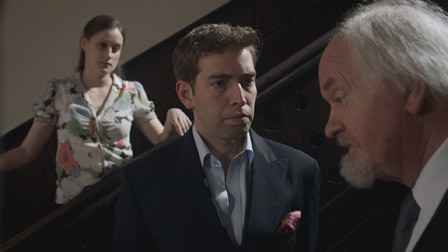
Polonius and Reynaldo
The Royal Shakespeare Production 2009
Directed by Gregory Doran
Act II, Scene i: The act starts with Polonius instructing his man Reynaldo to spy on Laertes. A very untrusting father, is Polonius. As soon as that important business is through, Ophelia dashes in to tell her father about a shocking encounter with Hamlet. The prince has apparently entered her chamber uninvited, grabbed Ophelia by the arm and creepily stared at her. Then he turned and left the room – eyes cast over his shoulder to gaze fixedly upon the distraught maiden. Polonius gets excited…not only has he discovered the reason for Hamlet’s madness (which the King and Queen want to know), but he now has the opportunity to say “Look! I did everything I could to discourage this mis-match, but the Prince is still in love with my daughter…perhaps they ought to marry?” *gleeful aspirations shine in eyes*

Rosencrantz and Guildenstern 
Rosencrantz and Guildenstern are Dead (1990)
Directed by Tom Stoppard
Act II, Scene ii: Hamlet’s friends Rosencrantz and Guildenstern have arrived in from abroad, and Claudius and Gertrude are asking them to check on Hamlet – to discover the reasons for his madness and perhaps soothe the melancholy prince. When they leave in search of Hamlet, Polonius comes with their messengers, newly arrived from Norway. The messengers tell Claudius that Fortinbras’ uncle has admonished the prince for threatening war with Denmark, but upon Fortinbras’ apology, his uncle has furnished the prince with more money for his army and told him to attack Poland instead. They now ask Claudius’ permission for Fortinbras’ army to cross through Denmark on the way to Poland.


Hmmm. Does someone smell a ploy? They’re just going to allow Fortinbras’ army to cross through Denmark? Oh well, it’s their kingdom. 

After the messengers have been thanked and sent away, Polonius tells the royal couple that Hamlet has gone mad with love for Ophelia. They decide to test this theory later by setting Ophelia loose on Hamlet. (Poor Ophelia.) Then Hamlet walks in. Polonius has a rather nonsensical conversation with Hamlet, partly because Polonius isn’t very clever and partly because Hamlet is playing with Polonius’ mind. Rosencrantz and Guildenstern walk in. The nonsensical conversation continues with them (and for the same reasons). *Why do Claudius and Gertrude keep sicing idiots on Hamlet? What do they hope to achieve?* Finally, a troupe of actors arrives, and Hamlet decides to use them as bait for Claudius’ guilty conscience.

Hamlet, Act I

In the first act of Shakespeare’s Hamlet, the scene is set. We meet the mournful young prince Hamlet who feels wronged by his mother’s hasty marriage to her deceased husband’s brother…and by their incessant partying in a time of sorrow. We meet Ophelia, admired by Hamlet, her brother Laertes and father Polonius. Finally, we are handed a juicy bit of gossip (adultery and murder!), which give Hamlet his excuse to vent his rage against the tyrant King Claudius. (For a more detailed summary, look below.)

This is my first time reading Hamlet since I was in high school, and I’m looking at it through very different eyes this time around. For instance, I’ve always been under the impression that Polonius was ridiculous. But this time, he appeared long-winded, but his advice seemed sound enough. Is he really ridiculous, or just verbose? I was gratified upon reading Harold Jenkins’ endnotes, where he suggests that Polonius was not meant to be ridiculous but paternal. Emphasizing Polonius’ fatherly relationship develops Laertes’ role as an avenger against Hamlet later in the play. 

A phrase that jumped out at me on this reading was when the ghost told Hamlet (I.v): “Taint not thy mind nor let thy soul contrive against thy mother aught.” Interesting. Because I recall Hamlet being very lusty in his anger against the Queen later in the play. Do I remember wrongly? Or is Hamlet disobeying the ghost? I will have to read on and see. Also, what did the ghost mean by “taint not thy mind”? Was the it admonishing Hamlet to keep his mind clear? Because Hamlet either feigns madness or actually goes mad later in the play. Again, did Hamlet disobey the ghost? 

The final thing that struck me in Act I was the questionable nature of the ghost. If Horatio (a clear-headed scholar) hadn’t believed in the ghost, I would suspect that Hamlet had hallucinated it in a fit of psychotic rage. Hamlet does incoherently rant during the scenes with the ghost. In his endnotes, Harold Jenkins suggests another alternative – perhaps Shakespeare meant the ghost to be a devil – an evil apparition sent to drive young Hamlet to vengeful madness. After all, the ghost has gone below stage, which represents Hell in classical theater. In a later scene (II.ii), Hamlet even questions the nature of the ghost: “The spirit that I have seen May be a devil.” However, based on all the swearing which closes Act I, Hamlet does seem to believe the ghost’s story, even if the ghost’s nature is questionable.

Perhaps I’ll be able to answer these questions as I read on…

(TO SEE MY OTHER POSTS ABOUT HAMLET, GO TO MY MASTER POST)

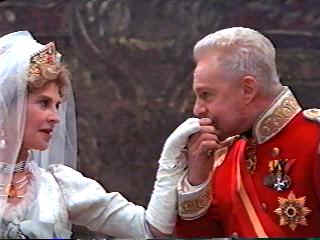
Claudius and Gertrude
Kenneth Branagh’s 1996 film

Act I, Scene ii: Only months after King Hamlet’s death, his brother Claudius has married the Queen, and wrested the throne Denmark. Claudius scolds Hamlet mourning the  dead King and then leaves to continue reveling in his new-found power. Left behind, Hamlet bemoans the disgraceful marriage…How could his mother have married so quickly? And to such a man?! Horatio then rushes in to tell Hamlet about the king’s ghost. Hamlet decides that he MUST see this for himself.


Ophelia, Laertes, and Polonius
The Royal Shakespeare Production 2009
Directed by Gregory Doran

Act I, Scene iii: Ophelia believes that Hamlet loves her, but her brother Laertes and her father Polonius both caution her against the young prince. Laertes believes that Hamlet, as heir to the throne, will not choose Ophelia for future Queen. Polonius agrees. “Hamlet is young!” he says. “Don’t set your heart on him.” Despite her assertions that Hamlet is courting her in a gentlemanly manner, Ophelia agrees to be cautious. After a long-winded speech from Polonius, Laertes departs for France.

Plate XLIV from Volume II
of 
Boydell’s Shakespeare Prints
Image taken from Emory’s Shakespeare Illustrated

Act I, Scene iv and v: It’s night, and Hamlet, Horatio, and Marcellus are looking for the ghost. When the apparition appears, it beckons Hamlet to follow. Hamlet desperately tries to follow, while his friends hold him back. Finally, he orders them to let him be.

Once alone, the ghost demands that Hamlet avenge his death. But it admonishes: “Taint not thy mind nor let thy soul contrive against thy mother aught.” Hamlet swears to avenge his father’s death, and then forces Horatio and Marcellus swear an oath of silence.

Hamlet: Act I, Scene i

BBC’s Dramatic Works of Shakespeare Collection
Image taken from Hyperion to a Satyr

Act I Scene i: 


Setting: Sentinels stand on the battlements of the castle

Characters

  • Barnardo, Marcellus, and Francisco of the King’s guard. 
  • Horatio, an educated gentleman, skeptical of ghosts, friend of Hamlet

Summary:

Twice recently, Barnardo and Marcellus have had their watch interrupted on the stroke of 1AM by an apparition in the form of the recently deceased King Hamlet. Fearing to speak to the ghost themselves, they had invited the skeptical scholar Horatio. Upon the tolling of the hour, the ghost appears, and Horatio calls out, charging it to speak. But the ghost stalks silently away. Our skeptical scholar (and therefore our audience) is now convinced that the ghost is not a fantasy. Aggrieved, Horatio suggests that the ghost is an ill omen. 

The three men then begin gossiping about an upcoming war, for which the ghost might be a portent. Thus, the audience is educated: Many years before, the late King Hamlet had slain in battle Fortinbras, the King of Norway. King Hamlet had confiscated some treasures and lands in that battle, which were given to young Hamlet upon his father’s death. The son of the late King Fortinbras, also named Fortinbras, has decided (after brooding for 30 years) to avenge his father’s death and seize the lands back from young Hamlet. He’s been gathering a band of misfits to wage war on Denmark. (This band of misfits apparently morphs into a well-organized army by the end of the play…nice to have footnotes to point out all the inconsistencies!) 

Gossip-fest complete, the ghost reappears and Horatio calls out, commanding it to speak. The ghost is about to answer when the cock crows. The ghost starts, and fades away as on a dreadful summons. Horatio decides that perhaps the ghost didn’t speak because it wants young Hamlet. The men resolve to tell Hamlet about the ghost.

My thoughts: Suspenseful first scene. I think it’s fascinating the way Shakespeare has managed to introduce several very important points into the scene, without distracting from the ghost. We now know that Horatio is a skeptical scholar, that the ghost is likely the spirit of the dead king, and that Denmark is about to be attacked by the vengeful young King of Norway. All that information flowed so smoothly into the dialog that the audience wouldn’t even realize they were being educated. I also like the suspense. What does the ghost want to say? We’ll have to wait and see.

See all my posts about Hamlet on my Hamlet Master Post.

The Headless Cupid, by Zilpha Keatley Snyder

2012 Book 140: The Headless Cupid, by Zilpha Keatley Snyder 


Reason for Reading: This is my first post for Book Journey’s Banned Books Week 2012 blog tour. By reading banned books, I feel that I’m expressing my freedom of speech, but I’m also interested in learning more about WHY people ban books. I don’t approve of banning most of the books on ALA’s top banned books lists, though for some of them I can empathize with the objections.  For the most part, I think the people who are objecting to these books need to give their children more credit for non-gullibility. All parents should watch what their children are reading, watching on TV, playing on the computer, etc. I believe that the best way to raise children is through a lot of communication. Banning books isn’t going to save our children from the real world. 


My Review
David, the eldest of the Stanley kids has had to take care of his three younger siblings ever since his mother died. When his father gets remarried, David has to adjust not only to the new mother, but to a new teen-aged sister. And what a strange sister she is! Amanda dresses in dark flowy clothing, has a triangle in the center of her forehead, and wears an upside-down smile. Amanda begins to teach the Stanley kids about the occult, but soon things get out of hand when they awaken a poltergeist! This book is appropriate for 3rd-5th grade range.


The Headless Cupid is 98th on on the ALA’s list of the top 100 books banned between 1990-2000. The complaints about the book were that kids might become interested in the occult (or even learn to practice the occult) from this book. Of course, this is preposterous. This is not a story about an evil little teen-aged witch–it’s a book about an angry girl who wants to get revenge on her mother for getting remarried. This is a book about the very real emotions children feel when their parents make life-changing decisions. It’s about coping with that anger. It’s about love and forgiveness. Any child reading the book will end on a note of acceptance and forgiveness (unless they don’t finish the book). I think people who fear a book about kids playing let’s-pretend probably ought to lock their doors and hide away…because the real world is a lot scarier than this book.


The Green Man, by Michael Bedard


2012 Book 81: The Green Man, by Michael Bedard (5/27/2012)

Reason for Reading: LibraryThing Early Review

My Review 4/5 stars
When her father temporarily moves to Italy, O is sent to live with her reclusive aunt Emily–so that O can take care of her aunt after a heart attack, and Emily can take care of O. In her eccentric way, Emily encourages O to get in touch with her inner poet, and O helps out by cleaning up her aunt’s dusty used book shop. However, there is a deeper evil that is creeping in to town…The Green Man was a very interesting specimen since it defies genres. In some ways, it’s a psychological mystery, in others a fantasy, and in others magical realism. Its deeper message is to encourage the poets in its readers–though you don’t have to appreciate poetry to enjoy the book. I think this book would be enjoyable to adults and budding young cerebrals of ages 10-13ish.

The Woman in Black, by Susan Hill


2012 Book 36: The Woman in Black, by Susan Hill (2/24/2012)

Reason for Reading: Thought it would be interesting to read and see if I wanted to watch the movie afterwards (Which I probably won’t for a while because none of my friends really seem excited to see it, and I am anti-drag-the-boyfriend-along.)

My Review: 3.5/5 stars
Arthur Kipps, a London solicitor, goes to a mysterious town for the funeral of a client. As he sorts through the deceased’s papers in her house, he realizes there is something spooky afoot. I was a big fan of ghost stories when I was a child, but this is the first I’ve read in a while. I was impressed by Hill’s ability to set a delightfully spooky mood—she’s very talented at descriptions and mood-settings. However, I guess I’m too rational to get spooked anymore. What a shame! I think it was a good book over all, even if the actual ghost’s story wasn’t particularly shocking at the end. Because it’s so short, it’s definitely worth a read just for the spooky mood setting.

One Hundred Years of Solitude, by Gabriel Garcia Marquez

2012 Book 22: One Hundred Years of Solitude, by Gabriel Garcia Marquez (2/5/2012)

Reason for Reading: This book was recommended by a couple of friends. It’s been on Mt. TBR for quite a while now.

My Review: 4/5 stars
One Hundred Years of Solitude chronicles 100 years of a family (of Buendia) and a village (city) that the “first of the family line” founded. The prose is lyrical and flows as smoothly as a river. That is, sometimes there are rapids and other times calm. The genre is magical realism, and it is fascinating watching the magic evolve with the family and village. After finishing this book, I’m not 100% certain what Marquez meant by it, though. It has anti-war and anti-oppressive-regime themes, but there’s something more that I haven’t quite put my finger on yet. I may need to re-read it after letting it settle for a while.