The Little Green God of Agony, by Stephen King


“The Little Green God of Agony,” by Stephen King 
(Found in A Book of Horrors, ed. Stephen Jones)


In the introduction to his new anthology, Stephen Jones expresses dismay at the overpowering onslaught of horror-lite which has obliterated the good old-fashioned horror story from the market. The purpose of this anthology is to take back the market with some bad-@$$ creepy stories. He opens his anthology with “The Little Green God of Agony,” a story by the well-known master of horror, Stephen King.

Newsome, the sixth richest man in the world, is a man in agony. A plane crash has left him scarred all over his body, and unable to get out of bed due to neuropathic pain. After exploring all the traditional medical procedures for freeing himself of this burden, he cashes in for the non-traditional treatment–a reverend who claims that Newsome is possessed by a god of agony, and that he (the reverend) has the power to expel the demon. Is the reverend a charlatan? Or is Newsome really possessed by a demonic agony?

This is the first Stephen King story I’ve read in quite a long time. I’ve always felt that he has an incredibly creative mind, and an amazing power to delve the reader into the darkness of his stories. On the other hand, the almost-book-snob in me cringes at his metaphors sometimes. (eg. “she…laced her hands together on the hanging hot-water bottles of muscle beneath his right thigh.” I’m sorry. That just really falls flat for me.) Once I’d managed to rid myself of the sharpened pencil stabs of distaste for SK’s continued use of unsatisfactory metaphors, however, I enjoyed the story quite a bit. His dark imagination was the perfect taster for the savory horrors to come in this anthology. 😉

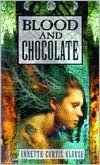
Blood and Chocolate, by Annette Curtis Klause

2012 Book 141: Blood and Chocolate, by Annette Curtis Klause

Reason for Reading: This is my second post for Book Journey’s Banned Books Week 2012 blog tourBy reading banned books, I feel that I’m expressing my freedom of speech (or in this case, the author’s freedom of speech), but I’m also interested in learning more about WHY people ban books. I don’t approve of banning most of the books on ALA’s top banned books lists, though for some of them I can empathize with the objections. In the case of this particular book, I understand the objections, though I think banning it only gives the book added attention. Blood and Chocolate is #57 on the ALA’s list of Top 100 Banned/Challenged Books 2000-2009.

My Review 

Vivian is a 15-year-old werewolf living happily with her pack in the country when a murder destroys the world she loves. In tragic disarray, her pack moves to the suburbs and tries to get reorganized. In the midst of this chaos, Vivian has an identity crisis and falls for a human “meat-boy.” Her experiences trying to fit in with meat-people teaches her a lot about herself. Meanwhile, the grisly murders continue, and the pack must hunt down the killers before they, themselves, become hunted. This book was very engaging. It was interesting and suspenseful enough that I really wanted to know how it ended, despite the fact that I disliked all the characters. Vivian was manipulative and conceited. Her mother had little character other than expressing concern for her daughter and being obsessed with sex. Vivian’s meat-boy boyfriend seemed likable enough at first (though not particularly alluring), but then his qualities took a nose-dive towards the end of the book. Honestly, I’m not sure why this book gets such good reviews, but I suppose it’s simply because the narrative is so engaging. 


My feelings about why this book was banned

I had the feeling while reading Blood and Chocolate that Klause intended this book to be a slap in the face to prudish book-banners. For me, that took a lot of the enjoyment out of the book because I felt like I was being beat over the head with a Message. Even if I agree with the Message, I think a novel’s MAIN objective should be to tell a story. If the story is told well, the message comes through in a smooth allegory. This book seemed like Klause was going for shock-value to pump up her sales. The reason I believe that this slap-in-the-face was purposeful and not simply part of the story is because Klause included a conversation between Vivian and her boyfriend about adults that objected to certain types of behavior and wanted to burn his books. 


Klause included almost all of the qualities that our book-banners of America hate: explicit sexualization of everything, the occult, disrespect for religious symbols, obscenties, violence, age-inappropriate relationships, and an entire page musing about different ways to commit suicide. None of this was bad enough to scar a child or young teen. However, I feel she REALLY overdid it with the sexualization. You’d think from this book that the defining characteristic of werewolves is that they were unabashedly and continuously horny. This seems to be the defining trait of teen-aged boys and middle-aged men as well ;). It was a bit obnoxious. The randiness of every character was SO overdone that it distracted from the story. So in the end, no, I don’t think this is subversive literature. But I have no respect for Klause’s ability to portray a message with finesse.


Zone One, by Colson Whitehead

2012 Book 138: Zone One

written by Colson Whitehead, narrated by Beresford Bennett

Reason for Reading: I read Zone One for A More Diverse Universe blog tour, which aims to increase awareness of authors-of-color…-of-speculative-fiction. (Is that the correct punctuation for that term?) Zone One is particularly fitting for this blog tour, since it is being considered for this year’s Hurston/Wright Legacy Award. Though this book is a “literary” zombie novel, so of course it is, by definition, genre defying. 😉 I also read this book for a the Surreal September LibraryThing theme read, and for the  R.eaders I.mbibing P.eril VII challenge.


My Review

This post-apocalyptic book takes place in on Manhattan Island (Zone One), where Mark Spitz and his colleges work as “sweepers.” Their job is to remove all the straggler-zombies from the area and bag them for disposal. This book isn’t plot driven so much as world-building-driven. Whitehead uses beautiful prose to describe the “reconstruction” of America. As spell-binding as his sentences are, however, this flowery language distracts from the few action scenes…making this book not so much about zombies as about compulsive and overwhelming mediocrity. I don’t mean that Whitehead’s writing is mediocre–not in the slightest!–but that the book is about mediocrity. The mediocrity of Mark Spitz is described in beautifully pregnant prose. In fact, Mark had “unrivaled mediocrity” and all the “advantages this adaptation conferred in a mediocre world.” The zombies themselves were a metaphor for the mediocre masses of Manhattan. Many of them harmlessly flipped non-existent burgers over ovens that had broken down long ago. They window shopped in front of boarded up displays and vegged in front of dead televisions. Thus, the book had a rather dark view of humanity…that we are descending irrepressibly into mediocrity. 


On top of that mediocre metaphor, Whitehead flirts with an allegory for the post-Civil War reconstruction. He compares the “untold Americans” who were not a part of the reconstruction to “slaves who didn’t know they’d been emancipated.” I pondered the meaning of this slave metaphor for a long time. Did Whitehead mean that these slaves hadn’t been told about the reconstruction? That there were untold numbers of them? That nobody would ever tell their story? Maybe he meant all of that? Following through with his mediocre-zombie metaphor, it seems that Whitehead meant that America is filled both with mediocre masses who live like zombies and their slaves…slaves of technology, slaves to the whim of the mediocre masses, slaves to the unpredictability of a fickle universe. 


I had a hard time reading this book because of all the flashbacks and literary musings–I don’t recommend people listen to the audiobook version due to these unexpected and frequent changes. I probably would have enjoyed it much, much more if I had physically read it. 🙂 I think this is an excellent work for its meaning and its prose, but it’s going to get bad reviews from the zombie-fiction-lovers out there, because, in the end, it’s not really about zombies. 


P.S. After writing that review, I’ve decided to give it 4 stars because it made me think…I was originally going to give it 3.5 stars because it was difficult for me to get through, and I didn’t immensely enjoy it. 🙂 But that may have been the fault of my choice of medium (audiobook).

About the Author
Colson Whitehead was born in New York City in 1969, and he grew up in Manhattan. After graduating from Harvard, he wrote for magazines and has published five novels. On top of that, he’s quite handsome. 😀

The Bells, by Edgar Allan Poe

Listen to The Bells


The first of Poe’s poems that I’ve read (recently) is The Bells (you might want to listen to it before reading my commentary). This poem was written in 1948, in the year following his wife Virginia’s death of consumption at the age of 25. Wikipedia suggests that the poem depicts a man mourning his lost wife. He courted her at Christmas to the sound of sleigh-bells in stanza one, married her in the second stanza, and then she dies in a fire as the husband watches in the third stanza. In the fourth stanza,  the grief-stricken husband goes mad. This is certainly an approachable interpretation. I think a life-cycle interpretation is more interesting though. In my opinion:

The first stanza is about the playful innocence of childhood. The merry tinkling of sleigh bells suggests a care-free mood–pure enjoyment of the moment. Even the Heavens twinkle with delight at the youthful merriment. But the poem also suggests that time is passing: 
              Keeping time, time, time
              In a sort of Runic rhyme 

“Runic rhyme” suggests an occult influence…perhaps a spell is cast over the innocents, trapping them in a ghoulish foreplay for the dance that lay ahead.

In the second stanza, the poem has matured. It is no longer care-free, since it is motivated by love for a new spouse, rather than by simple delight at existence. The bells are now “mellow” with “molten-golden notes.” These words suggest a sunset. Immediately following this symbolic sunset, the moon rises:

              What a liquid ditty floats
              To the turtle-dove that listens while she gloats
              On the moon!

Notice in this stanza the Heavens no longer join in the celebration, instead they are admired from afar. The universe has distanced itself from the poem. 

The third stanza tells of torture in the eve of death. This torture could represent a plethora of pains. To me, the fire recollected the turbulence of war and politics. Throughout Poe’s life he would have experienced the tortuous birth-pains of a new nation in a world at war. It could also symbolize the suffering of someone dying of disease–such as consumption, like his wife. Or the “deaf and frantic fire” could be the moral or religious guilt of a man who has lived a life of profligacy and regrets his youthful vices. He might be overcome by waves of self-abhorrence.

             Yet the ear, it fully knows,
             By the twanging 
             And the clanging,
             How the danger ebbs and flows–
  
In this third stanza the poet is “now to sit, or never / By the side of the pale-faced moon.” No longer does the poet admire the splendor of the moon. It is pale–it has lost its glory. Now, or never, he must sit and mourn by the Heavens which have deserted him.

In the final stanza Death (or perhaps Satan) triumphs. There are people–ah, the people! that dwell up in the steeple…all alone. These are spirits separated from their bodies. 

             They are neither man nor woman–
             They are neither brute nor human,
             They are Ghouls:

These ghouls have lost their identities. They are now simply servants of the king, Death. With finality they: “Feel a glory in so rolling / On the human heart a stone–” This is a tombstone, rolled over their hearts so they can no longer love. And the king’s merry bosom swells as he dances and yells

             Keeping time, time, time,
             In a sort of Runic rhyme
             To the throbbing of the bells–

Again, the “Runic rhyme” casts its spell over the ghouls. And they are captured for eternity.

Similarity to Paradise Lost:

While writing my interpretation of The Bells, I was reminded of my studies of Milton’s Paradise Lost. In lecture 18 of his series Why Evil Exists, Professor Charles Mathewes suggests that the difference between Satanic sin and human sin is that Satan sins out of a self-aware wish to rebel against God; Adam’s sin is that he loves Eve more than he loves God. He eats the forbidden fruit because Eve has already partaken. If he denies her, she will be “dead” to him, and he can’t handle that loss. So human sin ropes in feelings about other people. (See my full summary of the lecture here.)

While I was pondering how to express my feelings on Stanza II, I thought that this second stanza could represent Adam’s choice of Eve over God. It represents his marriage to her, and his subsequent separation from the Heavens–which, now, he could only admire from afar instead of living in its presence as in the first stanza. Following this train of thought, the third stanza would represent a human’s life on earth after the fall–filled with waves of earthly disaster. The final stanza would be the torment of Hell. 

Of course, I’m not suggesting that this is what Poe had in mind when he wrote the poem. But I think it’s interesting how such themes recur in literature. They are very powerful images that resound throughout time. Perhaps I’ll even wax Jungian and suggest that they are an archetype of our collective consciousness. 😉

Successors?
Another issue that struck me while I was reading this poem is thematic similarities between Poe’s poem and Quasimodo’s song about his bells in Notre Dame de Paris. I wonder if the playwright was influenced by Poe when he wrote this song? 🙂

Image taken from: http://schoolworkhelper.net/2011/06/edgar-allan-poe%E2%80%99s-the-bells-summary-analysis/
Dracula, by Bram Stoker

2012 Book 123: Dracula, by Bram Stoker (8/15/2012)

Reason for Reading: Coursera Fantasy and Science Fiction Course. Listened to it on my car ride to MN. 🙂 Didn’t finish it in time for the assignment though!

My Review
This review is for the Audible Edition of Dracula, narrated by Alan Cumming et al. (Wow, I just used et al. in a review. That makes me pretty darned special.) 

In this classic novel, a group of acquaintances must rid themselves of the sinister Count Dracula who has descended upon London with the eager desire to create a flock of bloodsucking fiends. This is my second reading of the novel–the first being when I was a young teenager. This time, I was impressed by Stoker’s ability to set a dark mood and maintain it through the entire book. There was always some creepy fog or a terrified dog or a creepily sleep-walking woman to spook the reader. The full-cast performance was delightful. It really brought the various characters to life. The end of the book dragged for me a little because I was on a long car trip, counting down the last 6 hours in 10 minute intervals. But that’s not really the fault of the book. 🙂

The Last Vampire, by Christopher Pike


2012 Book 89: The Last Vampire, by Christopher Pike (6/20/2012)

Reason for Reading: I used to read Christopher Pike when I was in middle school. Around the 7th grade, I decided he wrote trash and moved on to bigger and better books (literally). A few years back, I saw this book and whimsically bought it. I’ve finally gotten around to it…and come to the conclusion: My 7th grade self was very discerning. And my 30-something self should be ashamed of not trusting 7th grade self. Serves me right for reading a book entitled Thirst No. 1.

My Review 1/5 stars
Thirst No. 1 is a compilation of the first three books in a series written by Pike in the mid-90’s. I only made it through the first book, The Last Vampire, so that’s what I’m basing this review on. The basic plot-line is that a 5000-year-old vampire falls in love with a teenager and fights for her life against another 5000-year-old vampire. At first, I was impressed that Pike incorporated Hindu mythology into his plot (albeit with no dedication to the spirit of Hinduism). And the writing wasn’t as bad as I thought it would be. But then I realized how flat the characters were and how many loopholes the story had. I remembered why I didn’t like Christopher Pike–he scandalized me with his sexually active teenagers. I was less scandalized at 32 than I was at 12, but I still feel the casual “of course they’re sexually active” style was inappropriate for teen literature. I simply don’t think writers of teen books should make sex look like such a casual, unimportant act. However, I was prepared to finish Thirst No. 1 until the end of the first book. Total cliffhanger! And unnecessarily so. The only purpose of this cliffhanger was to leave the readers incomplete so that they’d rush into the next novel. One or two more sentences would have left the reader feeling complete. Personally, I feel authors should FINISH THEIR BOOKS!!!! What trash! Blagh!

The Woman in Black, by Susan Hill


2012 Book 36: The Woman in Black, by Susan Hill (2/24/2012)

Reason for Reading: Thought it would be interesting to read and see if I wanted to watch the movie afterwards (Which I probably won’t for a while because none of my friends really seem excited to see it, and I am anti-drag-the-boyfriend-along.)

My Review: 3.5/5 stars
Arthur Kipps, a London solicitor, goes to a mysterious town for the funeral of a client. As he sorts through the deceased’s papers in her house, he realizes there is something spooky afoot. I was a big fan of ghost stories when I was a child, but this is the first I’ve read in a while. I was impressed by Hill’s ability to set a delightfully spooky mood—she’s very talented at descriptions and mood-settings. However, I guess I’m too rational to get spooked anymore. What a shame! I think it was a good book over all, even if the actual ghost’s story wasn’t particularly shocking at the end. Because it’s so short, it’s definitely worth a read just for the spooky mood setting.