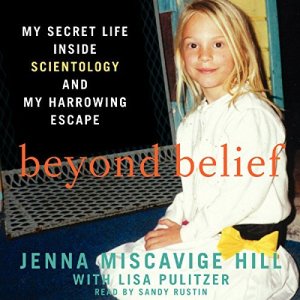
Beyond Belief, by Jenna Miscavige Hill

51zydywacll-_sl500_

Summary: Ms. Hill describes growing up within the inner echelons of Scientology. How, at first, she was fully indoctrinated (brainwashed, as she later called it), but after much emotional abuse she realized the church was not for her. She became an advocate for those who also escaped the inner echelons of Scientology, which (if her description is accurate) can only be described as a cult.

My Thoughts: This book was an eye-opener for me. I try not to call any religion a cult, even though I read Dianetics at one point and felt that it was very silly indeed. But if Ms. Hill’s descriptions are accurate (I also tend to take the descriptions of former members of churches with a grain of salt), Scientology is indeed a cult. And a fairly abusive one at that. I enjoyed listening to Jenna’s journey from indoctrination to disillusionment, and was emotionally involved in whether she would escape with any semblance of a  family life.

four snowflakes

Weekend Update 24

Happy weekend everyone! As you can see, I decided to chop my hair off today. It’s never been this short before, so this was a big move for me. My cough is much better on my new steroid inhaler, though I’m still feeling uber-fatigued. The haircut and lunch out with my friend was about all I could handle today.

I’m already tired from a long day yesterday driving my mom to the library, grocery shopping, and a follow-up appointment after her recent ER visit. Looks like she might have COPD. After that, I took the kids to swim lessons, and I could hardly stand up anymore. But the cough is gone!

On the blog

This week I published notes on chapter 4 of Kugel’s How to Read the Bible, a review of Powers’ No One Cares About Crazy People, and a review of Bradbury’s Fahrenheit 451.

I am thinking about hosting a very informal readalong of a classic like Plath’s The Bell Jar, or Goethe’s The Sorrows of Young Werther in September for Suicide Prevention and Awareness Month, if anybody would be interested in one or both books (perhaps two weeks per book?).

There are also two Coursera courses that I’m considering posting notes on for that month: Psychological First Aid, and The Social Context of Mental Health and Illness. But we’ll see what I can manage.

You are welcome to join me in any of these activities, or reviewing other suicide-related books as a guest blogger. Just let me know.

Currently reading

Due to lying in bed and typing this on my phone, I will list a few, rather than make a composite picture like usual:

Nonfiction: Hillbilly Elegy, by J. D. Vance

Fiction: Handmaid’s Tale, by Margaret Atwood & Harry Potter and the Goblet of Fire, by J. K. Rowling.

Audiobook: Doctor Who: 10th Doctor Tales, by various

Well Educated Mind: Gulliver’s Travels, by Jonathan Swift

Completed

Beyond Belief, by Jenna Miscavage Hill

Harry Potter and the Prisoner of Azkaban, by J. K. Rowling

Pilgrim’s Progress, by John Bunyan

Fahrenheit 451, by Ray Bradbury

6148sazvahl-_sl500_

Synopsis: Guy Montag is a fireman – in other words, his job is to burn down houses of anybody who is found to own books. He thinks he’s happy with his job until he meets Clarisse, a teenager who makes him question his belief about books, his marriage, and society in general.

My Thoughts: Loved it. I’m a fan of Ray Bradbury as it is, but this is my favorite so far. It’s so meaningful and scary. I suggest anyone read it, even those who are not interested in dystopias generally. This is not your typical teenage dystopia that are being mass produced at the moment.

5 snowflakes

The following is my analysis adapted from Susan Wise Bauer’s The Well Educated Mind’s description of how to think about a novel. It will have spoilers. 

👽What is the most central life-changing event?

Meeting Clarisse changing Montag’s entire outlook on life.

👽Am I transported? Do I see, feel, and hear this other world?

Oh yes, this world was very real to me.

👽Can I sympathize with the people who live there? Do I understand their wants and desires and problems? Or am I left unmoved?

I am moved by Montag’s desire to understand what he has been doing, and why society has become the way it is. I feel for him when Clarisse is removed from his life, and he mourns her loss.

👽Is this a fable or a chronicle? If the novel is a chronicle, how are we shown reality: Physical? Mental?

Despite being a dystopia, this world is very believable. It chronicles the time of Montag meeting Clarisse to the moment he discovers what he is going to do about the mess that has become of his society. The book takes place mainly in the mind of Montag, so I would say reality is shown mentally.

👽What does the central character want? What is standing in his or her way? What strategy is pursued to overcome this block?

Montag wants to understand the world around him, and to spend as much time with Clarisse as possible. Clarisse is taken away from him, which is tragic to him. He is also blocked by the illegality of his desire to find out more about the past in general and books in specific. His strategy to overcome this is to perform illegal acts which lead to his eventually being found out.

👽Who is telling you this story? Is this person reliable?

Montag is telling the story in his head. I would guess that this person is reliable, other than having been indoctrinated in society’s rules for all of his life.

👽Where is the story set? 

The story is set in a futuristic dystopian society in which it is unwise to think for yourself and illegal to own books. The universe is indifferent to Montag’s plight.

👽Images and metaphors: Are there any repeated images? If so, is this a metaphor, and if so, what does it represent?

The repeated images are Clarisse, who represents revelation and clarity, books, which represent knowledge, and fire, which represents destruction of knowledge.

👽 Endings: Does the end have a resolution or a logical exhaustion?

The story does have a resolution – the city is destroyed by war, and Montag runs into a group of people who has memorized certain passages of books so that when society grows again, they are able to start reprining the books.

👽Did the author choose characteristics to make a statement about the human condition?

Yes, the human condition in this represented as becoming less and less interested in knowledge and more interested in instant gratification and zoning out the life that surrounds them.

👽Is the novel self-reflective?

To a certain extent, I believe that Bradbury is worried about where society is going, and that, in a way, is self reflective. But I don’t think Montag is supposed to be a reflection on himself.

👽Did the writer’s times affect him?

Always


Classics Club Spin #18

spinning-book

The Classics Club is hosting Classics Club Spin #18. We are supposed to choose 20 books from our classics club list and assign numbers to each one. The Classics Club will then choose a number between 1-20, and we are supposed to read that book by the end of August. Since my list is all from my Well Educated Mind Project, which books I plan on reading in order as much as possible, I will choose 20 other classics that I am interested in reading.

  1. A Room of One’s Own, by Virginia Woolf
  2. Bluebeard, by Kurt Vonnegut
  3. Breakfast of Champions, by Kurt Vonnegut
  4. Discipline and Punish, by Michel Foucault
  5. A Tale of Two Cities, by Charles Dickens
  6. Master and Commander, by Patrick O’Brian
  7. The Merry Adventures of Robin Hood, by Howard Pyle
  8. The Jungle, by Upton Sinclair
  9. Catch-22, by Joseph Heller
  10. Far From the Maddening Crowd, by Thomas Hardy
  11. The Witches of Eastwood, by John Updike
  12. The Complete Sherlock Holmes, by Arthur Conan Doyle
  13. The End of the Affair, by Graham Greene
  14. Lord of the Flies, by William Golding
  15. Wuthering Heights, by Emily Bronte
  16. Gone With the Wind, by Margaret Mitchell
  17. The Grapes of Wrath, by John Steinbeck
  18. Rebecca, by Daphne du Maurier
  19. The Bell Jar, by Sylvia Plath
  20. Lolita, by Vladimir Nabokov

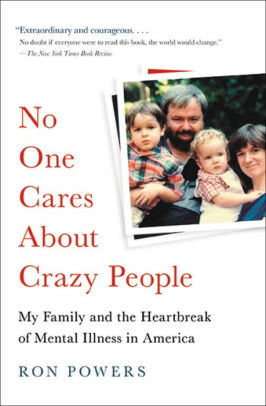
No One Cares About Crazy People, by Ron Powers

9780316341134_p0_v2_s550x406Summary: Ron Powers alternates the story of his own family, as his two boys grow up and eventually are diagnosed with schizophrenia, with a history of how the mental health system has failed to take care of mentally ill people.

My thoughts: I wanted to like this book. I did. But the historical sections weren’t anything I hadn’t read before in many a better-researched book (though they might be interesting to someone who has no background knowledge of the subject). Powers’ family story was interesting at first, but then it became apparent that he was going to make his sons into little saints whose only failures were due to either nascent schizophrenia or to the illness post-development. Not true. The kids were human beings who made mistakes. Dean didn’t get along with his dad as a teenager not because he was going to later fall into the grips of a mental illness, but because he was an angsty teen who had been through a lot of hardship in life. The car accident that was the life-changing event for Dean was, indeed, at least partly his fault. It doesn’t sound like he deserved the punishment he received…but then again, he HAD been underage drinking (though Powers says he was not legally drunk) which is a crime. And not a crime that was due to nascent schizophrenia – one that many (dare I say most) teenagers commit without any impending mental illness at all. And what can I say about Kevin? He was perfect. Not a mistake in his life. So talented. So amazing.

Kids make mistakes, Mr. Powers. Yes, the mental health system failed them. So, so true. But why make them into saints?

3 snowflakes

How to Read the Bible Chapter 4, by James L. Kugel

9780743235877_p0_v1_s550x406

In Chapter 4, Kugel discusses the story of Noah being saved by the great flood. In short, God became unhappy with the evilness he saw in humans, and he decided to flood the entire world and let only Noah and his family survive. They were to build an ark, and take all life (in either twos or sevens depending on the chapter) to safety with them.

Ancient interpretation: Despite what many people believe, the Bible never said that God told Noah to warn his fellow people about the oncoming flood – this was an ancient interpretation that lasted throughout the years. It came from this line:

So the Lord said “My Spirit will not contend with man forever, for he is mortal; his days shall be 120 years.” (Genesis 6:3)

Because Noah and his family lived many more than 120 years, the assumption the ancient interpreters made was that Genesis 6:3 meant that God would give Noah 120 years to complete his task of building the ark. While doing so, they interpreted that Noah tried to convince his neighbors to repent their evil ways.

Modern Interpretation: Kugel didn’t have much to say on his modern interpretation that I haven’t discussed elsewhere on this blog. In 1872, the English Orientalist George Smith of the British Museum discovered a passage that would later be considered part of the Epic of Gilgamesh. The similarities between the stories was unsettling to most Biblical scholars because the Epic of Gilgamesh predated the Bible, and this suggested that the Biblical story was borrowed from another source. For more information on this topic, you can read my posts on The Epic of Gilgamesh, especially the one entitled The Gilgamesh Epic and Old Testament Parallels.

Kugel also discussed the minutia of the multi-author theory, pointing out the inconsistency between two sections:

And of every living thing of all flesh, two of every sort shalt thou bring into the ark, to keep them alive with thee; they shall be male and female. Of fowls after their kind, and of cattle after their kind, of every creeping thing on the earth after his kind, two of every sort shall come unto thee, to keep them alive. (Genesis 6:19-20)

Of every clean beast thou shalt take to thee by sevens, the male and his female: and of beasts that are not clean by two, the male and his female. Of fowls also of the air by sevens, the male and the female; to keep seed alive upon the face of all the earth. (Genesis 7:2-3)

Chapter 1

Chapter 2

Chapter 3

Weekend Update 23

37410784_10100969331134497_7473045797127323648_n

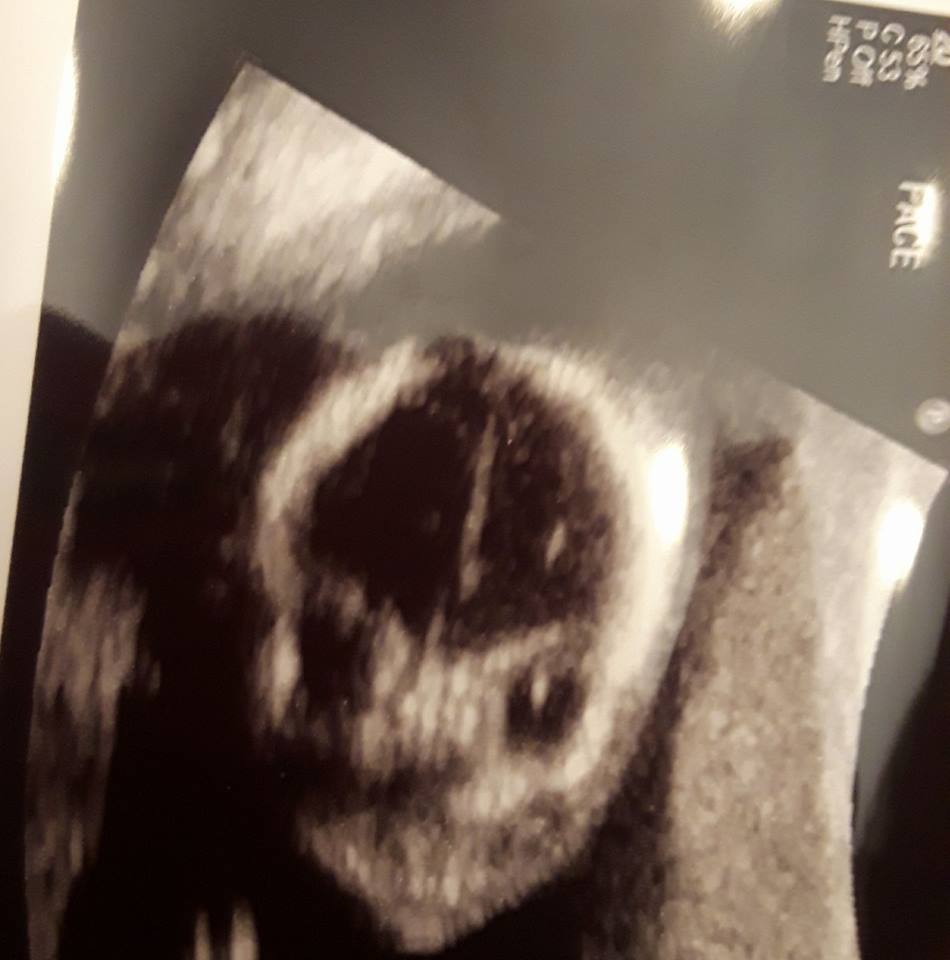
That’s my little nugget (apparently the size of a mango). Isn’t he adorable? The doc says that he is turning out “pristine” – in other words, no noticeable defects, or disorders of those that have been screened. Though after seeing this image of his face, I’m a little concerned he will come out looking like this:

37395352_10100969347875947_2950184469794914304_n

Uncanny resemblance, no? Luckily the profile pictures are a little more reassuring.

I’m afraid I had a back-swing in my “pneumonia” since Sunday (sorry to those of you whose comments I didn’t answer, I plan on getting to you today or tomorrow), and I went in to see my doc on Thursday. He scolded me for not coming in sooner, and put me on another dose of antibiotics, saying next time – if there is a next time – he’ll do a chest x-ray. My OB was a bit put out, saying that pregnant women don’t get the care they need because doctors are too afraid of being sued. I should have gotten a chest X-ray before my FIRST dose of antibiotics, and certainly before a second. I am feeling frustrated right now. I just want to know what’s going on with my lungs and fatigue.

On a happier note, I’m participating in the 24 in 48 readathon this weekend (if I don’t end up sleeping the entire weekend). Here is my post with which you can follow my progress.

On the Blog

I published notes on Chapter 2 and Chapter 3 of How to Read the Bible, as well as a review of Don Quixote.

Next week, I have three reviews scheduled: notes on How to Read the Bible Chapter 4, a review of No One Cares About Crazy People by Ron Powers, and a review of Fahrenheit 451 by Ray Bradbury.

Currently Reading

Currently Reading.png

Great Courses

great courses

Acquired

Acquired

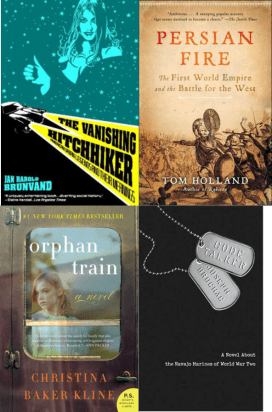
Orphan Train and Code Talker were for my nephew, who had to pick two books out of a reading list for his summer reading. Because, yeah, he choose to go to a prep school where they do things like that. 🙂

Completed

Completed

Don Quixote, by Miguel de Cervantes

9780060934347_p0_v2_s550x406

Summary: When Don Quixote goes insane and decides that he is a knight errant, he adopts a simple-minded friend to be his squire and they sally forth into the world to right all wrongs. He has many misadventures due to his tenuous hold on reality.

My Thoughts: This was an incredibly difficult book for me to read. I have wanted to read Don Quixote for a long time, ever since falling in love with the soundtrack for Man of La Mancha. However, I have made 4 failed attempts to get past the first half of the book. This time, I finally prevailed.

The first part of the book was very difficult for me because the story of Don Quixote and Sancho was interspersed with way too many very long side stories about other (often unimportant) characters. Frankly, I found it boring, but I SO wanted to know how the story ended.

The second half of the book was actually much easier to read because it covered the story of Don Quixote and Sancho without developing any unnecessary characters or reading any unnecessary love letters/novels. I’m glad that, in the end, I stuck with this book and finished it up. 🙂

3 and half snowflakes

The following is my analysis adapted from Susan Wise Bauer’s The Well Educated Mind’s description of how to think about a novel. It will have spoilers. 

👽What is the most central life-changing event?

There are two central life changing events in Don Quixote. The first is when he goes insane at the beginning of the novel. He begins to think he is a knight errant, and he sallies forth to right all wrongs. The second life changing event is at the end of the book, when he suffers defeat at the hands of another knight, who tells him to go home. After this event, Don Quixote begins to see ever more clearly that he has been living in a fantasy world.

👽Am I transported? Do I see, feel, and hear this other world?

In the second half of the book, yes, I was transported. The first half, no. I think the purpose of this book was to make people laugh and to parody books of chivalry rather than to engross people in a deeply engaging story.

👽Can I sympathize with the people who live there? Do I understand their wants and desires and problems? Or am I left unmoved?

I do sympathize with both Don Quixote and Sancho. I feel bad at how Don Quixote is taken advantage of and made fun of throughout the book – especially during the second half. Don Quixote only wants to right wrongs (and to be the most valorous night in history, of course), and he is kept from his goals by his unrealistic views of the moral values of others in the story. Sancho, on the other hand, isn’t only out for his self-interest – no matter what he keeps saying – he clearly loves Don Quixote and would follow him to the end of the world. He just wants to be able to talk a lot while doing so.

👽Is this a fable or a chronicle?

This story is supposed to be a “true history,” and should therefore be considered a chronicle. It follows the “true” life of Don Quixote from the beginning to the end of his madness.

The next question is: If the novel is a chronicle, how are we shown reality: Physical? Mental? But how do I even answer that? Are we shown reality at all? Sometimes, through Sancho, we can get an idea of what’s going on, and sometimes the narrator tells us what’s going on. But often, we just hear Don Quixote’s words, which we know aren’t a reflection of the “true” reality. But it is real to Don Quixote. Therefore, I’d say we see reality though both a physical and mental lens.

👽What does the central character want? What is standing in his or her way? What strategy is pursued to overcome this block?

Don Quixote wants to right all wrongs and to become the most valorous knight in history. His own madness is standing in his way. He sees things not as they are, but as he wants to. For instance, when he “helps” the boy who is being beaten by his boss, he takes the evil man’s word that he will “give the boy what he deserves.” Don Quixote thus abandons the boy to a worse fate than he’d have had if the knight errant hadn’t intervened. This is because Don Quixote views everyone else as having the same moral sense of right and wrong as he, himself does. But he is using an antiquated moral sense that no one shares with him.

Don Quixote never overcomes this block, other than to realize that he is mad, and then to die.

👽Who is telling you this story? Is this person reliable?

This story is generally third person limited, though there are times of omniscience, and other moments of first person when Cervantes talks about his own adventures trying to get this history written. No, I don’t believe the narrator is reliable, especially in the first half of the book. He seems to have a prejudice to be too kind to Don Quixote. The second half of the book has a much more reliable narrator, though it seems that Cervantes wasn’t himself the narrator of that section, rather it was a fictional historian.

👽Where is the story set? Is it natural or human constructed? If natural, does nature reflect the emotions and problems of characters? Or is the universe indifferent? 

The story is set in the lands surrounding La Mancha, Spain. This is a natural environment, and nature does (sometimes) reflect the problems of the characters – as when it gets very dark on the night of the adventure of the water mill. But this was in the first half. In the second half, I’d say the universe is indifferent.

👽What style does the writer employ?

The style is humor narrative.

👽Images and metaphors. Are there any repeated images? If so, is this a metaphor, and if so, what does it represent?

The images that are most often repeated are descriptions of how scrawny and long-faced Don Quixote is. Perhaps this was just for reality’s sake. But to me, it represented the wasting away of mental illness in a time when there was little sympathy for the mentally ill.

The other image that was very common was that of the inn. In the beginning, Don Quixote always believed that the inns were castles, but as his madness waned, he realized they were inns. I think they were meant to show us just how mad Don Quixote was at any given time.

👽 Does the end have a resolution or a logical exhaustion?

The logical exhaustion of the story is when Don Quixote becomes self aware and realizes the gravity of some of his mistakes.

👽Do you sympathize with the characters? Which ones, and why? Did the author choose characteristics to make a statement about the human condition?

I sympathized with both Don Quixote (who was mad and treated poorly by many people, though treated well by others) and with Sancho (who was treated well only by Don Quixote, and then, only sometimes). I think the “human condition” point that Cervantes was trying to make (other than just making fun of books of chivalry) was that people’s worth should not be judged by their status in life, but by their deeds and intents. The Duke and Duchess were horrible people – cruel to Don Quixote and Sancho. But Sancho, despite being a fool, was a wise and fair governor.

👽Did the writer’s times affect him?

Whose doesn’t?

👽Is there an argument in this book? If so, do you agree?

I think the main argument is as I said above, a person’s status does not reflect the quality of that person as a moral human being. And, yes, I totally agree.
How to Read the Bible, Chapter 3, by James L. Kugel

9780743235877_p0_v1_s550x406

Chapter 3 covers the story of Cain and Abel, the sons of Adam and Eve. In short, Cain was jealous and angry at Abel because Abel seemed to be preferred by God. Cain murdered his brother. God punished Cain by making him roam the lands without a permanent home. In order to prevent him from being murdered because of his deeds and roaming, God said that anyone who murdered Cain would suffer vengeance seven times over.

Ancient Interpretation: Ancient interpreters decided the meaning of this passage was that some people will stop at nothing – not even murder. But God will punish those who are wicked. Thus there is a moral order to the universe.

In addition, they decided that Cain was not human, but that he was half demon. Although most modern translations of the Bible say that Eve bore Cain “with the help of the LORD,” the word “help” is not included in the original text. What the Bible literally says is “I have gotten a man with the LORD.” Of course, that does not mean that the LORD God was the father of Cain, as angels were also referred to as LORD. The conclusion ancient interpreters reached is that an evil angel had impregnated Eve, and that Cain was the offspring.

Modern Interpretation: Again, the modern interpretation that Kugel mentions is the etiological one. In this interpretation, the individual Cain actually symbolized an entire group of people called the Kenites, who were fierce warriors and who were nomads. Thus, when one Kenite was killed, they would retaliate by killing “seven” Israelites.

Chapter 1’s review is here.

Chapter 2’s review is here.

How to Read the Bible, Chapter 2, by James L. Kugel

9780743235877_p0_v1_s550x406

Chapter 2 covers the story of creation and of the expulsion of Adam and Eve from the Garden of Eden. In short, God told Adam and Eve not to eat of the fruit of the tree of knowledge or they would die on that day. Eve ate of the forbidden fruit, and gave some to Adam. They were expelled from the Garden of Eden, and had to now toil to survive. Adam lived till 930 years old.

Ancient interpretation: Ancient readers saw a problem with this story. Why did God say they would die on the day they ate of the fruit, if they were allowed long lives? Was it an empty threat? Certainly God doesn’t give empty threats. At some point before the second century BCE, someone thought of connecting this problem to a verse in the book of Psalms:

For a thousand years in Your sight are as yesterday, the way it passes, or like a watch in the night. (Ps 90:4)

If God’s “day” was a thousand years, it makes sense that Adam would have lived almost that long before dying.

Another interpretation that was made after the fact (and was not directly included in the Bible) was that Adam and Eve were immortal and sinless when they were in the Garden of Eden. This explains why death is the punishment for eating of the forbidden fruit. The disobedience of Adam and Eve were then thought of as “Original Sin,” from which all subsequent sins followed. Ancient interpreters named the punishment for this sin “The Fall of Man.” This is how the story of Adam and Eve was thought of until modern times. In fact, there are many people who are surprised to learn that the terms “Original Sin” and “The Fall of Man” weren’t ever mentioned in the Bible. What’s more, the interpretation that the snake was the devil was also a later interpretation, and it was not mentioned in the Bible.

Modern Interpretation: The idea that the book of Genesis was actually etiological (that it explained the way things became the way they are now) was suggested by the German biblicist Hermann Gunkel (1862-1932). Thus, the story of Adam and Eve moving from the Garden of Eden to toiling for food outside the Garden was the story of how humans moved from hunter gatherer to an agricultural system. They now had to toil long days to plant seed and harvest it.

Modern scholars also know that the discovery of agriculture corresponded to the discovery that a man had to plant his seed in the woman in order to make her pregnant. Thus the quote the man “will cling to his wife and they shall be one flesh” (Gen 2:24).

Chapter 1’s review is here.