


The University of Michigan is teaming up with Coursera to create Teach-Outs which are week-long MOOC lecture series which address problems currently faced in society today. Following will be notes for The Opioid Crisis.
 Jay S. Lee, MD, is a health services research fellow at the University of Michigan Center for Healthcare Outcomes & Policy, and a General Surgery resident at the University of Michigan. He received his undergraduate degree in Chemical Engineering from the University of Michigan, and his medical degree from the University of Michigan. Dr. Lee’s research focuses on characterizing variation in postoperative opioid prescribing and consumption, with a specific interest in opioid use after cancer surgery. His research is supported by a T32 training grant from the National Cancer Institute. After residency, he plans to complete a fellowship in Complex General Surgical Oncology, and pursue a career in academic surgery.
Cancer patients are generally given opioids post-surgery, and since the opioids help manage the patients’ pain, these prescriptions are a good use of opioids. However, these patients are often observed taking those medications longer than necessary. Years ago, doctors didn’t know how much opioid to prescribe, and often over-prescribed. Now that the epidemic is in the front of their minds, they are surveying patients to see how many opioids are actually being taken in order to make a guess at how much they should prescribe. They found the the actual number used is much lower than they have been prescribing. Doctors have also been spending more time talking to patients about the risks of opioid use, and patients have been responsive by taking less of the medication.
The discussion question that accompanied this lecture was: Several of our experts have mentioned the pharmaceutical industry’s aggressive promotion of opioids to doctors and patients as a significant contributing factor in the opioid crisis. Should there be some controls or limits on the pharmaceutical industry’s influence on physicians? If so, what should they be? If not, why?
Wow. Of course there should be some limits on the pharmaceutical industry’s influence on physicians! At the very least, physicians should receive no kickbacks from any pharmaceutical company, ever. I wish there could be a go-between who gathered all the information about the new meds and talked to the physicians in a disinterested way – rather than the physicians talking directly to people who are trying to market the drug.
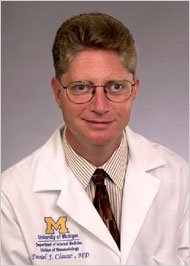 This lecture was given by Daniel Clauw, Professor of Anesthesiology, Medicine (Rheumatology) and Psychiatry at the University of Michigan. He serves as Director of the Chronic Pain and Fatigue Research Center. Until January 2009 he also served as the first Associate Dean for Clinical and Translational Research within the University of Michigan Medical School, and PI of the UM Clinical and Translational Sciences Award (CTSA).
 This is an interview with Pooja Lagisetty, whose research interests focus on culturally tailored behavioral interventions, social determinants, health disparities, neighborhood determinants of chronic diseases, and urban design. She is a primary care physician who provides medication assisted therapy (MAT) for opioid addiction to patients at the Ann Arbor VA, has studied the literature about MAT in primary care, and is involved in efforts to increase the number of primary care teams that provide MAT to patients as a way to combat the shortage of treatment options.
 This post is notes from an interview with Mike Smith, a Clinical Assistant Professor in the Department of Clinical Pharmacy at the University of Michigan College of Pharmacy and Clinical Pharmacist in Pain and Palliative Care at Michigan Medicine.
 Hibernator's Library