Kidnapped, by Robert Louis Stevenson

2012 Book 117: Kidnapped, by Robert Louis Stevenson (7/30/2012)

Reason for Reading: It was one of the top 5 books in LibraryThing’s recommended list for me. 🙂

My Review
When 16-year-old David Balfour meets his estranged uncle for the first time, he is shocked by the man’s cruelty. Soon, Balfour has been kidnapped and he must rescue himself and travel back to the town of his uncle to claim his inheritance. This is an exciting little book…not quite up to scratch with Treasure Island, but still has quite an adventure. It would probably be a fun book for teenagers to read, if they like classics (or if you want to thrust classics upon them).

Milton–Epic Evil

The Great Courses
Why Evil Exists
Lecture Eighteen
Milton–Epic Evil


I want to explore the nature of “evil” and popular ideologies. It is, of course, impossible to ever really understand evil, but I think that even scratching the surface of the nature of evil will broaden my horizons. 🙂 I have found what looks like an excellent set of lectures from The Great Courses called Why Evil Exists. I plan on using these lectures as a guide during my quest. I will record my adventures here in my blog. The course’s introduction states: people have been addressing the problem of the existence of evil in a “divinely governed or morally ordered world” for millennia. The course aims to chart the answers that the Western world has outlined throughout time. I suppose I am to be left in the dark about the Eastern world’s answers to these questions? How evil. 😉

Because I have already started my study of Milton, I will skip ahead to Lecture 18: Milton–Epic Evil. *Watches lecture while taking notes.*

*******

John Milton was a political revolutionary as well as a poet (see also: Milton and Paradise Lost: A Quest to Understand). All of Milton’s writings, even the political ones, were centered around how humanity can avoid corruption by evil. As a Calvinist and a republican,1 Milton meant Paradise Lost as an allegory for the failure of Oliver Cromwell’s rebellion. “Paradise Lost is the story of a rebellion gone terribly awry, and a leader horribly mutilated by his own revolt.” 2

Milton suggests in Paradise Lost that he intended the epic to “justify the ways of God to men.” He views God as timeless and eternal–existing at once in the past, present and future. So, although God knows all that has been or will be, it is not preordained. Adam and Eve had free choice, and they chose sin. But their sin was different from the sin of Satan, who represents Evil’s self-understanding in Milton’s epic.

In order to depict the embodiment-of-evil as a character, Milton had to display Satan in all his alluring charisma–for that is the nature of evil, it charms and tempts the unwary. It is easy to sympathize with Milton’s Satan. He oscillates between self-doubt (God has tempted me to fall thus!) and self-confidence (I am acting out my own ambitions, while God thinks he can control me!). Even though his emotions are self-contradictory, they make him more real to the reader…they make him someone the reader can understand. Along with Satan’s oscillating paradoxical motivations, Milton also uses paradoxical metaphors to represent evil. One of the most famous examples is Milton’s description of Hell as a “visible darkness.”

Milton had the difficult task of portraying self-aware evil (as opposed to portraying man’s perception of evil, as in Dante’s work). Because of this, he portrayed Satan as a much more interesting character than God or Jesus. Many critics believed that Milton himself sympathized with Satan. In The Marriage of Heaven and Hell, William Blake wrote: “The reason Milton wrote in fetters when he wrote of Angels & God, and at liberty when of Devils & Hell, is because he was a true Poet and of the Devil’s party without knowing it.” Other critics, like C. S. Lewis, insisted that Milton’s poem complimented Christian faith.

Unlike Satan, Adam and Eve are “surprised by sin.” Even though the angel Raphael warns them about sin, they are incapable of understanding the warning because they are too innocent. The warning is useless. Theirs is not “self-aware” sinning like Satan’s. Eve sins out of careless folly, vanity, and pride…not a “self-aware” wish to rebel. Adam’s sin was that he loved Eve more than he loved God, whom he was supposed to love above all else. This is the difference between Satanic sin and human sin. Satanic sin is about the sin itself; human sin tends to rope in emotions about other people.  


*******

Now that I have a good idea of what Milton was trying to say in Paradise Lost, I’m ready to attack the first book! 🙂

(TO SEE MORE ABOUT PARADISE LOST, GO TO MY MASTER POST)

1. “Republican,” at the time, meant a person who believed that the people should govern themselves (as opposed to a monarchy). 

2. Charles Mathewes, The Great Courses: Why Evil Exists, Lecture 18.

3. This is the title of a well-accepted contemporary critical analysis of Paradise Lost: Surprised by Sin: The Reader in Paradise Lost, by Stanley Fish.


The Confidence of Alice


As I said in my previous post on Alice (Alice, the Caterpillar, and the Serpent), Lewis Carroll used asterisks to denote metamorphoses in Alice. The last row of asterisks in Alice’s Adventures in Wonderland was when she shrunk back from a serpent to a reasonably-sized girl at the end of Chapter V. This sudden absence in transformative asterisks suggests that Alice is beginning to gain confidence in herself and to settle into the Alice she will be. 


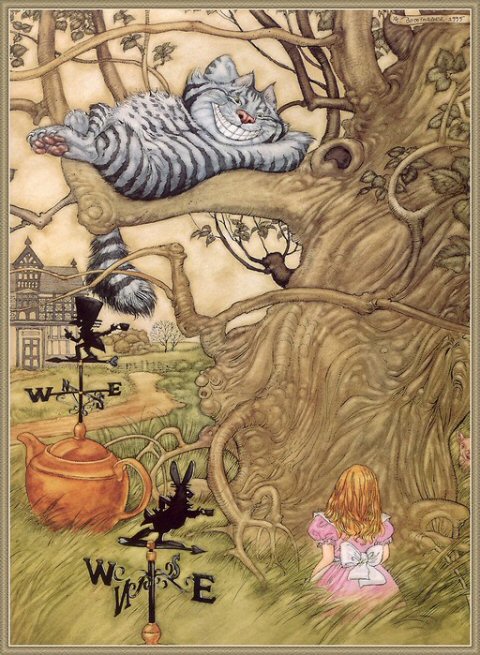
Chapter VI introduces another well-recognized icon of the Alice books: the Cheshire Cat. The conversation that commences is probably the most sensible she has in Wonderland. Alice asks:

“Would you tell me please, which way I ought to go from here?”

“That depends a good deal on where you want to get to,” said the Cat.

“I don’t much care where–” said Alice.

“Then it doesn’t matter which way you go,” said the Cat.  

Alice, in her newly acquired perfectly-sized body, is now feeling ready for an adventure. But she doesn’t know where to find one. The Cat, in the guise of nonsense, sensibly points out that if she doesn’t have a goal, she’ll be wandering aimlessly through life. This prods Alice into a decision–she’d like to meet more creatures in Wonderland, but she doesn’t want to “go among mad people.”

“Oh, you ca’n’t help that,” said the Cat: “we’re all mad here. I’m mad. You’re mad.”

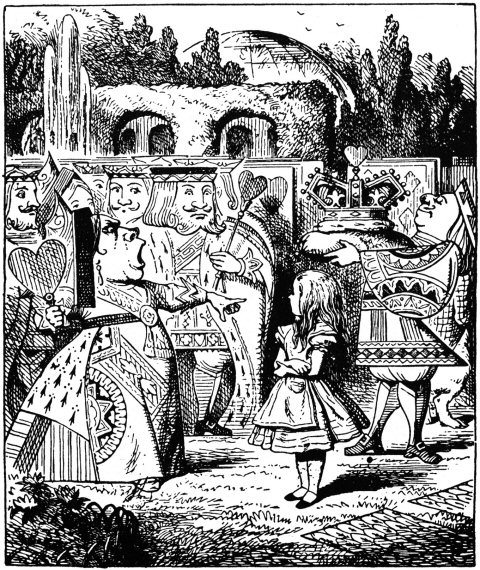
The Cat is the only creature of Wonderland who recognizes that he’s mad! This self-awareness allows him to sensibly see the rest of the world as it really is–mad. I believe that, like the Caterpillar, the Cheshire Cat is Alice’s alter-ego. He represents the sense, self-confidence, and goal-orientation that arises from self-awareness. After meeting the Cat, Alice marches right up to the Mad Tea-Party and sits down despite the party’s calls of “No room! No room!” Later, in the Queen’s croquet ground, she stands proud and erect as the queen’s procession nears. Her companions lie quaking face-down in the dirt. The Queen interrogates Alice:  

“Off with her head! Off with–“

“Nonsense!” said Alice, very loudly and decidedly, and the Queen was silent.  

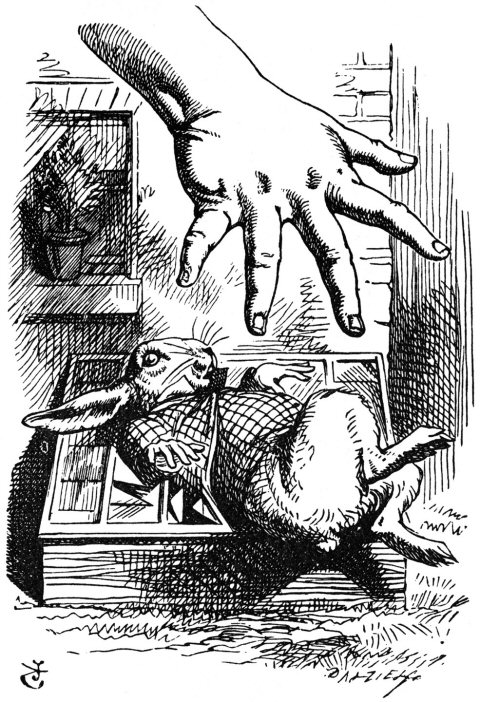
Ever since meeting the Cat, Alice does not need to be over-sized to have self-confidence. Her responses to the Mad Tea-Party and the Queen are quite sensible and self-assured. Earlier in the book, Alice’s self-confidence fluctuated with size. But the self-assurance she demonstrates at the end of the book is unlike the childish spats she had when she was over-sized. Think of the incident in Chapter IV, where she was stuck in the White Rabbit’s house. Instead of sensibly standing up for herself, as with the Queen, she simply used her bulk to terrorize the White Rabbit and poor Bill. 

Alice also demonstrates a mature self-assurance when she bursts out laughing (twice) in the Queen’s croquet ground. Earlier in the story, Alice’s main emotions were tear-soaking-frustration, foot-stomping-frustration, timidity, and confusion. Now that she is self-aware, she can see the rest of the world as it is–amusingly silly. 
*Images were taken from: 

Alice, the Caterpillar, and the Serpent


In chapter IV, we see the first evidence that Alice’s feistiness grows and shrinks with her size. When Alice is small she rushes off to do the White Rabbit’s bidding, so frightened by him that she doesn’t bother explaining that he’s mistaken her for someone else. But when she “grows up,” as she calls it, she confidently attacks first the White Rabbit (through the window) and then Bill (in the chimney). This pattern of fluctuating confidence-with-size continues throughout the book. Such changes are emphasized by a row asterisks that Lewis Carroll included to indicate a transformation in Alice. Alice’s frequent metamorphoses could be perceived as symbolizing both the inexplicable changes in a pubescent body and fluctuations in confidence and timidity during puberty.

Chapter V of Alice’s Adventures in Wonderland can be split into two sections. The first section is Alice’s identity crisis with the caterpillar, and the second section is Alice’s mistaken-identity issue with the pigeon. I will discuss how both of these sections play into the puberty allegory.  
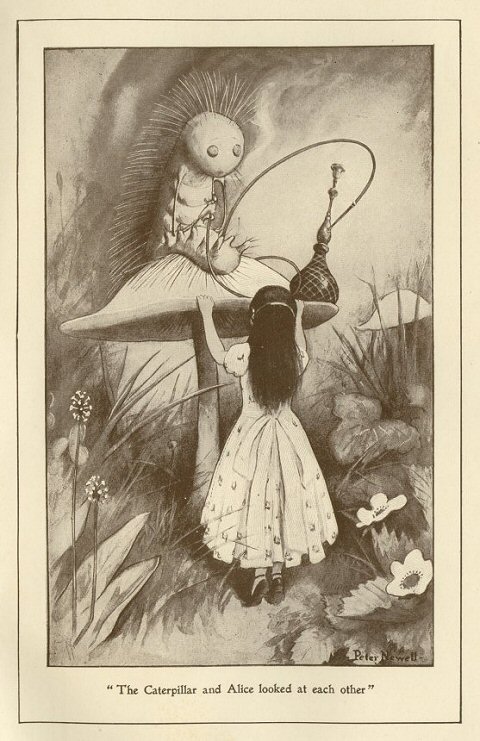
Once Alice escapes being eaten by a playful puppy 10 times her size, she finds a Caterpillar who contentedly smokes his hookah while reclining on a mushroom. When he sees Alice he demands “Who are you?” Rather timidly, Alice responds that she doesn’t know who she is. 

“I–I hardly know, Sir, just at present–at least, I know who I was when I got up this morning, but I think I must have been changed several times since then.”

Thus commences one of the best known conversations in the Alice books. The Caterpillar continues to demand that she identify and explain herself, and she timidly suggests that she can’t. Finally, she decides that the Caterpillar is in a rotten mood, and turns away. But the Caterpillar demands she return; so she timidly waits for “some minutes” until the Caterpillar finally tells her something useful–one side of the mushroom will make her grow larger, and the other will make her smaller. 

Caterpillars are well-recognized symbols of metamorphosis–they transform first into a chrysalis and then into a magnificent butterfly. Alice points out that the Caterpillar should feel a little bit “queer” when he’s changing, though the Caterpillar insists that he won’t. I believe that the Caterpillar represents an alter-ego of the metaphorically pubescent Alice. He’s that niggle in the mind of a pubescent girl that questions her identity. He represents the uncertainty in change.
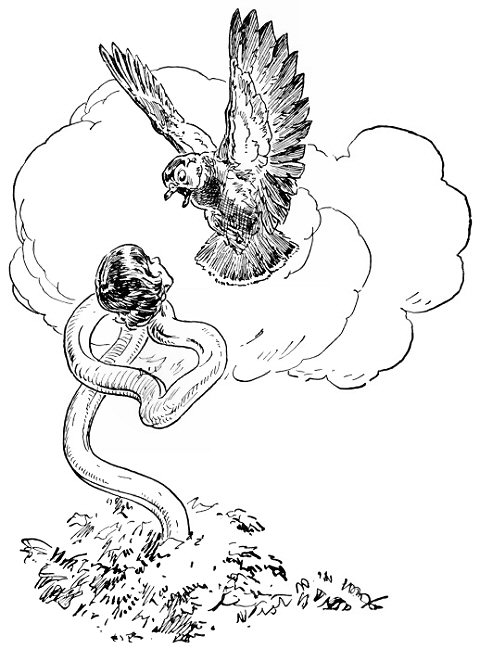
After Alice’s Caterpillar-induced identity crisis, she tries a bit of mushroom to modify her size. Throughout Alice’s Adventures in Wonderland, Alice refers to growing larger as “growing up.” Here, she realizes that one problem of “growing up” is that some body parts (in this case, her neck) may grow out of proportion with the rest of her body. When Alice begins to wind her serpentine neck through the foliage in hopes of reaching her hands (and the size-morphing mushrooms) a pigeon pops out and attacks her with enraged shrieks of “serpent!” Although Alice has already made the association between her neck and a serpent’s sinuous body, she insists that she’s not a serpent. Remembering all the changes she’s been through that day, she’s not entirely certain that she’s a little girl anymore, but she is quite certain that she’s not a serpent. In this “grown up” state, she argues with a confidence that is absent in the first part of the chapter.

There are two ways of viewing a serpent symbolically. We could take the Biblical/Freudian approach and say that Alice has turned into a temptress–a sexual being. Or, we could view a snake as a creature of change–one that sheds its skin and is born again.** Clearly, both of these interpretations fit with the puberty allegory.


My final blog post on Alice’s Adventures in Wonderland is: The Confidence of Alice.

*Images were taken from: 
**snakeskin metaphor is compliments of Laura Gibbs, whose Coursera blog can be found here: http://courserafantasy.blogspot.com/

Alice’s Adventures in the Circle of Life

I read a critique that claims the Alice stories are allegories for puberty–specifically, Freudian analysis suggests that they are about Alice’s change from innocence to a sexual being. I’m generally skeptical of Freudian analysis, but was surprised when I read the first two chapters of Alice in Wonderland and found evidence that the book may, indeed, be about puberty. In fact, I noticed possible allusions to the entire life cycle, from birth to death. I don’t know if this trend will continue throughout the book, but here’s what I have so far:

Birth
In the beginning, Alice falls down a rabbit-hole, landing in a room containing a tiny key, a tiny door, and a large table. When she is small, the door is locked–she’s not allowed out. But then she grows very large…so large that she can hardly fit into the womb room anymore. Ah! Now she can reach the key! But the way out is so tiny! Luckily, she is taken up by a force outside of her control (a sea of tears) and is thrust into Wonderland. 


Puberty–Between the Age of Innocence and the Age of Reason comes the Age of Nonsense
Even before falling down the rabbit hole, Alice has noticed that she acts like a selfish child but reprimands her own behavior like an older child:

She generally gave herself very good advice (though she very seldom followed it), and sometimes she scolded herself so severely as to bring tears into her eyes; 

In the rabbit hole, Alice feels small and insignificant (understandably, since she has shrunk down to several inches high). She has lost respect for herself and doubts the way she used to do things:

 “But it’s no use now,” thought poor Alice, “to pretend to be two people! Why, there’s hardly enough of me left to make one respectable person!”

Furthermore, her body keeps changing in awkward and embarrassing manners. Note the grotesque lengthening of her neck in the picture at the beginning of Chapter 2. Does this remind anyone of the awkward phases of growth, when body parts would suddenly become disproportionately too large or too small seemingly overnight? Even her voice sounded “hoarse and strange” when she recited the crocodile poem. These changes make her question her identity:

I wonder if I have changed in the night? Let me think: was I the same when I got up this morning? I almost think I can remember feeling a little different. But if I”m not the same, the next question is ‘Who in the world am I?’

I know that this question of identity will continue throughout Alice’s Adventures in Wonderland. Although it may seem strange to suggest that a book about a 7-year-old is an allegory for puberty, remember that Charles Dodgson’s friend Alice Liddle, on whom our Alice was modeled, was just reaching the age of puberty at the time that the first book was to be published. Note a diary entry by Dodgson in May 1865:

Met Alice and Miss Prickett in the quadrangle: Alice seems changed a good deal, and hardly for the better–probably going through the usual awkward state of transition.*

Alice’s Adventures in Wonderland was published in November of that year. 

Death
There even a moment when Alice contemplates death: 

“for it might end, you know,” said Alice to herself, “in my going out altogether, like a candle. I wonder what I should be like then?” And she tried to fancy what the flame of a candle looks like after the candle is blown out, for she could not remember ever having seen such a thing.

Later, Alice terrifies the mouse by mentioning her kitten, Dinah, and how great Dinah is at catching mice. When Alice realizes her mistake, she quickly changes topics to a dog she knows…as she chatters on, she again blunders by mentioning what a fantastic ratter the dog is. Apparently this Darwinian eat-or-be-eaten philosophy continues throughout the two books. Darwin’s book On the Origin of Species just been published in 1859, and Natural Selection was the talk of the town. I will watch for Natural Selection allusions while I read; though, apparently, some of them were taken out of the original story and can’t be found in the published book.  

A continuation of this theme can be found here.

Image taken from http://www.mymodernmet.com/photo/the-circle-of-life

*From The Diaries of Lewis Carroll, ed. Roger Lancelyn Green, quoted in Alice in Wonderland: Norton Critical Edition (New York: W. W. Norton and Company Inc., 1992) p279.

Renegade, by Ted Dekker


2012 Book 116: Renegade, by Ted Dekker (7/27/2012)

Reason for Reading: I want to finish up this series because it’s related to a set of books that I have been really appreicating

My Review
When Bilos betrays the team and disappears into the Books, Johnis, Silvie, and Darsal must rescue him. This is a really difficult book for me to review. I’m a huge fan of Ted Dekker, and I’m reading these books because they seem to be the glue that holds together his loosely related books: The Circle Trilogy, The Paradise Trilogy, and the stand-alone book Skin. However, I feel that this series of books suffers from two fatal flaws: 1) Dekker’s trying to be too clever and 2) Dekker’s hammering us over the head with a Message. The other series make sense on their own, this series does not. It’s wildly jumping around from unreal concept to unreal concept, without enough explanation or continuity. The ONLY reason I have an inkling of what’s going on is because I’ve read the other books. And that’s not as it should be. Furthermore, Dekker’s Message is much less subtle in this book than it is in his other works (possibly since this one was meant for teenagers), and the story gets lost in its Message at time. I will continue through this series because I want to know what happens for the sake of the other series. But I’m no longer enjoying it.

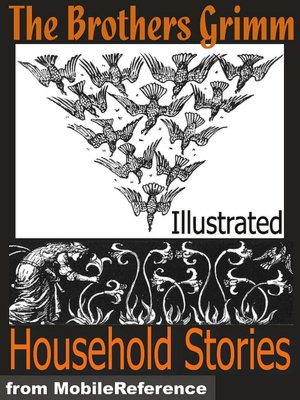
The Brothers Grimm Household Stories


2012 Book 115: Grimm’s Household Stories, by Jacob and Wilhelm Grimm; Lucy Crane translation (7/27/2012)

Reason for Reading: Fantasy and Science fiction Coursera text: week 1

My Review 
This is a short, illustrated collection of Grimm’s folktales. All of the most famous of Grimm’s tales are in there, without too many of the redundant same-story-but-slightly-different tales that you’ll inevitably come across in a longer collection. The illustrations are enjoyable. The translation has a few small errors (apparently), but overall I think it’s a good place to start with the Grimm brothers.


Essay for Coursera
Many critics claim that the Brothers Grimm had sexist portrayal of women in their stories. These critics ignore the negative portrayal of men that is also endemic in the tales. 
Despite misgivings, Hansel and Grethel’s father leads them into the forest to die. When they return, he leads them back out again because “when a man has given in once he has to do it a second time.” In other stories, like Aschenputtel or The Three Little Men in the Wood, the father conveys not one moment of disquietude at the injustice done to his daughter. Many men in the tales are spineless. In The Fisherman and his Wife, the husband returns time and again to ask the princely fish for favors for his wife—favors he does not wish for, and that he is terrified to request. In The Wolf and the Seven Little Goats, the wolf orders the miller to help disguise him. Despite the fact that the miller suspects the wolf, the miller “was afraid and did what he was told. And that just shows how men are.” The worst man, though, is the father in The Twelve Brothers. He’s willing to kill 12 of his boys to provide his newborn daughter with a larger inheritance!
These stories caricaturize the weaknesses of humans–both male and female. As the German-Swiss Nobel Laureate Hermann Hess said: “The literature of the tales and the legends refers us, often with frightening agreement, to something transcendent, to the very concept of the human race.”1These stories refer us to a deep-rooted fear of our own flaws, and they resonate throughout the ages because the most abhorred flaws of human nature have remained, in essence, the same throughout time.

1. Quoted on page 15 of: Bottigneimer, Ruth (1987). Grimms’ Bad Girls and Bold Boys. New Haven: Yale University.


Aside
It was really hard to get this down to the correct word length! I had to leave out so many fantastic examples of horrible snake-like men! As well as examples of brave women. After reading these tales, I’ve decided I don’t agree with the feminist analysis of these stories. Though I probably already had a skeptical bias.

One of the examples I really wanted to include was The Wonderful Musician. This guy had a marvelous power over fellow creatures…he played his music and creatures would come to praise him. These creatures would trust and revere him. However, he kept attracting animals that didn’t please him: a wolf, a fox, a hare. So he promised to tutor them, but deceived them and left them to die. When he finally found a man, he said: “At last! Here comes the right sort of companion. It was a man I wanted, not wild animals.” But the wild animals are more humane than the musician was. The wonderful musician is like a charismatic politician. One that can charm people during the election or important diplomatic meetings, and afterwards he does whatever he wants–essentially stabbing his supporters in the back. I could have written a whole second essay on this subject. 🙂


The Last Guardian, by Eoin Colfer


2012 Book 113: Artemis Fowl: The Last Guardian, by Eoin Colfer (7/25/2012)

Reason for Reading: The FINAL book in the Artemis Fowl series. At least it better be. 🙂 I suspect that he’s going to write a spin-off series, but that’s just my own thoughts on the subject.

My Review 
In this FINAL book of the Artemis Fowl series, Arty, Holly, Butler and friends must save the world from Opal’s last stand. The plot was fun, humorous, and a little silly. Overall, a good ending to a good series. This book isn’t up to scratch with the earlier books, but it’s better than some of the later books in the series. You should certainly read it if you’ve gotten this far in the series already! From the character development in this story, I’m GUESSING (personal theory) that Colfer plans on writing a spin-off series starring Miles & Beckett. If he did, I’d certainly check it out.

A Bottle in the Gaza Sea, by Valerie Zenatti

2012 Book 114: A Bottle in the Gaza Sea, by Valerie Zenatti (7/26/2012)

Reason for Reading: Reading Globally Middle Eastern Theme Read. 

My Review 
As a method of self-defense against increasing Israeli-Palestinian violence, feisty 17-year-old Israeli Tal writes a note and sticks it in a bottle. She asks her brother to throw the bottle in the Gaza sea, with hopes that she’ll meet a Palestinian girl and somehow put a personality to the people she knows must be behind the fence. What she gets is 20-year-old Naim, a scathingly sarcastic, but nice-under-the-surface Palestinian man. The book is a series of emails between the two, and as their understanding of each other grows, so does their affection for one another. This was a really sweet book. It was silly, as are all teenage romances, but actually believable (if you have faith in coincidence). I was surprised while reading because I’d originally thought the author was Israeli, writing for Israeli teens—but the book is written by a French woman who lived in Israel when she was younger. The target audience is therefore teens who do not necessarily know all the background in the Israeli/Palestinian conflict. This is something I appreciated, because I felt like I understood what they were talking about when they mentioned political and historical events. This is a quick, enjoyable read.

I Shall Not Hate, Izzeldin Abuelaish


2012 Book 112: I Shall Not Hate, by Izzeldin Abuelaish (7/23/2012)

Reason for Reading: Reading Globally Middle Eastern theme read

My Review 
In this heartbreaking (yet strangely uplifting) memoir, Abuelaish relates his life—growing up in poverty in a Palestinian refugee camp, slaving so that he could raise enough money to go to medical school, and his rising career coincident with his growing family. Despite losing 3 daughters and a niece to an Israeli military action, Abuelaish preaches that love, not hate, is required to bring peace. Abuelaish’s story is engrossing and tragic, yet I couldn’t help but think about all of the suffering Palestinians who don’t have a voice. If life is so hard for someone who has powerful connections, what must it be like for those who have no one to help them? This is a must-read for people who think Palestinians are all about terrorism and throwing rocks—people who likely wouldn’t touch the book with a 10-foot pole. It’s also a fantastic read for someone who is sympathetic to both sides of the conflict, but who wants to hear a personal story. I DO wish I could read the story of someone who isn’t highly connected, but this is a fantastic start. And Abuelaish’s enduring message of love make a monumental memoir.