Lone Wolf
Written by Kathryn Lasky, Narrated by Erik Davies
Reason for Reading: I rather liked the Ga’Hoole books, so I thought I’d try this series out, too.
Genre: Juvenile Fantasy / Anthropomorphism
Review
As an infant cub, Faolin was taken from his mother and abandoned to die. He was found by a bear who nursed him through childhood. Now as a young wolf, Faolin is once again on his own and he must find a way to rejoin his own kind. This was a cute little story, and I enjoyed it. But I don’t think I would have enjoyed it half as much if I hadn’t read the Ga’Hoole books first. Although the story of Faolin is independent of the three story lines in the Ga’Hoole series, Lasky’s world-building in this book was a bit dependent upon the other books. The world would have seemed confusing and frustrating to me if I didn’t already know all about it from the Ga’Hoole books. This is why I gave the book only 3.5 stars even though I thought it was really sweet. I will continue with this series myself, but I recommend to all of you – continue with this book if you loved the Ga’Hoole books as I did. But if you haven’t read the Ga’Hoole books, start there. 🙂
Category: adventure
Airman, by Eoin Colfer
Airman, by Eoin ColferReason for Reading: Seemed like a good idea
Genre: YA Steampunk
Review

Conor Broekhart has grown up as the best friend of the princess of the Saltee kingdom (an imaginary kingdom off of Ireland). But when he discovers a conspiracy to kill the king, the real traitor captures him and sends him to a prison camp to mine diamonds in obscurity. Conor must use his genius for flight to escape the prison and rescue the princess. Conor is much like a 19th century steampunk Artemis Fowl. Colfer delivers his usual book – fun, delightful, and humorous. Definitely a treat for fans of non-dystopia non-paranormal-romance YA. (YAY! for something different!) I’d say this book is appropriate for 5th – 8th graders.
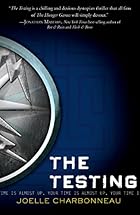
The Testing, by Joelle Charbonneau
The Testing, by Joelle CharbonneauReason for Reading: This book was provided by the publisher through Netgalley in exchange for an honest review. This book will be released in June 2013.
Genre: Young Adult Dystopia
Review

Cia wishes more than anything that she will be chosen for the testing procedure – leading to a university education. But the testing procedure turns out to be more than she’d bargained for. The other kids are literally cut-throat competitors, and the testing officials are cruel and calculating. Will Cia be able to hang on to the person she is and still pass the test? Does she even want to pass the test anymore? What dire consequences really do follow failure?
This book was a fantastic addition to the popular young adult dystopia genre. It took me a little while to get in to the story because there was little to distinguish it from all the other YA dystopias I’ve read lately, but after about 50 pages I was really sucked in and wanted to know where Charbaonneau was taking the story. I had an inkling what might happen in the end – sort of a “wow, I hope it goes in this direction, because that would make the next two books really interesting.” And it DID go in that direction. So, the ending wasn’t unpredictable, but it was unique, and I was in suspense for the entire book which way it would go. I hope she really works that aspect in the second and third books. To me, that’s the aspect that will make this trilogy stand out from the crowd. Another thing I liked is that although there’s potential for a love triangle, that aspect wasn’t focused on. As I’m really tired of the triangle, the lack thereof was very refreshing. I hope the trilogy stays that way. The violence might be a bit off-putting to some young readers, but I’d say it’s about the same as The Hunger Games – maybe a little less.
Overall, a fun quick read. I hope this trilogy is popular. 🙂
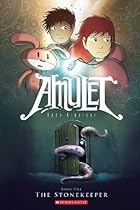
The Stonekeeper, by Kazu Kibuishi
The Stonekeeper (Amulet Book 1), by Kazu KibuishiReason for Reading: Helping my nephew with his book report.
Review

When their father dies, Emily and Navin must move with their mother to a run-down house in the middle of nowhere – an inheritance from a great uncle they’ve never met. On their first night in the disturbing old house, their mother is kidnapped by a gigantic squid-thing and the kids must rescue her with the help of a talking amulet that they’ve found in a dusty room.
I read this because my nephew really loved it, and he’s a very reluctant reader. I can see why he liked it – there’s lots of pretty pictures and very few words. It’s a book appropriate for middle-graders both in vocabulary and in plot. It was a cute, fast read, and I’m sure I’ll read the rest in the series. However, it’s not a book that would appeal to me for any other reason than bonding with my nephew. The premise and plot are simply too unsophisticated to be of much interest to most older kids or adults. On the other hand, the book seems to be VERY popular with the younger crowd, and I highly recommend The Stonekeeper for reluctant readers.
Call It Courage, by Armstrong Sperry
Call It Courage, by Armstrong SperryReason for Reading: This book won the Newbery Medal in 1941. It’s been sitting on my shelf for years.
Review

Mafatu is afraid of the ocean because he almost drowned when he was a boy. But in his culture, fear is scorned and laughed at. Mafatu feels that he must redeem his good name and prove that he is not afraid anymore. He climbs in a boat and goes on a voyage, but he soon finds himself shipwrecked on an apparently-deserted island. There, he keeps himself alive by making all of his own tools, weapons, and a new canoe. He battles a tiger shark, an octopus, and a boar. He defies the cannibals when they return to their island. But will he be able to return home? This was a cute book, and I enjoyed the adventure – though it’s very short and all the adventure is packed in at a very unrealistic pace. Regardless, I really enjoyed the couple of hours I spent with it. I think a young reader might find this book fun. It’s appropriate for someone reading at maybe the 3rd grade level.
The Last Battle, by C. S. Lewis
The Last Battle, by C. S. LewisReason for reading: This is the seventh (and final) book in the Chronicles of Narnia, which I’ve been reading in order-of-publication. I plan on rereading them all in chronological order using Planet Narnia: The Seven Heavens in the Imagination of C. S. Lewis, by Michael Ward as a guide.
Review

The final book in The Chronicles of Narnia depicts the apocalypse of Narnia. When a shrewd monkey teams up with Calormen to trick the Narnians into thinking Aslan has returned – and they are his spokespeople – Narnia is cut to ruins. Forests are destroyed, Narnians begin to doubt Aslan, and cities fall to heathen invaders. I’m afraid to say this was my least favorite of the Narnia books (though I still liked it quite well!). Intellectually, I know Lewis had to have an apocalypse – whatever begins must also end – but it was still a bit dreary. So although I understand why the apocalypse had to come, I still liked the other books so much better. Not only because they were much more cheerful, but also because they had more fun-filled adventure.
But that’s par for the course. Death is better than life; boys are better than girls; light-coloured people are better than dark-coloured people; and so on. There is no shortage of such nauseating drivel in Narnia, if you can face it.
I agree that Narnia conveys some rather sexist and ethnocentric views, but that’s what English literature of that period was like. Lewis (and the Narnia books) are a product of their time.
And in The Last Battle, notoriously, there’s the turning away of Susan from the Stable (which stands for salvation) because “She’s interested in nothing nowadays except nylons and lipstick and invitations. She always was a jolly sight too keen on being grown-up.” In other words, Susan, like Cinderella, is undergoing a transition from one phase of her life to another. Lewis didn’t approve of that. He didn’t like women in general, or sexuality at all, at least at the stage in his life when he wrote the Narnia books. He was frightened and appalled at the notion of wanting to grow up. Susan, who did want to grow up, and who might have been the most interesting character in the whole cycle if she’d been allowed to, is a Cinderella in a story where the Ugly Sisters win.
When I read this paragraph, I wondered what Lewis actually did do with Susan in the book. But when I read the book, I interpreted those events differently than Pullman: Susan wasn’t allowed into Heaven at that time. It was made clear that Susan was in one of the silly stages of life, but it was just a stage. She still had a chance to grow out of it. She hadn’t been rejected from Heaven permanently, and it wasn’t her time to die. Susan lived. And Susan had the ability to change (just as Pullman points out). Lewis wasn’t saying that grown-ups can’t go to Heaven. After all, the kids’ parents went to Heaven, didn’t they? Lewis was saying that Susan was in a phase where she idolized material things – and had thus turned away from her spiritual health.
Also, I’m not certain Susan really is the most interesting character. By Pullman’s definition (he-who-changes-is-most-interesting) I believe Eustace’s character developed much more than Susan’s character. Why is Pullman ignoring Eustace?
What do other people think about Susan’s character? Do you think Lewis meant for her to be denied Heaven permanently?
Crossed, by Ally Condie
2012 Book 164: Crossed
Written by Ally Condie, Narrated by Kate Simses and Jack Riccobono
Reason for Reading: Second book the the Matched trilogy
Review
Harry Potter and the Chamber of Secrets, by J. K. Rowling
2012 Book 152: Harry Potter and the Chamber of Secrets
written by J. K. Rowling, narrated by Jim Dale
Reason for Reading: I’m rereading these books along with Lost Generation Reader.
My Review


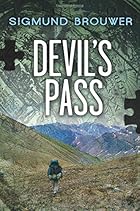
Devil’s Pass, by Sigmund Brouwer
Reason for reading: This book was provided by the publisher through the LibraryThing Early Reviewers program. The thoughts expressed in this review are mine, and I receive no benefit from giving a good review.
My Review:

I was pleasantly surprised by this little book. Not that I expected bad things from it, but I didn’t expect to be caught up in the action. Brouwer has worked in some interesting action scenes right at the beginning of the story, and by the time the action has slowed to a pace more suited for plot and character development, I was already quite interested in the book. I read it in only a couple of sittings. This would be an excellent book for boys in the 5th or 6th grade age range, even though the main character is 17.
Character Thursday:Fanda at Fanda Classiclit has organized a weekly blog event in which we can provide a detailed character analysis of a book that we’ve been reading. I thought I’d try my first character analysis out on Webb. I thought he’d be an interesting character to start with because his identity is developing throughout the story. The following information will contain more details than I usually provide in my review, but I’ll try not to include any plot-vital spoilers.
When Webb was 5th grade-ish, his widowed mother remarried a man who was abusive to Webb, but apparently not to Webb’s mother. So Webb was manipulated and threatened into keeping the abuse a secret. Eventually, at maybe 16 or 17, he ended up living on the streets. This is where he was when his grandfather died and the adventure begins.
Because of the abuse in Webb’s past, he adopted a protective role for other victims of abuse. At the beginning of the story, he saw a young woman being beaten by her boyfriend, and in order to defend her, he ended up in a fight with this very dangerous man.
At first blink, you’d see Webb’s behavior as “good.” He was using his own experience to help a woman in trouble. But soon you find out that as Webb gets angrier and angrier, he loses his logic…he wants to seriously hurt this man. A rational part of his brain says that seriously hurting people in self defense isn’t necessary, but that rational part of his brain isn’t working once his rage has fired up. So Webb is a protector of the weak, but he’s also teetering on the brink of violent, hateful jerk himself. The identity crisis that Webb struggles with throughout the book is where to draw the line between protector and wrathful avenger?
Webb didn’t think that his grandfather knew about Webb’s troubles. But his grandfather is more astute than Webb expected. Webb was left with two Nietzsche quotes to ponder during his hiking trip in the Northwest Territories. The first was: That which does not kill us makes us stronger. The second was: He who fights with monsters must take care lest he thereby become a monster. And if you gaze for long into an abyss, the abyss gazes also into you.
Webb had already experienced and accepted the meaning of the first quote. But he was puzzled by the second quote. It made him question what he was becoming…whether he needed to become that…and what the alternatives were.
Webb’s identity crisis was, granted, quite straightforward and clearly-laid-out for the readers. That’s because this book was written for 5th graders, who aren’t as attuned to subtlety as they will be as adults. I think Webb’s identity crisis allows someone of the appropriate reading age to learn something new about how the world affects their personalities…and how their personalities can affect the world. Thus, Web was a fascinating character, and I’m happy I met him. 🙂
Harry Potter and the Sorcerer’s Stone, by J. K. Rowling
Written by J. K. Rowling, Narrated by Jim Dale
Reason for Reading: This is my third book for Book Journey‘s blog tour for Banned Books Week, and this time I decided to try something familiar. Since Lostgenerationreader is having a Harry Potter readalong, I decided to join in and read the first HP book for Banned Books week. 🙂 This is probably my third time reading this particular book, but it will be my first time reading the series “in one go.”
My Review:
Harry Potter has been living with his neglectful and emotionally abusive parents ever since his parents died when he was a baby. But on his 11th birthday, everything changes. He finds out that his parents were a witch and a wizard and that he, himself, has been accepted to Hogwarts, a school for witchcraft and wizardry. He is thrilled to feel comfortable and welcome for the first time in his life, but he soon discovers that not all the teachers at Hogwarts are looking after his best interest. Can Harry and his adventurous friends save the Sorcerer’s Stone from being stolen and used for nefarious purposes?