
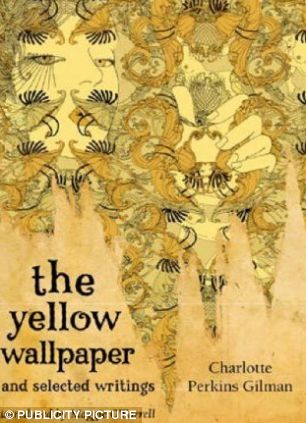
I decided that since I’m reading Herland, by Charlotte Perkins Gilman, I would read Gilman’s best-known piece of fiction, the short story “The Yellow Wallpaper.” This is one of the few short stories included in the list of 1001 Books You Must Read Before You Die (the others mostly being by Edgar Allan Poe).
The main character is a young wife and mother who is taken by her affectionate husband to a summer home so that she could rest from her “nervous” behavior for a while. Her husband wanted her to rest as much as possible–not to exert herself by writing, reading, taking care of her baby, or doing any other sort of wifely work. She was kept in a room with viciously ugly yellow wallpaper. At first, she wanted to be free of the wallpaper, but her husband affectionately refused to move her to another room. As the story continues, she (in the boredom of “rest”) becomes more and more fascinated by the wall-paper and is eventually driven to madness. Her descent into madness is so eerie that this work was classified as “horror” before it was brandished as a feminist gem.
Gilman describes the descent into madness with the naked honesty that can only come from a semi-autobiographical story. In fact, this story was a dire warning to herself, and to the world. Gilman became deeply depressed after giving birth to her own daughter. Her affectionate husband sent her to the well-known neurologist S. Weir Mitchell, who was a specialist in “women’s disorders.” Mitchell’s famous cure involved a regimen of rest–the woman would give up all work and simply gain back her health by bed-rest and isolation. Gilman was forbidden to write or paint, and was only allowed to read for 2 hours a day. Such treatment is enough to drive anyone crazy in my opinion! As Gilman got worse and worse, she made the difficult decision to leave her affectionate husband and find her health by other means. She never fully recovered, and she suffered from the world’s censure for leaving an affectionate husband–this was in the late 1800’s when such a divorce was a scandal. She wrote “The Yellow Wallpaper” as a warning to herself that she would have gone mad had she stayed with her husband. She wrote it as a warning to the doctors who supported Mitchell’s cure–she even sent a copy of the story to Mitchell himself. And she wrote it as a warning to young women who might be suffering from similar “cures.” Gilman never suffered from hallucinations herself, but the description of the descent into madness clearly bore her soul, making the story frighteningly realistic.






 Hibernator's Library