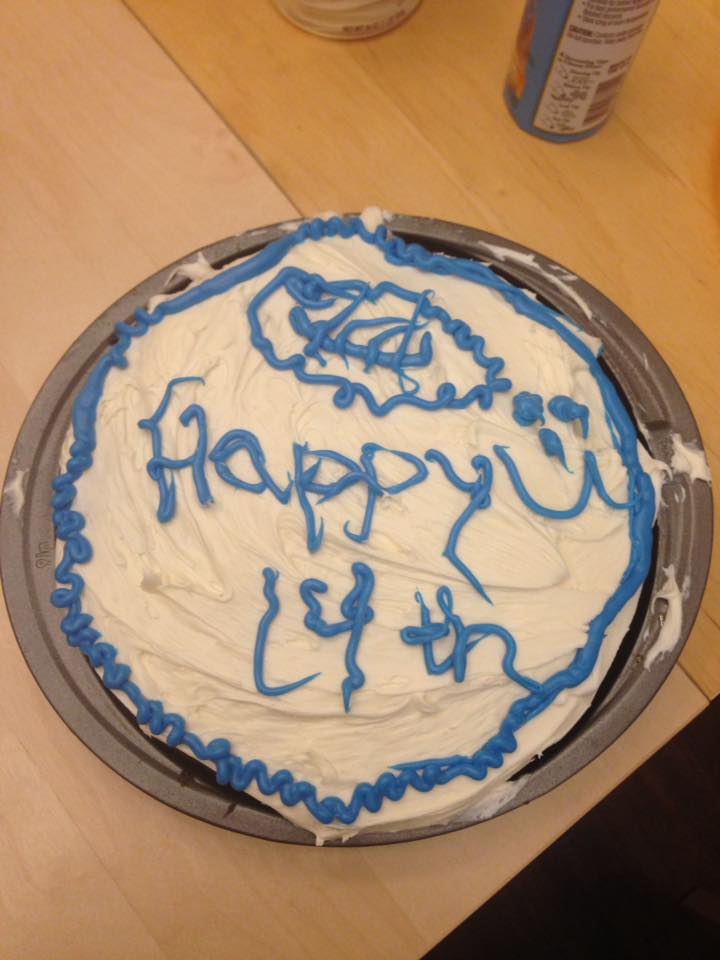
This week was my nephew J’s fourteenth birthweek. (We’re not quite finished celebrating, as my family, my sister’s family, and my parents will all go out to dinner to celebrate on Monday.) My step-daughter-to-be D baked him this lovely cake, which I decorated with my mad frosting-writing skills.
Saturday my fiancé (A), best friend (L), J, and I played D&D together. Mainly character building. I’m a Dragonborn Cleric, L is a Halfling Ranger, and J is a Dragonborn Fighter. A is Dungeon Master. This is J and my first time playing. We’ll be meeting every first Saturday. We also watched the first 5 episodes of Series One of the new Doctor Who.
Today I will have a book club meeting to discuss Shadow Land, by Elizabeth Kostova. Review is still upcoming, though I have to say that I found it rather meh. I wonder what everyone else thought?

On last Sunday, we had our family night, where we ate pork chops and played our first-ever game of Cadoo, which is a children’s version of Cranium. It was quite a bit of fun. I finished listening to Caesar’s Last Breath, by Sam Kean, which will be my next book club book in two weeks. J, A, and I watched The Wolverine on Friday night, and found it fairly palatable. Much better than the other Wolverine movie! Wow.

This week, I acquired quite a few goodies.
I bought the Goelet translation of The Egyptian Book of the Dead, which is the second book on Harold Bloom’s Western Canon which I will probably not finish in my life-time, but it’s still fun to use as a guide. Actually, I believe Bloom suggested Budge’s translation, but from doing a little research, I’ve decided that Budge was notoriously sloppy in his translations – perhaps I will read both (I own Budge’s translation too), or I will just read the Goelet one, which has beautiful pictures.
I also acquired two math workbooks (one for each step-kid-to-be) and several board games. Because we’ve noticed that both kids sit like zombies either on their tablet or in front of the TV for almost an entire day every day if you let them, we have decided to institute screen-time rules so that they will do constructive or educational stuff. Or at least stop zombifying in front of a screen for 12 hours straight. They will get 3 hours of screen-time daily (TV in the morning till 8, and then 2 hours of tablet time) before they have no screen options left. Then, they can do something else (whatever they want) or they can do something constructive/educational for extra screen time. Examples would include reading, being read to, doing a math workbook, or playing a board game. The board games were suggested by M’s kindergarten teacher, who feels they are great for learning social skills, which M is currently working on. (He’s had a hard couple of weeks behaviorally, but has shown great improvement at the end of this week, when we instituted a new reward/discipline system. Hopefully it will continue to work. Not much seems to motivate him to behave; but “special daddy time” does seem to work right now.) Of course, we are also making an effort to take the kids out of home for indoor parks and such as well. This evening we will all go to an indoor trampoline arena with nephew J – if they are up to it after their road-trip back from grandparents’ house with their mother.

Saturday morning, before D&D A and I bought a new Outback to replace his 13 year old car. We also got a bike rack mounted on the back – so now this summer we will be able to go on bike rides with the kids. 🙂
We also bought new Samsung Halo phones. They are a step up from our old iPhone 5s which had slowed down unbearably after Apple pulled their jerk-move, “sacrificing processing time for battery life” (in other words, slowing down the older phones so that everyone would have to buy new ones). Yes, they said that people with older phones could get a discounted ($50 off) a battery replacement to speed the phone up again, but we didn’t qualify because that only goes back to iPhone 6. So we were just out of luck. Which means we are angry at Apple and decided to get Samsungs instead. Of course, this also means that Apple has hijacked any messages sent from iPhones after my switch. I’m sure they have an excuse for why that’s in my best interest.

Except one, I’m still reading the same books with the same motivations as last week: I Stop Somewhere – Negalley ARC, No one Cares About Crazy People (edification), Freeing Your Child From Anxiety (hoping to help D cope), When Breath Becomes Air (Wellcome Trust Bookprize 2017 Longlist), Fablehaven (to the kids), The Island of Doctor Moreau (literature study).
Have a nice week everyone!





 Synopsis: Alexandria leaves her home in America to travel Bulgaria and teach. But on her first day there, she runs into a mysterious family, whose bag she accidentally “steals.” When she discovers how valuable the contents are, she feels she has to find the family and return the bag personally. However, the family is difficult to find and she is led on a wild goose chase looking for them. All the while, strange people are following and threatening her.

 Synopsis: This is the epic story following the lineage of Kunta Kinte, who was kidnapped as a teenager from his home in Africa to be a slave in the US. His family is dramatically followed down the line to Alex Haley, the author. In fact, this turned out to be false – the story was plagiarized (including some of the characters) from a lesser known book, and Alex Haley apparently didn’t know much about his African ancestors.






 The third set of lectures, Tools of Authoritarianism, begins with a set of lectures by Juan Cole, a Professor of History at the University of Michigan. He speaks about the Arab Spring of the 2010s. The Arab Spring took place because the post-colonial Arab world was ruled mainly by presidents-for-life. The Millennials became angry and scared because the colonial times that these presidents had saved their countries from had been long before the Millennials were born – the Millennials couldn’t remember and therefore couldn’t relate. Some of these presidents-for-life were setting up their children to take over for them, and the Millennials wanted a democratic vote. They mobilized by word-of-mouth and social media and managed to overthrow their governments. However, the presidents who were voted in during the Arab Spring also had authoritarian tendencies, such as arresting dissenters and suppressing gatherings using military force. These presidents had learned their lessons about social media and began to monitor it. Professor Cole warns against ignoring such prying into our private documents here in the US.
 The third set of lectures continues with a commentary by Brian Porter-Szucs, a Profesor of History at the University of Michigan. He talks about everyday authoritarianism in today’s Poland. Poland is ruled by the party that is in control, rather than by the President or Prime Minister per se. That means the leader of the Law and Justice Party (PiS), Jaroslaw Kaczynski, is the authoritarian ruler of Poland. Porter-Szucs points out that in any political argument, someone always gets compared to Stalin or Hitler, and says that this is usually an overstatement. However, he also points out that to MOST people during Stalin or Hitler’s regimes, life went on like normal. They went to work, fell in love, hung out with their friends, dreamed their dreams. It was the minorities targeted by these regimes that mainly suffered. Porter-Szucs’ point is that it is easy to ignore what is going on around you, and to not even realize that an authoritarian regime is being built.
 Pauline Jones, the Director of the University of Michigan’s International Institute and a Professor of Political Science, completes the third set of lectures by describing Putin’s Russia. He came to power through what seems to be a fair democratic vote, but soon started changing the laws so that the country became an autocracy. For instance, he increased the length of time he could be in power before another vote. He also indirectly supported assaults against, and assassinations of, journalists who disagreed with his regime. Professor Jones’ main point was how easy and often legal it is for a person in power to begin the first steps to create an autocracy.
 Hibernator's Library