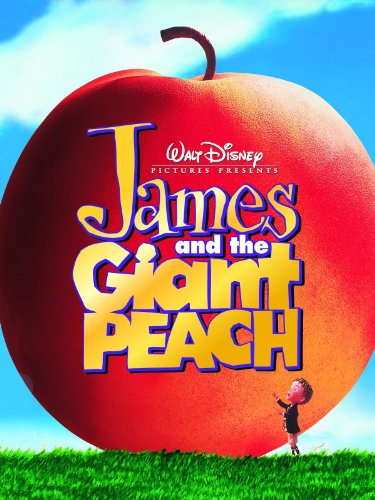
James and the Giant Peach, by Roald Dahl

James and the Giant Peach, by Roald Dahl

Reason for Reading: To keep up with my nephew’s book reports

Genre: Children’s Adventure / Fantasy

Review
After the tragic death of his parents, James has been living with his horrible neglectful, hateful aunts Sponge and Spiker. One day James is given a magical bag by a mysterious stranger – and in his excitement he trips on the root of a peach tree and dumps all the magic on the tree. Soon a peach larger than a house has grown out of the tree. James crawls into the peach and begins the adventure of a life-time. 

This is another classic kids story that I read as a child and haven’t picked up since. I’m glad I had a reason to pick it up again, because it was really funny and silly and it had a lot of nostalgia for me. Dahl has just the right amount of humor and whimsy in his books. 🙂


After reading the book, my nephew and I watched the 1996 stop-action movie. It was a cute movie that followed the basic story-line well enough. But it was a bit too sentimental and it lacked the dark humor of Roald Dahl’s story. Cute for an hour’s entertainment, but nothing I’m going to watch again and again. 
 

Lone Wolf, by Kathryn Lasky

Lone Wolf

Written by Kathryn Lasky, Narrated by Erik Davies

Reason for Reading: I rather liked the Ga’Hoole books, so I thought I’d try this series out, too. 

Genre: Juvenile Fantasy / Anthropomorphism

Review
As an infant cub, Faolin was taken from his mother and abandoned to die. He was found by a bear who nursed him through childhood. Now as a young wolf, Faolin is once again on his own and he must find a way to rejoin his own kind. This was a cute little story, and I enjoyed it. But I don’t think I would have enjoyed it half as much if I hadn’t read the Ga’Hoole books first. Although the story of Faolin is independent of the three story lines in the Ga’Hoole series, Lasky’s world-building in this book was a bit dependent upon the other books. The world would have seemed confusing and frustrating to me if I didn’t already know all about it from the Ga’Hoole books. This is why I gave the book only 3.5 stars even though I thought it was really sweet. I will continue with this series myself, but I recommend to all of you – continue with this book if you loved the Ga’Hoole books as I did. But if you haven’t read the Ga’Hoole books, start there. 🙂 

Maisie Dobbs, by Jacqueline Winspear

Maisie Dobbs

Written by Jacqueline Winspear, Narrated by Rita Barrington

Reason for Reading: Real Life book club

Genre: Historical Fiction / Mystery / Women’s Fiction

Review
Maisie Dobbs is disappointed when her first case as a PI is to investigate a potential infidelity; however, things get a little more interesting when her investigation brings to light a suspicious death in a home for soldiers injured in WWI. But investigating the home turns out to be more dangerous than she’d thought. 

This book was WAY outside my box. I generally don’t read women’s fiction or books that have a feminist leaning – though sometimes I enjoy such books. So this mystery wasn’t for me. The mystery part of the story was very light – she investigated a potential infidelity at the beginning, and at the end she investigated a suspicious home for injured soldiers. The middle half of the book was all Maisie’s background and character development, which I found off-topic and a bit contrived. Maisie is one of those WWI women who did absolutely everything the stereotypical WWI literary woman does. She got caught up in the feminist movement (somewhat), was educated beyond her class and gender, lied about her age so she could be a nurse in France, etc. etc. It’s like Winspear took a list of WWI woman stereotypes and checked them all off. Thus, I felt absolutely no empathy for Maisie’s character because she felt so fake to me. The little touch of mystery at the beginning and the end wasn’t enough to save the book. 

I can see that many readers would love this book – if you like women PI’s, especially of the historical variety, then this is probably a good book for you. The series IS popular. It just wasn’t for me. *shrug*

Anna Dressed In Blood, by Kendare Blake

 Anna Dressed in Blood

Written by Kendare Blake, Narrated by August Ross

Reason for Reading: I wanted to check off category 12 in Reading Outside the Box

Genre: YA Paranormal Romance / Horror

Review
Cas Lowood has always worked alone on his quest to dispatch murderous ghosts and discover the demon who killed his father. But when he moves to Thunder Bay everything changes – first, he has an explainable fascination with Anna, the ghost he’s come to kill; second, he accidentally picks up a team of teenagers who insist on tagging along as he rids the world of Anna’s horror. And Cas isn’t quite sure he wants to kill Anna anymore…

I picked this book up because of the fascinating cover art. (Yup! I’m one of those people.) I’m glad the cover was so awesome, because I enjoyed the book. Yes, it was sort of a copy of the TV show Supernatural, but that’s ok. Every story has its origins in another story, right? This book was fun and quick – I enjoyed the mystery and characters. If you like teen ghost stories, this would be a good book to pick up. But I recommend you pick up the physical book and not the audio book. Ross annoyed me with his too-clear annunciations, his pauses, and his slow reading. It ruined the rhythm of the narrative, and made the dialog fall flat. There were several times I wanted to give up on the book just because the narration was annoying me – and I generally am pretty laid back about audio books.  

The Ghost Map, by Steven Johnson

The Ghost Map

Written by Steven Johnson, Narrated by Alan Sklar

Reason for Reading: Science, Religion, and History group read

Genre: Non-fiction – Medicine and History


Review
The Ghost Map follows Dr. John Snow on his quest to discover the cause of a terrible cholera outbreak in Victorian England. Johnson makes investigative epidemiology so interesting that I could almost see it dramatized (and fictionalized) into a TV show – people DO love their investigative TV! 🙂 But that’s beside the point, I guess. At the time of this outbreak in 1854, the popular theory for the spread of cholera was miasma – deathly air that carried disease. After a LOT of investigative footwork, Snow drew a map of the cholera outbreak, demonstrating that the pattern followed streets that led to a particular well (the Broad Street pump) rather than following a circular pattern you’d expect with the spread of bad air. This map, and the investigation leading up to its creation, revolutionized epidemiology. In fact, many consider Snow the “first epidemiologist.” 

I really enjoyed this book. The writing was engaging (it had a few boring parts in the end when Johnson was describing the map in great detail – I think that may be a problem with listening to the audio book rather than actually reading it, though). The subject was fascinating. Sklar did a good job of narrating the book, and except for the very end with the description of the map, I was quite pleased with the book’s audio version. If you have any interest in epidemiology, or the history of medicine, I highly recommend this book.

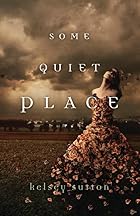
Some Quiet Place, by Kelsey Sutton

Some Quiet Place, by Kelsey Sutton

Reason for Reading: A free copy of the ARC was provided by Netgalley in exchange for an honest review. 

Genre: Teen paranormal romance

Review
Elizabeth Caldwell doesn’t remember a time when she felt emotions – her whole life has been blocked by a wall of nothingness where her feelings should be. Instead, she is able to see the personifications of Emotions all around her – Anger touches her former friend Sophia. Longing touching Joshua, the boy who has a crush on her. And Fear touches her mother, who claims Elizabeth is not her child – but perhaps a changeling that has taken the place of her daughter after a tragic accident at the age of 4. With the help of Fear, who has formed an obsession with the untouchable Elizabeth, she searches for answers to the questions that haunt her dreams. How did she become this way? Who is she? Is she in danger?

In some ways, this was an amazing book. I really loved the idea. I enjoyed thinking about Emotions as external personifications – powers that influence us by their touch or mere presence. I enjoyed the allegory of hiding your emotions in an abusive relationship – whether that be the result of an abusive parent or cruel bullies at school. I felt that this was a refreshing change from the dystopias, vampires, and werewolves that are popular these days. In this way, Sutton deserves 5 stars, and she has a lot of potential as a writer. 

On the other hand, this book does have the earmark of a debut novelist. Some things could have been done with more subtlety or finesse. The ending felt a bit long and clunky, for instance. And I sat through the entire book feeling that Elizabeth was an incredibly empathetic person considering she didn’t feel emotion. Was that intentional? Maybe. In fact, I’m inclined to give Sutton the benefit of the doubt and say that it was quite intentional. This was a very difficult character to develop, and Sutton did an amazing job of writing a character that had no emotions – but with whom I could relate.

I’m sad to say, this book DID have the dreaded love triangle. *sigh* I DO feel love triangles have a place in literature – my favorite Shakespeare play, Twelfth Night, features one – but lately (ever since the Twilight series, I think) it seems to be the basic romantic cop-out. Story doesn’t have enough romantic tension? Put in a love triangle! I wish more writers would take the time to think of a different technique to create tension. Isn’t there enough tension created just by the fact that Elizabeth doesn’t acknowledge emotion?

So, yes, I have a few quips about this book…but overall I think it was really creative and unique and I certainly hope Sutton continues writing. I have no doubt her debut-novel style will quickly vanish as she develops her career as a novelist. 🙂

Charlie and the Chocolate Factory, by Roald Dahl


Written by Roald Dahl and Narrated by Eric Idle

Reason for Reading: I’d watched the two movies with my nephew, who’d just read the book, and I decided that I wanted to know which one was more true to the book. 

Genre: Children’s Fantasy / Humor / Adventure

Review
When Willie Wonka announces that he’s hidden 5 golden tickets to his fantasticly famous, but very mysterious, chocolate factory, Charlie Bucket wishes more than anything that he could be one of the lucky 5 winners. But Charlie is very poor and can not afford to buy any of the chocolate bars that conceal the tickets. Luck knocks unexpectedly, though, and he’s up for the adventure of a life-time with 4 other kids – each of whom has at least one huge personality flaw. Violet Beauregarde is uber-competitive and has a nasty chewing-gum habit, Veruca Salt is spoiled rotten, Mike Teavee is a know-it-all who watches too much TV, and Augustus Gloop is grossly overweight and incredibly greedy. As the eccentric Willie Wonka takes the kids on a wild tour of his factory, each of the kids suffers dire consequences of their flaws. 

This is my FAVORITE Roald Dahl book. Hilarious and fun – and it has a classic movie that makes me even fonder of it. 🙂 I really enjoyed listening to Idle’s fantastic narration of the story – though I wish he’d sung the Oompa Loompa songs instead of just reading them. But no one’s perfect. 🙂 I think I enjoyed this book just as much as an adult as I had as a child. 

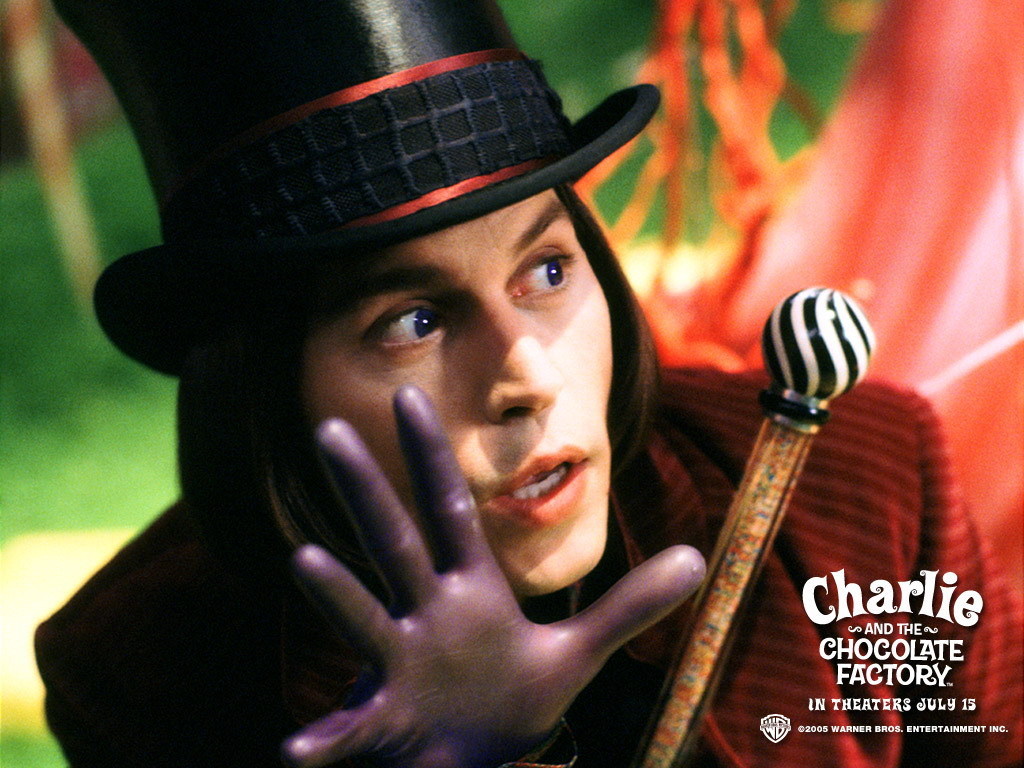
My nephew and I compared the two film adaptations. The first was the Gene Wilder version from 1971 and the second was the Johnny Depp version from 2005. I hadn’t seen the classic movie for many years, but I had watched the newer one when it came out. I remember being disappointed in the newer version, but this time around I rather enjoyed it. Yes. It was different than the classic movie, but they were both very interesting interpretations. They both took some artistic license – and each had some stronger points and weaker points. The 1971 version, of course, inserted all that stuff about Arthur Slugworth (not to be confused with Horace Slughorn) and the 2005 version inserted all that stuff about Wonka’s father. Other than that, there were only minor tweaks to the story in either one, and I was surprised to realize that they both were equally true to the book, in their own way.


So, who’s my favorite Willie Wonka? I don’t know! That’s really hard to decide. The character was acted QUITE well both by Wilder and by Depp, though in very different ways. Wilder’s was eccentric in a crazy-scary sort of way. Depp was eccentric in a wacky-vulnerable-creepy sort of way. These were very different interpretations  but I was surprised to realize that they were more similar to each other in some ways than they were to the book character (as read by Idle). Both of Depp and Wilder (especially Wilder) seemed almost to encourage the nasty little kids to misbehave. Willie Wonka of the book seemed mostly unconcerned with the consequences of misbehavior, but seemed to genuinely warn them not to misbehave. 
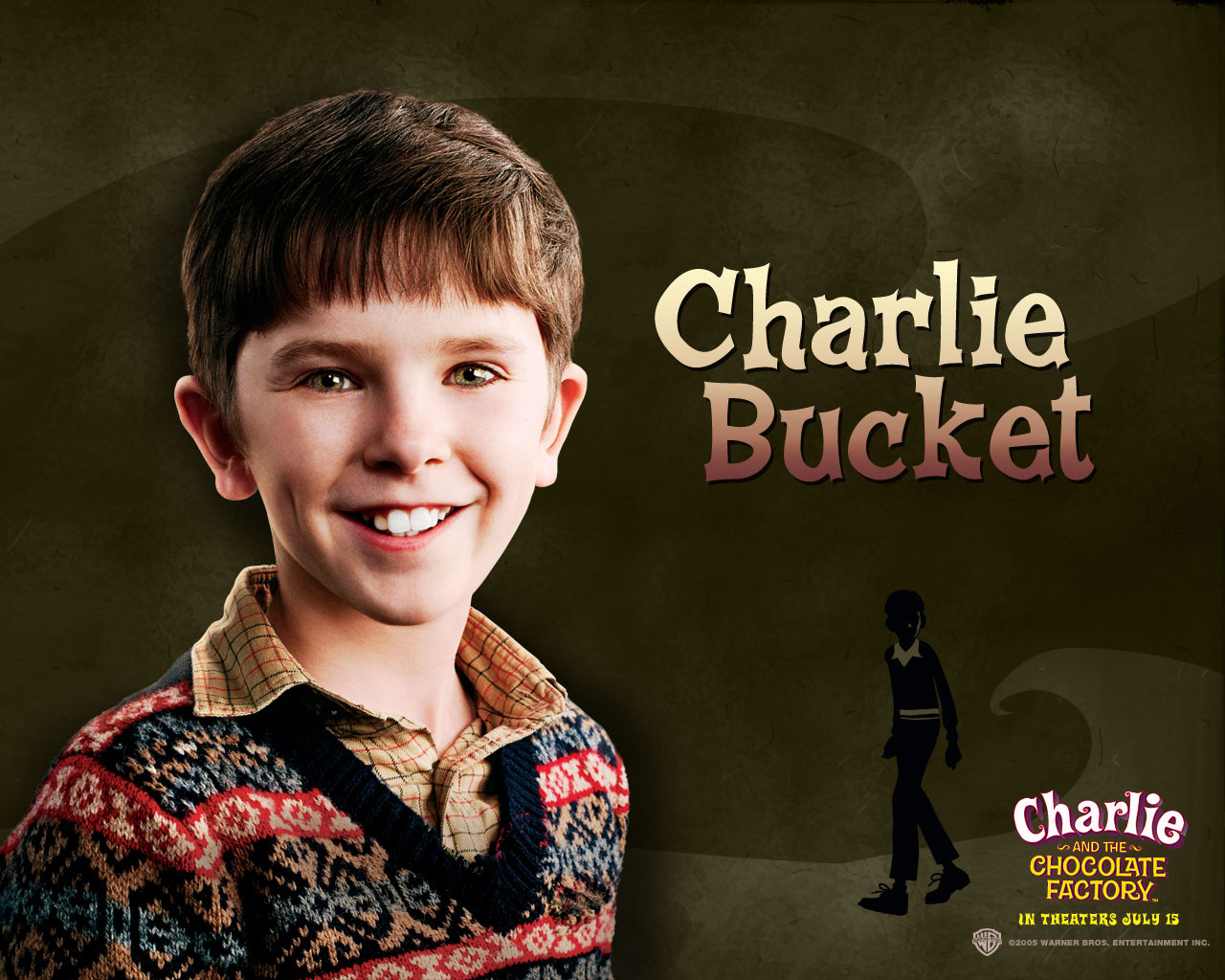
Charlie Bucket was cute in both movies, and the interpretations of the actors was fairly similar. I think Peter Gardner, of the 1971 version, sparkled just a tab bit more. Look at that cute expression when he finds the ticket. 🙂
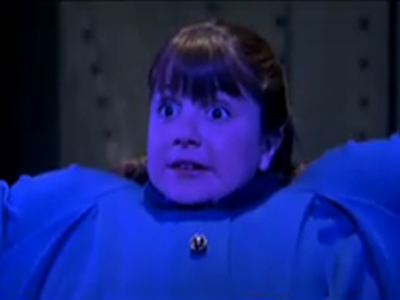
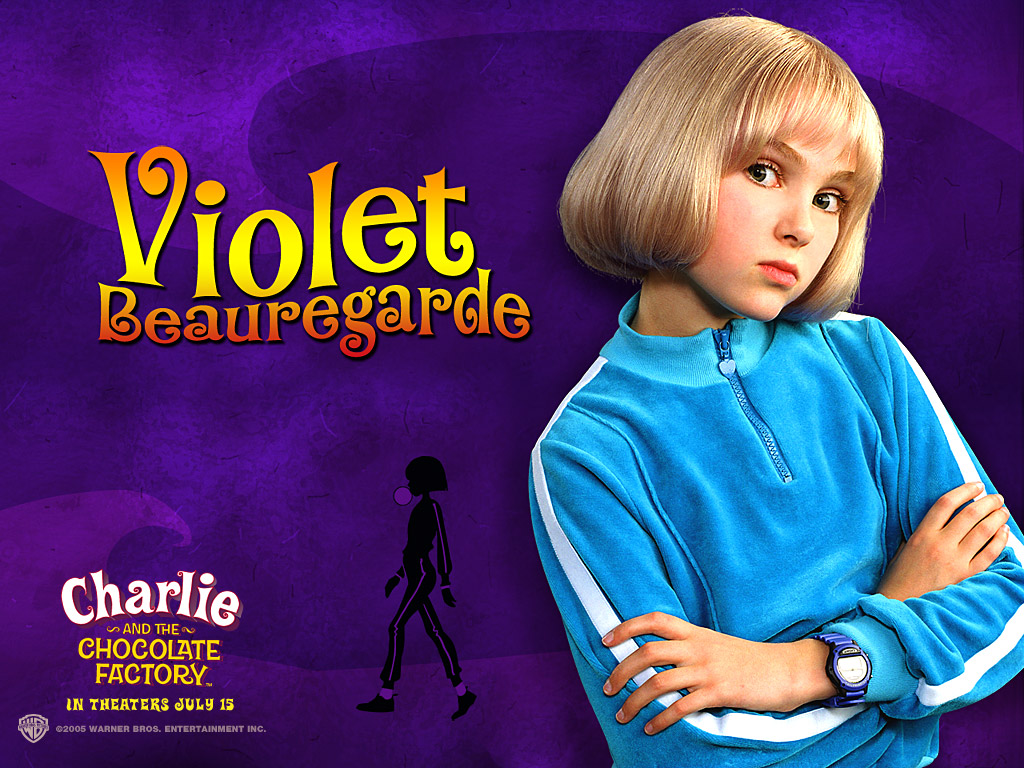
Violet Beauregarde was modernized in the 2005 version. She was still the over-competitive gum-chewing brat written by Dahl, but she was the daughter of a win-or-die beauty queen and was totally kick-butt in a losing-isn’t-an-option-because-you’re-better-than-them sort of way. Basically, it’s making fun of a certain stereotype of over-competitive girls that didn’t exist when Dahl wrote the book. So, the Violet of the 1971 version was more true to the kid in the book, but  I could better relate to the stereotype portrayed in the 2005 version – and I think this modernization was spot-on with the message Dahl portrayed in his book.
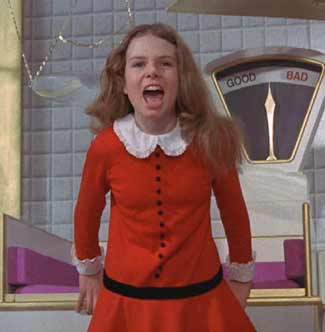
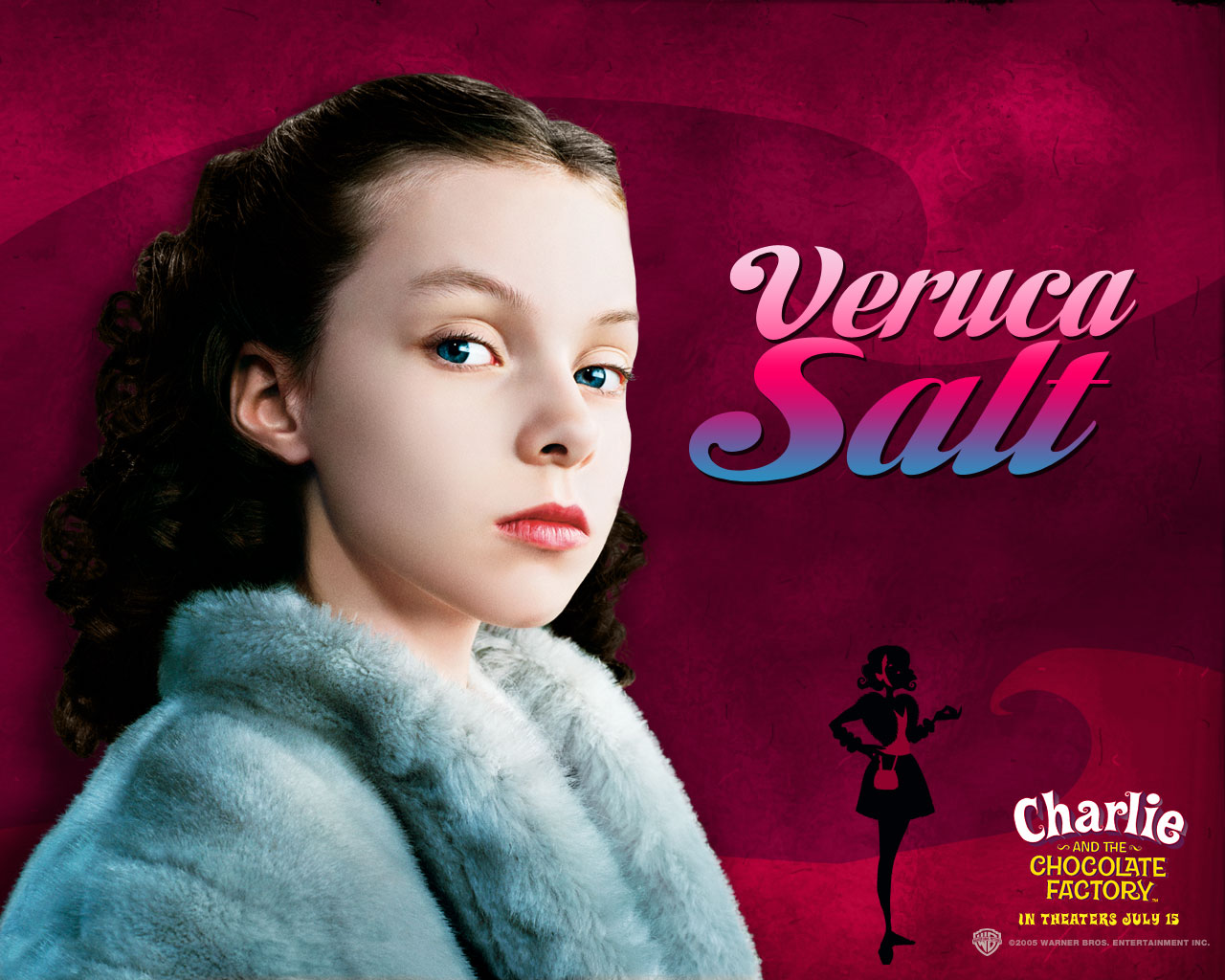
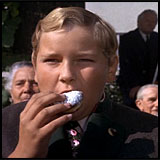
Veruca Salt was cuter in the 2005 version, but she had SO much more attitude in the 1971 version. Look at that “I want it NOW!” face. Definitely a bad egg.

Mike Teavee was obnoxious in both versions. He was modernized a bit in the 2005 version – he was addicted to video games rather than TV – but their interpretations of the character were pretty similar and I don’t see any reason to think one did a better job than the other.
The first thing my nephew said when he saw Augustus Gloop in the 2005 version is “he’s even fatter in this one!” Indeed, the only character trait Augustus had in the 2005 version is that he was severely obese. To the point of it being a little too much, I feel. Augustus Gloop in the 1971 version is quite fat enough to get the point across, and he has a lot more personality. 

Which movie did you like better, and why?
John Dies at the End, by David Wong

 John Dies at the End

Written by David Wong, Narrated by Stephen R. Thorne

Reason for Reading: Real Life bookclub

Genre: Quirky adult horror


Review
This book is the king of unreliable narration. Presumably, this book is about David and John, two friends in a Midwestern town who need to fight off evil forces when a new drug (soy sauce)  opens a door to a parallel universe. Although it’s clear that David exaggerates a good deal for the sake of story-telling, it is up to interpretation whether David and John are really kicking the EF from PU butt, or if they’re hallucinating. Either way, it’s a wild, crazy, and very humorous ride. The humor is very dark, dry, and sometimes witty. It was my favorite part of the book. The plot was fairly non-existent, though. The book was more about action and weirdness – the story was just too wild to actually have a coherent plot. During the middle of the book, I was starting to regret that it was so long because I’m more of a plot-driven than situational-driven reader. But I’m glad I hung in there, because I got some great laughs and may view the world a tiny bit differently after listening to this book. 

You wouldn’t think this book would lend itself well to audio format, but Stephen R. Thorne did an amazing job. His delivery of the dry humor and action was spot on. I’m happy that I took the risk on audio. 🙂

Against the Tide, by Elizabeth Camden

Against the Tide, by Elizabeth Camden

Reason for Reading: I’m leading the discussion of Against the Tide for the ACFW Bookclub on 5/27 – 5/31. If you would like to join the discussion (or see what else the bookclub is doing) you can join the Yahoo Group. There’s still time to read this fantastic book!

Genre: Christian Historical Romance 

Review
Lydia Pallas grew up surrounded with instability, but she is finally content with her comforting home and rewarding job as a translator for the U. S. Navy. She meticulously organizes her surroundings so that, for the first time in her life, she feels she’s in control of her life. However, her landlords are now threatening to throw her out of the only stable home she’s ever had. She needs to raise several hundred dollars to buy her home by December. Seemingly fortuitously, Alexander Banebridge (Bane), a friend of her boss, offers to pay her a lot of money for some free-lance translation work. Even though Lydia begins to question the odd requests of Bane, she finds herself attracted to his cleverness, charm, and sense of humor. Soon, she is swept up into a dangerous world of opium smuggling. 

I have a lot of good things to say about this book. I loved the late 1800’s Boston setting – it’s a time which lends itself easily to romance. Although there were a few moments that I wondered if the language was historically accurate, I felt Camden did an excellent job with her research into opium trade. Despite (or possibly because of) Lydia’s OCD quirks, she was very lovable. I really found myself empathizing with her pain – losing her family, the stress of raising money to buy the only home she’s ever felt safe in, and her feelings for Bane. On the other hand, I inwardly groaned at her devotion to Bane and his cause. I totally understood WHY she was in love, but cringed at the foolishness of loving a man who claims he has no interest in marriage, but doesn’t mind a bit of flirting. But love is foolish, often, isn’t it? 🙂 I was sort of torn – I empathized with her frustrations with Bane, but I also wished she would find herself a nice dedicated man. This is a similar conundrum I felt while reading Jane Eyre – I wanted her to live happily ever after with the man she loved, but I thought she was risking too much by loving him. I guess that makes it more romantic, in some ways?

The other thing that I really appreciated about this book (though my attention was only drawn to it because I’m about to lead a book discussion): the questions that Camden provided at the end of the book were really deep! I didn’t realize how many sticky philosophical and spiritual questions were brought up in the story until I read the discussion questions. And they’re not spiritual questions that have an obvious “right-if-you’re-REALLY-a-Christian” answer, which is what a lot of end-of-book discussion questions in Christian Fiction seem to be. Personally, I don’t see the world in black and white, so I love the opportunity to discuss grey. 🙂

Airman, by Eoin Colfer

Airman, by Eoin Colfer

Reason for Reading: Seemed like a good idea

Genre: YA Steampunk

Review
Conor Broekhart has grown up as the best friend of the princess of the Saltee kingdom (an imaginary kingdom off of Ireland). But when he discovers a conspiracy to kill the king, the real traitor captures him and sends him to a prison camp to mine diamonds in obscurity. Conor must use his genius for flight to escape the prison and rescue the princess. Conor is much like a 19th century steampunk Artemis Fowl. Colfer delivers his usual book – fun, delightful, and humorous. Definitely a treat for fans of non-dystopia non-paranormal-romance YA. (YAY! for something different!) I’d say this book is appropriate for 5th – 8th graders.