John Dies at the End
Written by David Wong, Narrated by Stephen R. Thorne
Reason for Reading: Real Life bookclub
Genre: Quirky adult horror
Review
This book is the king of unreliable narration. Presumably, this book is about David and John, two friends in a Midwestern town who need to fight off evil forces when a new drug (soy sauce) opens a door to a parallel universe. Although it’s clear that David exaggerates a good deal for the sake of story-telling, it is up to interpretation whether David and John are really kicking the EF from PU butt, or if they’re hallucinating. Either way, it’s a wild, crazy, and very humorous ride. The humor is very dark, dry, and sometimes witty. It was my favorite part of the book. The plot was fairly non-existent, though. The book was more about action and weirdness – the story was just too wild to actually have a coherent plot. During the middle of the book, I was starting to regret that it was so long because I’m more of a plot-driven than situational-driven reader. But I’m glad I hung in there, because I got some great laughs and may view the world a tiny bit differently after listening to this book.
You wouldn’t think this book would lend itself well to audio format, but Stephen R. Thorne did an amazing job. His delivery of the dry humor and action was spot on. I’m happy that I took the risk on audio. 🙂
Against the Tide, by Elizabeth Camden
Against the Tide, by Elizabeth CamdenReason for Reading: I’m leading the discussion of Against the Tide for the ACFW Bookclub on 5/27 – 5/31. If you would like to join the discussion (or see what else the bookclub is doing) you can join the Yahoo Group. There’s still time to read this fantastic book!
Genre: Christian Historical Romance
Review

Lydia Pallas grew up surrounded with instability, but she is finally content with her comforting home and rewarding job as a translator for the U. S. Navy. She meticulously organizes her surroundings so that, for the first time in her life, she feels she’s in control of her life. However, her landlords are now threatening to throw her out of the only stable home she’s ever had. She needs to raise several hundred dollars to buy her home by December. Seemingly fortuitously, Alexander Banebridge (Bane), a friend of her boss, offers to pay her a lot of money for some free-lance translation work. Even though Lydia begins to question the odd requests of Bane, she finds herself attracted to his cleverness, charm, and sense of humor. Soon, she is swept up into a dangerous world of opium smuggling.
I have a lot of good things to say about this book. I loved the late 1800’s Boston setting – it’s a time which lends itself easily to romance. Although there were a few moments that I wondered if the language was historically accurate, I felt Camden did an excellent job with her research into opium trade. Despite (or possibly because of) Lydia’s OCD quirks, she was very lovable. I really found myself empathizing with her pain – losing her family, the stress of raising money to buy the only home she’s ever felt safe in, and her feelings for Bane. On the other hand, I inwardly groaned at her devotion to Bane and his cause. I totally understood WHY she was in love, but cringed at the foolishness of loving a man who claims he has no interest in marriage, but doesn’t mind a bit of flirting. But love is foolish, often, isn’t it? 🙂 I was sort of torn – I empathized with her frustrations with Bane, but I also wished she would find herself a nice dedicated man. This is a similar conundrum I felt while reading Jane Eyre – I wanted her to live happily ever after with the man she loved, but I thought she was risking too much by loving him. I guess that makes it more romantic, in some ways?
The other thing that I really appreciated about this book (though my attention was only drawn to it because I’m about to lead a book discussion): the questions that Camden provided at the end of the book were really deep! I didn’t realize how many sticky philosophical and spiritual questions were brought up in the story until I read the discussion questions. And they’re not spiritual questions that have an obvious “right-if-you’re-REALLY-a-Christian” answer, which is what a lot of end-of-book discussion questions in Christian Fiction seem to be. Personally, I don’t see the world in black and white, so I love the opportunity to discuss grey. 🙂
Airman, by Eoin Colfer
Airman, by Eoin ColferReason for Reading: Seemed like a good idea
Genre: YA Steampunk
Review

Conor Broekhart has grown up as the best friend of the princess of the Saltee kingdom (an imaginary kingdom off of Ireland). But when he discovers a conspiracy to kill the king, the real traitor captures him and sends him to a prison camp to mine diamonds in obscurity. Conor must use his genius for flight to escape the prison and rescue the princess. Conor is much like a 19th century steampunk Artemis Fowl. Colfer delivers his usual book – fun, delightful, and humorous. Definitely a treat for fans of non-dystopia non-paranormal-romance YA. (YAY! for something different!) I’d say this book is appropriate for 5th – 8th graders.
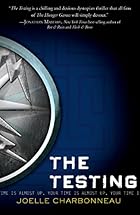
The Testing, by Joelle Charbonneau
The Testing, by Joelle CharbonneauReason for Reading: This book was provided by the publisher through Netgalley in exchange for an honest review. This book will be released in June 2013.
Genre: Young Adult Dystopia
Review

Cia wishes more than anything that she will be chosen for the testing procedure – leading to a university education. But the testing procedure turns out to be more than she’d bargained for. The other kids are literally cut-throat competitors, and the testing officials are cruel and calculating. Will Cia be able to hang on to the person she is and still pass the test? Does she even want to pass the test anymore? What dire consequences really do follow failure?
This book was a fantastic addition to the popular young adult dystopia genre. It took me a little while to get in to the story because there was little to distinguish it from all the other YA dystopias I’ve read lately, but after about 50 pages I was really sucked in and wanted to know where Charbaonneau was taking the story. I had an inkling what might happen in the end – sort of a “wow, I hope it goes in this direction, because that would make the next two books really interesting.” And it DID go in that direction. So, the ending wasn’t unpredictable, but it was unique, and I was in suspense for the entire book which way it would go. I hope she really works that aspect in the second and third books. To me, that’s the aspect that will make this trilogy stand out from the crowd. Another thing I liked is that although there’s potential for a love triangle, that aspect wasn’t focused on. As I’m really tired of the triangle, the lack thereof was very refreshing. I hope the trilogy stays that way. The violence might be a bit off-putting to some young readers, but I’d say it’s about the same as The Hunger Games – maybe a little less.
Overall, a fun quick read. I hope this trilogy is popular. 🙂
How the Catholic Church Built Western Civilization, by Thomas E. Woods
How the Catholic Church Built Western CivilizationWritten by Thomas E. Woods, Narrated by Barrett Whitener
Reason for Reading: I have an interest in Church history and history of religion.
Review

How the Catholic Church Built Western Civilization is an apologetics treatise about how the Catholic Church contributed to the development of science, philosophy, art, and culture. For someone who has not read a lot of books on the subject – who wishes to be disabused of the belief that the Catholic Church shunned science and tried to halt the progression of culture – this book is an excellent introduction. It covers a wide variety of topics in a superficial survey of how the Church changed and promoted civilization. On the other hand, if you’re like myself and are well-read on the subject, this book lacks depth. Although there was a wide variety of information discussed, there was very little that it discussed in greater detail than I already knew. Therefore, I would highly recommend this text to someone who’d like an introduction to the topic – it’s well-written, well-researched, and interesting. But if you’re looking for depth and detail, this may be worth just a quick read.
This audiobook was well-narrated by Barrett Whitener. No complaints there! 🙂
Interview with Elizabeth Camden
Hi everyone! I’ll be leading a discussion of Against the Tide by Elizabeth Camden for this month’s ACFW Bookclub. The discussion will take place from May 27 – 31st on a Yahoo groups email list. Everyone is welcome to join, and there’s plenty of time to read the book! Elizabeth will be participating in the discussion as well. I’ve included an interview with Elizabeth to entice you.
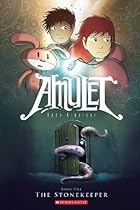
The Stonekeeper, by Kazu Kibuishi
The Stonekeeper (Amulet Book 1), by Kazu KibuishiReason for Reading: Helping my nephew with his book report.
Review

When their father dies, Emily and Navin must move with their mother to a run-down house in the middle of nowhere – an inheritance from a great uncle they’ve never met. On their first night in the disturbing old house, their mother is kidnapped by a gigantic squid-thing and the kids must rescue her with the help of a talking amulet that they’ve found in a dusty room.
I read this because my nephew really loved it, and he’s a very reluctant reader. I can see why he liked it – there’s lots of pretty pictures and very few words. It’s a book appropriate for middle-graders both in vocabulary and in plot. It was a cute, fast read, and I’m sure I’ll read the rest in the series. However, it’s not a book that would appeal to me for any other reason than bonding with my nephew. The premise and plot are simply too unsophisticated to be of much interest to most older kids or adults. On the other hand, the book seems to be VERY popular with the younger crowd, and I highly recommend The Stonekeeper for reluctant readers.
Harry Potter and the Half-Blood Prince, by J. K. Rowling
Harry Potter and the Half-Blood Prince
Written by J. K. Rowling, Narrated by Jim Dale
Reason for Reading: Re-reading the Harry Potter series in audio format.
Review
(Contains spoilers from earlier books in series)
The Ministry of Magic has finally admitted that Voldemort has returned, and Dumbledore has returned as Hogwarts Headmaster. Furthermore, Dumbledore has realized that it was a huge mistake to leave Harry in the dark for so long. He and Harry become much closer in Harry’s sixth year at Hogwarts, as Dumbledore reveals much of what he knows of Voldemort’s history and motivations to Harry. Harry is also kept busy with his new obsession that Draco Malfoy is up to new levels of “no good.” Ron and Hermione poo-poo his suspicions and keep themselves busy with escalating romantic tension.
Altogether, this book has a LOT going on, yet it’s more compact than the previous two books. Overall, I think this is Rowling’s best written book in the series, even if my favorites are the first four. I really enjoyed this re-read of the 6th book in the Harry Potter series – it’s only my second time reading this book, and I had forgotten a lot of it. The romantic tension between Ron and Hermione is my favorite part of the book, since it’d been building for SO long and was finally let loose terrifically. 🙂
Jim Dale’s reading, as usual, is excellent. It took some getting used to, but after the first or second book it really grew on me. I know all his voices for the characters, and that really ads to my enjoyment of the story.
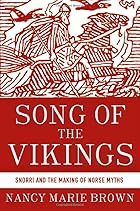
Song of the Vikings, by Nancy Marie Brown
Song of the Vikings: Snorri and the Making of Norse Myths
Written by Nancy Marie Brown
Reason for Reading: This book was provided by the LibraryThing Early Reviewers program in exchange for an honest review.
Review
This engaging biography describes the life of Snorri Sturluson, a powerful 12th-century Icelandic chieftain and the author of the poetic Edda – one of the oldest surviving documents of Norse mythology. As a novice of Viking history, I found this book fascinating and informative – though I suspect that there is much speculation and Brown isn’t always clear when she is speculating and when she has hard evidence for her claims. As such, I think this biography would be enjoyed by people who are interested in learning a bit about the Vikings, but not experts on the subject.
Brown started each chapter out with a legend out of Snorri’s Edda. Often, she told how this legend differs from other known versions and/or how it has affected modern culture. The rest of the book describes Snorri’s life – his youth in the household of “the uncrowned King of Iceland,” his marriage, his rise to political power, and his downfall. She seemed to get most of her hard evidence from a few primary documents and an outwardly biased biography written by Snorri’s nephew, so often she had to fill in the gaps by saying “it’s possible it happened more like this, since his nephew’s story doesn’t really jive with Snorri’s personality.” Of course, that makes me wonder if she had just as much positive bias towards Snorri as his nephew had negative bias. 🙂 Overall, though, I’d say this biography was a success. When there is so little information available, and when the book is intended for a popular crowd rather than an academic one, such speculation is necessary – it makes the book more fun.
Deadly Offer, by Caroline B. Cooney
Deadly Offer, by Caroline B. CooneyReason for Reading: This book was provided by the publisher through Netgalley in exchange for an honest review. When I was a teenager, I read the second book in this trilogy, and I was curious what I would think of the first.
Review

Althea craves popularity. She wants to be a cheerleader – swooned over by all the jocks and the envy of all the girls. When, against custom, she opens the shuttered tower room in her house, she releases a vampire who makes a deal with her: If she brings him victims, he will give her popularity. Althea finds herself spiraling out of control as the vampire asks for more and more – and she feels she has to give it to him or suffer public humiliation.
Looked at from a superficial point of view, there’s really not much to this book. It’s barely 200 pages long, and has little plot or character development. It’s pretty standard for those Point Horror books that were being pumped out in the ’90s. Teen readers should be wary – this is a quick, fluffy read with a (how dare Ms. Cooney?!) BAD vampire. Yes. That’s right. His skin looks and smells like soggy mushrooms. He feeds on the weakness of teenagers. And he doesn’t sparkle. He is in no way, shape, or form romantic. It was SUCH a wonderful change. 🙂 As long as bad vampires don’t insult your intelligence, you’ll enjoy this book if you’re 11-14ish. Or you might enjoy it if you’re older and enjoy exploring ideas.
What I liked about this book was that it was more meaningful on a deeper level. There were hints all along that Althea could have made herself popular on her own – that her own attitude ensured her unpopularity. She assumed no one knew she existed, so she hid from everyone. Result – nobody paid her any attention. This is also a story about how far some people are willing to go in order to gain what they want. She sacrificed her morals and trampled on other people in order to achieve her goals – and then she was dissatisfied with the results. It’s a story about being true to yourself and how your goals will be more lasting when you achieve them through hard work instead of back-stabbing. Any book that makes me think earns points with me! 🙂
Another thing that made me think: where the heck were her parents through all of this?! They weren’t mentioned even once! Did Cooney mean to do that? I read the second book in the trilogy many years ago, and I remember THAT protagonist had parents…