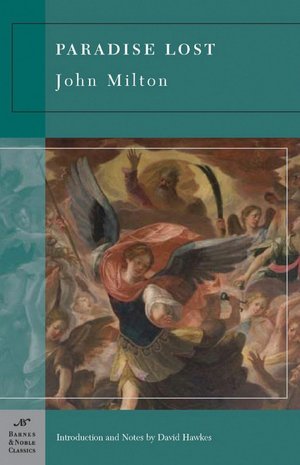
Milton and Paradise Lost: A Quest to Understand
Today, I am beginning yet again on my quest to understand Milton’s epic Paradise Lost. I have already listened to it on audio and read it once through using the Barnes and Noble edition. Now, I have purchased the Norton Critical Edition. I will read AND listen to the Norton Critical edition, and compare to the footnotes in the Barnes and Noble edition. I will read supplementary materials. I will record my quest here, because I know everyone who reads my blog is raring to hear follow me on my quest. 🙂
My first notes will be on David Hawkes’ introduction in the Barnes and Noble edition:
NOTES ON THE INTRODUCTION BY DAVID HAWKES (in Barnes and Noble edition)
During the time building up to the writing of Paradise Lost, the “free market” concept was emerging. In this system, land was being taken away from peasants and their labor was being exchanged for money. This emerging free market system seemed like objectification of labor, as if the laborers were “signs” or “symbols.” This system seemed idolatrous to Milton.
Henry VIII separated from the Roman Catholic Church so he could get a divorce, but he disliked many of the Protestant ways, so the Anglican church was more similar to the Roman Catholic Church than Puritans were comfortable with. They wanted to be free of religious practices they viewed as idolatrous.
Meanwhile, the new market economy provided a means for non-gentlemen to get money, so the long-established structure of the English society was breaking apart. Charles I kept trying to get Parliament’s consent to raise taxes, but Parliament insisted on economic or religious reformation as stipulations. Therefore, Charles I increased taxes without Parliament’s consent (around 1640). In 1642, Charles I needed to raise an army to quell the rebellion in Ireland, but Parliament no longer trusted him. Charles I left London and raised his army in Oxford, which initiated civil war. This is when Milton emerged into history. He considered the “free market” and legitimization of usury to be idolatrous. He wrote many political pamphlets about his views.
Paradise Lost is about Satan’s idolotry. It could even be viewed as a prophecy of today’s world, in which everything is represented as a symbol (think of virtual reality and the internet). To Milton, even viewing our perception of the world as reality was idolatrous. We forget that, through the filters of our human minds, we can not perceive the truth as it really is. Therefore, when we view our perceptions as reality, we are idolatrous.
…At least, so says Hawkes. I find this an interesting opinion and will look more into Milton’s political writings to see if I agree that Milton’s view of the political and economic state of affairs was idolatrous and consider how this may be represented in his epic allegory.
(TO SEE MORE INFO ABOUT PARADISE LOST, GO TO MY MASTER POST)
The Amber Spyglass, by Philip Pullman

2012 Book 109: The Amber Spyglass, by Philip Pullman (7/19/2012)
Reason for Reading: I was interested to see where Pullman was taking the Paradise Lost allegory
My Review
Lyra and Will finish up their journey (started in The Golden Compass) while desperately trying to dodge enemies and make the right choices. I enjoyed this book even less than the second book, The Subtle Knife, though The Golden Compass was in the “ok” range. I just didn’t feel attached to the characters of Lyra and Will, and I didn’t care what decisions they made. There was WAY too much Buddha-on-the-mountaintop both in the narrative and in the dialogue. I realize Pullman had a message he was trying to portray, and it wasn’t a bad message (if you ignore all the hateful representations of organized religion)–he wanted to say that you should enjoy and live life here on Earth. What is happening in the present is what is important. Build the “Kingdom of Heaven” here on Earth instead of always denying our fleshy bodies as we look to our afterlife. This is a reasonable message, but I felt as if I was pounded over the head with it–to the point that it was distracting from the action. Furthermore, the action seemed to stop half-way through the book, followed by a long philosophical denouement. I WAS interested in his message, and that’s why I continued the book after I didn’t like the second…but it was a long haul for me. I don’t really understand why this series is as popular as it is? But that’s just my opinion. *shrug*
A note on Pullman’s Message
In his 1998 article in The Guardian, The Darkside of Narnia, Pullman stated his opinion about the Narnia series: “there is no doubt in my mind that it is one of the most ugly and poisonous things I’ve ever read.”
He didn’t like Narnia because of Lewis’ blatant Message. The ironic thing is, Pullman’s message is JUST as blatant, and in many ways just as hateful as he considers Narnia’s message to be (his representation of organized religion is very hateful). It is difficult for me to like the Pullman’s trilogy when I can’t help but see his Message and feel the full impact of its irony. It’s probably good that there are people out there who are able to ignore it! 🙂
In case you’re interested, there’s also a 2005 New Yorker article on Pullman’s inspirations for His Dark Materials. It touches on his views on C. S. Lewis and J. R. R. Tolkien. Far From Narnia, by Laura Miller.
Translation of the Bones, by Francesca Kay

2012 Book 108: Translation of the Bones, by Francesca Kay (7/17/2012)
Reason for Reading: This book was longlisted for the Orange Prize this year, and it peaked my curiosity so I decided to give it a try.
My Review 
When Mary-Margaret, a well-meaning but slow young woman, sees a vision of Jesus’ blood in a Roman Catholic Church, she stimulates a miracle-craze which compels many people to question the meaning of faith. This is a very difficult book for me to review because I’m rather ambivalent about it. It is deep with meaning—but would mean something different to the “faithful” than it would to the “faithless.” This is a quality that few books attain, and I believe this is why it deserved to be nominated for the Orange Prize. However, this story is also very sad…it took me in a direction I didn’t expect. There were a lot of negative messages mixed in with the positive messages, which, I suppose, represents life perfectly. But still…some of it was hard for me to read. I would recommend this book to anybody who wants to explore faith and the meaning of mother-child relationships more deeply, and with an open mind.
Fantasy Media in the Classroom, ed. Emily Dial-Driver

2012 Book 107: Fantasy Media in the Classroom, ed. Emily Dial-Driver (7/12/2012)
Categories: Other
Reason for Reading: Early Reviewer’s Book.
My Review 4/5 stars
Fantasy Media in the Classroom is a collection of essays which describe why fantasy media and popular culture are useful in the classroom. For instance students can learn the same techniques using popular fiction as they can with an old-school class, but they feel more confident in their analyses because they already feel like they are experts on popular culture. These lessons and confidence can then be extrapolated on to classical literature. Fantasy Media in the Classroom also gives examples of how popular culture can be used to design lessons. This book was written mostly from the perspective of teaching college students, but a few essays talk about high school students. It’s possible these lessons could also be changed a bit and used for younger students, as well. I think this book would be useful to teachers, even if they don’t plan on fully incorporating popular culture in their classrooms, because it may help them to see the benefit of popular culture references their students make during class…and how such references could be embraced as an interesting interpretation rather than brushed off. I am not a teacher, but I found this book interesting because it helped me to better understand what fantasy media says about psychology/sociology/politics.
Saving Hope, by Margaret Daley
Abraham, by Bruce Feiler

2012 Book 105: Abraham: A Journey to the Heart of Three Faiths, by Bruce Feiler (7/11/2012)
Reason for Reading: It fit into Reading Globally’s Middle Eastern literature theme.
My Review 3.5 stars
In this short work, Feiler reviews the Biblical story of Abraham and then describes how the myth of Abraham has changed over time and between the Abrahamic religions. It is well-written and interesting, and its length is well-suited for the amount of information Feiler wishes to convey. (There were no lengthy speculations in order to add bulk!) I enjoyed it and learned a little bit, too!
Infidel, by Ted Dekker

2012 Book 103: Infidel, by Ted Dekker (7/9/2012)
Reason for Reading: Second book in the Lost Books of History series
My Review 
May contain spoilers for the first book, Chosen
Johnis has discovered that his mother is still living. He risks his life to follow his heart–which tells him to rescue his mother from the Horde. This second book in the Books of History series follows directly on the footsteps of the first book, Chosen. Since the world is less new to the readers, this second book spends more time developing action and suspense and less time describing the world. Thus, it is a more enjoyable read. It ends, of course, with a cliffhanger, leaving the reader wanting to read the third book.
Stuart Little, by E. B. White

2012 Book 104: Stuart Little, by E. B. White (7/10/2012)
Reason for Reading: Believe it or not, I have neither read this book, nor seen the movie. 🙂
My Review 
In this classic tale for children, the Little family adopts a son, Stuart…but he turns out to look very much like a mouse! As Stuart grows, he has many adventures within his home and, later, out in the real world. This is an adorable book filled with child-like adventure. Appropriate to be read to young children, or to be read by a 2nd or 3rd grader.
The Song of Achilles, by Madeline Miller

2012 Book 102: The Song of Achilles, by Madeline Miller (7/8/2012)
Categories: Speculative Fiction, Award Winner
Reason for Reading: This book won the Orange prize this year.
My Review 5/5 stars
On the outside, this book is a retelling of Achilles’ actions in Troy; however, Miller has incorporated deeper elements to the well-known story. The Song of Achilles is a celebration of Achilles’ humanity, rather than of his God-like martial skills. It is a touching love story between Achilles and his companion Patroclus. It is a story of forgiveness for human flaws. And it shows the reader that sometimes the best part of the story is forgotten in legends. Above all, it’s one of those books that sucks you right in…and then leaves you breathless when it’s over. Although Song of Achilles is technically fantasy, it is also a book that can be enjoyed by literary snobs and by people who don’t know much about Greek mythology. I loved it.