
Paraphilic Disorders

Paraphilias are sexual behavior patterns in which unusual objects, rituals, or situations are required for full sexual satisfaction. And yes, believe it or not, paraphilic disorders are diagnosable in the DSM-5. But in order to have a disorder, you can’t just be turned on by unusual situations – it has to involve suffering or humiliation of yourself or others. (Though unfortunately, the suffering may be caused by stigma within society.) I will list several paraphilic disorders and discuss each: 

Fetishistic Disorder: Individual has recurrent sexually arousing fantasies, urges, and behaviors involving inanimate objects (i.e. women’s underwear) or parts of the body (e.g. feet). People with fetishes are generally men. 

Transvestic Disorder: Hetreosexual men who must be wearing women’s clothes in order to experience full sexual experience. 

Voyeuristic Disorder: Individuals with voyeuristic disorder have intense sexual fantasies and behaviors of watching women undress or watching the sexual activities of others. People with this disorder are generally young men. 

Exhibitionist Disorder: These individuals have intense sexual desire and behavior to sexually expose themselves to others. This generally is a man exposing himself to a young, unsuspecting woman; but sometimes they expose themselves to children. 

My dad tells the story that one time he was standing in a check-outline for groceries, and a man laid it all out on the cashier’s countertop. Cool as a cucumber, and without even glancing at the man, she rang up a can of food and then whammed it down hard on…well, you know where. That man was hauled out in an ambulance. Sometimes bad decisions are made. 

Frotteuristic Disorder: In frotteuristic disorder, someone is sexually excited by rubbing his genitals against an unwilling participant. I originally became familiar with this one due to a series of incidents (twice involving myself) with a coworker in retail. Very, very gross. Ick. But it was an experience to learn a new word when my dad was like “Oh! there’s a disorder for that!”

Sexual Sadism DisorderThe term “sadism” derives from the Marquis de Sade who got great sexual excitement out of inflicting cruelty upon people. Similarly, an individual with sadism disorder is aroused by psychologically or physically abusing someone. When sadism is inflicted upon a willing participant, it is not considered a disorder. But some sexual sadists inflict it upon partially or fully unwilling people.

Sexual Masochism Disorder: The term “masochism” is based on a fictional character created by Leopold V. Sacher-Masoch. In masochism disorder, an individual must get intense sexual pleasure from fantasizing about or indulging in the experience of pain.

Sado-masochistic relationships can be healthy and cooperative, within reason; however, masochism can lead to humiliating experiences and sometimes death. 
This is a series of posts summarizing what I’m learning in my Abnormal Psychology course. Much of the information provided comes from reading my James N. Butcher’s textbook Abnormal Psychology. To read the other posts, follow these links: 

The Definition of Abnormal
A History of Abnormal Psychology
Abnormal Psychology in Contemporary Society
Contemporary Viewpoints on Treating Mental Illness – Biology
Contemporary Viewpoints on Treating Mental Illness – Psychology
Frontline: New Asylums
Brave New Films: This is Crazy
Clinical Mental Health Diagnosis: Biological Assessment
Clinical Mental Health Diagnosis: Psychological Assessment
Does the DSM Encourage Overmedication?
Post Traumatic Stress Syndrome – The Basics
Panic Disorder
Obsessive Compulsive Disorder
Hoarding and Body Dysmorphic Disorders
Depression – an Overview
Personality Disorders – Clusters and Dimensions
Personality Disorders – Cluster A
Personality Disorders – Cluster B
Personality Disorders – Cluster C
Biological Effects of Stress on Your Body
Somatic Symptom and Related Disorders
Dissociative Disorders
Borderline Personality Disorder
Dialectical Behavioral Therapy
Paraphilic Disorders
Gender Dysphoria – Homosexuality and Transgender
Anxiety Disorders
Bipolar Disorder – The Basics
Suicide – An Overview
References:

Butcher, James N. Hooley, Jill M. Mineka, Susan. (2014) Chapter 12: Sexual Variance, Abuse, and Dysfunctions. Abnormal Psychology, sixteenth edition (pp. 405-442). Pearson Education Inc.

November 2015 Review

This was a good month. I had three Thanksgiving celebrations: one with my cousins in Iowa, one with my boyfriend’s family, and one with my own family & boyfriend. They were all a wonderful time. I’m pleased with my progress in my Abnormal Psychology class, work is going uneventfully, and I was very active on my blog. I tried to alternate between “lecture” posts and book review posts this month.


I participated in Nonfiction November with the ladies at  Doing DeweySophisticated DorkinessI’m Lost in Books, and Regular Rumination. During the month, I read 6 nonfiction books (Evil Hours, I am Malala, The Epic of Gilgamesh and Old Testament Parallels, Quiet, and The Archetypal Significance of Gilgamesh) and reviewed 7. I also enjoyed reading science fiction along with Rinn Reads. I was only able to read 2 science fiction books (The Martian and Shada), and review 3. 

Next month I’ll be joining the Christmas Spirit Reading Challenge hosted by The Christmas Spirit. So far, my plans are Little Women, by Louisa May Alcott; The Three Sisters, by Sonia Halbach; and The First Christmas, by Marcus Borg. Hopefully I’ll be able to squeeze in some more. You can see other upcoming challenges in my Challenges Tab.

I’ve been having trouble with formatting this month. If I add a link or italicize after-the-fact, it sometimes turns out really big. In past months, I could resize it, but now it won’t let me do that. It’s irritating. Any advice? 


Abnormal Psychology Posts:

Depression – an Overview
Personality Disorders – Clusters and Dimensions
Personality Disorders – Cluster A
Personality Disorders – Cluster B
Personality Disorders – Cluster C
The Biological Effects of Anxiety on the Body
Stress and Your Body – An Introduction
Somatic Symptom and Related Disorders
Dissociative Disorders
Borderline Personality Disorder
Dialectical Behavioral Therapy

Book & Movie Reviews:

The Noonday Demon, by Andrew Solomon
Dark Eden, by Chris Beckett
Gilgamesh Translations
The Biology of Desire
The Martian, by Andy Weir
The Gilgamesh Epic and Old Testament Parallels, by Alexander Heidel
Black Five, by J. Lynn Bailey 
Crazy: A Father’s Search Through America’s Mental Health Madness, by Pete Earley
Quiet, by Susan Cain
Evil Hours, by David J. Morris
I am Malala, by Malala Yousafzai and Christina Lamb
Shada, by Douglas Adams and Gareth Roberts

Book Completed: 


Acquired:

Movies/Shows Watched: 


This update is posted to Sunday Salon, Sunday Post @CaffeinatedBookReviewer, Stacking the Shelves @Tynga’sReviews,  @MailboxMonday, It’s Monday What are You Reading @BookDate

Shada, by Douglas Adams and Gareth Roberts

Shada: Doctor Who, the Lost Adventure
By Douglas Adams and Gareth Roberts
Narrated by Lalla Ward and John Leeson

Shada is a novel tie-in to the popular TV series Doctor Who. Specifically, it is based on the screenplay (written by Douglas Adams) of an unbroadcast eighth doctor story arc.  The Doctor, Romana, and K-9 go to visit an old friend, Professor Chronotis, after receiving a distress signal. It turns out that Chronotis had stolen a dangerous book: The Worshipful and Ancient Law of Gallifrey. All the Time Lords have heard of this book, but none of them quite seem to remember what it’s for. When the book is accidentally borrowed by a post-doc, the Doctor and Romana must find the book and keep it out of the hands of Skagra, an evil genius bent on becoming the universe. (Important distinction here – he’s not taking over the universe; he’s becoming it.) 

This is the first time I’ve ever read a novel tie-in to a show or movie. My opinion has always been that books can become movies but movies shouldn’t become books. You have to add in so much information for a TV novelization to be a good book. When I read a book, I’m not just looking for a story, I’m looking for beauty. For art. For characterization. These are things that this book did not particularly have. You knew who the characters were, after all. Why develop them? You knew about the world in which this story was taking place. No need for world building. So, in that way, the book isn’t what I’m generally looking for in a book. 

That said, this book did have humor, excitement, and familiar friends going through wild adventures. It was Doctor Who, after all, how could I not like it? 

The book was well-read – narrated by the actress who played Romana in the TV show. K-9’s voice was John Leeson, as well. So that was a very nice touch. This is my first time listening to a dramatization with sound effects. I’ve heard multiple-reader dramatizations, but never with footsteps, creaking doors, etc. It was kind of fun. Maybe I’ll try something like this out again. 

I’m going to have to give this book 3.5 snowflakes because I prefer books that have more characterization and world-building. But I also recognize that this is not what tv novelizations are meant to have. 

Dialectical Behavioral Therapy

To supplement my post about borderline personality disorder (BPD), I’ll comment on a highly effective therapy developed especially for BPD. I, myself, have been through DBT and can attest to its wonderful results. DBT is a modified form of cognitive behavioral therapy (CBT). CBT focuses on addressing cognitive distortions (thoughts that assume negative reasons for a potentially neutral situation) and practicing changing the way you think about the situation. DBT focuses on accepting the way you think, but changing the way you react to the thoughts. 


DBT was created by Marsha Linehan for patients with BPD, but is now used for many other disordered patients who suffer from suicidal ideation and self-harm. DBT teaches skills that a person can use to react healthily to difficult emotions. 


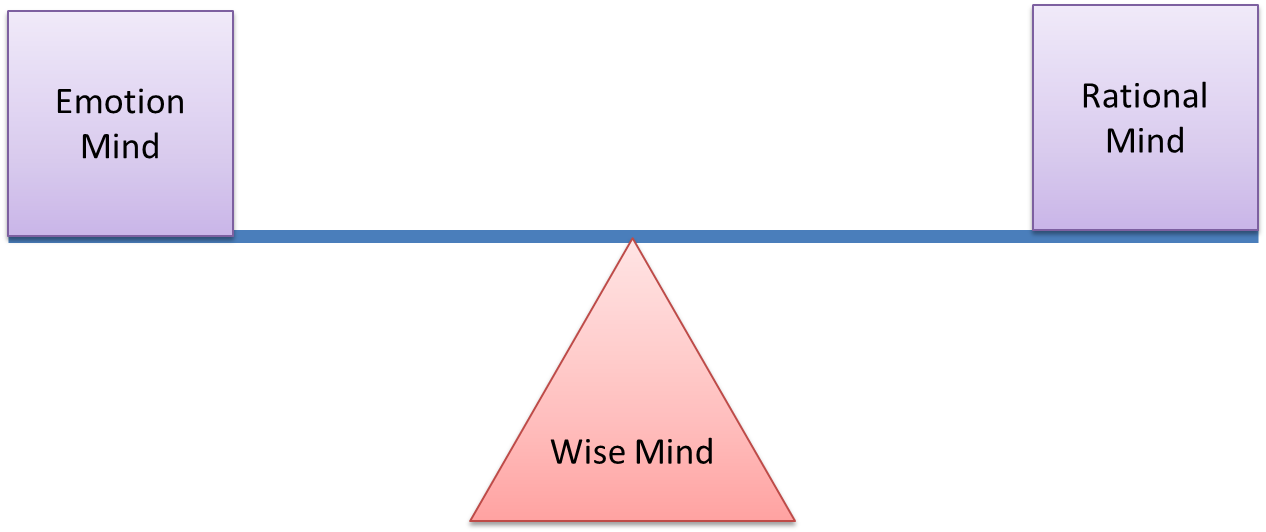
A dialectic, in the DBT sense, can be represented as a see-saw of extremes, with a healthy center-point. For instance, two state-of-mind extremes include Emotion Mind and Rational Mind. Emotion Mind is when a person’s thoughts and actions are governed entirely by emotions. This could be good – such as when someone is in love – but it is often bad. Too much emotion can lead to inappropriate decisions, behaviors, and unhealthy thoughts. 

On the other side of the see-saw, a person might be in Rational Mind. Although this sounds good (and can be good when you are performing highly rational tasks like solving puzzles), it is generally not good to think exclusively in rational mind because you miss emotional components of the situation. For instance, a person who is entirely in rational mind is unable to experience empathy or react appropriately to emotional situations (this is often a complaint made about people with Asperger’s syndrome). 

You are somewhere between rational and emotional mind at all times. The middle of the see-saw is called Wise Mind. Here, you can express the right amount of emotion and rational thought to make a clear-headed decision. DBT recognizes that people are often at the extremes of this see-saw, and asks that you use “skills” to move yourself back into Wise Mind before making decisions (such as breaking up with your significant other or self-harming). 

Almost every situation has a dialectic see-saw. And according to DBT, it is often best to keep yourself in the middle of the two extremes. The middle would be a compromise. Of course, sometimes compromise is the wrong decision to make (such as when you need to cut ties with an abusive relationship), but compromise is generally best. 

Skills that DBT suggest are separated into categories of mindfulness, interpersonal effectiveness, emotion regulation, and distress tolerance. 

Mindfulness includes: grounding yourself in a situation, for instance, recognizing where you are, what you are doing, and what is going on around you; being nonjudgmental, for instance, one of my employees assumes that when the nurses say “she is awful to work with” that they are talking about her. This is a judgmental thought. To be non-judgmental, she would have to say “well, maybe they’re not talking about me. Why am I assuming they are?” 

Interpersonal effectiveness entails balancing your own needs with the needs of others, building relationships, and being in Wise Mind when approaching difficult situations. 

Emotion regulation includes being mindful of what emotions you’re feeling; being aware of what you want to do – for instance isolating – and doing the opposite; doing things that make you feel good – like leisure activities – or work that makes you feel accomplished – like writing a blog post; coping ahead, for instance, if I know that I will be upset tomorrow because it’s the anniversary of my mother’s death, I can plan some distracting activities to keep myself from brooding.

Distress tolerance includes distracting yourself when you feel upset; self-soothing by taking a bath or rubbing a smooth stone; and accepting reality. 

Yes, all this mindfulness stuff might sound cheesy to a lot of you, but being aware of your emotions and how you’re reacting to them is an amazing way of changing the way you behave – and changing the way you behave can eventually remove your dysfunctional thoughts, as well. 

This is a series of posts summarizing what I’m learning in my Abnormal Psychology course. Much of the information provided comes from reading my James N. Butcher’s textbook Abnormal Psychology. To read the other posts, follow these links: 

The Definition of Abnormal
A History of Abnormal Psychology
Abnormal Psychology in Contemporary Society
Contemporary Viewpoints on Treating Mental Illness – Biology
Contemporary Viewpoints on Treating Mental Illness – Psychology
Frontline: New Asylums
Brave New Films: This is Crazy
Clinical Mental Health Diagnosis: Biological Assessment
Clinical Mental Health Diagnosis: Psychological Assessment
Does the DSM Encourage Overmedication?
Post Traumatic Stress Syndrome – The Basics
Panic Disorder
Obsessive Compulsive Disorder
Hoarding and Body Dysmorphic Disorders
Depression – an Overview
Personality Disorders – Clusters and Dimensions
Personality Disorders – Cluster A
Personality Disorders – Cluster B
Personality Disorders – Cluster C
Biological Effects of Stress on Your Body
Somatic Symptom and Related Disorders
Dissociative Disorders
Borderline Personality Disorder
Dialectical Behavioral Therapy
Paraphilic Disorders
Gender Dysphoria – Homosexuality and Transgender
Anxiety Disorders
Bipolar Disorder – The Basics
Suicide – An Overview

Somatic Symptom and Related Disorders


Somatic symptoms are medical complaints that arise from mental illness. In my experience, such symptoms are shrugged off by the general public as “oh, that’s not a real symptom, it’s just somatic.” Well, let me tell you: the symptoms feel very real to the suffering individual.(Something I learned in my work at a suicide hotline and my own intensive outpatient therapy is that what you feel is a real feeling, regardless of what others say.) And sometimes (in fact, maybe a lot of the time) symptoms are due to a “real” medical problem caused by the mental illness. Read my post about the physiological effects of anxiety if you don’t believe me.

Yes, sometimes the symptoms are explainable by factitious disorder, in which a person consciously produces physical and/or psychological symptoms. Generally in this disorder, a person is not maliciously lying to try to get out of anything, he simply wants the attention that comes with being sick. This could be due to feelings of being ignored or unloved. 

And sometimes the symptoms are malingering. In this case, the person is intentionally producing or exaggerating physical symptoms motivated by a wish to get out of something undesirable (such as work, military service, or criminal prosecution). I imagine it is these two types of symptoms that create the stigma surrounding somatic disorder. 

In somatic symptom disorders, the patient must find the symptoms so distressing that they get in the way of the person’s ability to function in daily life. The symptoms must have one of the following three features: disproportionate thoughts about the seriousness of one’s symptoms, persistent high level or anxiety about health or symptoms, or excessive time and energy devoted to these symptoms. 

Just because you sometimes exaggerate and worry about symptoms does not mean that you have somatic symptom disorder. As pointed out by Dr. Sapolsky in his first lecture n the Teaching Company Course Stress and Your Body, sometimes when you have a big test or presentation or work-related stressor the next day you can’t sleep. You just lie there in bed stressing about the fact that you’re not sleeping. And eventually you might begin to worry about symptoms you are feeling. Your gut is rumbling – maybe you have Chrohn’s disease. You have a headache or an ophthalmic migraine – maybe you have a brain tumor. This exaggeration is due to normal anxiety, and everybody feels it sometimes. In fact, I’m a big sucker for cyberchondria. 


People with somatic symptom disorders tend to be female, nonwhite, and less educated than are people with more medically founded symptoms. People with somatic symptom disorder tend to want test after test after test to find the cause of their disorder. If one test is negative, they want another. If the doctor tells them they’re fine, and they don’t need another test, they find a new doctor. This is because they really believe something is seriously wrong with them. They are disappointed when nothing is found. This is in contrast to “normal” people who would rather avoid more tests are are relieved when nothing is found wrong. Or people with factitious disorder or malingering symptoms who seem completely serene by the test results. 

Unlike the DSM-5, the DSM-IV separates hyperchondriasis, pain disorder, and conversion disorder. In hyperchondriasis, an individual is overly sensitive to small changes in his body. He might interpret a cough as lung cancer or varicose veins as blood poisoning. Much of his time and energy is exhausted in monitoring his symptoms and talking to his doctor. 

In pain disorder, the patient feels pain in one or more body parts. This pain is not intentionally produced or feigned. This pain is really felt by the patient – just as much as pain caused by a physical condition. This pain often causes the patient significant problems in their ability to function in daily life. The resulting social isolation and feelings of uselessness can result in depression, leading to more somatic pain. Luckily pain disorder is easier to treat than hyperchondriasis. The patient can be taught relaxation techniques which reduce the pain, and they can undergo cognitive behavioral therapy to reduce their cognitive response to the pain. Antidepressants also help with the pain. 


I find conversion disorder to be the most interesting of the somatic symptoms and related disorders. In conversion disorder, an individual might suddenly become blind, deaf, partially paralyzed, or have pseudoseizures. These symptoms occur during highly stressful situations like combat. Because the individual becomes too stressed to deal with combat, he suddenly becomes blind or partially paralyzed. These symptoms are not faked. The person really believes that he is blind or deaf. However, upon medical examination, people with conversion disorder unconsciously respond to stimulus. They will turn their head in a direction of a noise. They will be able to avoid obstacles while walking. 

Conversion disorder is most common in medically unsophisticated individuals. A particularly effective treatment for conversion disorder is to educate the individual about the psychological causes of his disorder. Also, these symptoms often go away after the stress has been reduced significantly. 

As mentioned above, factitious disorder is diagnosed when an individual consciously exaggerates her symptoms in order to get attention. This is distinguished from malingering in that she is not trying to get out of work, win a lawsuit, or get other obvious external gains. In popular culture, a form of factitious disorder called Munchausen’s syndrome by proxy is found frequently in books and movies. (In the DSM-5 it’s called “factitious disorder imposed on another” but that’s a boring name.) In this disorder, a caretaker (generally the mother) will invent symptoms in her child in order to get attention for herself. Often, the mother creates symptoms by slowly poisoning their child. Sometimes a child undergoes numerous surgeries to fix the complaint. It is difficult to diagnose and then prove that a mother is intentionally causing a child’s illness. One hint that such a thing is going on is if the child gets sicker after every time the mother is left alone with the child. But a doctor is hesitant to point fingers at the mother because of lawsuits. One way around this is to put a camera in the child’s room. 
This is a series of posts summarizing what I’m learning in my Abnormal Psychology course. Much of the information provided comes from reading my James N. Butcher’s textbook Abnormal Psychology. To read the other posts, follow these links: 

The Definition of Abnormal
A History of Abnormal Psychology
Abnormal Psychology in Contemporary Society
Contemporary Viewpoints on Treating Mental Illness – Biology
Contemporary Viewpoints on Treating Mental Illness – Psychology
Frontline: New Asylums
Brave New Films: This is Crazy
Clinical Mental Health Diagnosis: Biological Assessment
Clinical Mental Health Diagnosis: Psychological Assessment
Does the DSM Encourage Overmedication?
Post Traumatic Stress Syndrome – The Basics
Panic Disorder
Obsessive Compulsive Disorder
Hoarding and Body Dysmorphic Disorders
Depression – an Overview
Personality Disorders – Clusters and Dimensions
Personality Disorders – Cluster A
Personality Disorders – Cluster B
Personality Disorders – Cluster C
Biological Effects of Stress on Your Body
Somatic Symptom and Related Disorders
Dissociative Disorders
Borderline Personality Disorder
Dialectical Behavioral Therapy
Paraphilic Disorders
Gender Dysphoria – Homosexuality and Transgender
Anxiety Disorders
Bipolar Disorder – The Basics

Suicide – An Overview

References:

Butcher, James N. Hooley, Jill M. Mineka, Susan. (2014) Chapter 8: Somatic Symptom and Dissociative Disorders. Abnormal Psychology, sixteenth edition (pp. 264-292). Pearson Education Inc.

I am Malala, by Malala Yousafzai and Christina Lamb

I Am Malala: The Girl who stood up for education and was shot by the Taliban
by Malala Yousafzai and Christina Lamb
narrated by Archie Panjabi
I am Malala is Malala Yousafzai’s memoir about her time in Pakistan promoting education for girls. She begins by discussing her family – from her grandparents, to her parents, and then to herself. She discusses the major political and geological forces that impacted her childhood and led up to her eventually being shot by the Taliban. She finished the book talking about how she felt when she awoke in England not knowing what had happened or where her family was. It is truly an amazing story. 

Since I read this book for Non-Fiction November 2015, I will write my review in a different format than usual, by answering a list of questions: 

1. What did you think of the tone and style in which I Am Malala was written?

While listening to the book, two things occurred to me. The first is that the tone was a bit naive and honest in the way only a child can be. The types of things she observed, for instance, like how much or less attractive someone was than herself. Their skin color, etc. I realize these things are thought about by adults, but the innocent way she brought them up was darling. I also felt that the way she talked about her competition for being first in class was cute. In an adult that would seem like a lack of humility if talked about with such frequency. But in her, it was sweet. 

It also occurred to me that the writing was much too fleshed out to be entirely written by a young teenager. There was some obvious journalistic questioning going on before writing the book – and that is to the benefit of the story, and clearly the work of Christina Lamb. 

2. What did you think of the political commentary in the book?

I found the political commentary interesting, especially since I’m only somewhat educated on the subject. The commentary obviously didn’t have the powerful understanding shown in a book like The Kite Runner, by Khaled Hosseini but it showed that Malala was quite intelligent and observant. It was interesting hearing those events from the eyes of a child. 

As long as I’m comparing the book to fiction, it reminds me somewhat of In the Country of Men, by Hisam Matar in the sense that it is about “adult” events narrated from the eyes of a child. Of course, there are three major differences: location, fiction/non-fiction, and the age of the author. But still, I think it’s an interesting comparison. 

3. Did anything particularly surprise you about Malala’s daily life or culture?

I was surprised to hear how socially active Malala was before she was shot. I assumed the story was about a girl who became active only after she was shot – in other words, that the bullet was random, and that it gave her an opportunity to speak out. But, no, she was from a “privileged” environment (at least at the end) and was shot because she was speaking out. 

4. Do you think you would act similarly to Malala in her situation? If you were her parents, would you let her continue to be an activist despite possible danger?

I wouldn’t be as brave as Malala, nor do I think I am as intelligent as Malala. If I were her parents, I would support her doing whatever she felt was best. That’s what my parents always did with me. It’s a great way to let a child grow into her own.

5. What did you think of the book overall?

I do not usually read memoirs – not sure why, I just tend to gravitate towards the heavier non-fiction. But this book was pretty fascinating for me. Malala was so intelligent and perceptive. I loved her voice. (I don’t mean the narrator’s voice, though she did a lovely job.) This book makes me want to read more memoirs. 

I would normally give this book 4 stars for writing and interest level, but since it’s such an important topic, it gains an extra star. 

Borderline Personality Disorder

Borderline personality disorder (BPD) is in Cluster B, but I didn’t discuss it in my Cluster B post because I think BPD deserves a post of its own. People with BPD have high impulsivity, drastic mood swings, terror of abandonment, and extremely volatile relationships. Such individuals also have self-images that vary significantly from one moment to the next. 


Relationships with people with BPD can be very difficult, since these individuals have intense fear of being abandoned. They also have black-and-white thinking. Their loved ones tend to be either placed on an ivory tower or (with only small provocation) viewed a hateful, evil person. This is often seen in relationships with therapists, parents, and significant others. A person with BPD may feel an intense attachment to her therapist, to the point of crossing personal boundaries, and then feel abandoned and hateful when the therapist tries to set clearer boundaries. People with BPD often respond to environmental stimulus in extreme ways, not understanding or caring what the repercussions of their responses might be. In the example of the therapist, a patient who feels abandoned might become violent, verbally abusing the therapist or attacking her physically. 

People with BPD often self-harm, and make multiple attempts at suicide. Often, the attempts at suicide can be viewed as a manipulative attempt to get attention, though sometimes the suicide is completed. (After all, the more often someone attempts, the more likely it is that completion will eventually happen.) Patients with BPD can also experience psychotic or dissociative symptomsThey might have hallucinations or paranoia. 

BPD often occurs with other disorders – bipolar disorder is very common. I imagine this has a lot to do with the mood swings, impulsivity, and psychotic and dissociative symptoms. As I’ve said in previous posts, I have been diagnosed with both bipolar disorder II and BPD. I am still very skeptical of the BPD diagnosis, because all of my symptoms that fit in the BPD category can be explained by my bipolar disorder – and I don’t have the characteristic difficulty with relationships and fear of abandonment which are so strongly associated with BPD. 

Another disorder that often occurs with BPD is PTSD. This is most likely because people with BPD have often gone through traumatic experiences such as sexual, physical, or emotional abuse as a child. 

In order to be diagnosed with BPD, an individual must have five or more of the following traits: 1) frantic efforts to avoid real or imagined abandonment; 2) a pattern of unstable and intense interpersonal relationships characterized by alternating between extremes of idealization and devaluation; 3) identity disturbance – markedly and persistently unstable self-image or sense of self; 4) impulsivity in at least two areas that are potentially self damaging – spending, sex, substance abuse, reckless driving, binge eating; 5) recurrent suicidal behavior, gestures, or threats, or self-mutilating behavior; 6) Affective instability due to a marked reactivity of mood – intense dysphoria, irritability, or anxiety; 7) chronic feelings of emptiness; 8) inappropriate, intense anger or difficulty controlling anger; 9) transient, stress-related paranoid ideation or severe dissociative symptoms.

I have a former friend who has been diagnosed with BPD. She experienced most of these symptoms. One incident that really sticks out in my mind is that when we were going on a distance drive from city-to-city, we stopped at a truck stop along the way. She went into the bathroom, and I stepped into the book shop. When she found me she was frantic – she’d thought I’d abandoned her in the middle of nowhere and that she’d have no way of getting home. At the time I didn’t understand the symptoms of BPD, and I was shocked at her attack. I mean, why on earth would I abandon her in the middle of nowhere? Especially for no reason at all? I told this story to a BPD guest speaker for our class. She laughed and said that her best friend will hop behind an aisle while shopping and she’ll freak out and think he left her. Even though he’s done this many times, she still freaks out every time. 

Unfortunately I lost my friend who had BPD. As I said, at the time I didn’t understand BPD. She was having a particularly hard time with her mental illness at the same time that I was having a particularly hard time with my own. We got into fight after fight after fight. Then one day she invited me to a party. I refused – I was isolating because I was very depressed. She decided that I had decided to “friend dump” her and she friend dumped me first. I’ve made several attempts to rekindle the relationship, but it is unfortunately dead. 

That brings me to a point that I think is very important. BPD is highly stigmatized in our society. It’s even highly stigmatized among mental health workers – many of whom won’t take more than one BPD patient at a time. There are people who’ll say you should never be friends with someone who had BPD. I think this stigma is tragic. Every person with BPD that I have met was a wonderful person despite their problems. By understanding the symptoms of BPD, and by talking to them about how we should respond when the affected person is in a “mood,” we can have a healthy and wonderful relationship with someone who has BPD. 


This is a series of posts summarizing what I’m learning in my Abnormal Psychology course. Much of the information provided comes from reading my James N. Butcher’s textbook Abnormal Psychology. To read the other posts, follow these links: 

The Definition of Abnormal
A History of Abnormal Psychology
Abnormal Psychology in Contemporary Society
Contemporary Viewpoints on Treating Mental Illness – Biology
Contemporary Viewpoints on Treating Mental Illness – Psychology
Frontline: New Asylums
Brave New Films: This is Crazy
Clinical Mental Health Diagnosis: Biological Assessment
Clinical Mental Health Diagnosis: Psychological Assessment
Does the DSM Encourage Overmedication?
Post Traumatic Stress Syndrome – The Basics
Panic Disorder
Obsessive Compulsive Disorder
Hoarding and Body Dysmorphic Disorders
Depression – an Overview
Personality Disorders – Clusters and Dimensions
Personality Disorders – Cluster A
Personality Disorders – Cluster B
Personality Disorders – Cluster C
Biological Effects of Stress on Your Body
Somatic Symptom and Related Disorders
Dissociative Disorders
Borderline Personality Disorder
Dialectical Behavioral Therapy
Paraphilic Disorders
Gender Dysphoria – Homosexuality and Transgender
Anxiety Disorders
Bipolar Disorder – The Basics
Suicide – An Overview

References:


Butcher, James N. Hooley, Jill M. Mineka, Susan. (2014) Chapter 10: Personality Disorders. Abnormal Psychology, sixteenth edition (pp. 328-366). Pearson Education Inc.

Evil Hours, by David J. Morris

The Evil Hours, by David J. Morris
Narrated by Michael Chamberlain

In this important work, Morris traces the history of what we now call post-traumatic stress disorder (PTSD), even back into the ancient days. He begins the book with his own experiences with PTSD. He experienced many traumatic events when he was a war journalist in Iraq, most notably “the time he was blown up.” He remembers shortly before, one of the men asked him tentatively “Have you ever been blown up, sir?” Although the rest of the group chastised the man, it was too late. Morris had been “cursed.” When he was “blown up,” one of the men turned to him and yelled “What are you doing here?! We all want to go home and you’re here voluntarily?! What are you doing here?” Morris couldn’t answer that question. He understood that this moment had torn a rift between himself and this angry soldier – because Morris had chosen to put himself in danger. To be honest, I’ve often felt that way about war correspondents. Not that they deserve PTSD, no one deserves that. But if they repeatedly and purposely put themselves in danger, something will eventually happen.

In his book, Morris discusses not only his own PTSD & the history of PTSD, he talks about how PTSD affects the lives of its sufferers. He also discusses the major treatments for PTSD, many of which he has tried out himself. He apparently interviewed quite a few people for the book – at least he claims he did – though those interviews are generally chiseled down into two or three sentence mentions. 

One point that Morris brought up about “PTSD” in ancient culture is his suggesting that Epic of Gilgamesh and The Odyssey could be interpreted as allegories for PTSD. This was a fascinating new way to interpret an epic that I have been spending a lot of time thinking about lately (Gilgamesh, of course). The way he interpreted it, travel is good for the war-ravaged brain – seeing new places and having new experiences can release the trauma so that you can eventually return home to your life. I interpret it differently. I say that the voyage itself is in the mind. The voyage itself is the PTSD. Gilgamesh’s desperate hunts for immortality – whether by glory, by physical longevity, or by wisdom –  they’re different stages in his growth and healing from a trauma. I’d have to think about it more, but it’s definitely workable.

Morris also had an interesting section on treatments. The first he discussed was one that is highly lauded as the most successful treatment for PTSD: prolonged exposure (PE). In PE, the patient is made to relive his trauma in exact detail over and over. The theory is that after reliving it so many times, the mind becomes immune to the trauma, and is able to move on. This treatment has fantastic success rates. Problem is, the “success rates” of these studies don’t generally include people who drop out of treatment. And most people drop out of treatment because it makes their symptoms worse (at least at first). So is this a highly successful therapy? Or a potentially harmful one? Morris dropped out of PE because he became much, much worse. Morris also tried a form  of cognitive behavioral therapy which worked out much better for him – though Morris thought the idea of meshing out his cognitive distortions to be pointless and annoying. Morris also briefly talked about antidepressants. He pointed out that there is no proof that antidepressants have any effect at all on the symptoms of PTSD, but they might help the depression and suicidal ideation that often accompany PTSD.

One thing that disappointed me is that this is not a book about PTSD in general – it is a book about PTSD in military. PTSD is suffered more by women than by men. Most Americans with PTSD are women who have been raped or beaten or otherwise traumatized during a non-war setting. One review I read said “rape is also discussed extensively.” It wasn’t. Rape got a side comment every once in a while – generally in the form of a quote from Alice Sebold’s memoir. However, most of the research on PTSD, and Morris’ own personal experience with PTSD, is military-related, therefore it is understandable that he would focus on military PTSD.

The book also tended to wander and get a bit dull at times. And every once in a while there was a little touch of ignorance that the snobby intellectual will cringe at. Such as saying “as soon as I left PE, my stress almost mathematically declined.” That sentence is meaningless. Every decline can be modeled mathematically. I suppose he meant “exponentially declined.” But…sorry….I know….I’m a snob.

In the end, I thought this was a good book that could have been an amazing book if he had taken that extra step to include womens’ experiences a little more. Women are the majority of the sufferers of PTSD in the US, and a great journalist would certainly have the resources to look into this subject as well. 

A generous 4 stars for important content and good personal tie-ins


Dissociative Disorders

Dissociation is when an individual is able to go through complex cognitive processes without explicit knowledge of what they are doing. Someone might suddenly become self-aware while in a completely unfamiliar place without having any idea of how they got there. The DSM-5 recognizes several types of pathological dissociation: depersonalization/derealization disorder, dissociative amnesia, dissociative fugue, and dissociative identity disorder.

In depersonalization/derealization disorder, one loses track of oneself or environment. Depersonalization is when a person feels disconnected from himself – he might feel like he is floating elsewhere, looking down on his body, or he might feel like events are happening to someone else. In derealization, the individual feels like everything happening to them seems unreal. Everybody feels this way sometimes, for instance after sleep deprivation or during a panic attack, but to be diagnosed with this disorder the individual must lose his ability to function in daily life due to frequent or severe symptoms. 

In dissociative amnesia a person forgets very specific events of her life, generally something that is traumatic. To share something very personal, I was raped by my first boyfriend, and I am wracked with self-doubt about what actually happened (and whether it happened) because the memory has become so foggy. (I admit this very personal and humiliating bit of information not because I feel the need to share such things with strangers, but because there is so much stigma attached to women who were raped that it has become necessary to say “this can happen to anyone, it’s wrong, and it’s destructive.”) 

I know another person who, while in prison, was continuously attacked verbally and physically by one of the other inmates. At one point, my acquaintance grabbed the throat of her bully and began throttling her while screaming in her face. Afterwards, she left feeling that she had handled herself quite well, and that the argument had ended peacefully. She only discovered her behavior later, when other inmates told her what happened. These events can happen to everyone to some extent, but in order to be diagnosed with dissociative amnesia the symptoms must cause significant troubles in dealing with daily life.

A more serious condition is a dissociative fugue. This is a state in which a person completely dissociates from their consciousness and forgets pieces or all of his past. Days, weeks, or years later the person might find himself in an unfamiliar environment, working another job, or living a whole new life. I know someone who experiences a less extreme case of fugue in which he will lose awareness for hours at a time and suddenly become aware of himself in awkward situations (missing clothes, banged up car, etc.) 

During a fugue state, the individual is generally unaware of the amnesia, but his memory of what has happened during the fugue state remains intact. Many times a fugue state will remit on its own, and the memories from before the fugue state return, while the memories of what happened during the fugue state disappear. Like people experiencing conversion disorder, the individual is generally escaping from a highly stressful situation, but in this case they remove themselves from the source of the stress.


Dissociative identity disorder (DID), formerly known as multiple personality disorder (MPD), is another mental illness that is popularized in books and movies – usually with rather trite effects. (I mean come on, how many murder mysteries need to have the murderer be someone’s other personality?) DID is the most extreme of the dissociative disorders. It is characterized by two or more distinct personalities that have different ways of thinking and behaving. They also might have different personal history, self-image, name, sex, handedness, sexual orientation, eyeglass prescription, language, or age. There is generally an identity which most often presents itself, called the “host identity,” which may or may not be the best adjusted of the identities. 

One of the reasons the term “multiple personality disorder” was dropped was that it gives the impression that the affected person has separate identities making them more than one person. Actually, it is more like the affected person is fractured and is less than whole. People with DID might exhibit a slew of other symptoms such as depression, self-mutilation, suicidal behavior, headaches, hallucinations, and PTSD. 

According to the posttraumatic theory, the cause of fracturing is due to a traumatic event, usually during childhood. DID may be a coping mechanism in which the child can forget that something horrible has happened, or believe that the horrible thing is happening to someone else. Another theory is the sociocognitive theory, in which therapists inadvertently convince highly suggestible, hypnotized, patients that they have more than one personality. One argument for the sociocogntive theory is that “normal” patients can adopt multiple personalities under hypnosis. Also, many patients diagnosed with DID did not show obvious signs of DID before diagnosis. I tend to be a proponent of the sociocognitive theory, though I believe that the posttraumatic theory is probably true for many cases. 

Over the years, the prevalence of DID has increased dramatically. One reason for this is the 1973 release of Flora Rhea Schreiber’s Sybil, which depicted a woman with 16 separate personalities. The book, and subsequent movie, made a dramatic splash in popular culture as well as psychological circles. Highly suggestible patients began to wonder if they, themselves, had more than one personality, and these imaginings were encouraged under hypnosis by over-eager psychologists. The case of Sybil was since then discredited – for more information you can read Sybil Exposed, by Debbie Nathan – however, this discovery of fraud came too late for the MPD movement. It was about this time that the DSM-III recognized MPD as a mental illness. The DSM-III also tightened the criteria for schizophrenia so that people who had been previously diagnosed as schizophrenic were now diagnosed with MPD. 

Some personalities in DID are aware of the other personalities, and know what they know, and some personalities are completely unaware of the other personalities and lack explicit knowledge of events that occurred to the others. However, these personalities that lack explicit knowledge actually have some implicit (unconscious) knowledge. For instance, if you teach word associations to one personality and then ask another personality to repeat the associations, that second personality will be unable to do so. But if given a word and asked to free-associate, the personality that lacks explicit memory of the pairs will often come up with the matching word. 

There is a controversy about whether DID is real or faked. Because of episodes like Sybil, and because some people fake DID in order to get out of prison sentences, and because some over-eager therapists might be accidentally planting personalities into the mind of highly suggestible hypnotized patients, DID diagnoses are viewed with skepticism. 

Another symptom that clinicians are skeptical of is retrieved memories of abuse. Patients do not remember the abuse before they are treated, but upon probing begin to remember abuse as a child. These memories are real in the mind of the patient, but they might not be grounded in truth. Memory is frighteningly suggestible. Something I was highly suspicious of when I was reading Sybil as a teenager is her recovered memories from the age of 2 and earlier. Really? She suddenly remembers forgotten things that had happened to her when she was 2? Although I hate to discount the horror of sexual abuse, I also hate to see innocent people falsely accused of atrocious acts. 

I, myself, am skeptical of DID, as mentioned in an earlier post. It’s not that I don’t believe in DID hands down, only that I tend to think more cases are formed as described by the “sociocognitve theory.” However, due to the fact that part of my goal in this blog is to decrease stigma about  mental illness, I now feel a little ashamed of my skepticism, despite the fact that some clinicians express the same skepticism. I think I might read a few books on the subject and reevaluate.

This is a series of posts summarizing what I’m learning in my Abnormal Psychology course. Much of the information provided comes from reading my James N. Butcher’s textbook Abnormal Psychology. To read the other posts, follow these links: 

The Definition of Abnormal
A History of Abnormal Psychology
Abnormal Psychology in Contemporary Society
Contemporary Viewpoints on Treating Mental Illness – Biology
Contemporary Viewpoints on Treating Mental Illness – Psychology
Frontline: New Asylums
Brave New Films: This is Crazy
Clinical Mental Health Diagnosis: Biological Assessment
Clinical Mental Health Diagnosis: Psychological Assessment
Does the DSM Encourage Overmedication?
Post Traumatic Stress Syndrome – The Basics
Panic Disorder
Obsessive Compulsive Disorder
Hoarding and Body Dysmorphic Disorders
Depression – an Overview
Personality Disorders – Clusters and Dimensions
Personality Disorders – Cluster A
Personality Disorders – Cluster B
Personality Disorders – Cluster C
Biological Effects of Stress on Your Body
Somatic Symptom and Related Disorders
Dissociative Disorders
Borderline Personality Disorder
Dialectical Behavioral Therapy
Paraphilic Disorders
Gender Dysphoria – Homosexuality and Transgender
Anxiety Disorders
Bipolar Disorder – The Basics
Suicide – An Overview


References:

Butcher, James N. Hooley, Jill M. Mineka, Susan. (2014) Chapter 8: Somatic Symptom and Dissociative Disorders. Abnormal Psychology, sixteenth edition (pp. 264-292). Pearson Education Inc.
Quiet, by Susan Cain

Quiet: The Power of Introverts in a World That Can’t Stop Talking,
by Susan Cain
Quiet is Cain’s celebration of introversion. She discusses how America is a world of extroverts and that introverts are encouraged to be extroverts against their personalities. This is a society that does not appreciate introverts. Through interviews and personal experience, she provides scientific and anecdotal evidence that introverts can provide just as much (or more) to society as extroverts. 

I really wanted to like Quiet. Everybody seems to. And at the beginning I did. After all, I’m an introvert, at least I consider myself one despite the personality test that I took in a previous post. And that gets me to my first point. What is an introvert? Cain, and most others, define introverts as people who are drained by interpersonal interaction and need time to rejuvenate after a social situation. Extroverts are charged by socializing. But this is very black and white. What about the people like me who are 57.5% on the extroversion scale? I do need to rejuvenate after too much socialization, but I also seek out social situations. I do not seem to fit in her nice little structure. Cain briefly approaches this issue in her book, but I’m not sure most people care about the difference.

Another issue I had with the book is that it provided so much anicdotal scientific research. Don’t get me wrong. The research was fascinating. I just gobble that stuff up. But then I realized that she didn’t really seem to understand the implication of the research, and therefore the findings she presented weren’t very trustworthy. 

One example is that she discussed an experiment in which people were forced to “smile” by placing a pencil in their mouths. Then they watched a sad video. The people who were forced to smile felt much more cheerful after the video than the people who did not have pencils in their mouths. But later in that experiment, those same people – those who felt better after wearing the pencil – were more likely to react poorly to another sad video than the people who had not been forced to smile during the first video. Thus it s bad to suppress your emotions, because you will feel worse later.  

Then in the same chapter, she talked about another experiment in which people could not produce an angry face because of an injection of Botox. When anger was stimulated, the people who could express their angry-face were left feeling more angry after the experiment than those were weren’t able to express their angry-face.Thus it is bad to express your emotions because you will feel worse later.  

Note the contradiction?  

Another issue that bothered me about this book is her tendency to generalize a small population with the gigantic and diverse continent of Asia. In one study she quoted, the researchers compared the reactions of people from Hong Kong to the people of Israel, and found Israelis more willing to express their emotions. But Cain referred to the people from Hong Kong (a teensy tiny bit of Asia) as “Asians.” She referred to the people of Israel (a slightly larger territory) as “Israelis.” Israel, by the way is in Asia. Before you generalize, Ms. Cain, make sure you know your geography.

The last thing that bothered me about this book is that I felt it praised introverts to point of degrading extroverts. Yes,she continuously pointed out that both were needed, but I think if that were the case, she might have done a better job of showing how both are necessary to have a successful culture.

3 snowflakes for being an interesting read despite the weak points.