Quiet, by Susan Cain

Quiet: The Power of Introverts in a World That Can’t Stop Talking,
by Susan Cain
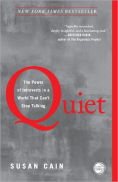
Quiet is Cain’s celebration of introversion. She discusses how America is a world of extroverts and that introverts are encouraged to be extroverts against their personalities. This is a society that does not appreciate introverts. Through interviews and personal experience, she provides scientific and anecdotal evidence that introverts can provide just as much (or more) to society as extroverts. 

I really wanted to like Quiet. Everybody seems to. And at the beginning I did. After all, I’m an introvert, at least I consider myself one despite the personality test that I took in a previous post. And that gets me to my first point. What is an introvert? Cain, and most others, define introverts as people who are drained by interpersonal interaction and need time to rejuvenate after a social situation. Extroverts are charged by socializing. But this is very black and white. What about the people like me who are 57.5% on the extroversion scale? I do need to rejuvenate after too much socialization, but I also seek out social situations. I do not seem to fit in her nice little structure. Cain briefly approaches this issue in her book, but I’m not sure most people care about the difference.

Another issue I had with the book is that it provided so much anicdotal scientific research. Don’t get me wrong. The research was fascinating. I just gobble that stuff up. But then I realized that she didn’t really seem to understand the implication of the research, and therefore the findings she presented weren’t very trustworthy. 

One example is that she discussed an experiment in which people were forced to “smile” by placing a pencil in their mouths. Then they watched a sad video. The people who were forced to smile felt much more cheerful after the video than the people who did not have pencils in their mouths. But later in that experiment, those same people – those who felt better after wearing the pencil – were more likely to react poorly to another sad video than the people who had not been forced to smile during the first video. Thus it s bad to suppress your emotions, because you will feel worse later.  

Then in the same chapter, she talked about another experiment in which people could not produce an angry face because of an injection of Botox. When anger was stimulated, the people who could express their angry-face were left feeling more angry after the experiment than those were weren’t able to express their angry-face.Thus it is bad to express your emotions because you will feel worse later.  

Note the contradiction?  

Another issue that bothered me about this book is her tendency to generalize a small population with the gigantic and diverse continent of Asia. In one study she quoted, the researchers compared the reactions of people from Hong Kong to the people of Israel, and found Israelis more willing to express their emotions. But Cain referred to the people from Hong Kong (a teensy tiny bit of Asia) as “Asians.” She referred to the people of Israel (a slightly larger territory) as “Israelis.” Israel, by the way is in Asia. Before you generalize, Ms. Cain, make sure you know your geography.

The last thing that bothered me about this book is that I felt it praised introverts to point of degrading extroverts. Yes,she continuously pointed out that both were needed, but I think if that were the case, she might have done a better job of showing how both are necessary to have a successful culture.

3 snowflakes for being an interesting read despite the weak points.


Crazy: A Father’s Search Through America’s Mental Health Madness, by Pete Earley

Crazy: A Father’s Search Through America’s Mental Health Madness,
by Pete Earley, Narrated by Michael Prichard 
When Pete Earley’s son was diagnosed with schizophrenia Earley was devestated. His son’s potential career was on the line, he wasn’t willing to accept treatment, and he was generally unpredictable and very unsafe. When Earley tried to get his son into the hospital, his son was turned away because he didn’t want to be treated – and laws say that unless someone is an immediate threat to himself or others, he can not be treated involuntarily. Earley had to pretend his son was a threat to Earley’s well-being to get his son hospitalized. Then Earley went to a commitment hearing to make sure his son stayed in the hospital until he was better. Early was appalled by his son’s defense lawyer who did her best to defend Earley’s son despite his son’s clear mental illness. In her own defense, the lawyer said it was her job to defend the rights of someone who did not want to be committed. Earley’s son won the case and was released. 


After this incident, Earley’s son broke into a house, peed on the carpet, turned over the all the photographs, and took a bubble bath. He was arrested and charges were filed against him by the family. Despite Earley’s pleading with the family that his son was not targeting them specifically, that he was sick, the mother felt threatened and continued to press felony charges. Earley knew that the charges would be an irremovable bar from his son’s career choice. 

Because of the horrors of being unable to treat his son, and the unfairness of the charges, Earley decided to research the state of the mentally ill in the Miami jail system. There are, according to the staff psychiatrist, “a lot of people who think mentally ill people are going to get help if they are in jail. But the truth is, we don’t help many people here with their psychosis. We can’t. The first priority is making sure no one kills himself.” The psychiatrist said that the point of the prison was to dehumanize and humiliate a person. Such treatment is counter to improving anyone’s health. 


The psychiatrist’s task was to try to convince the inmates to take antipsychotic medication so that they could be deemed stable enough to stand trial. Earley was shocked at the state of the prisoners. Most of them refused the medication, and were clearly psychotic. Some huddled down into corners, covered in their own body matter. Some stood motionless and unresponsive. Some harassed the guards as they walked by with strange and crude accusations. The prisoners who were on suicide watch were stuck alone in a cell with no blanket, mattress, or clothes. 

Miami has high numbers of mentally ill homeless people because of the nice weather and the immigration from Cuba. It is rumored that when a law was passed allowing Cuban refugees to enter America, Fidel Castro released his mentally ill inmates and deported them all to America – they ended up in Miami. 

Earley picked mentally ill inmates at “random” and decided to follow them throughout the next couple of years to watch their recidivism rate. Most people who were released were not given proper care after release. They were given some pills and sent away; not being given proper social services to help keep themselves off the streets and stable. Thus, these people ended up back in prison within months. Others were held indefinitely because they cycled from jail to a hospital, where they were stabilized and deemed ready for trial; back to the jail, where they destabilized; and then back to the hospital again. 

Earely wasn’t only out to castigate the Miami prison system, he also focused on what the system was trying to do to make the situation better for the prisoners. He discussed the CIT program, which is meant to train officers to respond with compassion to mentally ill people in crisis so that they are less likely to be shot or arrested. (This program is discussed in a previous post.) Earley also researched institutions that tried to keep the mentally ill off the streets by housing them.  

The end of the book returns to his son. Luckily, after too many postponements, the family that was pressing felony charges against Earley’s son were unable to make it to the trial. Therefore, the sympathetic prosecutor and judge found him guilty of a misdemeanor and was he mandated to stay on his medications. His career was no longer at stake. 

Earley encouraged society to end stigma about mental illness, and to change laws that inhibited proper treatment of unwilling mentally ill patients. Of course, this is easier said than done. 

If you are interested, I also have a post discussing the state of the mentally ill in Ohio state prisons, with a Frontline documentary. 
4.5 stars for excellent research, well- written narrative, and a fantastic, revealing topic

Stress and Your Body: An introduction

Great Courses: Stress and Your Body, by Professor Robert Saplosky,
narrated by Robert Saplosky
Robert Saplosky is a professor of biological sciences, neurology, and neurosurgery at Stanford University. His lab focuses on how stress affects the nervous system. He also has extensive field work, studying a particular population of wild baboons in East Africa – where he examines how social rank, personality, and sociality affect vulnerability to stress-related disease. He is a fantastic lecturer, and if you get the chance to watch a YouTube video of him lecturing, go for it. 


Saplosky and The Teaching Company developed the course Stress and Your Body to teach us about the detrimental effects of stress on our health. The primary textbook is his own Why Don’t Zebras Get Ulcers? Which, as far as I can tell from chapter 1 versus lecture 1, is pretty much verbatim with his lectures.  


Remember that time you were lying in bed, worrying about the big exam, presentation, or event that might make-or-break you the next day? You couldn’t sleep because you were ruminating about the fact that if you couldn’t sleep, you’d do terribly the next day. Then you noticed some minor symptom that’s been troubling you lately. Your head’s been aching. Oh no! You have a brain tumor! Now not only can you not sleep because of your event the next day, but you’re worried about your health.

This is the type of stress that often happens to humans. We worry about things that might happen in the future, rather than worrying about things that are happening now. Thus, our stress is generally long-lasting rather than immediate and acute. 

Animals biologically respond to stressors in very similar ways to ourselves, but their reasons for being stressed vary significantly from ours. A zebra might be munching contentedly on grass until suddenly he spots a lion. His fight-or-flight response ramps up. A part of his autonomic nervous system (responsible for controlling unconscious bodily functions) called the sympathetic nervous system is activated. His body goes into energy saving mode: it turns off all the functions that are unnecessary for fight-or-flight, and turns on the ones that are. 

He saves energy. That means his stomach stops digesting, he stops producing semen, his immune system – which requires a huge amount of energy – slows way down. Tissue repair – also another drain on energy – halts.  The rate of his heart and glucose metabolism increases so that oxygen and energy flows to the limbs for fight or flight. 

He runs.

This is a very helpful response to an immediate stressor like a lion. As soon as the zebra escapes the lion, the stress is gone and the zebra contentedly starts munching on the grass again. His parasympathetic nervous system activates, reversing all the bodily changes outlined above. He’s now in rest-and-digest mode. 

When humans experience long-term stress, many of the same pathways as short-term stress are activated, leading to chronically increased blood pressure, poor digestion, dysfunctional glucose metabolism, and heightened susceptibility to infection (among many other things). Such effects on the body will be discussed in detail as we explore Saplosky’s course. 

References:
Saplosky, Robert. (2004) Chapter 1: Why Don’t Zebras Get Ulcers? Why Don’t Zebras Get Ulcers? Third edition. (Nook ebook pp. 13-30). Holt, Henry & Company, Inc.

Saplosky, Robert. (2010) Lecture 1: Why Don’t Zebras get Ulcers? Why Do We? Stress and Your Body. The Teaching Company, The Great Courses.

Black Five, by J. Lynn Bailey

Black Five, by J. Lynn Bailey
In exchange for a fair and honest review,
I received an advanced release copy of this book through NetGalley

in exchange for a fair and honest review. 

Penelope Jackson has had a hard life. Her earliest memories were living with her crack-addicted adopted mother – who died when she was 8. Scarred by horrible memories of that time, Penelope moved to live with her aunt JoAnne. Life for the next almost-10-years went pretty calmly. She wasn’t popular in school, but she had her couple of good friends, and her loving aunt. But then everything changed. She found out that she’d been lied to her whole life. That she was a special immortal being called a “black five.” She was the only one who could save the world from an evil tyrant. 

I think this book would appeal to its target audience – perhaps 12-15 year old girls. Penelope is a unique, charming, and engaging character. The two romantic interests are handsome, powerful, masculine, mysterious, and totally enamored by her. This is also a nice story because the main character is a girl; but a loving, strong-willed, powerful one. Flawed, as well, which makes her likable. Most stories like this feature a boy as the magical-one-who-will-save-the-world (e.g. Harry Potter). Or if it’s a girl, she’s either a weak, needy one (yeah, I’m thinking Bella Swann); or a hard, unempathetic one (e.g. Tris or Katniss). I’m thinking of this book as sort of a mix between Harry Potter and Twilight. It’s young, it’s clean, it’s magical, and it’s got that love triangle. So, yes, if you’ve got a 12-15 year old girl who loves this type of book, it’s definitely appropriate and enjoyable.  

Now I get to the part that’s harder to say, but this is a “fair and honest review” after all. This book was not for me. I doubt it’s really for many adults at all. Love triangles? Ick. Not only do they give me the willies because I feel like the girl likes one guy and leads on the other, but they always seem to be leading on the guy that I think is better (so it always comes with disappointment in the end). Oh, and the Edward Cullen creepiness factor? It’s in this one too. Except – oh change-up! – it’s in the guy that I actually like. 🙂 Another problem I had with this book is the lengthy journal section. The hand-writing was atrocious. The writer even admitted that his writing was atrocious. It was an incredible struggle for me to read. 

Ok. So here’s what I think. This book wasn’t for me, but it’s a great book for 12-year-old girls. Therefore, I think it’s fair-and-honest to give the book 4 stars with the disclaimer: this is a book for young girls. 🙂

4 stars for appropriateness, likable characters, and magical story

Nonfiction in Audiobooks

The discussion post for the third week of Nonfiction November is to discuss “nontraditional nonfiction.” I admit, I’m a really slow reader and by the time I’m relaxing at home with a book, I’d rather be reading fiction. Therefore, my “traditional” nonfiction reading is pretty much at a snail’s pace. But I get a lot of nonfiction read through audiobook. In fact, I alternate fiction with non-fiction when I’m listening, so I get a lot of nonfiction “read” this way. I can’t recommend a specific book, because there are just too many, and I’m  not all that picky – as long as the reader is reasonably good, I’m happy. 

Instead, let me tell you about why I started listening to audiobooks. When I was younger, I never listened in class. My teachers in middle school used to accuse me of “staring off into space instead of listening,” which I really didn’t think I was doing. By the time I got to high school, I knew I didn’t listen – my chemistry teacher used to always praise me about how I’d discovered a new way to solve his problems. Well, the reason I didn’t do it his way is because I never listened to a word he said. I had no idea how he told us to solve the problems. I didn’t tell him that. Then in college, I had a rather shocking experience. I was sitting with a group of students discussing a class. One of them mentioned something the professor said. I was floored. People actually hear what the professor says? 

After that, I tried. The rest of my undergraduate career I tried really hard to pay attention. It didn’t work. During the first couple of years of grad school, I tried chanting in my head “you must listen, you must listen, you must listen.” Somehow I managed to continue that chant in my head while thinking of other things. I even tried yoga. No luck. I just couldn’t listen to what people said. I decided I was audibly challenged. As in, low auditory comprehension, not poor hearing.

That’s when I tried out audiobooks. I figured I could practice listening to auditory stimulation while I was exercising and stuff. I specifically picked books that I wouldn’t otherwise have read – because I didn’t want to miss something that I actually wanted to read. For instance, I listened to the entire Twilight series. 🙂 

It worked! Now I am able to listen to books that I want to read, and I do it all the time. I like audio for non-fiction, because it doesn’t make my eyes blur over when I’m tired, like written non-fiction can. (Though maybe if I stopped reading books that “read like textbooks” I’d not have this problem – but I like those books!)

Less importantly, I’m better able to listen in classes now. So, thank God for audiobooks!


The Biological Effects of Anxiety on the Body

Stress and anxiety can wreak havoc upon your body. It can lead to problems with childhood physical development, and affect the immune, endocrine, gastrointestinal, and cardiovascular systems. It can exacerbate diabetes. Stress affects the mind as well, a tragic example being PTSD, where an individual might relive a traumatic event over and over. 

Stress can be either good or bad event – such as marriage or a divorce. Low levels of stress can actually be a good thing – for instance, a small amount of stress might help you prepare for an upcoming exam better than you otherwise would have. But sometimes stress becomes overwhelming, and biological systems in your body that would usually only slightly increase during “good stress,” go into overdrive – potentially on a long-term basis. 

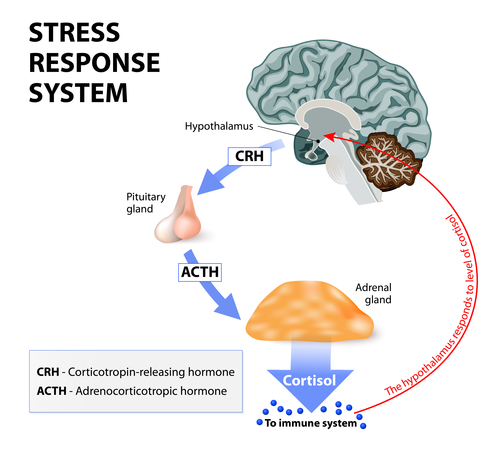
In order to understand why long-term stress can be bad, we need to understand what immediate effect stress has on our bodies. Under stress, the hypothalamus-pituitary-adrenal system (HPA axis) is activated. The hypothalamus releases corticotrophin-releasing-hormone (CRH). CRH stimulates the pituitary gland. The pituitary then secretes adrenocorticotrophic hormone (ACTH). The Adrenal cortex then produces the stress hormone cortisol in humans. 

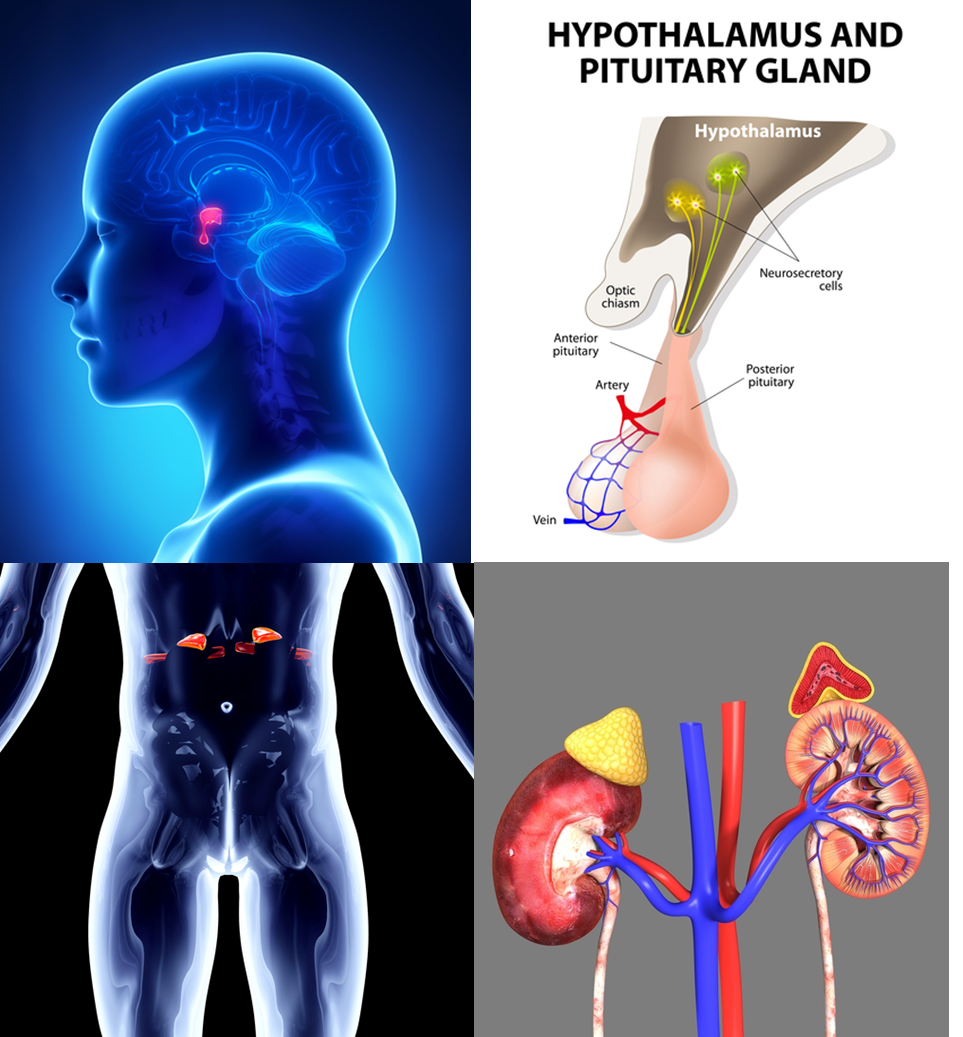
Anatomy of hypothalamus-pituitary-adrenal system
Top left, the pituitary gland is red
Top right, the hypothalamus and pituitary glands are connected
Bottom left, the adrenal glands are bright red
Bottom right, the adrenal glands are the yellow cones on the kidneys

Cortisol activates the fight-or-flight response. The sympathetic nervous system shuts down anything that your body doesn’t need during a traumatic event where you might need to fight or run away from a threat. That means your stomach stops digesting, you stop producing semen / ovulating, your immune system – which requires a huge amount of energy – slows way down. Tissue repair – also another drain on energy – halts.  Activation of the sympathetic nervous system leads to release of the adrenaline (epinephrine) and noradrenaline (norepinephrine). These hormones circulate through the body and increase rate of the heart and of glucose metabolism – that gets the oxygen and energy flowing so you can use your limbs for fight or flight. 

Cortisol is the hormone that prepares the body for fight-or-flight; thus, it is a good hormone to have around in an immediate danger. However, if stress continues, and cortisol is not turned off, the long term effects of suppression of vital bodily functions is quite detrimental to the body. Usually, after immediate stress, the cortisol has a feedback inhibition mechanism, in which it signals to slow its own production. However, if the stress continues for too long, cortisol’s feedback inhibition loop can be deactivated; thus allowing the adrenal cortex to continue pumping out cortisol and keeping the physiological effects of the sympathetic nervous system still active. 

Since the immune system is inhibited by the sympathetic nervous system, individuals experiencing long-term stress are susceptible to infection by viruses and bacteria. 


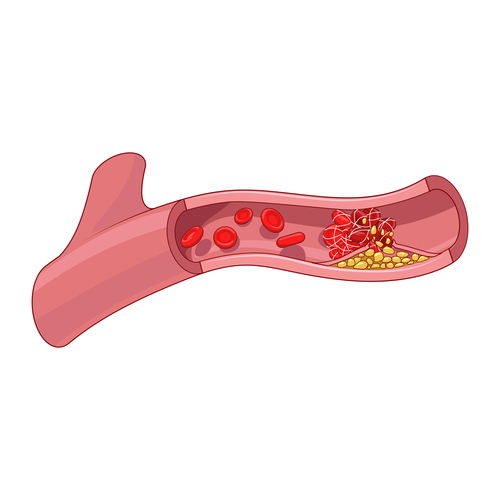
The best known physical side effect of stress is cardiovascular problems. As mentioned earlier in this post, the sympathetic nervous system increases heart-rate so that blood pumps more quickly throughout the body. Not only can this increase blood pressure directly, but it can also lead to damage of the blood vessel walls. The high blood pressure leads to tiny tears in the blood vessel walls. These tears are susceptible to accumulating circulating “junk” such as particles of fat and cholesterol. This accumulation – pictured n yellow above – can decrease blood flow through the vessel, or completely block flow as seen above. When the heart doesn’t get enough oxygen, then a heart attack may occur. Another problem with decreased blood flow is that if the brain doesn’t get enough oxygen, this can cause a stroke. 

As you can see, stress can have a huge impact on your health. Doesn’t that stress you out?


This is a series of posts summarizing what I’m learning in my Abnormal Psychology course. Much of the information provided comes from reading my James N. Butcher’s textbook Abnormal Psychology. To read the other posts, follow these links: 

The Definition of Abnormal
A History of Abnormal Psychology
Abnormal Psychology in Contemporary Society
Contemporary Viewpoints on Treating Mental Illness – Biology
Contemporary Viewpoints on Treating Mental Illness – Psychology
Frontline: New Asylums
Brave New Films: This is Crazy
Clinical Mental Health Diagnosis: Biological Assessment
Clinical Mental Health Diagnosis: Psychological Assessment
Does the DSM Encourage Overmedication?
Post Traumatic Stress Syndrome – The Basics
Panic Disorder
Obsessive Compulsive Disorder
Hoarding and Body Dysmorphic Disorders
Depression – an Overview
Personality Disorders – Clusters and Dimensions
Personality Disorders – Cluster A
Personality Disorders – Cluster B
Personality Disorders – Cluster C
Biological Effects of Stress on Your Body
Somatic Symptom and Related Disorders
Dissociative Disorders
Borderline Personality Disorder
Dialectical Behavioral Therapy
Paraphilic Disorders
Gender Dysphoria – Homosexuality and Transgender
Anxiety Disorders
Bipolar Disorder – The Basics
Suicide – An Overview

References:

Butcher, James N. Hooley, Jill M. Mineka, Susan. (2014) Chapter 5: Stress and Physical and Mental Health. Abnormal Psychology, sixteenth edition (pp. 129-161). Pearson Education Inc.

Women’s Classic Literature Event 2016

Women’s Classic Literature Event
Hosted by the Classics Club

Ok. I’ve broken down and decided to join the Women’s Classic Literature Event with the Classics Club. “Why do you say ‘broken down'” You ask? Because I’m trying to only join events that will supplement my personal reading goals or introduce me to bloggers with common interests. After thinking about it, I’ve decided that this challenge fits those needs. I’m starting today. 

I hate making lists of books to read, because I will not stick to it – in fact, writing my Classics Club list was stressful enough. But here are the books (8 of 54 – oh sad, sad day; I’m embarrassed) on my Classics Club list that are by female authors – I will try to focus on them this year as much as feasible. 

  1. Persuasion, Jane Austen
  2. The Bell Jar, Sylvia Plath
  3. The Collected Poems of Sylvia Plath
  4. Ten Days in a Mad-House, Nellie Bly
  5. North and South, Elizabeth Gaskell
  6. Middlemarch, George Elliot
  7. Jane Eyre, Charlotte Bronte
  8. Cotillion, Georgette Heyer
Furthermore, Ali @heavenali is maybe hosting a Woolf-a-long through 2016, though its structure is still a little up in the air. I told her that the books by Woolf that I am interested in reading are: Mrs Dalloway, To the Lighthouse, Orlando, The Waves, and Between the Acts.

The Gilgamesh Epic and Old Testament Parallels, by Alexander Heidel

This classic book published in 1946 begins with a short introduction to The Epic of Gilgamesh, gives Heidel’s translation of the Epic, and finally provides a comparison of the Epic of Gilgamesh, and other Mesopotamian tablets with similar stories. Heidel’s translation is organized into tablet format, with fragments and unsure translations represented with an ellipsis and brackets.
Heidel begins his comparison with a chapter about death and the afterlife. In Mesopotamian literature, gods can die, evil was innate because humans were formed from the blood of a “bad” god, and there was an afterlife in which a person carried the objects buried with him into the afterlife. In Hebrew tradition, the one God can not die – he lives forever. However, there is a concept of original sin, similar to the Mesopotamian belief of innate evil. There seems to be some contradiction about whether Hebrews believed that there was an afterlife or not – most likely because of different beliefs of different sects.
The Mesopotamians partook in ancestor worship, which suggested that the ancestors could somehow intercede on behalf of their descendants. On the other hand, in Hebrew culture, there doesn’t seem to be any contact between the spirits of the dead and the living people.
The second, and final, chapter of Heidel’s book compares the Utnapishtim’s flood story that took place in the Epic of Gilgamesh with Noah’s flood story that took place in the Old Testament. There are obvious similarities. Utnapishtim and Noah both built ships to save them from a massive flood that the gods (or God) unleashed on the earth. They collected a male and female of every animal so that they could repopulate the earth. And at the end they released birds to let them know if the flood had subsided. Both the gods and the one God promised never to kill off humanity with such a calamity again.
But there were some interesting differences. First of all, Utnapishtim was not directly told of the flood. Nobody was meant to be told. But a god that favored Utnapishtim whispered to him through the wall of his home while Utnapishtim was sleeping. He told Utnapishtim to lie to the people around him – saying that one of the gods hated him, and that in order to save the entire community, he must leave in a ship. If the community helped Utnapishtim build the ship, they would be rewarded with a season of plenty, which would start with a “wheat-rain.” The community built the ship. Utnapishtim loaded on his family and his entire household of servants. At the end of the story, not all of humanity had died – just most of them. Some had survived the flood.
In the Old Testament, Noah was told directly by God to build a ship. He was asked to warn the community – telling them they must repent. The community did not repent. Noah built the ship and took only his family with him. All of humanity died.
Finally, Heidel discussed arguments of whether the Old Testament story had been derived directly from the Gilgamesh Epic, or if they had the same origins from a different source. He also wrote an interesting, though incredibly theoretical discussion about whether the flood really did happen, and what could have caused such a flood.
In the end, this book was very interesting, though I was hoping for a little more from it. However, I’m not quite certain what I expected, or why I expected it. After all, it delivered what was promised in the title. I think part of my higher expectations came from the fact that pretty much every list of references for studying the Gilgamesh Epic included this book.
Besides the rather silly overly-detailed theoretical discussions about the origins of the flood, one other thing I found annoying about this book was his over-use of the word “obviously.” These points were certainly not obvious to me, so why did he keep using that word? Perhaps his target audience was nothing like me.
3.5 stars for excellent research and being a classic reference book for Gilgamesh Epic.

Personality Disorders – Cluster C

As mentioned in my opening post about personality disorders, personality disorders are split into three clusters -A, B, and C. This post will discuss cluster C. People with these disorders tend to be  anxious and fearful.

Avoidant Personality Disorder is characterized by extreme social inhibition and introversion, which lead to few friends and a tendency to avoid social interactions. Unlike schizoid personalities, people with avoidant personality disorder want to have friends, but they are too afraid of rejection to attempt social interaction.  They do not enjoy being alone, and are often bored. They generally have low self-esteem and high self-consciousness. 

In order to be diagnosed with avoidant personality disorder, the individual must have four or more of the following characteristics, which create clinically significant problems in functioning: 1) avoids occupations that involve interpersonal contact; 2) unwilling to get involved with people unless certain of being liked; 3) shows restraint within intimate relationships for fear of being shamed or ridiculed; 4) preoccupied with criticism and rejection; 5) inhibited in new interpersonal situations; 6) views self as socially inept, unappealing, and inferior; 7) does not take personal risks or engage in new activities for fear of embarrassment. 

Dependent personality disorder is characterized by extreme need to be taken care of. They tend to find one person to cling to, and they ask that person for advice on everyday decisions. They are terrified of separation from the person they are dependent upon. They sacrifice their own needs in order to please their chosen person, and often agree to do unpleasant things. They often remain in physically and emotionally abusive relationships. When their relationship is broken off, they desperately seek another person immediately, and often choose an inappropriate partner because of their fear that they are unable to take care of themselves. 

In order to be diagnosed with dependent personality disorder, the individual must have five or more of the following traits, leading to clinically significant impairment of function: 1) difficulty making everyday decisions without excessive advice; 2) needs others to assume responsibility for most major areas of life; 3) has difficulty disagreeing with others; 4) has difficulty initiating projects or of doing things alone; 5) goes to excessive lengths to obtain nurturance and support of others; 6) feels uncomfortable or helpless when alone; 7) urgently seeks another relationship when his source of care is broken off; 8) is terrified of being left alone to take care of himself. 

I met someone like this at a party once. He asked the entire group if anyone wanted to go wine tasting with a “bunch” of friends the next weekend, and I agreed. Within a day, he was asking me what to wear, how much money he should bring, and how early I thought we should be. He also told me that his wife had made him convert to Lutheran, and he felt extreme guilt over his conversion and wanted to be Catholic again – but he felt uncomfortable going to Mass alone. I naively volunteered to go to Mass with him a few times until he got used to the new church. “A few times” ended up to be every week. He began depending on me for every small decision in his life. Wanted to be around me every day. Said that he couldn’t eat alone and couldn’t exercise alone, so: could I come over and do those things with him? I was unemployed at the time (lots of time) and have an overly agreeable personality, so I got stuck helping him out way too much. I kept telling him I wasn’t interested in an intimate relationship, but he seemed not to understand this concept. (That may have been my fault for helping him out so much.) 

Finally, I got sick of him and said that I couldn’t spend that much time helping him. He needed to learn to be independent. I even suggested that he had dependent personality disorder and ought to seek help. That was mean, perhaps, but I was annoyed. It was a sign of his dysfunctional inability to disagree that he agreed I was right: he must have dependent personality disorder.

Anyway, dependent personality disorder is one of the disorders that will be dropped if diagnosis switches over to the dimensional rather than cluster approach. Which I think is unfortunate since I’ve met someone who clearly has those features. 

People with obsessive-compulsive personality disorder are the type of people that Freud would call “anally retentive.” They have an incredible need for symmetry, order, and perfection. They have specific rules and schedules and get very upset when those rules and schedules are broken by themselves or others. They tend to be dysfunctional because they are so obsessed with perfectionism that they aren’t able to finish projects. Unlike people with obsessive-compulsive disorder, they do not have true compulsive rituals like excessively washing hands. 

In order to be diagnosed with obsessive-compulsive personality disorder, an individual must have at least four of the following traits, which cause clinically significant impairment of function: 1) preoccupation with details, rules, lists, order, organization, or schedules; 2) perfectionism that interferes with task completion; 3) excessively devoted to work and productivity to the exclusion of leisure activities; 4) overconscientious, scrupulous, and inflexible about matters of morality, ethics, or values; 5) unable to discard worn-out or worthless objects even when they have no sentimental value; 6) reluctant to delegate tasks or to work with others unless they follow his instructions perfectly; 7) has miserly spending style towards self or others; 8) shows rigidity and stubbornness.

What do you know? I know someone like this, too! But I won’t discuss him on my blog. 🙂 Some of my readers know who he is, though. 
This is a series of posts summarizing what I’m learning in my Abnormal Psychology course. Much of the information provided comes from reading my James N. Butcher’s textbook Abnormal Psychology. To read the other posts, follow these links: 

The Definition of Abnormal
A History of Abnormal Psychology
Abnormal Psychology in Contemporary Society
Contemporary Viewpoints on Treating Mental Illness – Biology
Contemporary Viewpoints on Treating Mental Illness – Psychology
Frontline: New Asylums
Brave New Films: This is Crazy
Clinical Mental Health Diagnosis: Biological Assessment
Clinical Mental Health Diagnosis: Psychological Assessment
Does the DSM Encourage Overmedication?
Post Traumatic Stress Syndrome – The Basics
Panic Disorder
Obsessive Compulsive Disorder
Hoarding and Body Dysmorphic Disorders
Depression – an Overview
Personality Disorders – Clusters and Dimensions
Personality Disorders – Cluster A
Personality Disorders – Cluster B
Personality Disorders – Cluster C
Biological Effects of Stress on Your Body
Somatic Symptom and Related Disorders
Dissociative Disorders
Borderline Personality Disorder
Dialectical Behavioral Therapy
Paraphilic Disorders
Gender Dysphoria – Homosexuality and Transgender
Anxiety Disorders
Bipolar Disorder – The Basics

Suicide – An Overview

References:


Butcher, James N. Hooley, Jill M. Mineka, Susan. (2014) Chapter 10: Personality Disorders. Abnormal Psychology, sixteenth edition (pp. 328-366). Pearson Education Inc.

The Martian, by Andy Weir

The Martian, by Andy Weir, narrated by R. C. Bray
When a team of Mars explorers runs into some problems while on Mars, they think that astronaut Mark Watney has died. The rest of the crew avoid the storm by immediately heading back home to Earth. Unknown to them, Watney is still alive and must survive on Mars alone with meager supplies left behind by the Mars expedition. With his extraordinary resourcefulness, he manages to survive while desperately hoping that Earth will realize that he’s still alive and come to rescue him. 

This book was as fantastic as everyone says it is. Watney’s struggle to survive is fascinating, and the action moves forward at a steady pace. Yeah, there’s a lot of technical language, which made the book a little slower than I would have liked at times, but it was never so slow that I wanted to stop listening. It was more of an “ok, I get that you’re doing awesome technical stuff, let’s move on.” But those scenes were only paragraph-long. I was a little amused at how much money and time America was willing to put in to save Watney. After all, he was only one person and there are so many people on earth that could have benefited greatly from that money. They could have helped thousands of people instead of just one. I get it. He’s a hero. But he also made the choice to go on a dangerous adventure. The homeless and hungry in America and around the world did not make the choice to starve. Shouldn’t they be helped first?

The narration in the audiobook was also excellent. The humorous parts were so well executed that I had to laugh out loud on numerous occasions. 

I can’t wait to see this movie. I plan on going with my boyfriend next Tuesday. 🙂
4.5 stars for interest level and superb execution