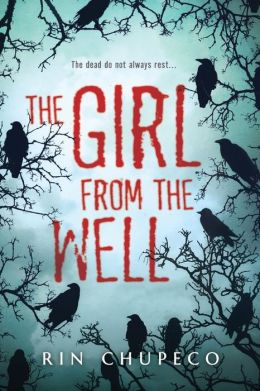
Girl from the Well, by Rin Chupeco


The Girl from the Well, by Rin Chupeco 

Genre: Teen Horror / Suspense

Reason for Reading: This book was provided by the publisher, Sourcebooks Fire, through Netgalley in exchange for an honest review. 

SummaryTarquin (Tark) Halloway has been haunted his entire life. With a mentally ill mother and a caring father who works too much, he feels he has no one to talk to about the strange lady that slinks through mirrors and makes Tark do terrible things. But when he meets a roaming spirit, Okiku, they both begin to remember what it is to be human. With the help from Tark’s cousin Callie, Okiku and Tark must rid himself of his haunting. 

My Thoughts: Let me tell you, if I had read this book when I was 14, I would have been sleeping with the lights on for weeks. The spookiness / imagery is reminiscent of Japanese horror films that The Grudge (Ju-On: The Grudge) and The Ring (Ringu) were based on. (Have you seen the originals? Not the American remakes. Watch the real thing. Darn spooky! That’s what The Girl From the Well is like.) Same evil-ghost-child-with-long-creepy-hair-staring-at-you-in-crazy-fast-did-that-actually-just-happen-flashes feel to it. 

Part of Rin Chupeco’s spooky genius is her narration style. The story is narrated from the POV of the ghost, Okiku. Often, it reads like a 3rd person omniscient narrative, because Okiku mostly observes rather than acting. I often forgot I was reading a first person POV, and then suddenly Okiku would say something in the first person, and it was like she had just appeared out of nowhere. Like a ghost. Spooky. And then, sometimes Okiku would describe herself in the third person – a description of a ghost as Callie or Tark would have seen. This gave Okiku’s character a sense of otherness. She felt inhuman. Ineffable.

Overall, I think this was an fantastic book, and I look forward to reading more of Chupeco’s works. I miss the old days when ghosts were ghosts and monsters were monsters. I applaud Chupeco’s work as one more for the #reclaimhorror team. (Ok, I just made that hashtag up, so technically she’s the first on the team. But it’s all good.)


Rin Chupeco: Despite uncanny resemblances to Japanese revenants, Rin Chupeco has always maintained her sense of humor. Raised in Manila, Philippines, she keeps four pets: a dog, two birds, and a husband. She’s been a technical writer and travel blogger, but now makes things up for a living. The Girl from the Well is her debut novel. Connect with Rin at www.rinchupeco.com.

//widget.rafflecopter.com/load.js

Weekend Update – Blogging in the Twin Cities

This week’s Feature and Follow Friday asks its participants to tell our readers a little bit about our neighborhoods. I have lived in several states, mostly in the mid-west, and Minnesota is my favorite by far. It’s a fantastic combination of urban hipster, historic city, and wilderness. Above is a picture of Downtown Minneapolis, prominently featuring the stadium-formerly-known-as-the-Metrodome (home of the “president,” Richard Starkey, in The Postman). Below is a photo of our State Capitol building in Saint Paul. 


Minnesota can also be rather artsy, and one of the iconic Minnesotan sculptures is Spoonbridge & Cherry. That’s the Minneapolis skyline in the background.


Rochester, Minnesota was the home of the Mayo brothers, who founded the Mayo Clinic. Its skyline is below:

But, of course, my favorite part of Minnesota, by far, is the North Shore on Lake Superior. Hundreds of miles of breathtaking shoreline with campsites and hiking galore. 


Life of a Blogger – Favorite Outings


I’ve just discovered a new meme Life of a Blogger, which seems a great way to get to know other book bloggers in a more personal way. This week’s theme, favorite outings, fits in really well with my already-established MN theme. My fondest memory of going on a trip as a child is when dad took my sister and me on a canoe/backpacking trip to the Boundary Waters in MN. I remember how beautiful it was. And how adventuresome I felt! Having more experience with backpacking now than I did as a 10-year-old, I can only imagine how tired my poor dad was canoeing alone in the wilderness with two children. 


And now for an update on Rachel B and her blog!
(Yes, I just spoke about myself in the third person. Deal with it.)

This month (well, really, this past year) has been quite rough here in Rachel B. world. I’ve been on the long haul trying to battle depression without any medical aid. Finally, I broke down and tried out anti-depressants, and they made me feel GREAT! In fact, a little too great. And then I went “crazy.” Turns out, I’m bipolar. And bipolar people flip manic when they take anti-depressants. I’d just never experienced that before, so I didn’t know how to deal with it. But now that we know what it is, I think we’re finally getting it under control. I’d like to take this moment to give a hearty thanks to all of my supporters out there (both in the real-world and in the cyber-world) who stuck by me through my hard times. And for those of you who abandoned me…well, you’re not reading this, are you? YOUR LOSS. HA!

Ok, sorry, just had to stick my tongue out just a little. 

My main point is, mental illness is poorly understood and greatly stigmatized in American culture. (I assume in many other cultures, too, but I don’t want to generalize too much.) We need this stigma to stop. It’s the people who speak out about their illnesses that get the support that they need, and it’s the people who are abandoned and stigmatized that often end up losing their sense of who they are…We need to end the stigma!


I’ve been doing my part to end the stigma by organizing a Suicide and Mental Illness Awareness Theme in September and October. You can sign up on the post, or just jump in at the last minute. It’s all good. I’ll have some giveaways and some guest bloggers (still looking for people, so if you have something you’d like to share on the subject, just let me know!). In the following week, I’ll post a list of books / movies just to give you ideas. But this is very informal. If you think your book, essay, documentary, movie, etc. fits the theme, it counts! Write a review and send me the link. Reviews on Goodreads, blogs, or any sort of public post will work. I’ll post a list of the reviews as I collect them, so everyone can see what other people are doing. 

Other than that, my blog has been sadly inactive, other than occasional poetry posts – Facing My Demons


Recent Acquisitions

This week, I have acquired only one new book, and it was the Free Friday book on the Nook:


Text copyright 2014, by Rachel B. Images of Minnesota are stock photos purchased from depositphotos

To ASIST or not to assist…

This month, I have been training to answer texts for a crisis hotline aimed at teens. My first shift is tomorrow, and I’m really looking forward to helping out teens in crisis. I think this is the best decision I’ve ever made in my life. 

Let me tell you a little secret – I’ve battled on and off with suicidal thoughts myself. At times, to the point where I’m honestly afraid that I will kill myself. Almost no one who is suicidal actually wants to die. These people want to live, and they send out signals. They ask for help. Too many people ignore these signals for one reason or another. 

Some people have absolutely no empathy for suicide – they feel that if someone wants to die, let them die. After all, isn’t that “Darwinian selection”? What these people fail to see (whether they are willingly blind or not) is that suicidal people are ill. Their perception of reality is often distorted, and they honestly feel that death is the only way out. They need to be reminded of why life is wonderful. They need (and want!) help. Suicide is a tragedy – not only for the individual, but for all the friends and family. 

Some people have empathy, but they are squeamish of mental illness and suicide. They are not comfortable talking about such things. And although they might see the signs, they shy away from providing help, often leaving the suicidal person feeling abandoned. I, myself, have felt that way….and it is one of the most painful emotions I can imagine.

And some people would like to help, but they just aren’t able to recognize the signs or they don’t know what they can do. 

But we, as a community, can change this. We can educate ourselves about suicide, and learn to encourage friends and family (and even strangers if we’re willing!) to talk to us. Because it’s the people who talk that end up living. There are lots of ways to educate yourself about suicide. For instance, my blog, Resistance is Futile, is going to host an annual Suicide and Mental Illness Awareness theme read in September and October. I will post about suicide and mental illness (hopefully with guest posts too!) and list book reviews from all participants in the theme read (everyone is welcome!). Hopefully, this will spark discussion about how to raise awareness in our community.


Another way to educate ourselves is by taking awareness classes. Several are offered as community classes, but I highly recommend the one that I completed last weekend. The ASIST workshop organized by Living Works. In this two-day workshop, I learned what signs to watch for, how to address the question “Are you feeling suicidal?”, when to listen to and then remind that person of what he or she has that’s worth living for, and how to create a safety plan. It was probably one of the most important training events of my life. And I hope that many, many other people will also get such training. Living Works also has a less expensive class SuicideTalk (or eSuicideTalk)

Suicidal thoughts can happen to ANYONE. No one is immune. I am lucky enough to have a large, loving family and an AMAZING bunch of friends. I’m intelligent and have accomplished a lot in life. I (usually) have faith in a spiritual system which frowns upon destroying “the temple of our flesh.” I should be immune to such thoughts. But I’m not. It can happen to anyone. And I want to help create a world in which people aren’t afraid to express their feelings and openly ask for help. Who’s with me on that?

Rachel’s Media Update

Completed


Inbox


Update Memes

Stacking the Shelves with @Tynga’s Reviews


Blood Ties, by Garth Nix and Sean Williams

Blood Ties, by Garth Nix and Sean Williams

Genre: Middle Grade Fantasy / Adventure Series

Reason for Reading: I’m already reading this series, of course, but I was happy that Scholastic provided an ARC through Netgalley in exchange for an honest review. 

Synopsis (May contain some light spoilers for earlier books in the series): Meilen has run away from the Greencloaks to search for her father in her homeland of Zhong. Conor, Abeke, and Rollan quickly follow – they hope to recover their friend and get the Slate Elephant talisman from Dinesh, the Great Elephant. But Zhong has been conquered, so the kids must fight through armies of enemies to find what they seek. The Devourer is gaining power, and he will stop at nothing to take over all of Erdas with his nature-defiling bile. 

My thoughts: Another great installment of the series. And they just keep getting better and better! (Not, of course, because the authors are changing, but because the plot and characters are developing as the series progresses.) Like in the earlier books, Blood Ties shows the power friendship – of working with your team rather than trying to fight evil alone. It encourages trust – of your partners, your friends, and the power of Good to conquer Evil. Most of all, the story is fun. It’s a delight to watch as the kids’ distinct characters develop, and how each character adds to the dynamics of the team. The world-building is also a lot of fun – it has both a familiar and a novel taste. For instance, Zhong is the Erdas-equivalent of Asia. The comparison is undeniable, and yet Zhong’s culture and scenery are also delightfully unique. And, of course, this book is filled with adventures, intrigue, and battles – which any lover of middle grade fantasy / adventure books craves. I’m looking forward to the release of the next book in the series, Fire and Ice, in July.

Did Jesus believe the end of the world was nigh?

Week 2 of Practicing Tolerance in a Religious Society was a lot of work for me, mostly because it was essay week. The assignment was to read and compare Jesus’ prophecy of the destruction of the Temple in Matthew 24, Mark 13, and Luke 21. In these very similar passages, Jesus prophesied the destruction of the Temple, war, and many false prophets coming in his name. We were supposed to describe how these passages helped the early Christians make sense of the world around them, keeping in mind that the New Testament was written a half-century or more after Jesus’ death (i.e. around the time of the Temple’s destruction in 70CE). 

This was a difficult topic for me because I’m still struggling a lot with the difference between the spiritual Jesus that I was brought up to worship as God, and the historical Jesus who was most likely an apocalyptic preacher. (Though I have decided to keep these two versions of Jesus separate in my mind, for now.) I took the time to read The Eschatology of Jesus, by Dale C. Allison.

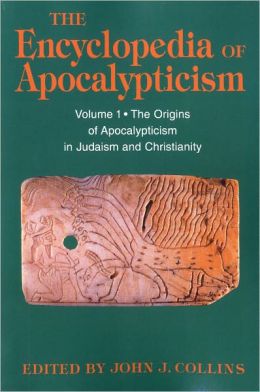
The Encyclopedia of Apocalypticism, Volume 1

Chapter 8: The Eschatology of Jesus, by Dale C. Allison

Allison’s essay addresses the controversy of whether or not the historical Jesus was an apocalyptic prophet – a phenomenon which was common at the time of Jesus. The reason this question is so controversial, despite the strong apocalyptic message of Jesus’ speeches, is because it would suggest 1) that Jesus was just one among many apocalyptic prophets and 2) that Jesus was wrong, since the end of the world proved not to be so nigh, after all.


Allison surveys current arguments for and against Jesus’ eschatology. He then demonstrates that the New Testament has undeniable eschatological imagery and phrasing. He points out that although it’s possible that the authors of the New Testament had eschatological leanings when Jesus did notthere’s no reason to believe that they mistakenly, or intentionally, changed Jesus’ message; therefore, it is very likely that Jesus was an apocalyptic preacher.

As I thought about my assignment, however, I pondered the possibility that perhaps the authors wrote the passages about the destruction of the Temple after the fact, and then attributed the words to Jesus in order to help make sense of the tragic destruction of Jerusalem by Rome. Did Jesus really foresee the destruction of the Temple? Or were the authors of the Gospels trying to provide spiritual guidance to their people during a time of great turmoil?

In the end, I decided that, since this prophecy isn’t the only eschatological speech Jesus made, he was very likely an apocalyptic preacher – regardless of whether he believed the end of the world was nigh. I plan to read some more on this subject before fully making up my mind, though. 

What does everyone else think? Was Jesus an apocalyptic preacher? Did he believe the end of the world was coming in the near future? Were certain passages of the Gospels written by people who retroactively attributed a prophecy of the Temple’s destruction to Jesus?

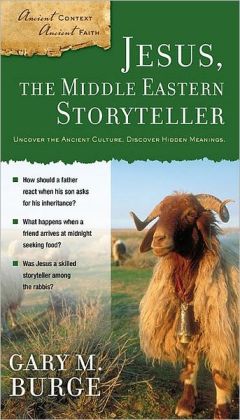
Jesus, the Middle Eastern Storyteller, by Gary M. Burge

Jesus, the Middle Eastern Storyteller, by Gary M. Burge

Genre: Ancient History / Bible Studies

Reason for reading: This year, I’m studying Jesus and the New Testament. This book was loaned to me by Elizabeth, a friend from work. It was given to her by a friend because the author was her professor.

Synopsis: In this short book, Burge guides the reader to interpret Jesus as a storyteller – a teacher who uses allegory and hyperbole to make important points within his own social context. The book is filled with beautiful pictures and several examples of Jesus’ use of hyperbole to teach an important point. Burge provides historical and cultural insight into what Jesus may have been talking about when telling his parables. 

My thoughts: I was surprised at how fun this book was. Although it’s quite short, and half of it was pictures, it made me look at Jesus from a interesting new perspective. Of course, I already knew that Jesus used parables and hyperbole to make points, but it was really interesting to read Burge’s cultural analysis of those parables. 

The story I found most enlightening was Burge’s interpretation of the fig tree incident. For those of you who don’t recall, the story is related in Mark 11:12-14, 11:20-25; and in Matthew 21:18-22. In my unromantic version, Jesus is hungry, and he sees a fig tree by the road. It’s not fig season, so the tree isn’t bearing any fruit. Jesus curses the poor tree and it withers. I’ve always disliked that story. Despite my cousin Steve’s insistence that fig trees don’t have feelings, and I shouldn’t take the story so literally, I always felt sorry for the tree. Why’d Jesus curse a tree just because it wasn’t bearing fruit in the off-season? (And, yes, Mark clearly states that it wasn’t the season for figs.) 

Burge pointed out that the fig tree represented the Jewish state and religion. Throughout the New Testament Jesus repeatedly pointed out the hypocrisy of the Pharisees, who made a public spectacle of themselves fasting, praying, and giving alms; but who did not keep the spirit of religion in their hearts. They prayed for the approval of the people, not for the approval of God. Thus, they were not “bearing fruit.” 

Of course, I realize that this insight about the fig tree and the Pharisees is not uniquely Burge’s – in fact I found some interesting articles on the subject after reading Burge’s book (here’s a good one). What’s important is that Jesus, the Middle Eastern Storyteller introduced me to some interesting interpretations that I could look into in more detail later. In that way, this book was a valuable resource for me.


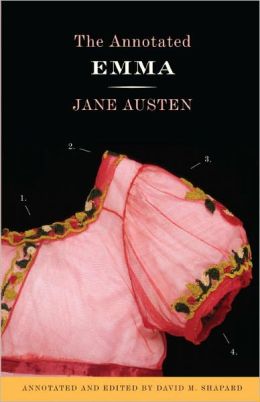
The Annotated Emma, by Jane Austen

The Annotated Emma, by Jane Austen

Genre: Classic / Regency Romance

Reason for Reading: I’m rereading all of Austen’s novels. I’ve seen these Annotated versions and been tempted to try them out for a while, and this is the one I ended up picking up. 

Synopsis: Emma is young, rich, beautiful, and the most important gentleman’s daughter in her neighborhood. When her governess marries and moves away, Emma must find another friend to entertain herself. She chooses Harriet Smith, the love-child of nobody-knows-whom, and boarder at a local country school for girls. Emma, well-meaning but naively self-important, makes a mess by foisting potential suitors upon poor Harriet, while Emma’s old friend Mr. Knightly tries in vain to check Emma’s eager naivete. 

My thoughts: I’m a huge fan of Jane Austen. This is the third time I’ve read this novel, and I’ve seen all the movie renditions multiple times. I love watching Emma grow in wisdom throughout the story. And her romance is, in my opinion, the sweetest of those written by Austen. But I recognize that this is a difficult book for many people to get into because of Emma’s painful flaws and poor choices. Another reason that Emma is less appealing to some readers is because the narrator’s perspective is so unique. The POV focuses almost entirely on Emma’s perception of the world, to the point where it is easy to be mislead about what is really occurring since we are only seeing what Emma sees. Emma, especially at the beginning of the novel, tends to be very self-centered and aloof, and so is the narration of the novel. However, even though this POV makes the story harder to get into than the other Austen novels, this is Austen’s most appealing work for character study.  

The annotations of this book are lengthy and detailed. Many interesting images and comments are included so that we can visualize antique customs, fashions, and furniture that Austen’s readers would take for granted. That aspect of the annotations was fantastic. The annotations also included a lot of character analysis commentary, such as “Emma thinks such-and-such is happening, which shows you how much she lacks self-awareness at this stage.” These annotations included a lot of spoilers (the reader is warned which annotations include spoilers, but sometimes these warnings were dropped out of the ebook version – so caution should  be practiced if you’re reading the book for the first time and you have ebook format). These character analysis annotations were sometimes interesting, but mostly they told me things I’d already knew – either because I was familiar with the story or because I am sensitive to Austen’s nuances. Therefore, I think this annotated version is for you if 1)You are interested in having some historical perspective, 2)You are reading the book for the first time and don’t mind spoilers, 3)You’re re-reading the book, but don’t remember the details and nuances, and/or 4)You just love reading annotations. In other words, I am glad that I read this one book from The Annotated Austen series, because I enjoyed the historical perspective notes, but I probably will not pick up any of the others because I think I got the main idea now. 


Practicing Tolerance in a Religious Society – Thoughts on the first week

Practicing Tolerance in a Religious Society

The first week of Coursera’s Practicing Tolerance in a Religious Society, taught by Bernard Dov Cooperman at the University of Maryland is complete! And I’ve thoroughly enjoyed it. One thing that impresses me is the development of Coursera’s discussion platform since the last time I took a course (a couple years ago). The discussion board is much easier to navigate now. Plus, there is a striking lack of trolls considering the topic. Trolls were a huge problem in the last class I took (one on Greek Mythology). I don’t know if this lack of trolls is specific to this course, or if they’ve been beaten away from Coursera altogether, though. We’ll see!

In this course, Dr. Cooperman wants to depart from the question that is usually asked: “Why were the Jewish people persecuted throughout history,” and look at the issue from a different angle: 

“Our focus is not on why a majority society saw Jews as different or reacted with violence to Jews’ “otherness.” Rather, we ask how, in a society dedicated to religious uniformity, one group of people was tolerated even though it refused to join the dominant faith. Many modern writers assume that Christianity, and perhaps religion itself, is inherently intolerant of non-believers. But we will see that neither religious nor secular world views necessarily lead to toleration or discrimination…Our question then is not: how tolerant was this religious society towards members of other faiths? Rather we ask, how did a religious society manage to practice tolerance, and under what circumstances did that practice break down?

Dr. Cooperman begins his lectures by asking the students a question: what is the difference between tolerance and toleration, and why do we think he chose the phrase “the practice of tolerance” for the title of his course. 


When I looked up the definitions of toleration and tolerance in the Merriam-Webster dictionary, this is what I came up with:

toleration – a) the act of tolerating something; b) a government policy of permitting forms of belief and worship not officially established

tolerance – a willingness to accept feelings, habits, or beliefs that are different from your own. 

From these definitions, many of us concluded that toleration was an act and tolerance a feeling. However, there is also a more subtle difference: the “practice of toleration” in Cooperman’s course title could refer to the act of accepting and embracing people who are different than ourselves. So this course is about how, at some times throughout history, the Roman Catholics truly accepted the Jewish people rather than just allowing them to remain in their midst. It remains for Cooperman to show us the ebbs and flows of this “practice of toleration.”

Cooperman then provided many links and references to introduce us to the Jewish faith, including this YouTube link to part 2 of a series called “History of the Jews.” This week, Cooperman is focusing mainly on Judaism and Christianity as it was during Jesus’ time and during the following Jesus Movement of early Christianity. An important issue to note about the dynamics of these two groups was that the early Christians were Jews. Cooperman points out that Paul was not a systematic thinker trying to re-create rules of Judaism, but a Jew who had undergone a powerful spiritual experience and who was most likely struggling to make sense of these new revelations. He urged us to read Paul’s letters to the Romans and keeping an eye out for passages that show this tension in Paul. Unfortunately, I haven’t had time to complete this assignment yet, but I’ll post my findings when I do. 🙂


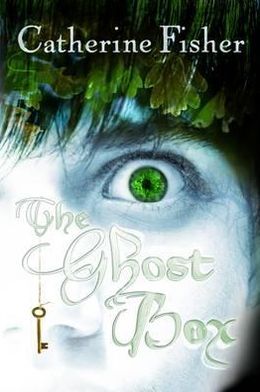
The Ghost Box, by Catherine Fisher

The Ghost Box, by Catherine Fisher

Genre: Middle School Fantasy / Reluctant Readers

Reason for Reading: In exchange for an honest review, this book was provided by Myrick Marketing & Media, LLC via Netgalley.

Synopsis: When Sarah discovers that the ancient tree outside her window is haunted by the ghost of a boy, she is both terrified and fascinated. The ghost boy gives her a beautiful old box and begs her to find a key to open it. But soon, Sarah’s pesky goth step-brother Matt is sticking his nose into her business. Can Sarah find a key to the box without Matt figuring out what’s going on? 

My Thoughts: This book was written specifically for middle-school-aged reluctant readers. I’d say the interest level / maturity is for a 10 to 12 year old, but it is second grade reading level. For that target audience, I think this is a wonderful  novel! The plot is just the type of story I loved reading when I was in the 4th grade, and the difficult dynamics between Sarah and her step-brother are something that a lot of kids this age will relate to. And, these dynamics end with a message of cooperation, teamwork, and new understanding. So there’s a great message to the story, too. If you are struggling to find books that are age-appropriate for your dyslexic child, I highly recommend this book. In fact, I wish there were a lot more books like this available. The more our reluctant readers enjoy their books, the more likely they are to become readers. 

Practicing Tolerance in a Religious Society: The Church and Jews in Italy – Enrollment!

Practicing Tolerance in a Religious Society: The Church and Jews in Italy

Well, I’ve shown a terrible lack of discipline this week. Quite against the spirit of Resolution 5: Please, Just Stop! I have signed up for several Coursera MOOCs this year – Practicing Tolerance in a Religious Society begins on March 10, and runs for 6 weeks. I intend to post my thoughts on this course weekly. 

a little later…
I’ve now looked over all the lecture notes for the first week and I’m so thrilled at all the wonderful supplemental reading suggestions provided by Dr. Cooperman! One reason I only rarely sign up for these Coursera classes is because I have an OCD need to read all suggested readings and totally immerse myself in a subject. And such a thing simply isn’t possible within a course’s time-frame. And then I get all nervous and shaky and feel overwhelmed. So I tend to focus on Great Courses lecture series instead, because I can go as slowly as I want. But I really love being able to interact and network with people who have similar interests (albeit different opinions) – and that’s what I love about Coursera.  

So I’ve vowed that I will simply move through this entire course and not fret about reading everything. I’ll just write down all the suggested readings, and I can get to them later during my personal studies.

Does anyone else have this tendency to get frustrated when you can’t read everything, or to over-commit to your passions and interests?