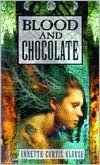
Blood and Chocolate, by Annette Curtis Klause

2012 Book 141: Blood and Chocolate, by Annette Curtis Klause

Reason for Reading: This is my second post for Book Journey’s Banned Books Week 2012 blog tourBy reading banned books, I feel that I’m expressing my freedom of speech (or in this case, the author’s freedom of speech), but I’m also interested in learning more about WHY people ban books. I don’t approve of banning most of the books on ALA’s top banned books lists, though for some of them I can empathize with the objections. In the case of this particular book, I understand the objections, though I think banning it only gives the book added attention. Blood and Chocolate is #57 on the ALA’s list of Top 100 Banned/Challenged Books 2000-2009.

My Review 

Vivian is a 15-year-old werewolf living happily with her pack in the country when a murder destroys the world she loves. In tragic disarray, her pack moves to the suburbs and tries to get reorganized. In the midst of this chaos, Vivian has an identity crisis and falls for a human “meat-boy.” Her experiences trying to fit in with meat-people teaches her a lot about herself. Meanwhile, the grisly murders continue, and the pack must hunt down the killers before they, themselves, become hunted. This book was very engaging. It was interesting and suspenseful enough that I really wanted to know how it ended, despite the fact that I disliked all the characters. Vivian was manipulative and conceited. Her mother had little character other than expressing concern for her daughter and being obsessed with sex. Vivian’s meat-boy boyfriend seemed likable enough at first (though not particularly alluring), but then his qualities took a nose-dive towards the end of the book. Honestly, I’m not sure why this book gets such good reviews, but I suppose it’s simply because the narrative is so engaging. 


My feelings about why this book was banned

I had the feeling while reading Blood and Chocolate that Klause intended this book to be a slap in the face to prudish book-banners. For me, that took a lot of the enjoyment out of the book because I felt like I was being beat over the head with a Message. Even if I agree with the Message, I think a novel’s MAIN objective should be to tell a story. If the story is told well, the message comes through in a smooth allegory. This book seemed like Klause was going for shock-value to pump up her sales. The reason I believe that this slap-in-the-face was purposeful and not simply part of the story is because Klause included a conversation between Vivian and her boyfriend about adults that objected to certain types of behavior and wanted to burn his books. 


Klause included almost all of the qualities that our book-banners of America hate: explicit sexualization of everything, the occult, disrespect for religious symbols, obscenties, violence, age-inappropriate relationships, and an entire page musing about different ways to commit suicide. None of this was bad enough to scar a child or young teen. However, I feel she REALLY overdid it with the sexualization. You’d think from this book that the defining characteristic of werewolves is that they were unabashedly and continuously horny. This seems to be the defining trait of teen-aged boys and middle-aged men as well ;). It was a bit obnoxious. The randiness of every character was SO overdone that it distracted from the story. So in the end, no, I don’t think this is subversive literature. But I have no respect for Klause’s ability to portray a message with finesse.


Who Fears Death, by Nnedi Okorafor

2012 Book 139: Who Fears Death
written by Nnedi Okorafor, narrated by Anne Flosnik
Reason for Reading:
 This is my fourth book for The Diverse Universe blog tour, in which we are reading speculative fiction books written by authors-of-color. Who Fears Death was a Nebula nominee in 2010 and won the World Fantasy Award in 2011.

My Review

This book takes place in a post-apocalyptic Sudan, which is peopled by two races–the dominant Nurus and their “slaves” the Okekes. Onyesonwu Ubaig-Ogundiwu (whose name means “Who Fears Death?”) is a the daughter of an Okeke woman who was raped and brutalized by a Nuru sorcerer and his genocidal army. Onyesonwu was considered “Ewu,” a mixed-race child who brings bad luck and violence wherever she goes. Despite Onyesonwu’s mother’s lucky marriage to a kind man, the girl spent most of her younger years feeling insecure and angry at the world. However, as Onyesonwu grew, she inherited the powers of a sorcerer…angry powers that she couldn’t control without the help of a teacher. This story is the coming-of-age of a young sorcerer destined to wreak vengeance on a violent father. 
I am having a really difficult time deciding what rating to give this book. Okorafor’s writing was powerful (as was the reading by Flosnik). The story was compelling, though a few sections dragged for me–these parts could have been cut out to make a shorter book with no loss to the story. The genocidal violence and rape were described in disturbing detail, though these details were tactful and necessary. Okorafor used a post-apocalyptic setting to write a powerful story about issues (like genocide, female circumcision, and oppressive sexism) that are current problems in parts of Africa today. In fact, the most powerful part of the story (the consequences of human brutality) were disturbingly realistic and representative of the world many of us Westerners choose to ignore today. But, as disturbing as this book’s content was, there was also a ray of hope and optimism. And behind all of this darkness and light, there is the story of a girl who wants nothing more to love her man, her friends, and her mother despite all odds. (Well, ok, she also wants revenge…)
About the Author:
Nnedi Okorafor is the American-born daughter of Igbo Nigerian parents. She holds a PhD in English from the University of Illinois, Chicago. She is a professor of creative writing at Chicago State University. She has written several YA fantasy novels. Who Fears Death is her first book for adults.  

The Hundred Thousand Kingdoms, by N. K. Jemisin

written by N. K. Jemisin, narrated by Casaundra Freeman


Reason for Reading:

First of all, let me thank Morphi who recommended this book a few weeks ago when I said I was reading authors-of-color…-of-speculative-fiction for the Diverse Universe Tour. This is EXACTLY what I needed after reading all those heavy literary works. This book was fun brain candy, but it also had some interesting messages as well. 🙂 


My Review:

When Yeine Darr’s mother dies, she is called for an unexpected interview with her estranged maternal grandfather, the ruler of The Hundred Thousand Kingdoms. Under the guise of adopting her into the family, her grandfather’s twisted family holds Yeine against her will in the city of Sky. Presumably, she is a third contender to take her grandfather’s place as ruler–but what are his motivations for accepting her (as outcast) into the family? On top of that, Yeine is also being seduced by the charms of the “gods” of Sky…and one of them is the ultimate bad-boy. These gods have been treated as slaves by Yeine’s family for two thousand years, and they want their own piece of Yeine’s new life. Yeine must weave her way through a maze of deceit to decide who her allies are. I loved this book because I was in great need of some brain candy right about now. It’s light, fun, fluffy…as long as you approach it like brain candy, you’ll really love it. 🙂 Despite it’s fun fluffy nature, Jemisin manged to weave in messages about unbendingly dogmatic religions, slavery, women’s rights, and abuse of power. These messages do not overpower the story, but they’re there if you want to think about them. In my mind, this was a perfect mixture and just what I needed right now. 🙂

About the Author:
N. K. Jemisin was born in Iowa city in a year un-noted by Wikipedia. 😉 She grew up in New York City and Mobile, Alabama. The Hundred Thousand Kingdoms is her debut book…it was considered for the Hugo, Nebula, and World Fantasy awards the year it came out. I look forward to watching as Jemisin’s writing develops. 🙂 If her first book is so good, then perhaps her writing will get even better as time progresses!

Kafka on the Shore, by Haruki Murakami

2012 Book 137: Kafka on the Shore

Written by Haruki Murakami; Narrated by Sean Barrett and Oliver Le Sueur

Reason for Reading: In order to increase awareness of speculative fiction authors-of-color for A More Diverse Universe blog tour, I have read and reviewed Kafka on the Shore, by Haruki Murakami, which is Japanese magical realism / surrealism. This is one of the 1001 Books You Must Read Before You Die, and it won “best novel” for the World Fantasy Award in 2006.

My Review

Kafka on the Shore follows two seemingly unrelated characters whose stories collide in surreality. The first character is a 15-year-old runaway boy who has renamed himself Kafka Tamura. Kafka runs away from his father for reasons that slowly reveal themselves as the plot thickens. He ends up in an obscure library, where he must overcome a dark curse. The second character is Nakata, an old man who suffered an injury as a child and lives as on a stipend for the mentally disabled. Nakata may not be very smart, but he can talk to cats, and he has an uncanny ability to accept surreal events at face value, thus providing a unique perspective to the strange plot twists. Kafka on the Shore highlights the extreme effects alienation can have on a person’s psyche. It had some VERY dark undercurrents (and even one scene of brutality that was quite shocking). It was a fascinating story, but after thinking about it for several days, I’m still unable to figure out quite what it meant. Perhaps it was only an expression of dark loneliness and nothing more? Whether I’m missing the deeper meaning or not, I greatly enjoyed reading my first Murakami book, and look forward to reading many more of these fascinating works. 


About the Author

Haruki Murakami was born in Kyoto, Japan in 1949 to parents who taught Japanese literature. Murakami was greatly influenced by Western culture. His “modernist” books invoke an interesting mixture of classical music, Western literature, and Japanese culture. Like many surreal / modernist writers, his novels depict alienation, loneliness, and trauma.


Final Comments

It’s interesting that I followed up The Blind Owl with Kafka on the Shore. Both are Asian surrealism (which I haven’t read too very much of) and both have explicit use of the Oedipus complex. Is the Oedipus complex a common characteristic of surreal literature? Or a common characteristic of Asian modernist fiction? Or maybe the Oedipus complex is a defining characteristic of alienated characters? Maybe it was just a coincidence. I guess I’ll see as I read more of these types of books. 🙂 I have decided to include Kafka on the Shore in the R.eaders I.mbibing P.eril VII challenge because of the unexpected dark undercurrents. 


Rose Daughter, by Robin McKinley


2012 Book 132: Rose Daughter, by Robin McKinley (9/9/2012)

Reason for Reading: More light reading. 🙂 I chose this book because I had just finished reading Beauty, by Robin McKinley and I wanted to compare her two versions of the Beauty and the Beast story. They had a lot of similarities (both were rather canonical retellings rather than “twists.” But they were also very different. In the end, I think I enjoyed reading Beauty more, but I found the ending of Rose Daughter more satisfying.

My Review
Beauty and her two sisters were living in the lap of luxury with their successful father when suddenly everything changed. Her father’s business failed, and they were left destitute. They made a new beginning in Rose Cottage, where things weren’t quite what they seemed. The coming of Beauty’s family to Rose Cottage was the first step to opening an ancient curse that would change their lives forever. This was an adorable little story…just as enjoyable as McKinley’s first retelling of the Beauty and the Beast story. I was skeptical that McKinely could tell the story twice but, although there were some similarities, the two stories were very different. THIS Beauty used her magical gardening capabilities to change the world…

Beauty, by Robin McKinley

2012 Book 124: Beauty: A Retelling of the Story of Beauty and the Beast, by Robin McKinley (8/23/2012) 

Reason for Reading: Green Dragon Group Read

My Review

Beauty must sacrifice her own freedom in order to save her father…she ends up trapped in a castle with a beast who wants to marry her! I really enjoyed this story because it was sweet and simple. It was a refreshing change from all the more recent “twist” retellings of the story. Highly recommended to any fan of children’s fairy tales.

Inheritance, by Christopher Paolini

2012 Book 120: Inheritance, by Christopher Paolini (8/7/2012)

Reason for Reading: Fourth and final book of the Inheritance Cycle

My Review 
I can’t claim to actually have READ this book. I only burdened myself with it because I wanted to know how Galbatorix was killed (assuming he was, of course). I read the first 300 pages, skimmed the next 350 pages, and skipped the last 100 pages. 🙂 I got what I wanted out of it, which is the important part. All I can really say to those of you who are interested: Paolini’s writing got significantly better in this book. Still not fantastic, but he’s got potential. He did a much better job of pacing (though it could have been shorter), and the style flowed better than the last two books–it was less pedantic. If you’re a more patient person than me and are interested in how the story ends, I think it’s worth a read. 🙂

Alice in Wonderland (Norton Critical Edition)

2012 Book 119: Alice in Wonderland Norton Critical Edition, by Lewis Carroll (8/5/2012)

Reason for Reading: Coursera Fantasy and Science Fiction course

My Review 
This NCE contains Alice’s Adventures in Wonderland, Through the Looking Glass, and The Hunting of the Snark. I was pleased with the footnotes, which were helpful in clarifying many of Carroll’s jokes. The critical information included some interesting biographies/diaries of Dodgson (Carroll), as well as a few critical essays. I was disappointed in these because although they were mostly good, the editor clearly has some negative feelings about Dodgson’s morals and included many unnecessary Freudian-finger-pointing passages. If I were younger or more impressionable, I’d have been left with a very negative view of Dodgson indeed! Because of these attempts at manipulating the readers’ good opinions of Dodgson, I wish I had gotten The Annotated Alice instead.

Note about the stories themselves: These were a re-read for me. Although I love Alice and really enjoyed reading the stories with footnotes (I understood them a lot better this time around!), I tend to prefer books with a little more plot development. Scandalous, I know, but what can I say?

Alice Transformed: Coursera Essay

Lewis Carroll*


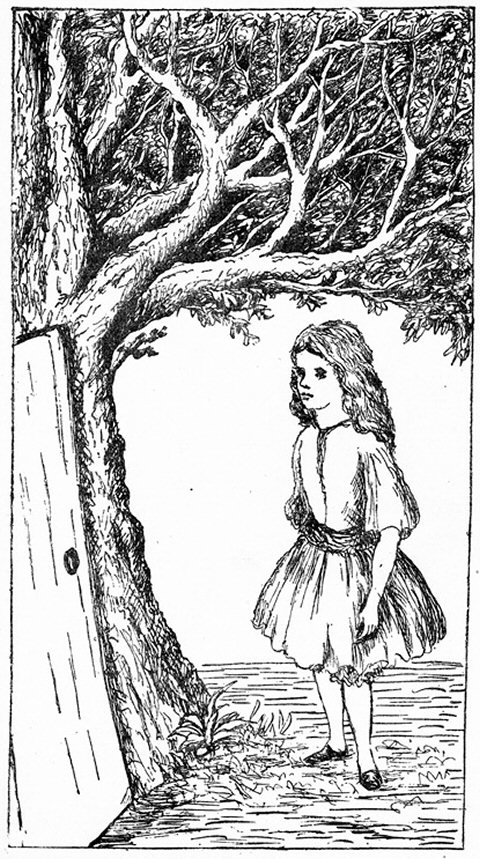
In the beginning, Alice falls down a rabbit-hole, landing in a room containing a tiny key, a tiny door, and a large table. When she is small, the door is locked–she’s not allowed out. But then she grows very large…so large, she can hardly fit into the womb room anymore. Ah! Now she can reach the key! But the way out is so tiny! Luckily, she is taken up by a force outside of her control (a sea of tears) and is thrust into Wonderland.

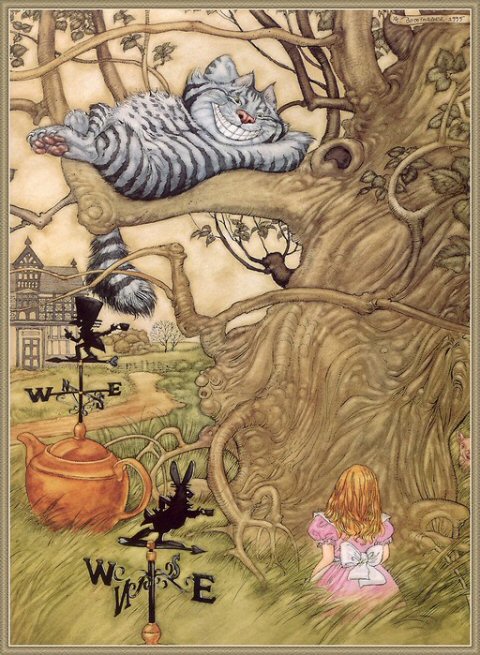
This initial entrance into Wonderland is a metaphor for Alice’s birth into a new life. In Wonderland, she sees many unusual sights that amaze, frustrate, and/or delight her. The Caterpillar leads her to question her own identity—an elusive concept in the ever-changing world of Wonderland. The Cheshire Cat encourages her to be self-aware: “we’re all mad here. I’m mad. You’re mad.” The Cat is the only creature in Wonderland who recognizes his own madness! After talking to the Cat, Alice is less frustrated by the madness that surrounds her. She allows the Mad Tea-Partiers to entertain instead of frustrate her.

After the tea party, she again finds the room from which she was first thrust into Wonderland. This time, she does not hesitate. She confidently grabs the key, drinks the shrinking potion, and walks through the door–reborn as a new, confident Alice.

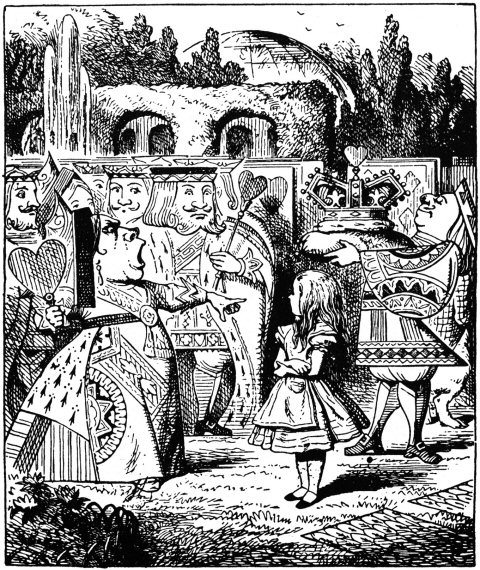
Alice is essentially “born” into Wonderland twice. The first birth is full of frustration and self-doubt. But the second birth is followed by self-confidence. She now applies lessons that she learned the first time around. For instance, she stops herself before telling the Mock-Turtle that she eats lobsters and fish. She confidently deals with the intimidation tactics of the Queen of Hearts, whereas she would have been frightened or angry before. Alice’s Adventures in Wonderland is an allegory in transformation. It’s a story about growing up.

*******
Yes, I have done the unthinkable. Just to spite all those angry essay-format-Nazis, I have written *dum dum dum* AN ESSAY WITHOUT A THESIS STATEMENT. I hope you will all forgive me for this unkindness. 😉


*Images were taken from: 

The Confidence of Alice


As I said in my previous post on Alice (Alice, the Caterpillar, and the Serpent), Lewis Carroll used asterisks to denote metamorphoses in Alice. The last row of asterisks in Alice’s Adventures in Wonderland was when she shrunk back from a serpent to a reasonably-sized girl at the end of Chapter V. This sudden absence in transformative asterisks suggests that Alice is beginning to gain confidence in herself and to settle into the Alice she will be. 


Chapter VI introduces another well-recognized icon of the Alice books: the Cheshire Cat. The conversation that commences is probably the most sensible she has in Wonderland. Alice asks:

“Would you tell me please, which way I ought to go from here?”

“That depends a good deal on where you want to get to,” said the Cat.

“I don’t much care where–” said Alice.

“Then it doesn’t matter which way you go,” said the Cat.  

Alice, in her newly acquired perfectly-sized body, is now feeling ready for an adventure. But she doesn’t know where to find one. The Cat, in the guise of nonsense, sensibly points out that if she doesn’t have a goal, she’ll be wandering aimlessly through life. This prods Alice into a decision–she’d like to meet more creatures in Wonderland, but she doesn’t want to “go among mad people.”

“Oh, you ca’n’t help that,” said the Cat: “we’re all mad here. I’m mad. You’re mad.”

The Cat is the only creature of Wonderland who recognizes that he’s mad! This self-awareness allows him to sensibly see the rest of the world as it really is–mad. I believe that, like the Caterpillar, the Cheshire Cat is Alice’s alter-ego. He represents the sense, self-confidence, and goal-orientation that arises from self-awareness. After meeting the Cat, Alice marches right up to the Mad Tea-Party and sits down despite the party’s calls of “No room! No room!” Later, in the Queen’s croquet ground, she stands proud and erect as the queen’s procession nears. Her companions lie quaking face-down in the dirt. The Queen interrogates Alice:  

“Off with her head! Off with–“

“Nonsense!” said Alice, very loudly and decidedly, and the Queen was silent.  

Ever since meeting the Cat, Alice does not need to be over-sized to have self-confidence. Her responses to the Mad Tea-Party and the Queen are quite sensible and self-assured. Earlier in the book, Alice’s self-confidence fluctuated with size. But the self-assurance she demonstrates at the end of the book is unlike the childish spats she had when she was over-sized. Think of the incident in Chapter IV, where she was stuck in the White Rabbit’s house. Instead of sensibly standing up for herself, as with the Queen, she simply used her bulk to terrorize the White Rabbit and poor Bill. 

Alice also demonstrates a mature self-assurance when she bursts out laughing (twice) in the Queen’s croquet ground. Earlier in the story, Alice’s main emotions were tear-soaking-frustration, foot-stomping-frustration, timidity, and confusion. Now that she is self-aware, she can see the rest of the world as it is–amusingly silly. 
*Images were taken from: