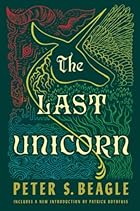
The Last Unicorn, by Peter S. Beagle
Reason for Reading: Group read on LibraryThing’s Green Dragon
Review
When a unicorn realizes that she may be the last remaining unicorn, she leaves her peaceful home on a quest to find out what happened to all her brothers and sisters. Along the way, she picks up bumbling magician seeking his talent and a dour cook looking for her lost innocence. The unicorn soon discovers that the world has changed since she last ventured out. Humans have lost their youthful innocence, and they are no longer able to see things as they truly are – humans have excelled in the art of deceiving themselves.
When I originally picked up this book, I’d expected a cute young adult tale, but never expected such depth. The Last Unicorn is a multi-layered allegory: about lost innocence, self-fulfilling prophecies, and self-deception. But these cynical themes aren’t the main point. The main point is that only in fully understanding humans can the ethereal unicorns save themselves. Only by sacrificing a piece of their ineffable essence can they form a closer bond to humans. And this closer bond can lead humans to do wonderful things.
Yes, it is a Christian allegory by my interpretation. But I think it’s amazing the way Beagle didn’t just throw in a Christ Figure and be done with it….The allegory of Beagle’s unicorn isn’t uniquely Christian – it defies religious boundaries. It is a story of love and innocence that mixes cynicism and hope. Quite extraordinary! 🙂
I was also a HUGE fan of the bumbling wizard Schmendrick who (in my opinion) was only fooling himself into believing he wasn’t a capable wizard. He’s like the Lion, the Scarecrow, and the Tin Man in Wizard of Oz – just the fact that he wanted so badly to be a wizard made him into one. He could laugh at all the people who deceived themselves, as he unconsciously deceived his own self. He reminded me of myself when I’m in a glum mood thinking I’m not capable of anything when, of course, I’m quite capable if I’d stop expecting so little of myself. 😉 This book was a good reminder to have faith in yourself and think about the consequences of your beliefs. 🙂
Category: Young Adult
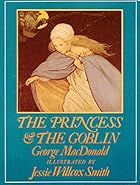
The Princess and the Goblin, by George MacDonald
The Princess and the Goblin, by George MacDonaldReason for Reading: Group read with Simpler Pastimes
Review
This classic fairy-tale-style story is set in a land where the Goblins and Humans have had a “cold war” for many, many years. Long ago, the Goblins threatened that some day they will steal a princess…and their day finally comes when Princess Irene’s nurse accidentally keeps the Princess out after sunset. Luckily, they are rescued by a miner’s boy, Curdie – but now the Goblins know where the Princess lives and what she looks like. When the Goblins hatch a devious plot, Curdie and Irene become fast-friends as they act in turn as heroes. First and foremost, this is a fairy-tale. But it is also an allegory about faith. Princess Irene has a great-great-grandmother – a mysterious and heavenly woman that only she can see. Irene’s very-great grandmother gives the Princess a magical string and tells her to follow the string whenever she’s afraid – never doubting it or deviating from it, regardless of where it may take her. Irene must learn to have faith even when she thinks that the string has led her astray. And Curdie must learn to have faith in a very-great grandmother that he has never seen. This is a sweet story, nice for reading aloud to young children.
Harry Potter and the Order of the Phoenix, by J. K. Rowling
Harry Potter and the Order of the PhoenixWritten by J. K. Rowling, Narrated by Jim Dale
Reason for Reading: I’ve been going through the Harry Potter books by audio now. This is my first time reading straight through the entire series, and by “straight” I mean I finish one every one or two months. 😉
Review
(WARNING: Contains unavoidable spoilers from earlier novels!!!)Voldemort has recently returned, and Harry Potter has spent the entire summer listening to the muggle news for some sign of terror. But it turns out that most people don’t believe Harry and Dumbledore that Voldemort has risen, and Voldemort is using that ignorance to his advantage. Furthermore, the Ministry of Magic has decided that Dumbledore isn’t stable, and they’re interfering at Hogwarts with the addition of a new teacher – the throttle-worthy Dolores Umbridge. *Yes. I wanted to throttle her EVERY time she entered the narrative. That shows excellent caricaturization by Rowling.* This year, Harry must battle the disciplinary hand of the Ministry and skepticism from his fellow students, without losing focus on his upcoming OWL exams. Will he pass Potions?!
This is one of the more complex books in the series (which wins it bonus points with me), but it is also the angstiest book. Harry spends the entire book angry at his friends, angry at Dumbledore, angry at the Ministry, angry at Umbridge, and just plain pissed off in general. His confusion is compounded by his interest in Cho, who is still mourning the death of her dead boyfriend Cedric. Overall, it’s a good book because it advances the story and develops character, but I got a bit tired of angsty Harry. This is my least favorite (though still highly enjoyable) of the Harry Potter books.
Jim Dale’s narration is quite enjoyable now that I’ve gotten used to it. He has recognizable voices for each of the characters, and his voice is entertaining and engrossing.
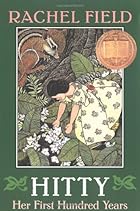
Hitty: Her First Hundred Years, by Rachel Field
Hitty: Her First Hundred Years, by Rachel FieldReason for Reading: This book won the Newbery Medal in 1930 and has been sitting on my shelf for years.
Review

While sitting idly one evening in her antique shop, Hitty, a 6-inch-long doll carved out of Mountain Ash wood, decides to write her memoirs. She begins her narration with her birth into the brave new world of 1830’s Maine. Her little girl drags her on many adventures beginning first with their village and ending in a far-off land…where she finds a new owner. Follow Hitty’s adventures over a hundred years as she changes hands and lands and occupations. This is an adorable little classic of historical fiction for 8-9 year-old girls. The story is sweet and generally easy to read (though some of the historical references went over my head, and the book succumbed to the racial stereotyping common for books written around the turn of the century). I’m glad I finally picked this one up.
Call It Courage, by Armstrong Sperry
Call It Courage, by Armstrong SperryReason for Reading: This book won the Newbery Medal in 1941. It’s been sitting on my shelf for years.
Review

Mafatu is afraid of the ocean because he almost drowned when he was a boy. But in his culture, fear is scorned and laughed at. Mafatu feels that he must redeem his good name and prove that he is not afraid anymore. He climbs in a boat and goes on a voyage, but he soon finds himself shipwrecked on an apparently-deserted island. There, he keeps himself alive by making all of his own tools, weapons, and a new canoe. He battles a tiger shark, an octopus, and a boar. He defies the cannibals when they return to their island. But will he be able to return home? This was a cute book, and I enjoyed the adventure – though it’s very short and all the adventure is packed in at a very unrealistic pace. Regardless, I really enjoyed the couple of hours I spent with it. I think a young reader might find this book fun. It’s appropriate for someone reading at maybe the 3rd grade level.
The Last Battle, by C. S. Lewis
The Last Battle, by C. S. LewisReason for reading: This is the seventh (and final) book in the Chronicles of Narnia, which I’ve been reading in order-of-publication. I plan on rereading them all in chronological order using Planet Narnia: The Seven Heavens in the Imagination of C. S. Lewis, by Michael Ward as a guide.
Review

The final book in The Chronicles of Narnia depicts the apocalypse of Narnia. When a shrewd monkey teams up with Calormen to trick the Narnians into thinking Aslan has returned – and they are his spokespeople – Narnia is cut to ruins. Forests are destroyed, Narnians begin to doubt Aslan, and cities fall to heathen invaders. I’m afraid to say this was my least favorite of the Narnia books (though I still liked it quite well!). Intellectually, I know Lewis had to have an apocalypse – whatever begins must also end – but it was still a bit dreary. So although I understand why the apocalypse had to come, I still liked the other books so much better. Not only because they were much more cheerful, but also because they had more fun-filled adventure.
But that’s par for the course. Death is better than life; boys are better than girls; light-coloured people are better than dark-coloured people; and so on. There is no shortage of such nauseating drivel in Narnia, if you can face it.
I agree that Narnia conveys some rather sexist and ethnocentric views, but that’s what English literature of that period was like. Lewis (and the Narnia books) are a product of their time.
And in The Last Battle, notoriously, there’s the turning away of Susan from the Stable (which stands for salvation) because “She’s interested in nothing nowadays except nylons and lipstick and invitations. She always was a jolly sight too keen on being grown-up.” In other words, Susan, like Cinderella, is undergoing a transition from one phase of her life to another. Lewis didn’t approve of that. He didn’t like women in general, or sexuality at all, at least at the stage in his life when he wrote the Narnia books. He was frightened and appalled at the notion of wanting to grow up. Susan, who did want to grow up, and who might have been the most interesting character in the whole cycle if she’d been allowed to, is a Cinderella in a story where the Ugly Sisters win.
When I read this paragraph, I wondered what Lewis actually did do with Susan in the book. But when I read the book, I interpreted those events differently than Pullman: Susan wasn’t allowed into Heaven at that time. It was made clear that Susan was in one of the silly stages of life, but it was just a stage. She still had a chance to grow out of it. She hadn’t been rejected from Heaven permanently, and it wasn’t her time to die. Susan lived. And Susan had the ability to change (just as Pullman points out). Lewis wasn’t saying that grown-ups can’t go to Heaven. After all, the kids’ parents went to Heaven, didn’t they? Lewis was saying that Susan was in a phase where she idolized material things – and had thus turned away from her spiritual health.
Also, I’m not certain Susan really is the most interesting character. By Pullman’s definition (he-who-changes-is-most-interesting) I believe Eustace’s character developed much more than Susan’s character. Why is Pullman ignoring Eustace?
What do other people think about Susan’s character? Do you think Lewis meant for her to be denied Heaven permanently?
Losing Christina: Fog, by Caroline B. Cooney
Losing Christina: Fog, by Caroline B. CooneyReason for Reading: I had hit a reading slump and wanted to perk myself up by reading something “exciting.” I was browsing through the ebooks at my library, and found this. I remembered how much I loved it when I was a child and thought “I wonder how bad it could be?” So I borrowed it. 🙂 I’m rather glad I did!
Review

Christina is excited because this year she is 13 and she gets to leave the island she grew up on and attend junior high on the mainland in Maine. Despite her excitement, she is torn by worry about whether she’ll be bullied by the mainland kids, who think islanders are stupid and poor. But those worries soon take second place when she realizes that the owners of the bed and breakfast where she and her islander friends lodge are using psychological torment to suck the souls out of girls. She’s terrified as she watches the beautiful and brilliant senior Anya fade away. And soon the psychopaths are after her own mind.
When I was pre-junior high I used to gobble up these Point Horror books like a turkey dinner. (haha. ok, I know that wasn’t funny. Just work with it.) There are very few of those books that I actually remember liking though. This is one that has really stuck with me through the years. When I found it in the library recently I thought: “I wonder…” And I’m glad I did, because I found this book terrifying. When I was a teenager, I think I found the spooky psychological aspects of going insane scary. Now, the book is even more terrifying, but for a different reason. Those psychopath adults who have FULL control over those poor children were horrible! They were charming, and fantastic liars, and those kids’ parents weren’t around to see what was going on. They just believed whatever the adults told them rather than believing their own children. And the things those psychopaths said to the kids! Ohhhhh shudder. Yes, the book lacked subtlety. But the fact that it terrified me even now gets it four stars in my blog! My only complaint (besides the lack of subtlety – which is really due to its target audience) is that it ended in a cliffhanger. This is a trilogy of short books. It really should be one longer book. Even combined, I think the book would still be reasonably short. But it WAS Point Horror, after all. They had to be short.
The Magician’s Nephew, by C. S. Lewis
The Magician’s Nephew, by C. S. LewisReason for Reading: I’m finishing up the Narnia chronicles in order-of-publication. This is the penultimate book. 🙂 I chose to read this book NOW because of the Classics Children’s Literature Challenge.
Review

When Digory’s evil magician uncle tricks Polly into entering another world, Digory must rescue her. Their adventure heightens when they discover an evil witch and then witness the creation of Narnia. This is the first time I’ve read this adorable classic. I’ve heard it was the book that Lewis meant to start the series with, but it was so difficult to write that he put it off until he had developed Narnia a bit more. It’s probably good that he did, because I enjoyed seeing references to the earlier books…like the story of how the light-post ended up in the middle of a forest in Narnia. 🙂 I look forward to re-reading this book later (this year?) when I read them in chronological order. 😀
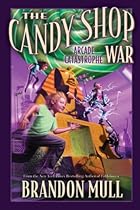
The Arcade Catastrophe, by Brandon Mull
2012 Book 171: The Arcade Catastrophe, by Brandon MullReason for reading: This is a sequel to a book I loved – The Candy Shop War. Plus, I’ve read all of Mull’s books, so I can’t stop now, can I? This book counts for California in my Around the World Challenge. It’s this week’s review for Read and Review Hop, hosted by Anya from On Starships and Dragonwings.
Review

Nate, Summer, Pigeon, and Trevor believe that things have calmed down since the wicked plans of Belinda White were foiled last year. But when they find out that Jonas White, Belinda’s brother, is running a suspicious Arcade in the area the kids are plunged into a new adventure. Because magicians can MAKE magic, but can’t actually USE it (and because they’re only safe from magical attack if they’re in a magical sanctuary – so they’re not often mobile), they use magical candy to recruit kids to do all their dirty work. Nate and his friends must use magical powers provided by the Magician/Candyman Mr. Stott to infiltrate White’s team. White sends them on a wild and magical treasure hunt for a dangerous artifact. How can the kids keep undercover without providing White unimaginable power? How can they keep such a huge secret from Lindy Stott?
Mull intended The Candy Shop War to be a standalone book, but because people kept asking for a sequel, he delivered. And you know what? I’m pretty sure it was better than the first book! Mull’s writing has developed quite a bit since he wrote The Candy Shop War. This book has adventure, humor, and good characters. It was a delight to read. I had a hard time putting it down. Originally, I was skeptical because I’m a fan of keeping standalone books standalone, but I’m really happy Mull wrote this book and I’m eager for the following one. 😀 These books are aimed at a slightly younger crowd than the standard YA book…I’d say they’re appropriate for 11-year-olds, but could be enjoyed by kids (and adults) of other ages too.
The Fox Inheritance, by Mary E. Pearson
2012 Book 169: The Fox InheritanceWritten by Mary E. Pearson, Narrated by Matthew Brown
Reason for Reading: It’s the second book in the Jenna Fox Chronicles.
Review

After 260-years of purgatory, Locke Jenkins awakens with a body that seems familiar – yet somehow changed. His friend, Kara, who died in the car crash that killed Locke, also has a achingly similar body…but her mind isn’t quite right. Locke and Kara soon learn that their minds had been downloaded and saved centuries ago by the father of Jenna Fox – another victim of the fatal crash. Although Jenna had been given a new life right away, the copies of Locke’s and Kara’s minds had collected digital dust until Dr. Gatsbro brought the teens back to life in this brave new world. But Dr. Gatsbro’s motives are not altruistic. Locke and Kara make a desperate attempt to escape the doctor’s nefariousness clutches…and are jettisoned into the foreign world of the future. But can Locke keep Kara from making a terrible mistake?
When I read The Adoration of Jenna Fox years ago I really liked it, but as I was reading The Fox Inheritance, I realized that I remembered almost nothing of the first book (perhaps it wasn’t so great after all?). I had to rely on spoiler reviews of the first book, and on the hints-of-what-came-before in the second book to remember. This made the first part of the book rather confusing. I’d recommend familiarizing yourself with The Adoration of Jenna Fox before starting The Fox Inheritance. Although I enjoyed this book, I wasn’t as impressed as I had been after reading the first in the trilogy. The Fox Inheritance had some world-building and good characters. It brought some interesting moral issues to the table: Is it ethical to bring someone back to life after they’re dead – and risk changes? Is it ethical to use a sentient being that of human-creation for our own purposes, or do they deserve civil rights? These are intriguing questions, but they’ve been explored in many other books/movies. So, in the end, I liked this book. It was a fun read. I’ll probably pick up the third book when it comes out. But I would have been perfectly happy if this trilogy had stayed as ONE standalone book. And I’m pretty sure I’ll forget the plot of this book within a few weeks.