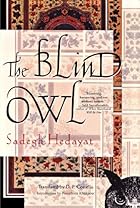
2012 Book 136: The Blind Owl
Written by Sadegh Hedayat; Translated by D.P. Costello; Introduction by Porochista Khakpour
Reason for Reading:
In order to increase awareness of speculative fiction authors-of-color for A More Diverse Universe blog tour, I have read and reviewed The Blind Owl, by Sadegh Hedayat. Although The Blind Owl may not be considered speculative fiction by critics, I felt that the surreal nature of this book fit with the spirit of speculative fiction.
My Review
In this surreal novella, an unnamed protagonist unburdens the deadly weight on his chest by confessing to his own grotesquely owl-shaped shadow on the wall.
“in order to explain my life to my stooping shadow, I am obliged to tell a story. Ugh! How many stories about love, copulation, marriage and death already exist, not one of which tells the truth! How sick I am of well-constructed plots and brilliant writing!”
In his mind-spinning narration, it is difficult to tell when the events described are cloaked with opium, veiled with madness, or are simple truth. This novel is deeply disturbing in many ways. It narrates horrific events, certainly, but it is the manner that they are conveyed that is frightening. His imagery is surreal. His repetition is hypnotic. His words are oppressive.
“Only death does not lie. The presence of death annihilates all superstitions. We are the children of death and it is death that rescues us from the deceptions of life.”
The imagery and symbolism used by Hedayat portrays his personal marriage between Western and Eastern culture. Although this book is considered the essence of Persian literature, there are signs of Poe and Kafka. The Blind Owl bled, vomited, and wept Freudian symbolism.
This was an amazing book, and highly recommended to people interested in Persian fiction or in modernist fiction.
About the Author and Book:
Sadegh Hedayat (1903-1951) was one of the two fathers of Persian fiction, and sole father of modernist Persian literature. He was born to an aristocratic family in Tehran, and grew up during a turbulent time in the history of Iran. After WWI, the country underwent “modernization” and “Westernization.” As always happens with modernization, many people felt oppressed by the loss of culture and ceremony…by the loss of what makes them THEM and by the adoption of foreign values. Hedayat was apparently not one of these people. In 1925 he left Iran for studies in Europe. After short-lived attempts at studying engineering, architecture, and dentistry, he dedicated his life to studying Western literature and to learning Iranian folklore and history. From 1937 to 1939, Hedayat lived in India. The Blind Owl was first published in 1937 in Bombay, India with the label: “Not for publication in Iran.” At the time of publication Iran was suffering from the oppressive later years of the reign of Reza Shah. Free press was limited, the middle class was ruled with an “Iron Fist,” and the bureaucracy was falling apart under corruption.
In Hadayat’s later years, his writings attacked the monarchy and the clergy of Iran, which he felt were leading to its downfall. However, he felt alienated by everyone around him in Iran, and moved to Paris. In 1951, he gassed himself in his apartment by plugging all the windows and doors with cotton. He left money for his burial in plain view.
The introduction to The Blind Owl, written by Porochista Khakpour in the Costello translation is well worth reading. She tells about her history with the novel…how her father wouldn’t let her read it when she was a child because it had lead to so many suicides among Iranian youths. I get the impression that Khakpour’s family was of a melancholic nature and was strongly affected by books of this nature. I found The Blind Owl disturbing, but I didn’t experience any inconvenient urge to off myself after reading it.
Personal interpretation that will contain middle-of-story SPOILERS:
I generally roll my eyes whenever the phrase “Oedipus complex” is introduced into an interpretation. However, in this case, I think “Oedipus complex” is exactly what Hedayat was aiming for. The ONLY character named in the entire book was his mother. He described his mother’s dancing in sensual detail. He obsessed sexually about all maternal figures in his life, including his aunt and his nanny. He admits to marrying “that bitch” his wife because she reminded him of his aunt (whom he worshiped with an almost sensual passion). He viewed his mother, nanny, and aunt as sexually unattainable…but that view was extended to his wife. He insisted that he had never slept with her. That he had gone mad from her denial of him and her promiscuity with flea-ridden brutes off the streets. I interpreted these obsessive delusions as false. I assumed that he had, indeed, coupled with his wife, but in his madness repressed those memories and created new delusional memories about other men. (On a side note, I’m not even certain his wife was his aunt’s child…she may have been the daughter of his nanny…but I don’t know why that would matter?)
The Oedipus complex extended towards his feelings for his father, his father’s brother, and his father-in-law. He seemed to fear and loathe the very idea of any of these men–they had, in fact, merged with each other in his own mind. Worse, they had merged with his own self-image so that he feared and loathed himself–probably for his unsatisfied sexual desires towards maternal figures.
Of course, I don’t think the entire story was about an Oedipus complex…that was just the theme that jumped out at me on my first perusal. The story was about a man who was isolated from the rest of the world. A man who would never belong. A man who had no one to unburden himself to as the world around him crumbled into surreal chaos. The isolation was likely a reflection of Hedayat’s own feelings of alienation. The world crumbling around him was likely how he viewed the socio-economic failure of Iran.
I’m sure this is the type of book that you find something new each and every time you read it…even if you meticulously study it for years.


 About the Author:




 Hibernator's Library