Democratic to Authoritarian Rule – A Teach-Out by University of Michigan

Big Fist Over People

The University of Michigan is teaming up with Coursera to create Teach-Outs which (as far as I can determine) are week-long MOOC lecture series which address problems currently faced in society today. I have belatedly signed up for their Teach-Out “Democratic to Authoritarian Rule” which started on 2/12/2018. 

arun_agrawal_0The first lecture was by Professor Arun Agrawal, who explained how modern democracy can become authoritarian. In both older and modern authoritarianism, the leader/regime attempts to disable the basic building blocks of democracy, such as elections, free press, check and balances on their power, and rule of law. They may also unfairly enforce laws against people of certain race, ethnicity, sexual orientation, etc. For instance, the regime might promote what they call a democratic election, but undermine the election by keeping some populations from voting (like the modern ID laws, which make it difficult for very poor and homeless people to vote) and by calling the election fraudulent when they don’t agree with the outcome. They might undermine the rule of law by criticizing the judicial system when it disagrees with the regime’s own point of view. (Or by removing the Judicial Branch from the list of government branches on the White House webpage.) They can undermine free press by calling it “fake news” and handing out awards for the “fakest” news. They might claim that they are above the law (for instance, are unable to be sued). [Specific examples aimed at Donald Trump are my own insertions.]

Professor Agrawal ends his lecture with a prompt to introduce ourselves by noting any experience we have had with authoritarian politics and/or our concerns about democratic vs. authoritarian tendencies in our own countries:

I am a soon-to-be-married white middle-class woman from the USA, who has been privileged enough to not be personally impacted by what I would consider the authoritarian tendencies of Donald Trump. I can vote, and I’m fairly confident that my vote wasn’t unfairly discounted due to claims of fraud or lack of identification. I have not been banned from traveling, though I personally know people who have been stuck on one side of the border or the other by such bans. I have not been immediately affected (though I expect the impact to come eventually) of Trump’s withdrawal from the Paris Climate Accord, and his denial and suppression of climate change data. Despite my relative safety from these issues, I am very frightened of where Donald Trump’s plans (or lack thereof) are leading the US and the world. I know that if he continues as is, many more people will suffer, and I am saddened by where our county is headed.

However, I also realize that many people felt the same way about Obama (though I can’t imagine how they can rationalize that). I also know that we, in the US, have it pretty good compared to millions others in authoritarian countries. For that, I am grateful.




Incarceration Nations, by Baz Dreisinger

51gwmenzrl-_sl500_
Synopsis: Dr. Dreisinger travels to different prisons around the world, giving 2-day seminars to the prisoners and comparing the pros and cons of each prison system.
My Thoughts: I admit this book wasn’t quite what I expected. I expected it to have more complaints (with evidence) about the problems of over-incarceration. Although it did contain such comments, that was not the point of the book. It was a fascinating description of different prisons throughout the world and what they were doing right (and wrong) in rehabilitating their inmates. She left some prisons feeling uplifted and left others feeling quite depressed. I found the book quite interesting even if it wasn’t quite what I expected.
I give this book 4 snowflakes for interest level and fluidity of writing
four snowflakes

Sunday Update – Week 2

I hope everyone had a happy Valentine’s Day week. I did. I even spent it with someone, which is rare for me. My fiancé wasn’t as much of a fan of the Viking Blod as I was, but he loved the chocolate covered strawberries.

This wasn’t a great reading week for me as I have been drifting between hypomanic and depressed all week. However, the incumbent insomnia inherent to bipolar disorder meant I had plenty of time to listen to my audiobook while silently sitting, sulking away in the dark. As selfied here:

Yup, that’s me listening to Shadow Land, while trying to fall asleep without waking up the fiancé.

And these (the words you’re reading) are me writing while hypomanic in the middle of the night. Ah, mania is so fun. I wish it weren’t unhealthy. Alas!

My step-daughter-to-be and I baked cupcakes on Thursday, while watching Frozen:

img_3302

This week I have finished 0 books. But I watched:

Watched

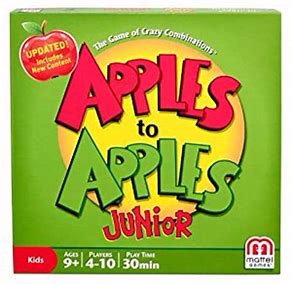
My step-children-to-be, nephew, fiancé, and I watched Wonder and played Apples to Apples Junior as part of a family night last Sunday.  Wonder was an amazing movie. The fiancé and I watched Bridget Jones Diary on Valentine’s Day. And the fiancé, nephew, and I watched X-Men Origins: Wolverine on Friday night after the kiddos went to bed. That was a sucky movie, but since we’re watching all the X-Men movies in order we had to check it off. 

I played:

I acquired:

Acquired

I am currently reading:


Don Quixote Prologue – Chapter 7

DQWEM

This is not a review, it is notes and an analysis of Don Quixote. Therefore, it will contain spoilers.

So far, there are two issues that make me cringe about Don Quixote. They are: the book burning *shudder, and the way the characters treat a mentally ill man. We’ll start with a discussion of the book burning.

The prologue makes fun of writers of the day – how they are pedantic and (Cervantes claims) list off references in their works of fiction in alphabetical order from Aristotle to Xenophon. It would also appear from the prologue that the purpose of Don Quixote was to make the readers laugh by satirizing chivalric works of the time.

After Don Quixote’s first sally forth, his friends (who in the past encouraged the old man’s interest in works of chivalry) decided to burn his books and wall off the library, so that even the room where his madness overtook him could no longer be accessed by the erstwhile knight errant. I was a little confused by this book burning at first. Surely Cervantes felt the pain of destroying something so valuable as that library? So what was his point? Then I realized that he was making fun of the completely arbitrary way Don Quixote’s friends chose which books would be burned and which saved. They would look at a book, rattle off some preposterous monologue about whether the story were worth saving, and then decide whether to burn it. Then, they got really lazy, and just burned the rest. This is not the act of a caring friend, but someone who wants to solve a problem quickly, despite what damage he may incur.

Then, they walled off the library, and told the madman that an evil wizard had whisked it away to spite Don Quixote. Really? They’re encouraging the madness? These are his friends. At this point it seems like they care more about appearances (keeping Don Quixote from indulging in his madness) than about the actual health of their friend/uncle. But this is not the only terrible way he had been treated in the story. It seems that everyone he runs into, except for Sancho, is cruel. They mock him and encourage the madness. At the moment, I wonder whether Cervantes was also making a social statement about having compassion for the mentally ill, but that may be a bit forward thinking in the early 1600s. I will make a more educated guess as I proceed with the book.


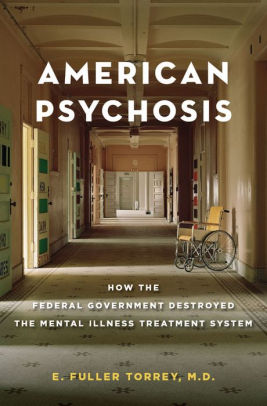
American Psychosis, by E. Fuller Torrey

Synopsis: In this strongly stated book, Torrey describes how the formation of the National Institute of Mental Health (NIMH) took place, accompanied by well-meaning, but ill-planned federal programs for the out-patient care of mentally 9780199988716_p0_v2_s550x406ill patients and the emptying of state-funded mental hospitals. Due to terrible conditions in state hospitals and to the discovery of antipsychotics, many well-intended people wanted to improve the condition of mentally ill people by giving them independence and better living conditions through outpatient treatment. So the founders of NIMH, with the help of President Kennedy, began a federal program intended to care for patients on an outpatient basis, as well as providing resources which were intended on reducing the onset of mental illness in future generations. Unfortunately, as the state hospitals closed en masse, these federal programs didn’t do their job as intended. The federal programs focused too much on trying (and failing) to reduce the new onset of mental illness, and not enough on taking care of people who were released from hospitals. Many people from the hospitals had nowhere to go and/or stopped taking their meds (for various reasons). The populations of homeless and jailed/imprisoned mentally ill people skyrocketed. Violence by and against people with mental illness skyrocketed. Chaos ensued.
My Thoughts: First of all, I think Torrey’s book was too strongly stated. He puts a lot of blame on the US federal government when these same problems with deinstitutionalization and ensuing homelessness/incarceration-of-mentally-ill occurred in other countries around the same time. The book was also long on problems, short on solutions – even in the chapter whose title suggested that solutions would be presented. Despite these flaws, I enjoyed reading American Psychosis. It was full of interesting facts that I didn’t know about what the federal government was doing during the deinstitutionalization of state hospitals.

I give this book 3.5 snowflakes for interesting information and research.3 and half snowflakes


Virtual Hike Up the Appalachian Trail: Week 0

Depositphotos_2259751_original.jpg

Please forgive this and a few more reposts from my old blog, which I’m slowly seeding into this blog for the sake of continuity on this blog.
I’ve always wanted to hike the Appalachian Trail. Big dreams – out of shape woman. (In my defense, I used to be in much better shape, but those days are gone.) So instead I’m going to hike it in my mind, as I try to lose weight for my upcoming wedding. Unfortunately, as well as being out of shape, I’m recovering from leftover breathing problems from the flu, so it may take some effort to start really moving.
Daily goals:
  • Get up to 1 hour exercise bike (Except weekends)
  • Either lift weights or do an ab workout (Except weekends)
  • 88 oz water

Weekly goals:

  • >11,500 calories
  • 14 or fewer Diet Mountain Dews

Longer term goal: get to 140lbs by the end of December

Starting weight: 172lbs
Starting Waist Size: 35.5in
Appalacian Trail Full.png
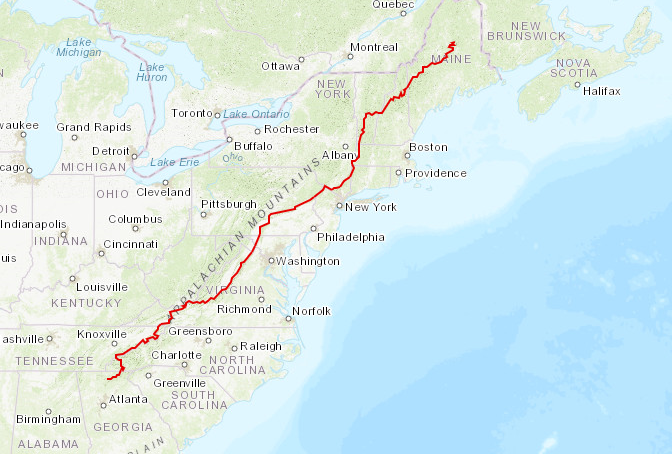
What I will do is keep track of how many “miles” I travel on my exercise bike, and log it as if I were hiking the Appalachian Trail. I will start on Springer Mountain in Chattahoochee National Forest (Georgia). I’m at altitude 3771 feet. 

Classics Club 2018 – 2023

classicsclub

This is my list for the Classics Club, which is a fantastic group of people that read and write about the classics. They choose a list of 50+ books that they want to read in the next five years. Then they share their reviews with each other.

  1. Don Quixote, by Miguel de Cervantes
  2. Roots, by Alex Haley
  3.  The Pilgrim’s Progress, by John Bunyan
  4. The Island of Doctor Moreau, by H. G. Wells
  5. Gulliver’s Travels, by Jonathan Swift
  6. The Picture of Dorian Gray, by Oscar Wilde
  7. Fahrenheit 451, by Ray Bradbury
  8. Handmaid’s Tale, by Margaret Atwood
  9. Foundation, by Isaac Asimov
  10. Oliver Twist, by Charles Dickens
  11. The Scarlet Letter, by Nathaniel Hawthorne
  12. The Merchant of Venice, by William Shakespeare
  13. Much Ado About Nothing, by William Shakespeare
  14. Twelfth Night, by Wiliam Shakespeare
  15. Moby Dick, by Herman Melville
  16. Uncle Tom’s Cabin, by Harriet Beecher Stowe
  17. Madame Bovary, by Gustave Flaubert
  18. Crime and Punishment, by Fyodor Dostoyevsky
  19. The Return of the Native, by Thomas Hardy
  20. The Portrait of a Lady, by Henry James
  21. Adventures of Huckleberry Finn, by Mark Twain
  22. The Red Badge of Courage, by Stephen Crane
  23. Heart of Darkness, by Joseph Conrad
  24. The House of Mirth, by Edith Wharton
  25. The Great Gatsby, by F. Scott Fitzgerald
  26. The Trial, by Franz Kafka
  27. Native Son, by Richard Wright
  28. The Stranger, by Albert Camus
  29. 1984, by George Orwell
  30. Invisible Man, by Ralph Ellison
  31. Seize the Day, by Saul Bellow
  32. The Bible
  33. Mahabharata
  34. The Decline and Fall of the Roman Empire, by Edward Gibbon
  35. Room of One’s Own, by Virginia Woolf
  36. Swann’s Way, by Marcel Proust
  37. The Souls of Black Folk, W. E. B. Du Bois
  38. A Tale of Two Cities, by Charles Dickens
  39. Master and Commander, by Patrick O’Brien
  40. The Divine Comedy, by Dante
  41. The Merry Adventures of Robin Hood, by Howard Pyle
  42. The Jungle, by Upton Sinclair
  43. Far From the Madding Crowd, by Thomas Hardy
  44. Catch-22, by Joseph Heller
  45. The Witches of Eastwick, by John Updike
  46. The Complete Sherlock Holmes, by Arthur Conan Doyle
  47. Paradise Lost, by John Milton
  48. The First Men in the Moon, by H. G. Wells
  49. The Island of Doctor Moreau, by H. G. Wells


Sunday Update: Week 1

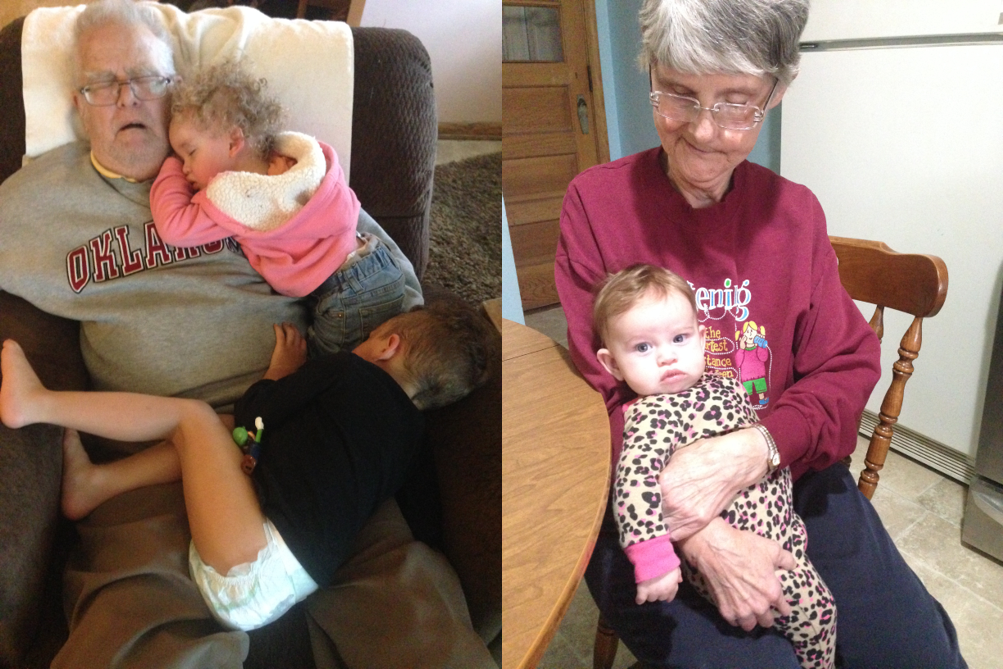
Mom and DadUntil recently, I’ve been living with my parents – helping them when they needed it. But now it’s time to move on: I’ve moved in with my fiancé and am slowing transferring my books from their house to his. This week was very productive in working out some details in how my sister and I will keep my parents safe and happy now that they are living alone. It was a good week for getting stuff done. It was also a good week for my step-children-to-be, who have been in Disney World for the week – though my heart goes out to their mom who must be exhausted!
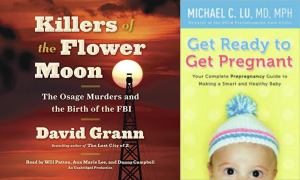
This week I completed:

Completed

I acquired no new books.

I am currently reading:

Currently Reading

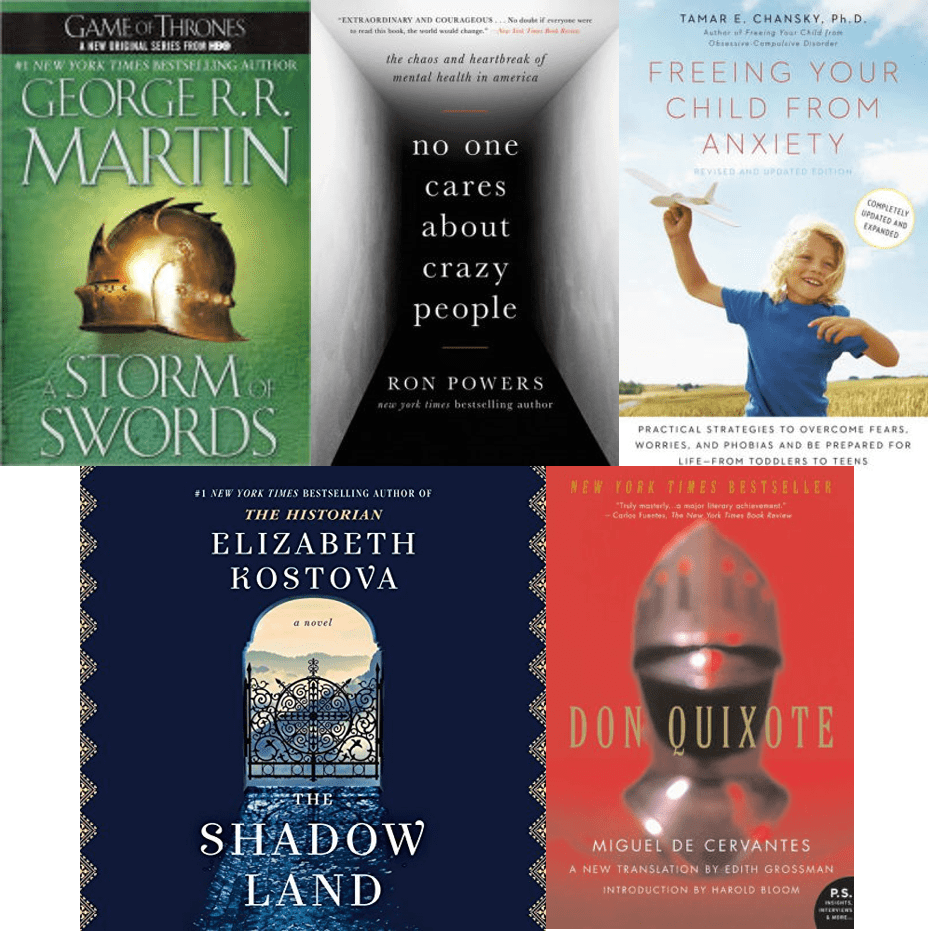
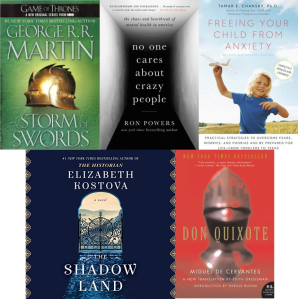
I’m about 500 pages into the Storm of Swords tome, and will probably take another palate-cleansing break at about page 750. I just started No One Cares About Crazy People as my general nonfiction and Freeing Your Child From Anxiety as my adulting book. I also just started listening to The Shadow Land for my real-life book club, and am studying Don Quixote in my Well Educated Mind project.

This update is posted in the Sunday Salon and Caffeinated Reviewer’s Sunday Post.

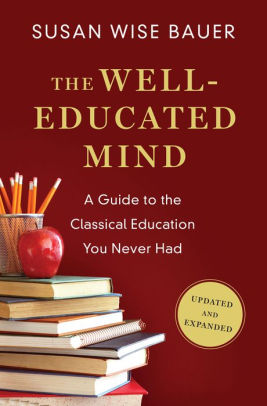
The Well-Educated Mind: reading through the novel

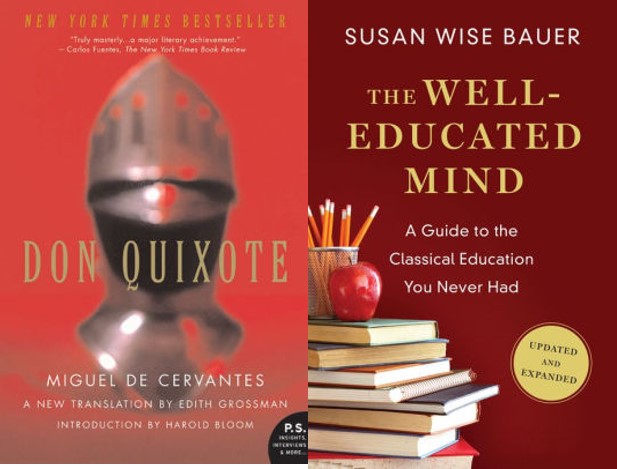
9780393080964_p0_v1_s550x406I have started a new project: I will be reading through the novels (and histories) as suggested by Susan Wise Bauer in her popular book The Well Educated Mind. (I intend on reading through the other categories, too, but later.) I have completed an outline for questions I’m going to ask myself while reading the first book on the novel list – Don Quixote:

Bauer suggests three levels of study:

Inquiry Level 1: Grammar

This is the first read-through, during which I will take important notes from biographies and blurb, and list the characters and relationships to each-other. She suggests dog-earing and underlining the book. Instead, I will take notes in Evernote, and share them here on Saturdays.

Inquiry Level 2: Logic

After reading through the book, she wants me to come up with my own title and subtitle for the book, describing the major event or point. I should also take note of:

👽What is the most central life-changing event?

👽Am I transported? Do I see, feel, and hear this other world?

👽Can I sympathize with the people who live there? Do I understand their wants and desires and problems? Or am I left unmoved?

👽Is this a fable or a chronicle?

If the novel is a chronicle, how are we shown reality: Physical? Mental?

If the novel is a fable, what was the intent? Is it an allegory? If not, is it speculation?

Is the novel realistic with a few fantastic elements? If yes, it’s not simply a fable. What is the phenomenon being described that can not be described in real terms?

👽What does the central character want? What is standing in his or her way? What strategy is pursued to overcome this block?

👽Who is telling you this story? Is this person reliable?

Is it first person? Second person? Third person limited? Third person objective? Omniscient?

👽Where is the story set?

Is it natural or human constructed? If natural, does nature reflect the emotions and problems of characters? Or is the universe indifferent? If human constructed, do those constructions set a mood?

👽What style does the writer employ?

👽Images and metaphors

Are there any repeated images? If so, is this a metaphor, and if so, what does it represent?

👽 Beginnings and endings

Does the beginning sentence/scene come with meaningful imagery that represents where the story is going?

Does the end have a resolution or a logical exhaustion?

Inquiry Level 3: Rhetoric 

👽Do you sympathize with the characters? Which ones, and why?

Did the author choose characteristics to make a statement about the human condition?

👽Does the author’s technique give you a clue as to her argument: her take on the human condition? 

👽Is the novel self-reflective?

👽Did the writer’s times affect him?

👽Is there an argument in this book? If so, do you agree?


Welcome to Hibernator’s Library

Path Split

Welcome to Hibernator’s Library! This year I am beginning a new life. I’m getting married, beginning to raise my two new step-children, and being a homemaker for the first time in my life. I have explored many options for a career, and somehow being a homemaker right now feels right to me.

I have been a book blogger on and off for several years, but the reason I’m making this sudden leap to WordPress is that I’d like to try out freelance proof-reading and editing. So I decided to (yet again) start a new blog with a new feel to it. This blog will feature mainly book mini-reviews, but will have some personal notes on a bi-weekly basis. So welcome readers, old and new!