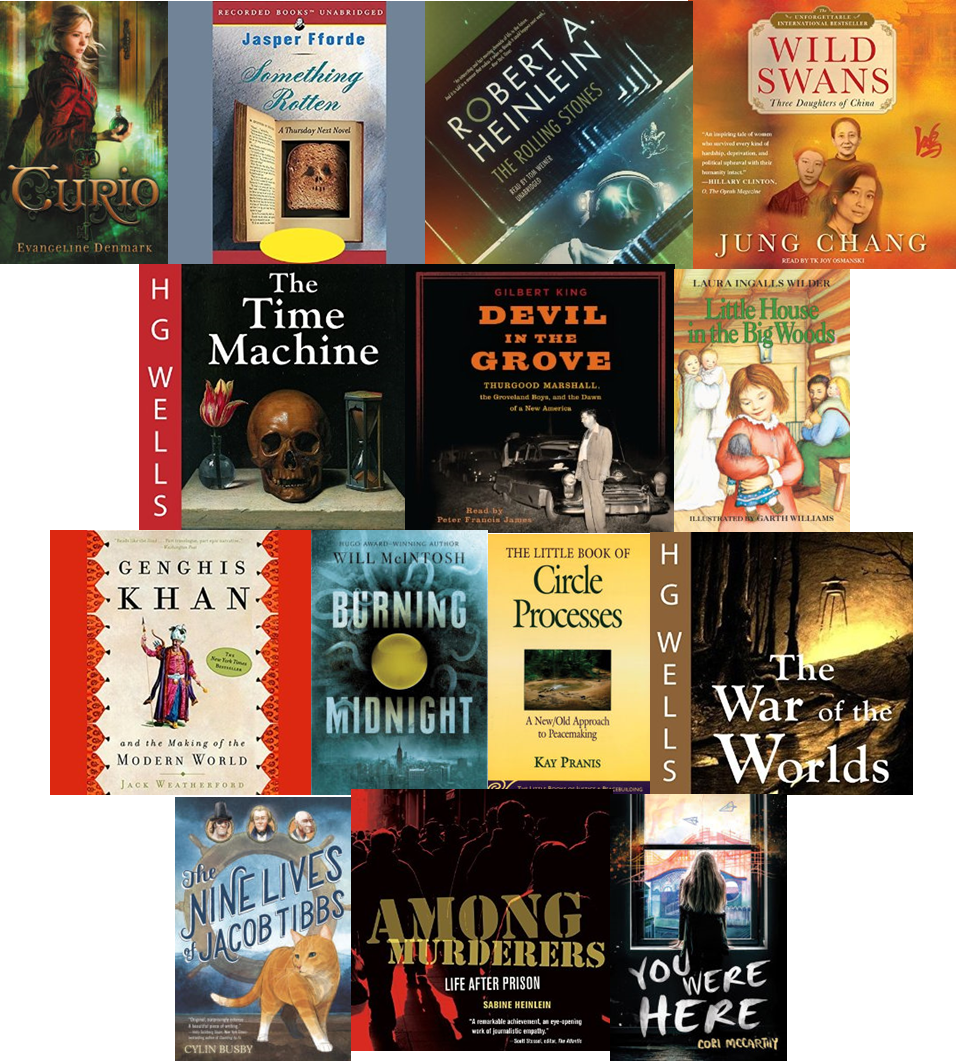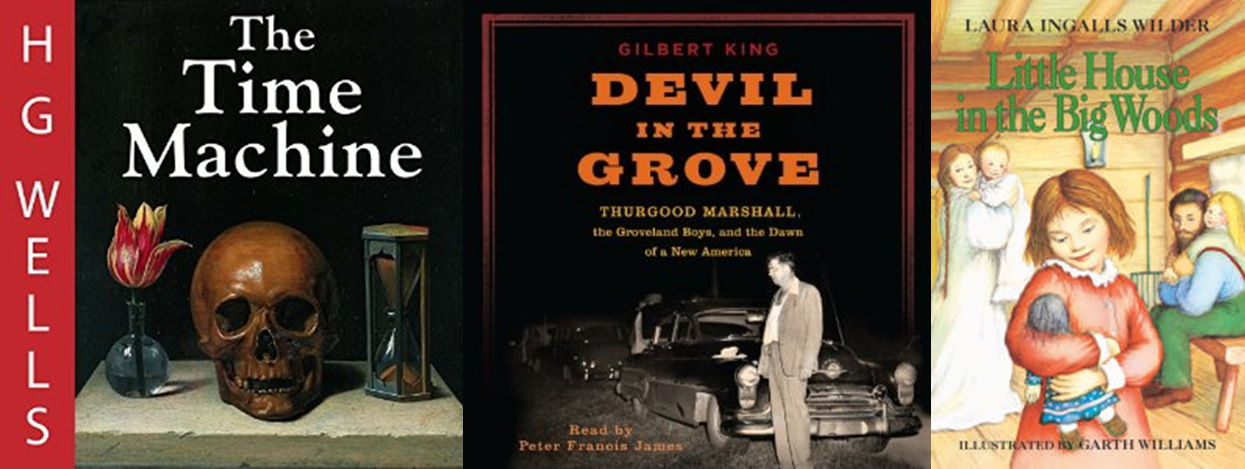
Devil in the Grove, by Gilbert King

Devil in the Grove:
Thurgood Marshall, The Groveland Boys, and the Dawn of a New America
by Gilbert King, narrated by Peter Francis James
In this 2013 winner of the Pulitzer Prize for General Nonfiction, Devil in the Grove is about Thurgood Marshall’s (“Mr Civil Rights” and arguably one of the best lawyers of the 20th century) work to save three black men accused of gang raping a 17 year old girl.

Gilbert King did an amazing amount of research for this book including reading the FBI’s Groveland case files and the NAACP’s legal defense files – and this research really shone through. His prose was acerbic at times, and it flowed smoothly keeping my interest the whole way through. Devil in the Grove gave a lot of background information on Thurgood Marshall’s life outside of the of the trial, thus bringing a personal light to the story. Gilbert also included stories about KKK activities against lawyers who defended black people accused of rape, which was terrifying and disgusting. 

Overall, a fantastic book. Read it. 

Little House in the Big Woods, by Laura Ingalls Wilder

Little House in the Big Woods
by Laura Ingalls Wilder
This is the first story of Larua as a 4-year old in a log cabin in the woods of Wisconsin. I’ve never read any of these books before, and honestly I can’t even say whether I ever watched the TV show. So I didn’t know quite what to expect. Whatever I expected, this wasn’t it. This book is written with a slice-of-life narrative with no plot and very little dialog – it was kind of a passive story…or perhaps a string of memories/anecdotes that are connected in approximate chronological order. 

Not that I’m saying I disliked it. It was really cute and a really quick read. I’m definitely going to continue with the rest of them. I’m also not entirely sure why this is considered a Christmas book. Yes, Christmas was included in the time-line, but it was about an entire year living in the little log cabin in the woods. I think the cutest part of the book was when Laura and her mother went out to milk the cow at night and mistook a bear for the cow. 🙂 Laura’s corn-cob doll was also pretty adorable. 

I think it’s interesting how many people care about whether this story was truly factual. I mean, of course it’s not fully factual – apparently Laura was younger when she lived on the Prairie than when she lived in the woods in Wisconsin, but she switched the timeline around. I’m sure some of the memories she mentions are also not fully factual, but that’s how family anecdotes are – they change with time and audience. This isn’t an autobiography, this is a string of anecdotes for children. 

In which Rachel gets the stomach flu

5 year throwback.
I miss you Grandma!

This week wasn’t as eventful as last week. I started working with my boss to have a smooth transition out – though I’m leaving him in a tight spot, so the transition won’t be much easier than if I strolled out in the middle of the day and never came back. I caught the stomach flu from my sister and was sick a couple of days. Spent a nice Olive Garden dinner with a friend, and that’s about it!

Posts

Wild Swans, by Jung Chang

The Rolling Stones, by Robert A Heinlein

The Time Machine, by H. G. Wells

The Reluctant Romantic Challenge

Currently Reading: 

Books Completed: 

Watched: 

Nothing!

Acquired:


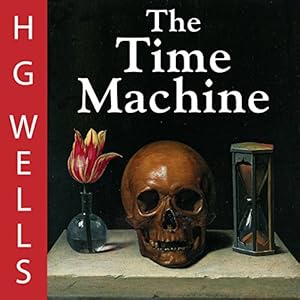
The Time Machine, by H. G. Wells

The Time Machine, by H. G. Wells
Narrated by Greg Wagland

This review contains spoilers

Using a time machine of his own making, a man travels to the year 802,701 to discover a world where humans have diverged into two separate species. The first species he meets are the Eloi. They are an indulgent people living in what the time traveler calls a communist society. It appears to be a utopian society in which everyone shares living spaces and food. But our time traveler soon discovers that this society isn’t as perfect as it seems. The Eloi are an uncaring race. When one of their own is drowning, they glance uncaringly in her direction and then move on with their own entertainments as if such an event were normal and uninteresting. There is a complete decline of intellect. 

Soon enough, our time traveler meets a second brutish and cunning race that live underground. They are called the Morlocks. (How he discovers this is unclear, since the Morlocks don’t talk to him and the Eloi refuse to talk about them as if it is extremely rude even to bring them up.) He has very little contact with them, but he believes that the Morlocks eat the Eloi. 

At a loss for what exactly H. G. Wells was getting at when he wrote this book, I read a couple of critical essays. Critics say that H. G Wells 1) was suggesting that there would be an inevitable decline in intellect of the human race, 2) was parodying the indulgent and uncaring aristocracy and the brutishness of the working class – a common parody of his time, and 3) was parodying communism despite the fact that he, himself, was a socialist. My father suggested that H. G. Wells had the Nazis (Morlocks) and the Jews (Eloi) in mind when he wrote The Time Traveler – though I find it hard to believe that the Wells believed that the Jews were a self-indulgent and unintellectual race. 

What I noticed about both The Time Machine and The War of the Worlds is that both mentioned a subclass of humans who, in the future, would prey upon other humans. (In War of the Worlds it was suggested that humans might, in the future, be used as slaves to hunt humans so the alien race could eat them.) Thus I am inclined to believe that H. G. Wells is suggesting that some humans have a brutish quality in which they inevitably take advantage of and prey upon an untintellectual and uncaring group of people. 

I am also interested in this communist aspect. What was he saying? If you have any ideas, please let me know. I am curious what other people think of this story. 


The Rolling Stones, by Robert A Heinlein

The Rolling Stones, by Robert A Heinlein
Narrated by Tom Weiner
Teenaged twins Castor and Pollux Stone cajole their father into buying a space ship, and the entire family goes on a trip around the galaxy. But Castor and Pollux repeatedly end up in trouble with their schemes to make a fortune on distant planets.


This is a hard book for me to review, so I’ll keep it short. I’ve only read one other book by Heinlein, A Stranger in a Strange Land, and that was as a teenager, so I expected something a bit more serious and meaningful in this book. Is this what pulp is? I’ve only read one pulp-fiction book, A Princess of Mars, by Edgar Rice Burroughs, so I’m very inexperienced with the genre. It took me a while to get over the cheese. But I recognize that when you’re reading a book that was written in a style foreign to you, it’s better to view the book within its context rather than comparing it to your usual type. And after I approached the book from this perspective, I began to really enjoy the humor and even became emotionally invested in the characters. I wouldn’t say I highly recommend this book, but I enjoyed my second pulp experience. 


Wild Swans, by Jung Chang

Wild Swans: Three Daughters of China
by Jung Chang
narrated by Joy Osmanski

This contains spoilers. 

Wild Swans is the memior of Jung Chang’s childhood in China during the Cultural Revolution, but it’s not only about her. She begins with the story of her grandmother. 


Jung Chang’s grandmother was a concubine to a warlord. She had to use charm and wit to keep herself safe from being held prisoner by the warlord’s family – as she was considered the property of the warlord and of his legitimate wives. Upon her warlord’s death, she made the very difficult decision to marry, which caused many problems for her, her new husband, and potentially her afterlife (in which her husband and warlord would cut her in half to share her). This story delves into great detail about the strife that Jung Chang’s grandmother had to overcome. Now that I’m familiar with how foot binding works I will shudder every time I hear mention of it. I never realized….

The next section of the book is about Jung Chang’s mother, who grew up mainly during the strife between her mother and her stepfather’s family. WWII was also raging, which meant occupation and brutalization by the Japanese. (This was the most difficult section for me to read.) Once the Japanese occupation ended, their country was ruled by tyranny, thus bringing on the communist uprising. Jung Chang’s mother became deeply involved in the Communist Party while very young, but felt betrayed by The Party by the time she was pregnant with her first child. 

The final section talks about Jung Chang’s childhood, watching the Communist Party emotionally and physically torture those around her, including her parents. She vividly portrays the original innocence that she had – believing in the communist party and Mao’s propaganda. Slowly, gently, she began to emerge from this innocence. More gracefully than would be expected, given what was going on around her. That speaks to the power of Mao’s campaign. 

This was a fascinating and beautifully written book. It’s written lovingly, yet it’s brutally honest. The research is so amazing that every once in a while I wondered “how does she know that?” Her years’ worth of research definitely paid off. This book deserves the fantastic worldwide sales that it has received. I am tempted to read Jung Chang’s biography of Mao pretty soon. 


In which Rachel Quits her Job

Favorite picture of the week

So this week I lost one of my employees. This particular employee is a very difficult person to work with, so in that way it was a relief. But it also meant that I would have to work every single weekend covering shifts from 2 missing employees instead of every other weekend covering the shifts of only one. Having just finished an incredibly busy week of EMT class and MnCOSA training while working full time, I realized that there’s no way I’d pass my EMT class if I start working every weekend. It’s just too much. So I quit. I actually quit my job. Well, in truth, I moved down to part time – so I’m helping out every other weekend and on Wednesdays until my boss can find someone to replace me and/or the missing employees. It was a hard choice to make, and a hard phone call to make as I hated dumping so much stress on my poor boss. But it was what I needed to do. 

As I said above, the EMT class started this week. It was nothing new since I’d already finished about 3 weeks of the class before asking to transfer to this semester. But I’ve now been CPR certified twice in 4 months. I feel a lot more confident this time around since I won’t have another class and a full time job to distract me. 

Do you remember me telling you about how I was going to volunteer for COLUMNS, which is a program through the MN Department of Corrections to help a paroled life-termer reintegrate safely into society? Well, instead I ended up in the MnCOSA program, which works with sex offenders reintegrate safely into society. Remember, this isn’t just about the safety and happiness of the sex offender (though that’s partly what it’s about to me), but it is also about helping the sex offender not offend again – it’s for those people out there who could potentially be hurt. That’s what Restorative Justice is all about. My training, which started on Tuesday, will last 2 more weeks…so I’m going to be very busy until then with my EMT class twice a week and training twice a week and full-time job (for two more weeks). The training so far has been pretty interesting – learning about the justice system, about sexual deviancy, and talking to a rape survivor who writes and speaks nationally about his experiences and restorative justice. If you’re interested, his name is Grant Watkins, and his book is called Unpinned. I’m reading it now. 

Posts: 


Currently Reading: 


Books Completed: 


Watched: 

Nothing!

Acquired: 


The Buried Book, by David Damrosch

The Buried Book: The Loss and Rediscovery of the Great Epic of Gilgamesh
by David Damrosch, narrated by William Hughes
This is an interesting study of the discovery of the tablets that comprise the most complete sections of the Epic of Gilgamesh. It starts with a discussion about the archaeologists involved in discovering the tablets – what trials they underwent while digging, politics behind their dig, and even quarrels between archaeologists. (Sounds like Wallis E Budge was a jerk despite his fame.) The most interesting story was that of George Smith. He came from a working class background, but he had a brilliant ability to learn languages so he moved up to a classier job as apprentice in a printing shop. He spent all of his free time in the British Library learning languages and looking at ancient documents. Eventually he was hired on, first as a volunteer, and then as a full-fledged member of the team to research ancient Babylonian tablets. He was the one to discover the flood story within The Epic of Gilgamesh and he got so excited that he ran around the library in a “state of undress.” (How much undressed he was remains a mystery. But I don’t imagine he ran naked through the library yelling Eureka! or anything. He probably took off his jacket and loosened his tie.)


The book then jumps back to the time of Ashurbanipal  (668-627 BCE), a historical king of Nineveh who collected rare literature from around the world (at least the world within reach of himself). It was inside this buried library, which was destroyed in the fall of Nineveh, that the most complete set of tablets for Gilgamesh was discovered. Buried Book tells of Ashurbanipal’s father, who was severely depressed and paranoid. He couldn’t read and was terrified that his assistants were hiding things from him when they read correspondences. Historians believe that this may be why Ashurbanipal was encouraged to learn to read at a young age. I found this section quite interesting and wished that there were more to it than there was. Though I suppose you can’t say THAT much about a historical figure about whom only fragments of records exist. 

The Buried Book then retreats farther into a short analysis of Gilgamesh with historical perspective. It discusses how the trip to tame Humbaba in the forest may have represented Gilgamesh’s famed war to retrieve wood in other parts of Persia. 

Finally, The Buried Book jumped back to how Gilgamesh has affected modern readers – including a longish section on Saddam Hussein. Apparently, Hussein could see Gilgamesh in himself and this impacted his philosophy on ruling. I was pretty interested to hear that Hussein had written a decent novel – I had no clue! Of course, chances are someone else wrote it from Hussein’s notes, but still. Very interesting. 

Half the Sky, by Nicholas D. Kristof and Sheryl WuDunn

Half the Sky: Turning Oppression into Opportunity for Women Worldwide
by Nicholas D. Kristof and Sheryl WuDunn
narrated by Cassandra Campbell
In Half the Sky Pulitzer Prize winning journalists Nicholas D. Kristof and Sheryl WuDunn share a heartbreaking study of oppression of women around the world. It begins with a long section on the sex trafficking of women, sharing personal stories of many victims. Girls may be told that they are about to go to earn money selling fruit in a city, and then they are kidnapped, beaten and raped until they submit to prostitution. Some are born into brothels. Many who escape or are rescued from their situation return “willingly” because they know no other way to make a living and they are stigmatized in their community for their past occupation. And many return because they crave the drugs that their pimps have forced upon them to keep them complacent and needy. The book also explores lack of freedom to get educated, honor killings, genital mutilation, and maternal mortality.  


Half the Sky was a difficult read because it’s hard not to be dragged down by the pain these women have experienced – and that millions worldwide are still experiencing. This is a powerful and important book, and I believe that everyone even remotely interested in the topic should either read this book or watch the documentary that is based on it. 


The Well of Lost Plots & Something Rotten, by Jasper Fforde

The Well of Lost Plots, by Jasper Fforde
narrated by Emily Gray
After Thursday Next’s husband is erased from existence (eradicated), she decides to take a break from the real world by vacationing in the Well of Lost Plots. She finds a nice unpublished book to hide in – and in her spare time she begins an apprenticeship with Jurisfiction – the group responsible for policing fictional characters. 

This is the third book of the Thursday Next books, and although not as great as the first, it was quite funny. It has some healthy British humor and is probably one of the weirdest alternate realities I’ve ever read. Highly recommended. 

Something Rotten, by Jasper Fforde
Narrated by Emily Gray
Now that little Friday Next has been born, Thursday decides her son must meet his father – eradicated or not. Thursday returns to the “real” world and takes her job back in Spec Ops. She keeps herself busy smuggling Danish books out of the country while pretending to hunt them down and burn them, fighting Goliath Corporation for the existence of her husband, and trying to get her town’s cricket team to win the championship so that a fictional character won’t achieve world domination. 

This fourth book in the Thursday Next series is just as funny as the third. Definitely going to hunt down the next book soon(ish).