
The Hijra – the Trans Community of India

Communities of transsexual women called Hijra have existed in India for centuries – they began as a holy group which could bless people and places and remove the Evil Eye. But as the British colonized India, the Hijra began to be shunned and stigmatized. These communities still exist in India today, but now the Hijra are generally beggars and prostitutes. They are often shunned by their families and by society in general. Those who were once great have fallen due to Western stigma. 


I will share my thoughts about two documentaries about the Hijra. The first is called Harsh Beauty, which was distributed by Frameline, a nonprofit LGBT media arts organization: 


This hour-long documentary is almost entirely in Hindi and Tamil, with English subtitles. It is interview style – focusing on several people. These people range from holy people who ask for alms in exchange for blessings to politicians to prostitutes. Unfortunately, it appears that the former (more “presentable”) categories have very, very few people, whereas the majority of Hijra are beggars and prostitutes. 

In some ways, the trans communities in India are tighter than those in the US. In India, the Hijra live, work, and die together. They form very strong bonds. However, this also means that they do not have strong relationships with their birth families. They do not live with their families or marry (at east not conventionally, as I’ll discuss later). In fact, many have been shunned by their families, or must visit them only discretely.  

Transsexuals in the US have to jump through an amazing amount of red tape for years in order to get their surgeries, but when they have the surgery it is in a safe, sterile, finely-tuned environment. A man->woman surgery can rearrange the nerve endings to form a clitoris. Although this is a major surgery in the US, and it takes much dedication to jump through all the hoops, it seems to me that the Hijra must be even more dedicated than American trans people to get their operation:.

In India, the surgery is much more “brutal” than it is here. There’s no anesthesia (because this is a spiritual ritual). The boy stands naked in a temple looking up at his deities. Then, the guru cuts off his “manhood” (testicles and penis). There is no delicate reorganization of the nerves in this surgery. After the surgery, hot oil is poured on the wound for 41 days to help it heal. 

This procedure may make me shudder in its “brutality,” but I doubt it seems brutal at all to the Hijra community. As I said, to them it’s a spiritual experience. After the surgery, Hijra from all over the area will come to have a huge festival of celebration – because a new member of their community has been initiated. 

I would say this documentary was an excellent introduction to transsexual culture in non-Western cultures. However, because of its format (interviewees speaking in a foreign language, and very little other action), it wasn’t the most dynamic of documentaries.

3.5 stars for good coverage of an excellent topic

The second documentary I watched was The Third Sex, which was episode 10, season 5 of National Geographic’s Taboo series. 

This film had a fantastic description of a Hijra festival which takes place in Koovagam, Tamil Nadu. This festival celebrates the wedding of the god Aravan, who was destined to die in battle in one day. He prayed to be married before his death, but no woman would marry him and become a widow so quickly (widows do not have very good lives in India). So the male god Vishnu came in woman’s form and married Aravan. Every year, Hijra from all around India flock to Koovagam to celebrate their own marriage to Aravan. It is a happy marriage festival with much celebration. Then, the next day, the Hijra cover their faces in turmeric, beat their chests, wail, dress in white, and morn the death of their husband. 

Watching this documentary was a much more enjoyable experience than watching Harsh Beauty. It was more dynamic and had beautiful filmography; however, it was also more sensationalized and less realistic and informative than Harsh Beauty. Of the two, I think Harsh Beauty was the better.   

3.5 stars for dynamic filmography and interesting topic

Narcopolis, by Jeet Thayil

Narcopolis, by Jeet Thayil
Narrated by Robertson Dean 
(This is an edited version of a review I wrote for my retired blog. I’m republishing because it is timely with a documentary I’ll be reviewing on Saturday.)

In this opiate-veiled book, Thayil introduces readers to the seedy underbelly of Bombay. It begins in the 1970’s and transitions with surreality into modern-day Mumbai–which has lost not only its tradition and identity, but also it’s name. The story follows several memorable characters, all of whom fight addiction in one form or another. Addictions range from opiates to violence to sex. 
The most memorable character is Dimple, a pipe-wallah, a prostitute, and an addict. Dimple was abandoned by her mother and sold into prostitution as a child. At the age of 9, she was castrated and her penis was removed, transforming her into India’s “third sex:” a hijra. Some men specifically prefer hijra over male or female prostitutes. When we are introduced to Dimple, she is a little older, and is suffering the ill effects of her surgery–including addiction to opium, which was originally given to her as a narcotic for her pain. The story follows Dimple as she transforms from a beautiful young woman to a sickly and shriveled middle-aged woman.

Perhaps I’m reading too much into the story (I think it would be clearer after a second reading), but I think Dimple was meant to represent India. When we met Dimple, she was young and beautiful, as was the young India. She had been docked and gelded, yes, but she was beautiful, intelligent, and had potential if ONLY she could get out of her rut. Perhaps this is meant to imply that the Westerners had “docked and gelded” India (by their colonization and then partitioning of the land), but that India still had potential. She was still beautiful. But time passed, and the slow-and-easy opium life in the “best opium den in Bombay…maybe even India,” was forcibly supplanted by frightening hallucinatory “cheap” chemical-laced heroin. During this time, Dimple became increasingly sick. Likewise, India itself was getting sicker from the negative influences of modernization. As time passed, Dimple’s name changed, as did Bombay’s, and their identities were lost in the harsh new world.

This book was allegorically very deep, and I’m sure that a second, third, and fourth reading would teach me something new every time. But, unfortunately, once was enough for me. I don’t regret reading the book…it will stay with me forever. But the violence, sex, drugs, and sickening human condition described was enough for me the first time around. Don’t get me wrong, all of these negative issues were handled with graceful tact. But it was still difficult for me to read.

Now, a note on the narration: I imagine this book was a very difficult one to read aloud. Robertson chose to represent surreal quality behind the veil with an airy tone of detachment. This tone was meaningful and perhaps necessary, but some might prefer to read the book instead. For me, Robertson’s tone of detachment didn’t distract from the story once I got used to it and understood the purpose. I was happily able to engross myself in the flow. 


The Archetypal Significance of Gilgamesh, by Rivkah Scharf Kluger

The Archetypal Significance of Gilgamesh: A Modern Ancient Hero
By Rivkah Scharf Kluger
As a young student of Jung, Kluger was encouraged by her mentor to study the archetypes of the Epic of Gilgamesh. Throughout her career, she gave many lectures on the subject, and was working on this book when she died. This is Kluger’s posthumous opus about the archetypes of Gilgamesh. As you can imagine, this is a very Jungian literary analysis. Her thesis was that the Epic of Gilgamesh was a coming-of-age story in which the character developed became fully aware (or conscious). 

In the first part of the story, Gilgamesh has only an id. He is wild – forcing the men to slave night and day on his building projects. Mothers would weep at the untimely deaths of their husbands and sons who had died from overwork. Gilgamesh would rape the maidens. He would ride around on the shoulders of children (how he managed this feat, I don’t know). Enkidu, likewise, was pure id – though in a different sense. He was someone who could run with the animals because he wasn’t yet quite human. 

When Enkidu and Gilgamesh met, there was the first inkling of ego – they became conscious that there was something else to their selves besides this wild energy. But even after they fought Humbaba, they were still a little wild. They scorned Ishtar, throwing insults (and bull haunches) at this revered and dangerous goddess. They were aware of their egos – they wanted immortality through glory – but they still had no self-control. 

This insult to Ishtar was another step in their development. Ishtar was the mother goddess, as well as the sexual goddess. By insulting her, they separated themselves from their “mother figure,” thus becoming men. Granted, immature men, but men all the same. 

After insulting Ishtar and maddening some others of the gods, Enkidu died. Neither Enkidu nor Gilgamesh was ready for this turn. They had not come to grips with the reality of death. In fact, even after Enkidu’s death, Gilgamesh was in denial. He waited for his friend to return until maggots fell out of Enkidu’s nose.

This realization of death was a new step in Gilgamesh’s life. He now needed to discover his superego,  which is the part of himself that would moderate the impulses of the id – his child-like, uncontrolled desires – with his ego – the part of him that was aware of the needs of the real world. Basically the superego is his conscience. 

He dressed himself as a wild-man, in some ways regressing away from his ego’s consciousness, and went on a quest for immortality. Along the way, he was tested – over and over – by gods and men. They kept telling him to turn back, his quest was pointless. But he passed all of those tests and reached his goal: Utnapishtim, the man who had survived the deluge and achieved immortality. Much to Gilgamesh’s disappointment, Utnaphishtim couldn’t tell Gilgamesh how to become immortal. But he gave Gilgamesh a plant which would restore the youth of whomever ate it. 

Instead of eating it right away, Gilgamesh decided to bring it back to his home in Uruk to share with others. Perhaps this was his first glimmer of conscience? But, of course, even this plan failed. A snake found the plant and ate it. Gilgamesh’s journey for immortality had failed. But it was not pointless. Because in that journey, Gilgamesh had gained wisdom. He’d become aware of his conscience. He was fully conscious. 

This was a very difficult book for me to read because I’m not very familiar with Jungian literary analysis. In fact, I don’t think I really processed what Kluger was saying until I tried to put it into my own words. Therefore, this book wasn’t very enjoyable to me, and it will not get a very high star rating. That doesn’t mean it wasn’t a good analysis, only that it wasn’t for me. 

Gender Dysphoria – Homosexuality and Transgender

In the past, there was an amazing amount of stigma against homosexuality. King Henry the VIII of England declared “the detestable and abominable vice of buggery” a felony punishable by death. It was not until 1861 that the maximum penalty in England was reduced to 10 years in prison. Similarly, in 1885, when lesbianism was about to be criminalized, Queen Victoria declared lesbianism to be impossible, and therefore there was no point in making a law against it. In the US, the last law prohibiting homosexuality was struck down by the Supreme Court in 2003. As recently as 1973, homosexuality was a diagnosable disorder in the DSM. 


However, homosexuality was accepted in non-Western cultures. For instance, in Melanesia, which is a group of islands in the South Pacific, a society called the Sambia believe that semen is important for physical growth, strength, and spirituality. They also believe that the body is only capable of creating a small amount of semen, so they must get the semen from elsewhere. In order to maintain adequate semen levels, boys exchange semen through oral sex. After puberty, the teens can penetrate the younger boys, thus providing them with semen. As the teen ages, he “transforms” into a heterosexual, and ends sexual intercourse with boys after the birth of his first child. Melanesian children who refuse such practices are considered abnormal and are therefore very rare. 

Thankfully, Western culture is beginning to accept homosexuality. In the 1960’s gay and lesbian people began to be more active for their rights. Such activist action led to increased brutality of police and homophobic citizens against homosexuals. Most recently, homosexual activity, although still highly stigmatized by some groups, is more widely accepted as within moral boundaries. Same sex marriages have become legal in all 50 states. 

Despite the removal of much of the stigma against homosexual people, there is still a shocking amount of stigma against transgender / transsexual people. In fact, trans people are the minority most likely to be killed in the US. As of October 2015, 22 transgender women have been killed in the US. Considering how rare trans people are in the US, these are shocking murder rates. 


Again, the stigma against trans people is most pronounced in Western culture. For instance, before being colonized by the British in the 18th century, transsexuals were revered as holy people who could remove the Evil Eye and bless homes and other places. But with the British also came stigma. Now, transsexual women resort mainly to begging and prostitution. (I will review a documentary on this subject on Saturday.)

In the US, transsexuals must jump through many hoops and red tape in order be approved for surgery. It is a several year-long process. The first step is to be diagnosed with “gender dysphoria” – persistent discomfort about one’s biological sex, or the belief that one should be another sex. Gender dysphoria can be diagnosed in children if six of the following characteristics are met: strong desire to be of another gender; a strong preference for cross-dressing in boys; a strong preference for cross-gender rolls; a strong preference for toys, games, and activities associated with the opposite sex; a strong preference for playmates of another gender; in boys, a strong rejection of typically masculine toys and activities; a strong dislike of one’s sexual anatomy; a strong desire for the sex characteristics of the opposite gender. 

Generally, boys with gender dysphoria more often turn out to be homosexual than transexual; however, the large majority of adults with gender dysphoria develop this characteristic as a child. Given that most children with gender dysphoria grow into emotionally healthy adults, there is some controversy about the inclusion of child gender dysphoria in the DSM-5. In fact, when children with gender dysphoria are brought in for counselling, it is often the parents who receive the most counseling. 

In adults, gender dysphoria can be diagnosed if two of the following traits are present: an incongruence between the person’s sexual gender and his perceived gender; a strong desire to be rid of one’s sex characteristics; a strong desire for the sex characteristics of the opposite sex; a strong desire to be of the other gender; a strong desire to be treated as the other gender; a strong conviction that one has feelings of the other gender. 

After an adult is diagnosed with gender dysphoria, he must undergo years of therapy, including a year of living as the other sex. Only after all these years of hard work can the transsexual be approved by insurance for gender reassignment surgery. 

Disclaimer: I apologize for the male (or male->female) leaning of this post. I’m making these posts to help me study for my Abnormal Psychology class, and the book was mainly about men on this subject. 

This is a series of posts summarizing what I’m learning in my Abnormal Psychology course. Much of the information provided comes from reading my James N. Butcher’s textbook Abnormal Psychology. To read the other posts, follow these links: 

The Definition of Abnormal
A History of Abnormal Psychology
Abnormal Psychology in Contemporary Society
Contemporary Viewpoints on Treating Mental Illness – Biology
Contemporary Viewpoints on Treating Mental Illness – Psychology
Frontline: New Asylums
Brave New Films: This is Crazy
Clinical Mental Health Diagnosis: Biological Assessment
Clinical Mental Health Diagnosis: Psychological Assessment
Does the DSM Encourage Overmedication?
Post Traumatic Stress Syndrome – The Basics
Panic Disorder
Obsessive Compulsive Disorder
Hoarding and Body Dysmorphic Disorders
Depression – an Overview
Personality Disorders – Clusters and Dimensions
Personality Disorders – Cluster A
Personality Disorders – Cluster B
Personality Disorders – Cluster C
Biological Effects of Stress on Your Body
Somatic Symptom and Related Disorders
Dissociative Disorders
Borderline Personality Disorder
Dialectical Behavioral Therapy
Paraphilic Disorders
Gender Dysphoria – Homosexuality and Transgender
Anxiety Disorders
Bipolar Disorder – The Basics
Suicide – An Overview

References:

Butcher, James N. Hooley, Jill M. Mineka, Susan. (2014) Chapter 12: Sexual Variance, Abuse, and Dysfunctions. Abnormal Psychology, sixteenth edition (pp. 405-442). Pearson Education Inc.

The Three Sisters, by Sonia Halbach

The Three Sisters (The Krampus Chronicles Book 1), by Sonia Halbach
This book was provided by the publisher through NetGalley in exchange 
for a fair and honest review. 
Every Christmas Eve, Maggie has the same dream. Santa is walking on the top of her grandfather’s manor, when suddenly he slides off the end. But this year is different. This year, it’s a nightmare in which he is pushed by something sinister. Awakened from her dream, she decides to go sledding – ending up in an accident that leads to meeting the handsome (but older) Henry. Henry has come with strange claims: that Maggie’s grandfather, who is well known for writing the poem ‘Twas the Night Before Christmas, had plagiarized his poem. 


While exploring the mansion for proof of plagiarism, Henry and Maggie are accidentally swept into a strange underground village named Poppel – a village strangely resembling Santa’s fabled home. But not all is right in Poppel. It is ruled by tyrants called the Garrison, and Nikolaos is missing. She and Henry must find three hidden objects before the end of Christmas Eve, or else Maggie, Henry and their families are in terrible danger – as is the hidden village of Poppel. 

This was a refreshingly unique story based on the poem ‘Twas the Night Before Christmas and Alpine German folklore of the anti-Santa named Krampus. Who knew a world could be built just around such a short poem? And I’d never heard of Krampus before reading this book. (Of course, just yesterday I went to the theaters and found out that a movie named Krampus is soon to be released, though there seems to be no relation between the two.) I really enjoyed reading this book. It was cute, adventurous, and had a tad of romantic tension. And one thing I really loved about this book is that the story was complete at the end. That is the perfect beginning to a series, as far as I’m concerned. I will definitely watch for the next in the series. 

4 snowflakes for creativity, action, romance, and fun

Paraphilic Disorders

Paraphilias are sexual behavior patterns in which unusual objects, rituals, or situations are required for full sexual satisfaction. And yes, believe it or not, paraphilic disorders are diagnosable in the DSM-5. But in order to have a disorder, you can’t just be turned on by unusual situations – it has to involve suffering or humiliation of yourself or others. (Though unfortunately, the suffering may be caused by stigma within society.) I will list several paraphilic disorders and discuss each: 

Fetishistic Disorder: Individual has recurrent sexually arousing fantasies, urges, and behaviors involving inanimate objects (i.e. women’s underwear) or parts of the body (e.g. feet). People with fetishes are generally men. 

Transvestic Disorder: Hetreosexual men who must be wearing women’s clothes in order to experience full sexual experience. 

Voyeuristic Disorder: Individuals with voyeuristic disorder have intense sexual fantasies and behaviors of watching women undress or watching the sexual activities of others. People with this disorder are generally young men. 

Exhibitionist Disorder: These individuals have intense sexual desire and behavior to sexually expose themselves to others. This generally is a man exposing himself to a young, unsuspecting woman; but sometimes they expose themselves to children. 

My dad tells the story that one time he was standing in a check-outline for groceries, and a man laid it all out on the cashier’s countertop. Cool as a cucumber, and without even glancing at the man, she rang up a can of food and then whammed it down hard on…well, you know where. That man was hauled out in an ambulance. Sometimes bad decisions are made. 

Frotteuristic Disorder: In frotteuristic disorder, someone is sexually excited by rubbing his genitals against an unwilling participant. I originally became familiar with this one due to a series of incidents (twice involving myself) with a coworker in retail. Very, very gross. Ick. But it was an experience to learn a new word when my dad was like “Oh! there’s a disorder for that!”

Sexual Sadism DisorderThe term “sadism” derives from the Marquis de Sade who got great sexual excitement out of inflicting cruelty upon people. Similarly, an individual with sadism disorder is aroused by psychologically or physically abusing someone. When sadism is inflicted upon a willing participant, it is not considered a disorder. But some sexual sadists inflict it upon partially or fully unwilling people.

Sexual Masochism Disorder: The term “masochism” is based on a fictional character created by Leopold V. Sacher-Masoch. In masochism disorder, an individual must get intense sexual pleasure from fantasizing about or indulging in the experience of pain.

Sado-masochistic relationships can be healthy and cooperative, within reason; however, masochism can lead to humiliating experiences and sometimes death. 
This is a series of posts summarizing what I’m learning in my Abnormal Psychology course. Much of the information provided comes from reading my James N. Butcher’s textbook Abnormal Psychology. To read the other posts, follow these links: 

The Definition of Abnormal
A History of Abnormal Psychology
Abnormal Psychology in Contemporary Society
Contemporary Viewpoints on Treating Mental Illness – Biology
Contemporary Viewpoints on Treating Mental Illness – Psychology
Frontline: New Asylums
Brave New Films: This is Crazy
Clinical Mental Health Diagnosis: Biological Assessment
Clinical Mental Health Diagnosis: Psychological Assessment
Does the DSM Encourage Overmedication?
Post Traumatic Stress Syndrome – The Basics
Panic Disorder
Obsessive Compulsive Disorder
Hoarding and Body Dysmorphic Disorders
Depression – an Overview
Personality Disorders – Clusters and Dimensions
Personality Disorders – Cluster A
Personality Disorders – Cluster B
Personality Disorders – Cluster C
Biological Effects of Stress on Your Body
Somatic Symptom and Related Disorders
Dissociative Disorders
Borderline Personality Disorder
Dialectical Behavioral Therapy
Paraphilic Disorders
Gender Dysphoria – Homosexuality and Transgender
Anxiety Disorders
Bipolar Disorder – The Basics
Suicide – An Overview
References:

Butcher, James N. Hooley, Jill M. Mineka, Susan. (2014) Chapter 12: Sexual Variance, Abuse, and Dysfunctions. Abnormal Psychology, sixteenth edition (pp. 405-442). Pearson Education Inc.

November 2015 Review

This was a good month. I had three Thanksgiving celebrations: one with my cousins in Iowa, one with my boyfriend’s family, and one with my own family & boyfriend. They were all a wonderful time. I’m pleased with my progress in my Abnormal Psychology class, work is going uneventfully, and I was very active on my blog. I tried to alternate between “lecture” posts and book review posts this month.


I participated in Nonfiction November with the ladies at  Doing DeweySophisticated DorkinessI’m Lost in Books, and Regular Rumination. During the month, I read 6 nonfiction books (Evil Hours, I am Malala, The Epic of Gilgamesh and Old Testament Parallels, Quiet, and The Archetypal Significance of Gilgamesh) and reviewed 7. I also enjoyed reading science fiction along with Rinn Reads. I was only able to read 2 science fiction books (The Martian and Shada), and review 3. 

Next month I’ll be joining the Christmas Spirit Reading Challenge hosted by The Christmas Spirit. So far, my plans are Little Women, by Louisa May Alcott; The Three Sisters, by Sonia Halbach; and The First Christmas, by Marcus Borg. Hopefully I’ll be able to squeeze in some more. You can see other upcoming challenges in my Challenges Tab.

I’ve been having trouble with formatting this month. If I add a link or italicize after-the-fact, it sometimes turns out really big. In past months, I could resize it, but now it won’t let me do that. It’s irritating. Any advice? 


Abnormal Psychology Posts:

Depression – an Overview
Personality Disorders – Clusters and Dimensions
Personality Disorders – Cluster A
Personality Disorders – Cluster B
Personality Disorders – Cluster C
The Biological Effects of Anxiety on the Body
Stress and Your Body – An Introduction
Somatic Symptom and Related Disorders
Dissociative Disorders
Borderline Personality Disorder
Dialectical Behavioral Therapy

Book & Movie Reviews:

The Noonday Demon, by Andrew Solomon
Dark Eden, by Chris Beckett
Gilgamesh Translations
The Biology of Desire
The Martian, by Andy Weir
The Gilgamesh Epic and Old Testament Parallels, by Alexander Heidel
Black Five, by J. Lynn Bailey 
Crazy: A Father’s Search Through America’s Mental Health Madness, by Pete Earley
Quiet, by Susan Cain
Evil Hours, by David J. Morris
I am Malala, by Malala Yousafzai and Christina Lamb
Shada, by Douglas Adams and Gareth Roberts

Book Completed: 


Acquired:

Movies/Shows Watched: 


This update is posted to Sunday Salon, Sunday Post @CaffeinatedBookReviewer, Stacking the Shelves @Tynga’sReviews,  @MailboxMonday, It’s Monday What are You Reading @BookDate

Shada, by Douglas Adams and Gareth Roberts

Shada: Doctor Who, the Lost Adventure
By Douglas Adams and Gareth Roberts
Narrated by Lalla Ward and John Leeson

Shada is a novel tie-in to the popular TV series Doctor Who. Specifically, it is based on the screenplay (written by Douglas Adams) of an unbroadcast eighth doctor story arc.  The Doctor, Romana, and K-9 go to visit an old friend, Professor Chronotis, after receiving a distress signal. It turns out that Chronotis had stolen a dangerous book: The Worshipful and Ancient Law of Gallifrey. All the Time Lords have heard of this book, but none of them quite seem to remember what it’s for. When the book is accidentally borrowed by a post-doc, the Doctor and Romana must find the book and keep it out of the hands of Skagra, an evil genius bent on becoming the universe. (Important distinction here – he’s not taking over the universe; he’s becoming it.) 

This is the first time I’ve ever read a novel tie-in to a show or movie. My opinion has always been that books can become movies but movies shouldn’t become books. You have to add in so much information for a TV novelization to be a good book. When I read a book, I’m not just looking for a story, I’m looking for beauty. For art. For characterization. These are things that this book did not particularly have. You knew who the characters were, after all. Why develop them? You knew about the world in which this story was taking place. No need for world building. So, in that way, the book isn’t what I’m generally looking for in a book. 

That said, this book did have humor, excitement, and familiar friends going through wild adventures. It was Doctor Who, after all, how could I not like it? 

The book was well-read – narrated by the actress who played Romana in the TV show. K-9’s voice was John Leeson, as well. So that was a very nice touch. This is my first time listening to a dramatization with sound effects. I’ve heard multiple-reader dramatizations, but never with footsteps, creaking doors, etc. It was kind of fun. Maybe I’ll try something like this out again. 

I’m going to have to give this book 3.5 snowflakes because I prefer books that have more characterization and world-building. But I also recognize that this is not what tv novelizations are meant to have. 

Dialectical Behavioral Therapy

To supplement my post about borderline personality disorder (BPD), I’ll comment on a highly effective therapy developed especially for BPD. I, myself, have been through DBT and can attest to its wonderful results. DBT is a modified form of cognitive behavioral therapy (CBT). CBT focuses on addressing cognitive distortions (thoughts that assume negative reasons for a potentially neutral situation) and practicing changing the way you think about the situation. DBT focuses on accepting the way you think, but changing the way you react to the thoughts. 


DBT was created by Marsha Linehan for patients with BPD, but is now used for many other disordered patients who suffer from suicidal ideation and self-harm. DBT teaches skills that a person can use to react healthily to difficult emotions. 


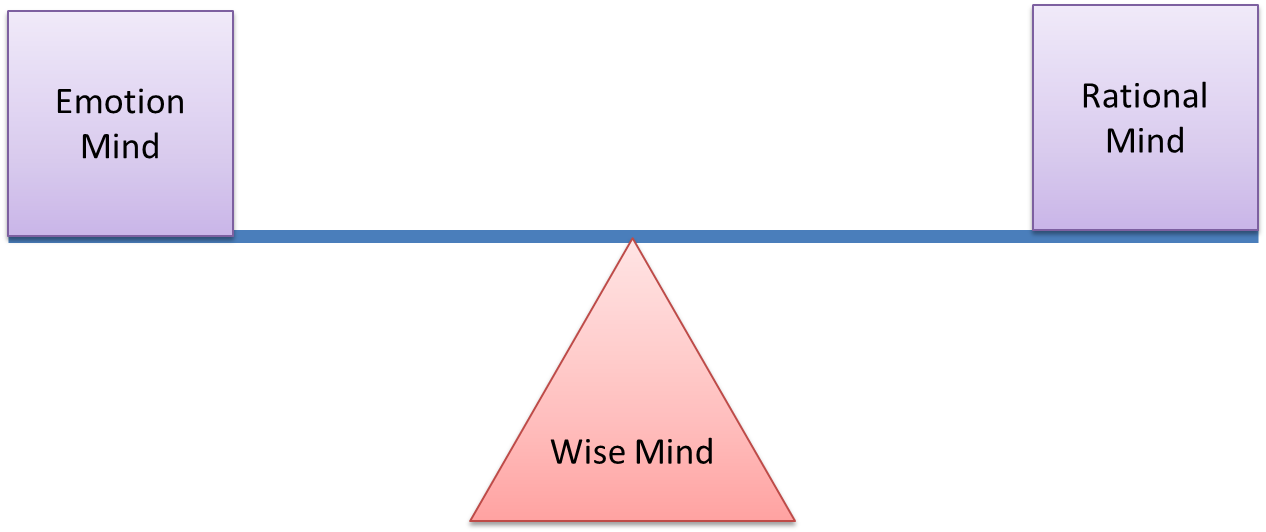
A dialectic, in the DBT sense, can be represented as a see-saw of extremes, with a healthy center-point. For instance, two state-of-mind extremes include Emotion Mind and Rational Mind. Emotion Mind is when a person’s thoughts and actions are governed entirely by emotions. This could be good – such as when someone is in love – but it is often bad. Too much emotion can lead to inappropriate decisions, behaviors, and unhealthy thoughts. 

On the other side of the see-saw, a person might be in Rational Mind. Although this sounds good (and can be good when you are performing highly rational tasks like solving puzzles), it is generally not good to think exclusively in rational mind because you miss emotional components of the situation. For instance, a person who is entirely in rational mind is unable to experience empathy or react appropriately to emotional situations (this is often a complaint made about people with Asperger’s syndrome). 

You are somewhere between rational and emotional mind at all times. The middle of the see-saw is called Wise Mind. Here, you can express the right amount of emotion and rational thought to make a clear-headed decision. DBT recognizes that people are often at the extremes of this see-saw, and asks that you use “skills” to move yourself back into Wise Mind before making decisions (such as breaking up with your significant other or self-harming). 

Almost every situation has a dialectic see-saw. And according to DBT, it is often best to keep yourself in the middle of the two extremes. The middle would be a compromise. Of course, sometimes compromise is the wrong decision to make (such as when you need to cut ties with an abusive relationship), but compromise is generally best. 

Skills that DBT suggest are separated into categories of mindfulness, interpersonal effectiveness, emotion regulation, and distress tolerance. 

Mindfulness includes: grounding yourself in a situation, for instance, recognizing where you are, what you are doing, and what is going on around you; being nonjudgmental, for instance, one of my employees assumes that when the nurses say “she is awful to work with” that they are talking about her. This is a judgmental thought. To be non-judgmental, she would have to say “well, maybe they’re not talking about me. Why am I assuming they are?” 

Interpersonal effectiveness entails balancing your own needs with the needs of others, building relationships, and being in Wise Mind when approaching difficult situations. 

Emotion regulation includes being mindful of what emotions you’re feeling; being aware of what you want to do – for instance isolating – and doing the opposite; doing things that make you feel good – like leisure activities – or work that makes you feel accomplished – like writing a blog post; coping ahead, for instance, if I know that I will be upset tomorrow because it’s the anniversary of my mother’s death, I can plan some distracting activities to keep myself from brooding.

Distress tolerance includes distracting yourself when you feel upset; self-soothing by taking a bath or rubbing a smooth stone; and accepting reality. 

Yes, all this mindfulness stuff might sound cheesy to a lot of you, but being aware of your emotions and how you’re reacting to them is an amazing way of changing the way you behave – and changing the way you behave can eventually remove your dysfunctional thoughts, as well. 

This is a series of posts summarizing what I’m learning in my Abnormal Psychology course. Much of the information provided comes from reading my James N. Butcher’s textbook Abnormal Psychology. To read the other posts, follow these links: 

The Definition of Abnormal
A History of Abnormal Psychology
Abnormal Psychology in Contemporary Society
Contemporary Viewpoints on Treating Mental Illness – Biology
Contemporary Viewpoints on Treating Mental Illness – Psychology
Frontline: New Asylums
Brave New Films: This is Crazy
Clinical Mental Health Diagnosis: Biological Assessment
Clinical Mental Health Diagnosis: Psychological Assessment
Does the DSM Encourage Overmedication?
Post Traumatic Stress Syndrome – The Basics
Panic Disorder
Obsessive Compulsive Disorder
Hoarding and Body Dysmorphic Disorders
Depression – an Overview
Personality Disorders – Clusters and Dimensions
Personality Disorders – Cluster A
Personality Disorders – Cluster B
Personality Disorders – Cluster C
Biological Effects of Stress on Your Body
Somatic Symptom and Related Disorders
Dissociative Disorders
Borderline Personality Disorder
Dialectical Behavioral Therapy
Paraphilic Disorders
Gender Dysphoria – Homosexuality and Transgender
Anxiety Disorders
Bipolar Disorder – The Basics
Suicide – An Overview

Somatic Symptom and Related Disorders


Somatic symptoms are medical complaints that arise from mental illness. In my experience, such symptoms are shrugged off by the general public as “oh, that’s not a real symptom, it’s just somatic.” Well, let me tell you: the symptoms feel very real to the suffering individual.(Something I learned in my work at a suicide hotline and my own intensive outpatient therapy is that what you feel is a real feeling, regardless of what others say.) And sometimes (in fact, maybe a lot of the time) symptoms are due to a “real” medical problem caused by the mental illness. Read my post about the physiological effects of anxiety if you don’t believe me.

Yes, sometimes the symptoms are explainable by factitious disorder, in which a person consciously produces physical and/or psychological symptoms. Generally in this disorder, a person is not maliciously lying to try to get out of anything, he simply wants the attention that comes with being sick. This could be due to feelings of being ignored or unloved. 

And sometimes the symptoms are malingering. In this case, the person is intentionally producing or exaggerating physical symptoms motivated by a wish to get out of something undesirable (such as work, military service, or criminal prosecution). I imagine it is these two types of symptoms that create the stigma surrounding somatic disorder. 

In somatic symptom disorders, the patient must find the symptoms so distressing that they get in the way of the person’s ability to function in daily life. The symptoms must have one of the following three features: disproportionate thoughts about the seriousness of one’s symptoms, persistent high level or anxiety about health or symptoms, or excessive time and energy devoted to these symptoms. 

Just because you sometimes exaggerate and worry about symptoms does not mean that you have somatic symptom disorder. As pointed out by Dr. Sapolsky in his first lecture n the Teaching Company Course Stress and Your Body, sometimes when you have a big test or presentation or work-related stressor the next day you can’t sleep. You just lie there in bed stressing about the fact that you’re not sleeping. And eventually you might begin to worry about symptoms you are feeling. Your gut is rumbling – maybe you have Chrohn’s disease. You have a headache or an ophthalmic migraine – maybe you have a brain tumor. This exaggeration is due to normal anxiety, and everybody feels it sometimes. In fact, I’m a big sucker for cyberchondria. 


People with somatic symptom disorders tend to be female, nonwhite, and less educated than are people with more medically founded symptoms. People with somatic symptom disorder tend to want test after test after test to find the cause of their disorder. If one test is negative, they want another. If the doctor tells them they’re fine, and they don’t need another test, they find a new doctor. This is because they really believe something is seriously wrong with them. They are disappointed when nothing is found. This is in contrast to “normal” people who would rather avoid more tests are are relieved when nothing is found wrong. Or people with factitious disorder or malingering symptoms who seem completely serene by the test results. 

Unlike the DSM-5, the DSM-IV separates hyperchondriasis, pain disorder, and conversion disorder. In hyperchondriasis, an individual is overly sensitive to small changes in his body. He might interpret a cough as lung cancer or varicose veins as blood poisoning. Much of his time and energy is exhausted in monitoring his symptoms and talking to his doctor. 

In pain disorder, the patient feels pain in one or more body parts. This pain is not intentionally produced or feigned. This pain is really felt by the patient – just as much as pain caused by a physical condition. This pain often causes the patient significant problems in their ability to function in daily life. The resulting social isolation and feelings of uselessness can result in depression, leading to more somatic pain. Luckily pain disorder is easier to treat than hyperchondriasis. The patient can be taught relaxation techniques which reduce the pain, and they can undergo cognitive behavioral therapy to reduce their cognitive response to the pain. Antidepressants also help with the pain. 


I find conversion disorder to be the most interesting of the somatic symptoms and related disorders. In conversion disorder, an individual might suddenly become blind, deaf, partially paralyzed, or have pseudoseizures. These symptoms occur during highly stressful situations like combat. Because the individual becomes too stressed to deal with combat, he suddenly becomes blind or partially paralyzed. These symptoms are not faked. The person really believes that he is blind or deaf. However, upon medical examination, people with conversion disorder unconsciously respond to stimulus. They will turn their head in a direction of a noise. They will be able to avoid obstacles while walking. 

Conversion disorder is most common in medically unsophisticated individuals. A particularly effective treatment for conversion disorder is to educate the individual about the psychological causes of his disorder. Also, these symptoms often go away after the stress has been reduced significantly. 

As mentioned above, factitious disorder is diagnosed when an individual consciously exaggerates her symptoms in order to get attention. This is distinguished from malingering in that she is not trying to get out of work, win a lawsuit, or get other obvious external gains. In popular culture, a form of factitious disorder called Munchausen’s syndrome by proxy is found frequently in books and movies. (In the DSM-5 it’s called “factitious disorder imposed on another” but that’s a boring name.) In this disorder, a caretaker (generally the mother) will invent symptoms in her child in order to get attention for herself. Often, the mother creates symptoms by slowly poisoning their child. Sometimes a child undergoes numerous surgeries to fix the complaint. It is difficult to diagnose and then prove that a mother is intentionally causing a child’s illness. One hint that such a thing is going on is if the child gets sicker after every time the mother is left alone with the child. But a doctor is hesitant to point fingers at the mother because of lawsuits. One way around this is to put a camera in the child’s room. 
This is a series of posts summarizing what I’m learning in my Abnormal Psychology course. Much of the information provided comes from reading my James N. Butcher’s textbook Abnormal Psychology. To read the other posts, follow these links: 

The Definition of Abnormal
A History of Abnormal Psychology
Abnormal Psychology in Contemporary Society
Contemporary Viewpoints on Treating Mental Illness – Biology
Contemporary Viewpoints on Treating Mental Illness – Psychology
Frontline: New Asylums
Brave New Films: This is Crazy
Clinical Mental Health Diagnosis: Biological Assessment
Clinical Mental Health Diagnosis: Psychological Assessment
Does the DSM Encourage Overmedication?
Post Traumatic Stress Syndrome – The Basics
Panic Disorder
Obsessive Compulsive Disorder
Hoarding and Body Dysmorphic Disorders
Depression – an Overview
Personality Disorders – Clusters and Dimensions
Personality Disorders – Cluster A
Personality Disorders – Cluster B
Personality Disorders – Cluster C
Biological Effects of Stress on Your Body
Somatic Symptom and Related Disorders
Dissociative Disorders
Borderline Personality Disorder
Dialectical Behavioral Therapy
Paraphilic Disorders
Gender Dysphoria – Homosexuality and Transgender
Anxiety Disorders
Bipolar Disorder – The Basics

Suicide – An Overview

References:

Butcher, James N. Hooley, Jill M. Mineka, Susan. (2014) Chapter 8: Somatic Symptom and Dissociative Disorders. Abnormal Psychology, sixteenth edition (pp. 264-292). Pearson Education Inc.