The Epic of Gilgamesh – Historical Background

History of the epic

The Epic of Gilgamesh is the oldest epic still in existence. Coming from the third millennium BCE, it predates Homer’s epics by at least one and a half thousand years. It is from a time long forgotten by historians – only rediscovered in the last century by archaeologists in the Middle East. The fascinating part about the Epic of Gilgamesh is that even though it is 5 millennia old the humanity and passion of the story still resonate with readers today. 

The most complete version of Gilgamesh yet discovered is a series of eleven tablets in the Akkadian language found in the library of Ashurbanipal in Nineveh. Ashurbanipal  (668-627 BCE) was a great king of the Assyrian empire and a collector of literature from all over the Middle East. His library disappeared after the fall of Nineveh in 612 BCE, and was uncovered by archaeologists in 1839. The tablets were transferred to the British Museum where they received little attention until 1873, when a scholar named George Smith realized that they included an account of the flood (recounted in the Bible as the story of Noah’s ark). This announcement set off an immediate sensation because it suggested that the authors of the Bible might have been familiar with Gilgamesh’s story (though possibly both versions come from an earlier source). After this discovery, archaeologists dug up more and more tablets and scholars busied themselves with translations. Unfortunately, some of the tablets are fragmented, and the story has to be pieced together from different versions. This leaves the story very open to interpretation. 

Who was Gilgamesh?

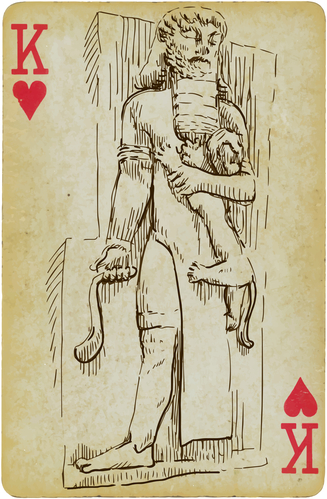
The character of Gilgamesh is thought to be based on a real king of the Mesopotamian city of Uruk (Erech in the Bible). The historical Gilgamesh probably raised up the famous walls of Uruk, described in glorious detail in the epic. The walls had a 6 mile perimeter and more than nine hundred towers. Its ruins are near the town of Warka, in southern Iraq. Archaeologists date parts of the wall to around 2700 BCE, so they believe Gilgamesh may have lived around then. According to the “Sumerian king list,” Gilgamesh was the fifth king of the founding dynasty of Uruk. 

Gilgamesh was clearly a great builder – not only building the great wall, but also restoring the shrine of the goddess Ninlil. He very likely led a successful expedition to retrieve timber from the lands to the North – a story which was related in the epic.  

This is a series of posts about The Epic of Gilgamesh. Here is a list of all posts thus far: 

A History of Abnormal Psychology

Chapter 2 of Butcher’s Abnormal Psychology is a bit harder to summarize than Chapter 1. It covered the reactions of people towards  the mentally ill throughout history. There were lots of names mentioned, and trends galore. But I will try to focus on the ones that I found most interesting. 

During the classical age of Greek and Roman philosophers, mental illness began to be viewed more as a physiological trait than as demonic possession, which was the common viewpoint before this time. Hippocrates, a Greek philosopher considered the father of modern medicine, believed that mental illnesses were due to brain pathology. He recognized heredity, predisposition, and head injuries as common causes of mental illness. The doctrine of the four humors was related to Hippocrates and later to the Roman physician Galen. These four fluids in the body could combine in different ways to regulate the personality of an individual. Hippocrates promoted healthy living as a remedy to mental illness.


Plato, also, supported the kind, empathetic treatment of mentally ill individuals. He suggested that mentally disturbed individuals were not responsible for criminal acts. However, Plato viewed mental illness, at least partly, as an effect of spirituality. Hippocrates’ and Plato’s support of humane treatments for mental illness influenced later Greek and Roman philosophers. 
During the Middle Ages, the belief that mental illness had physiological origins almost disappeared in Europe. The texts of the Greeks and Romans survived in Islamic and Middle Eastern regions, but very few Europeans of this time were able to read Greek or Roman texts. The Middle Ages marked a regression in both scientific and philosophical thought. The Greek and Roman texts weren’t “rediscovered” until the Renaissance

Supernatural explanations for mental illness gained popularity, and treatment was left mainly to the clergy. At least the treatment of the mentally ill by the clergy was mainly humane. 


It is commonly thought that the mentally ill were often accused of being witches during the Middle Ages, and were thus cruelly executed. However, recent research suggests that witchcraft was not believed to be an effect of possession, as mental illness was. Usually the accused were ill-tempered, impoverished women. 

Scientific explanations for mental illness reemerged in the late Middle Ages and Renaissance. Even some of the clergy were falling away from possession as the cause of mental illness. Saint Vincent de Paul declared “Mental disease is no different than bodily disease and Christianity demands of the humane and powerful to protect, and the skillful to relieve the one as well as the other.” 

Despite the resurgence in the belief of physiological explanations for mental illness during the Renaissance, inhumane asylums for the storage of individuals who could not care for themselves were on the rise. 

In the late 1700s, humanitarians began to intervene on behalf of the mentally ill. Physicians began to experiment with more humane treatment of individuals. The French physician Philippe Pinel demonstrated that the removal of chains, and introduction of healthy living in an asylum had extraordinary effects on the recovery of mentally ill individuals. English Quaker William Tuke later established a pleasant retreat for mentally ill patients, with similar positive results. 

The success of Pinel and Tuke led to a period of humanitarian reform and the use of moral management. This movement promoted the rehabilitation of moral and spiritual character, as well as manual labor. Moral management was highly effective. Recovery and discharge rates increased dramatically.

Unfortunately, moral management made way to the mental hygiene movement, which emphasized the physical (rather than spiritual) treatment of institutionalized patients. Although hygiene and the belief in physiological as well as spiritual causes of mental illness were important, improving the hygiene of the patients alone was not successful, and recovery rates plummeted. However, the mental hygiene movement was meant to create a more humane environment for the institutionalized – so in that way it was progress. 


The number of institutionalized patients increased throughout the 19th and 20th centuries, but during the late 20th century humanitarians began to support deinstitutionalization of the mentally ill. Popular culture seems to believe deinstitutionalization to be a good thing – and for many, it was. Reintroduction of the mentally ill and developmentally challenged  to their supportive families was a huge success when that family had the resources to care for its loved one. However, deinstitutionalization occurred too quickly, leaving many people without shelter, and of those who had shelter, many families didn’t have the resources to care for the patients. Many of the shelterless people became homeless, and others were quickly shunted off into prisons. 

During the 19th and 20th centuries, four major themes in psychology developed: 1) biological discoveries, 2) classification system for mental disorders, 3) the emergence of psychological causations and views 4) experimental and research psychology. 

The first major breakthrough in biological treatment of mental illness was the discovery that a form of paresis was caused by syphilis. This discovery boded well for the discovery of more biological treatments for other illnesses. Later discoveries showed deterioration of the brain led to senility and that some disorders could be caused by exposure to toxic substances. Biological treatments also had some mishaps – such as surgical removal of body parts including tonsils, part of the colon, gonads, and the frontal lobe of the brain. 

Emil Kraepelin, a German psychiatrist, pioneered classification of mental illnesses, and his system became the forerunner to the DSM. 

The Nancy school began a movement exploring psychological causations of mental illness. Two scientists in Nancy, France, discovered that some of the traits observed in hysteria – psychological paralysis, blindness, deafness, and pain – could be introduced in healthy patients through hypnosis. These symptoms could also be removed by hypnosis. Therefore, the Nancy school believed that hysteria, and later other disorders, were a form of self-hypnosis. Jean Charcot, a French neurologist, disagreed with the Nancy School. His research suggested that mental disorders were caused by brain degeneration. Toward the end of the 19th century, it was accepted that mental disorders could have a psychological basis, biological basis, or both. 

Sigmund Freud was a student of Charcot, but later leant more towards the psychological causations mental illness. Freud discovered that if patients were encouraged to discuss their problems under hypnosis, they felt considerable emotional release. The patients, upon awakening, made no connection between their problems and their disorder. This led to the discovery of the unconscious mind. Freud also discovered that free-association and dream analysis had the same cathartic effect on his patients. 

By the first decade of the 20th century clinical psychology labs, which performed experiments on causes and treatments of mental illness, were on the rise. Soon, the behavioral perspective developed. This perspective emphasized the role of learning in disorders. It began with Ivan Pavlov’s serendipitous discovery that he could condition dogs to salivate upon the ringing of a bell. Watson used Pavlov’s discovery to develop behaviorism – the belief that humans gain personalities through changes in their environments. Watson believed that he could train a child to become anyone he wanted the child to become simply by creating the right environment. (Stephen Pinker’s argument against this belief is discussed in my review of The Blank Slate.) 

B. F. Skinner developed his own form of behaviorism in which consequences of behavior influenced subsequent behavior. This type of learning was named “operant conditioning.” For example, positive conditioning occurs when someone is rewarded for a behavior, such as when we give a treat to a potty-training child who has successfully used the toilet. Negative conditioning occurs when a child receives a shock when sticking his finger into an electrical outlet. 

And thus abruptly ended Chapter 2 – after a long list of names and dates that the book thought were important for us to remember.

This is a series of posts summarizing what I’m learning in my Abnormal Psychology course. Much of the information provided comes from reading my James N. Butcher’s textbook Abnormal Psychology. To read the other posts, follow these links: 

The Definition of Abnormal
A History of Abnormal Psychology
Abnormal Psychology in Contemporary Society
Contemporary Viewpoints on Treating Mental Illness – Biology
Contemporary Viewpoints on Treating Mental Illness – Psychology
Frontline: New Asylums
Brave New Films: This is Crazy
Clinical Mental Health Diagnosis: Biological Assessment
Clinical Mental Health Diagnosis: Psychological Assessment
Does the DSM Encourage Overmedication?
Post Traumatic Stress Syndrome – The Basics
Panic Disorder
Obsessive Compulsive Disorder
Hoarding and Body Dysmorphic Disorders
Depression – an Overview
Personality Disorders – Clusters and Dimensions
Personality Disorders – Cluster A
Personality Disorders – Cluster B
Personality Disorders – Cluster C
Biological Effects of Stress on Your Body
Somatic Symptom and Related Disorders
Dissociative Disorders
Borderline Personality Disorder
Dialectical Behavioral Therapy
Paraphilic Disorders
Gender Dysphoria – Homosexuality and Transgender
Anxiety Disorders
Bipolar Disorder – The Basics
Suicide – An Overview

References:

Butcher, James N. Hooley, Jill M. Mineka, Susan. (2014) Chapter 2: Historical and Contemporary Views of Abnormal Behavior. Abnormal Psychology, sixteenth edition (pp. 29-53). Pearson Education Inc.

The Definition of Abnormal

Well, my first week of Abnormal Psychology is through. We’ve read chapters 1-2 of our textbook, Abnormal Psychology by James N Butcher.

Chapter 1 was mainly about defining “abnormal” in the sense of “abnormal psychology.” This is a lot more difficult than you might imagine. 


You could try a statistical approach, for instance. If someone’s behavior is statistically rare, then that behavior is abnormal. But lots of people have behavior that is statistically rare. For instance, I went to the Minnesota Renaissance Festival just yesterday, and enjoyed some good people-watching. The Ren Fest has a variety of people – some are just pop-culture “nerds.” Some are people who love cosplay (where you dress up as a character – either made up by you or pre-created in popular culture – and act as if you are that person). And some people honestly believe they are wizards. Should we consider any of these statistically rare behaviors due to mental illness? Well, perhaps people who really believe they are wizards, but some of those people are pagans – and should we consider people of a rare religion to be mentally ill per se

You could also try a societal norm approach. If someone behaves outside the behavioral norm, then they are abnormal. But this, in itself does not imply mental illness. Societal norms can change from culture to culture. As an example, in some tribal cultures, the men cut themselves over and over again to “beautify” themselves with scars; but in America teens who cut are generally diagnosed with depression. Norms can also change within one culture over time. For instance, a couple decades ago homosexuality was considered a mental illness, but now it is, for the most part, accepted as “normal” behavior for certain individuals. 

There is also the maladaptive approach. If someone’s behavior is injurious to himself or to society, then he is abnormal. A person with OCD who washes her hands so much that they are cracked and bleeding is maladaptive. But this approach is not full-proof either. Not everyone who commits a crime is mentally ill. Likewise, should we consider someone who donates bone marrow, blood, or a kidney mentally ill?


Many people who are mentally ill suffer. But not all. The mania state of bipolar disorder is often pleasant to the patient, but he is considered mentally ill. Also, where do we draw the line of diagnosing mental illness for those who are suffering? If someone has just lost her home or a loved one, she is suffering from grief. But isn’t grief a natural and healthy response, within limits? 

Another approach is irrationality and unpredictability, but teenagers and young adults often do irrational and unpredictable things for attention or just because they’re trying to impress a girl. Mental illness? Nah. 

The last approach I will discuss is dangerous behavior. But yet again, that is not always indicative of mental illness. Many people jump out of planes, bungee jump, or fight in a war. These people are not considered “abnormal.” 

The DSM-5 defines mental disorder as: 

“a syndrome characterized by clinically significant disturbance in an individual’s cognition, emotion regulation, or behavior that reflects a dysfunction in the psychological, biological, or developmental processes underlying mental functioning. Mental disorders are usually associated with significant distress in social, occupational, or other important activities. An expectable or culturally approved response to a common stressor or loss, such as the death of a loved one, is not a mental disorder. Socially deviant behavior (e.g., political, religious, or sexual) and conflicts that are primarily between the individual and society are not mental disorders unless the deviance or conflict results from a dysfunction in the individual, as described above.”

What the heck does that mean? 

In the end, mental illness diagnoses are subjective to the clinician. For instance, I was diagnosed with bipolar disorder II. This means that I experience abnormal highs and lows (as well as other traits). I totally agree with this diagnosis. But another psychiatrist diagnosed me with borderline personality disorder. “What?!” I said. I don’t have an intense fear of abandonment, a pattern of intense interpersonal relationships characterized by alternating states of idealization and devaluation, paranoid ideation, or disassociative symptoms. Granted, I have more than 5 other traits, which makes me diagnosable with borderline. But all of those symptoms are traits that can be explained by bipolar disorder. So why the boderline personality disorder diagnosis?

What do you think? How would you define “abnormal”?

This is a series of posts summarizing what I’m learning in my Abnormal Psychology course. Much of the information provided comes from reading my James N. Butcher’s textbook Abnormal Psychology. To read the other posts, follow these links: 

The Definition of Abnormal
A History of Abnormal Psychology
Abnormal Psychology in Contemporary Society
Contemporary Viewpoints on Treating Mental Illness – Biology
Contemporary Viewpoints on Treating Mental Illness – Psychology
Frontline: New Asylums
Brave New Films: This is Crazy
Clinical Mental Health Diagnosis: Biological Assessment
Clinical Mental Health Diagnosis: Psychological Assessment
Does the DSM Encourage Overmedication?
Post Traumatic Stress Syndrome – The Basics
Panic Disorder
Obsessive Compulsive Disorder
Hoarding and Body Dysmorphic Disorders
Depression – an Overview
Personality Disorders – Clusters and Dimensions
Personality Disorders – Cluster A
Personality Disorders – Cluster B
Personality Disorders – Cluster C
Biological Effects of Stress on Your Body
Somatic Symptom and Related Disorders
Dissociative Disorders
Borderline Personality Disorder
Dialectical Behavioral Therapy
Paraphilic Disorders
Gender Dysphoria – Homosexuality and Transgender
Anxiety Disorders
Bipolar Disorder – The Basics
Suicide – An Overview

References:

Butcher, James N. Hooley, Jill M. Mineka, Susan. (2014) Chapter 1: Abnormal Psychology: An Overview. Abnormal Psychology, sixteenth edition (pp. 2-27). Pearson Education Inc.

The Blank Slate, by Stephen Pinker

The Blank Slate, by Stephen Pinker; narrated by Victor Bevine

In The Blank Slate, Pinker outlines three dogmas that he says are the prevailing views of human nature in modern philosophy: 

1) The blank slate, in which the mind has no innate (genetic) properties and, as John Watson boasted, through conditioning you could train a child to become anybody you want her to become. 

2) The noble savage, in which people are born good, and society forms them into deviants. Pinker suggested that Rousseau was a strong proponent of this theory, but according to Wikipedia (which is always accurate), Rousseau never used this term. 

3)  The ghost in the machine, in which people’s choices are solely dependent upon their soul. 

Personally, I’m a little skeptical that these are the dominant views of most scholars of human nature. I’m sure there are quite a few people who believe quite firmly in a genetic component to behavior, as Pinker does. But perhaps I’m biased because I’m a biologist and not a psychologist. 

Pinker provides evidence that these three dogmas are false, and that there is a strong genetic drive in human behavior.  
The first section in The Blank Slate that really caught my attention was the one on racism. He brings up the controversial book The Bell Curve, by Richard J Herrnstein and Charles Murray. Much to the dismay of the politically correct (I’m sure), Pinker suggests that Herrnstein’s data are correct and that African Americans have a lower IQ than white people, and that this difference is at least partly genetic. He says that the reason people are so horrified by The Bell Curve is due to their fear of inequality. That it is not racist to report such data – what is racist is to judge someone solely upon that data and not upon the person’s demonstrated abilities. 

Pinker also suggests that we only fear inequality when bigotry on the subject already exists. For instance, there is another set of studies in which height and IQ are positively correlated. He points out that no one frets about those studies, because there isn’t an already existing negative bias about short people. 

I was originally offended by Pinker’s thoughts on racism, but then I realized that at some level, at least, he is correct. I don’t like the data because it implies something that I don’t want to believe. I still cringe at the data presented in The Bell Curve, and I like to think there was some bias in the studies which led to incorrect results. That Herrnstein and Murray were terrible racists who should be shunned from academia. But Pinker managed to sew a seed of doubt. 

More interesting sections were those on violence and rape. Pinker suggests that both violence and rape are part of human nature. He says that most people cringe at this concept because we believe that anything that is “human nature” must be good. But why do we believe that? Are we all proponents of “the noble savage” dogma? 

In the section on rape, Pinker references Randy Thornhill and Craig Palmer’s book A Natural History of Rape. This book posits that rape is motivated by sexual and aggressive urges, not upon a male desire to dominate females (as many feminists claim). Personally, I have no problem believing that rape is motivated by sex and violence and not by male domination. In fact, it never occurred to me that men rape women for the purpose of oppressing them. Is this really a currently common belief? I guess I should follow the #YesAllWomen hashtag on Twitter more. Perhaps that would educate me on this subject. If you follow that hastag, please let me know your thoughts.

This brings us into Pinker’s section on the genetic differences between women and men. Pinker points out that it is not sexist to suggest that there are genetic (and therefore emotional as well as physical) differences between women and men. There are two kinds of feminism: gender feminism and equity feminism. Gender feminists believe that the male and female “roles” are determined by society and not by genetics. Pinker argues that these roles are genetically driven – that girls naturally want to play with dolls and boys naturally want to roughhouse. He points out that although his beliefs are contrary to gender feminism, they are compatible with equity feminism, in which women and men deserve civil and legal equality. Pinker says that most modern women don’t consider themselves feminists because they equate “feminism” with gender feminism. That most women are equity feminists, they just don’t know it. 

In fact, that’s true of me. I always considered myself “not a feminist” because I believe that my feminine qualities are naturally derived and not societally derived. Now I know that I am a feminist. 🙂

Overall, I found this book fascinating. I didn’t think I was going to agree with Pinker…especially when I first started the book. But he presented some pretty good arguments. One problem I did have with the book, though, is how arrogant Pinker is. Instead of saying “I will now provide evidence that…” he says “I will now prove…” 

He also makes an off-putting comment that poked a pet peeve of mine. He says that any scientist that believes in the three prevailing dogmas of human nature should be as skeptical of evolution as the Pope. I guess I’ve never asked the Pope his personal opinions of evolution, but being a Roman Catholic, I know that evolution is quite acceptable in the Church. If you don’t know anything about what Catholics believe, then don’t write about them. 

This is a pet peeve of mine because I’ve had people tell me: “I know about Catholics because I’ve read about them. If you don’t believe [insert false belief here] then you aren’t a very good Catholic.” Someone literally said that to me (where the inserted false belief was that mother Mary is divine). It is ignorant statements by otherwise intelligent and educated people like Pinker that make well-read people think they know more about my religion than I do. 

That aside, I still recommend the book. 🙂

4.5 snowflakes for fascinating subject, good research, and writing style

Reason for reading: Interest, TBR pile
Format: Audiobook

The Epic of Gilgamesh – Analytical Summary

The Epic of Gilgamesh is a story about the futility of seeking immortality. It’s a journey of self-discovery in which Gilgamesh learns the ultimate truth – every human dies. It follows Gilgamesh, king of the ancient city of Uruk in southern Mesopotamia. As a youth, Gilgamesh was a capricious and domineering king. He deflowered the maidens, bullied the children and elderly, and forced labor on the men. His people prayed to the gods that they would send respite. So the gods formed the magnificent wild-man Enkidu out of clay. Enkidu fought in mighty hand-to-hand combat with Gilgamesh. When they found themselves nearly equal in strength, they embraced and became dear friends. 

Gilgamesh found entertainment and love in his new friend, and left the people of Uruk alone. But the two unearthly men soon became bored. They decided that they wanted to earn immortality by achieving great feats – or at least die trying. Rash youths, they glorified death, thinking it would immortalize them. 

First, they set out to defeat the beast Humbaba, whom the god Enlil had appointed protector of the forest. Once conquered, Humbaba begged for mercy. But the two youths, mistaking death for victory, chopped off his head and then downed many of the huge trees Humbaba had protected. 

Gilgamesh and Enkidu certainly made an impression, because upon returning to Uruk, Ishtar, the fertility goddess, fell in love with Gilgamesh. In his blood-glory, Gilgamesh scorned the love of Ishtar, who ran to daddy and pouted and screamed until her father loaned her the Bull of Heaven to punish Gilgamesh. 

The Bull brought famine and drought. He drank the Euphrates in a few gulps. He snorted, and the earth cracked before him. But Gilgamesh and Enkidu were in a blood-lust fury. They tore the Bull apart, and Enkidu threw the shank of the Bull at Ishtar claiming he’d tear her limb from limb if only she’d come down from the wall. Then Gilgamesh and Enkidu rode through the streets exclaiming: “Who is the most magnificent hero? Gilgamesh is! Enkidu is!”
With these two “victories” over death, Gilgamesh and Enkidu fancied themselves equal to the gods. But they soon found themselves sorely wrong. The gods punished the two by giving Enkidu a wasting illness. Before, they had glorified death as a path to immortality. But now they were standing face-to-face with death, and they were appalled by what they saw. To slowly die breath by breath? Humiliating! The loss of life, of friendship, of love? Tragic!
Gilgamesh could not face the reality of his friend’s death; refusing burial until maggots fell out of Enkidu’s nose. Then Gilgamesh melted down. He realized that he is human – and humans die. And death is not glorious. It leads to rot and decay. This was the second stage of Gilgamesh’s folly: he no longer saw death as a path to immortality, nor did he see it as a natural part of life. To Gilgamesh, death was an enemy who must be defeated.

Gilgamesh wrapped himself in the bloody skins of a lion and roamed the earth trying to hide from death. He became increasingly more violent and insane. In one passage, he found a boat that would take him to a man-god who Gilgamesh thought could advise him on becoming immortal. But instead of asking the boatman to ferry him across the lake to Utnapishtim, Gilgamesh furiously destroyed everything in sight. Having shown his power, he then demanded the boatman ferry him. But the boatman told him “How can I? You have destroyed the tools I need to do that.”

Everyone Gilgamesh talked to on his journey told him the same thing – death is inevitable. You are wasting your life in futility. But he would not listen. 

He finally reached Utnapishtim and asked the man-god how he had become immortal. Utnapishtim related the story of an annihilating flood which killed all but him, his family, and the animals he brought on his ship with him. Realizing the horror that they had empowered, the gods rewarded Utnapishtim with god-hood – promising never again to destroy the inhabitants of earth. But, Utnapishtim assured, the gods would never again grant immortality. Death was now the inevitable finale of life.

Gilgamesh was relentless, so Utnapishtim challenged him to fight death’s younger brother sleep for only seven days. Gilgamesh reclined and immediately fell asleep from exhaustion. He slept for 7 days before Utnapishtim woke him. 

Defeated in the realization that death could not be overcome, Gilgamesh prepared for his journey home. He bathed, anointed his body with oils, and donned civilized clothes. He was now willing to face death as a man. But there was one more lesson Gilgamesh had to learn before returning to his kingdom. 

As a parting consolation prize, Utnapishtim told Gilgamesh that at the bottom of the lake lay a plant that would return youth to whomever ate it. Gilgamesh dove into the lake and retrieved the plant. Instead of eating it right away, Gilgamesh decided to take it back to Uruk. In his hand, he finally clutched a tiny morsel of immortality, something that would allow him to return to Uruk wise and youthful. Yet he hesitated.

While on his return journey, Gilgamesh stopped by a lake and bathed. He carelessly placed the plant on the shore. Of course, the plant was stolen by a passing snake, which sloughed its skin and slithered youthfully into the ground. 

Thus Gilgamesh realized that his entire quest for immortality – from the glory-seeking of his youth, to the insane grasping for godhood, to his desperate clutching at the comfort of youth – was in vain. He returned to Uruk an introspective, wise king. This elderly Gilgamesh finally attained a form of immortality: he built temples, halls, and the great wall of Uruk (parts of which have been found by archaeologists today). He brought prosperity to the city. 

My one lingering question after writing this analytical summary is why did Gilgamesh hesitate to eat the plant? Was it his final folly to hesitate? Or was this hesitation encouraged by his new-found wisdom? I can’t decide.

There are so many things to say about The Epic of Gilgamesh, and I had big plans for this post. But I see now that there’s no way to give even a small portion of Gilgamesh’s due in one post. So I will break this into a series of posts. More is yet to come. If you have anything specific you’d like me to discuss, let me know.

This is a series of posts about The Epic of Gilgamesh. Here is a list of all posts thus far: 

Fighting the Healthy Battle

So that time of year has come – the one in which the days become more dark – along with my thoughts. Every year about this time, I get bipolar depression. Or perhaps I should call it seasonal affective disorder. Regardless of the name, it’s very real. I become lethargic, I cry for no reason, and suicidal thoughts traipse through my brain. 

But that can’t happen to me this year because I’ve got a full time job to hold down at the same time as taking Abnormal Psychology and an EMT training class. So what do I do? Preemptive strike!


First thing: give up caffeine. I always say: I’m not addicted to caffeine – I give it up all the time. And I will try, try again. Starting today, I will only drink one can of Diet Dew a day. At the end of August, I’ll switch to one every other day. And at the end of September, I’m done. Part of my worry is that my teeth will rot out of my head. But I’ve also heard a lot of stories about how getting caffeine and aspartame out of your body does wonders for health and decreases anxiety. Let’s try it out. 


Next: exercise. Now, I have a job where I’m scrubbing and lifting and squatting all day long. I’m exhausted when I get home. But I can exercise on Saturdays and Sundays. I plan on spending an hour or so each of these two days at the gym. Running and biking is the goal  – I can listen to my audiobooks while doing that. 😉


I’ve always promised myself I wouldn’t become a pill-popper, but over the years I’ve added more and more supplements to my list. I’m going to ween it down to just a few – and make sure they’re quality. My doctor tells me that most Minnesotans are low in Vitamin D, and that raising Vit D can help fight depression. Sure enough, when tested, I was low. I will start taking Cod Liver Oil each day – it’s high in Vit D and is apparently the magical oil that fixes everything from brainpower to complexion. I will switch from the CVS brand of calcium (which is calcium carbonate) to one that uses calcium citrate. Apparently, this increases absorption. And I’m going to take an iron supplement because often when I go to the Red Cross they find that my hemoglobin is too low. 

That’s it. Those, and my multi-vitamin tablet, is all I need. Get rid of all those extra, dubious supplements. 

Last but not least, I’m going to be like this woman – basking in a happy lamp each morning. I’ve never tried this out, but I hear it works wonders. It’ll mean I have to get up a half hour earlier, but if it will save me from depression, it’s worth it. 

The scientist in me is flinching switching so many variables at once – but I must ignore those anxieties and journey on. 

The Coldest Girl in Coldtown, by Holly Black


2015 Media #6 / Book #3: The Coldest Girl in Coldtown, by Holly Black 

Reason for reading: This was the January pick for my bookclub.

Summary: In this near-future book, vampires have emerged into the public eye due to an outbreak started by a sloppy newly-made vampire who left his victims living instead of completely draining them. Vampires, and the Cold (people infected with the vampirism disease, but who haven’t yet tasted the blood of humans and so haven’t turned) are forced to live in ghettos called Coldtowns. In this setting, the story starts out with Tana waking up to a vampire-related disaster, which begins both a physical journey away from the disaster and a spiritual journey of self-discovery.

What I thought: This book was fast-paced and difficult to put down. It asked some interesting philosophical questions. Do we all have monsters within us? Do we crave immortality and beauty at the price of humanity? If not, why are so many people attracted to paranormal romances? Is it because we want the ultimate bad-boy? Or, in the opposite line of questioning, why do so many people seek good in what seems evil?T

Fire & Ash


Fire & Ash, by Jonathan Maberry

Reason for reading: This is the fourth and final book in a series that I’ve been reading. I’m making a goal this year to get farther in / finish as many series as possible

Summary: In this fourth and final book in the Rot & Ruin series, Benny, Chong, Lila, and Nix battle the genocidal Reapers while keeping the zombies at bay. But they might have to become monsters to fight monsters. And who is more of a monster: The zombies or the humans? 

Thoughts: This book was filled with action and adventure with a dash of intrigue. Like most Maberry books that I’ve read, the action got a little too much at times, to the point of feeling a little B-rate. But Maberry has some interesting plots and his philosophy about who really is the monster is quite interesting. Overall, a good finale. If you liked the first three books, you’ll like this one as well.

The New Testament Canon, by Harry Y Gamble


The New Testament Canon, by Harry Y. Gamble

Reason for reading: This is one of the supplementary books for the great course The New Testament (The Great Courses, Course Number 656), by Bart D. Ehrman. 

Thoughts: This short “guide to biblical scholarship” glossed over some of the reasons certain books, and not others, were chosen for the New Testament canon. This is a very heavy topic with lots of scholarship, and this book tended to disagree with most of the specific theories in favor of the broader theory that there’s no evidence that any specific movement had a great impact on the formation of the New Testament canon, but added all together they DID have an impact. I found this book rather dense at times. It assumed prior knowledge of the topic, which I’m only beginning to study. 

Notes
Chapter 2: The History of the New Testament Canon

The history of the New Testament (NT) canon must be pieced together on fragmentary evidence. There are a couple types of evidence that are useful: 1) The contents of the ancient manuscripts of the NT together with scriptural aids like concordances or prologues. This evidence is mainly from the fourth and fifth centuries. 2) The use of early Christian documents written from the second through the fifth centuries. By noting early scholars’ allusions to various texts, we can deduce which of these early texts were widely accepted.

The gospels which were incorporated into the NT did not gain clear prominence until the late second century. Mark, written around 65, appears to have been the first narrative gospel. But it originally ended at 16:8 and thus lacked any post-resurrection narrative of Jesus. John, too, was originally lacking sections that were later accepted as gospel – Chapter 21 was not composed by the same person that wrote the rest of the Gospel of John. Additionally, the story of the adulteress (John 7:53 – 8:11) wasn’t originally part of the Gospel of John. These discrepancies might have cast doubt on the authoritative truth of these gospels. Furthermore, having too many gospels, especially ones that seem to contradict each other, cast doubt on the adequacy of any gospel. 

The first evidence for a collection of four Gospels was in a document written by Irenaeus, bishop of Lyons in Gaul, writing around the year 180. There is also evidence of a four-gospel collection in the Muratorian canon list, which claims that the diversity of the gospels “matters nothing for the faith of believers.” This comment suggests that some people had indeed found the discrepancies in the gospels disturbing.

The formation of a four-gospel collection was neither a necessity nor a natural outcome of the history of gospel literature in the early church. It is a compromise which balances an unmanageable number of gospels and a single self-sufficient gospel. Writers of the period tend to speak of the group of gospels as “gospel” (singular); thus, there are not four gospels but a fourfold gospel. Thus a balance is reached between two extremes. 

There are several theories as to why Paul’s letters gained the widespread appreciation that led to their placement in the canon. 

One theory is that because his letters were highly valued by the communities he wrote to, they all sent his letters to neighboring communities so that everyone could share. But if this were the case, why did some letters survive and others disappear? And why did the author of Acts of the Apostles not mention the letters, if they were so important? 

Another theory (Goodspeed’s) is that Paul’s letters were highly valued by one scholar, who went out of his way to collect as many of them as he could. He then wrote the letter to the Ephesians, in Paul’s name, as an introduction to his collection. That would explain the difference in writing styles of that letter to the rest of them. Gamble suggests that this is an extremely romantic theory, but with no evidence to support it.

Another scholar (Schmithals) changed Goodspeed’s theory a bit to say that the collector/editor of the letters did so to create a weapon against gnosticism, since many of Paul’s letters contain comments that are in opposition to gnostic spirituality. Again, there’s no evidence that this theory is true, and it’s too complex to accept without evidence. (Occam’s Razor and all that jazz.)

Schenke suggested that the letters were collected by a Pauline school of scholars that valued Paul’s teaching. This theory seems to be the most attractive to our author Gamble. 

Chapter 3: Factors in the Formation of the Canon

In the early years of Christianity, there were several Christian movements. Many theologians suggest that the New Testament was developed specifically to refute the claims of one or more of these movements. Gamble lists a few of them, and provides the arguments for and against particular groups having strong influence on the formation of the NT. Although Gamble does not support beliefs that any of these groups had much influence on the NT formation, he does suggest that all of them together could have had a larger effect on the NT.

The Marcionite Christians (second century) – movement begun by Marcion, a shipowner-turned-scholar who arrived in Rome in about the year 140. Marcionites Believed that there was an angry Jewish Creator God and a good God that Jesus came to save us from. Since Jesus was not created by the Creator God, he did not have a corporal body – he only appeared to. Thus, Jesus was not human, but he was divine. (This would sorely undervalue Jesus’ gift of dying for our sins if he only appeared to suffer.) Because Judaism had nothing to do with Christianity (different Gods) the Jewish scriptures had no place in the Church. 

Marcion was the potentially the first scholar to compile a canon of literature – composed of the letters of Paul and Gospel of Luke. Some theologians believe that the Church adopted Paul’s letters into their canon because of pressures from Marcionites, and that it was compelled to compensate for Marcion’s bias towards Paul by including a variety of other apostolic writings to the canon. However, this theory does not explain why Paul’s letters were widely known before Marcion’s time. 

The Gnostic Christians – Believed that the real truth was only revealed to a select few. That when Jesus was baptized, a spirit entered him and he became the savior who taught the way to salvation. This spirit left Jesus and returned to heaven when Jesus was dying on the cross. We, also, are spiritual in nature, stuck in corporal bodies. (This doesn’t fit exactly with the way Elaine Pagels described Gnostics in the two books of hers that I’ve read, but I guess there’s room for error in studying a group of people on which so little information is available.)

It is commonly supposed that the NT was developed as an effort to oppose The privacy of many Gnostic beliefs, which were only abailable to the select few, and to oppose the “heretical” literature circulated by the Gnostics. However, Gnostics made free use of canonical literature, too, and it seems that the major difference between Gnotics and the Church was more about interpretation than literature.

Montanism – The Montanists were followers of a charismatic prophet named Montanus who claimed that the Paraclete promised by Jesus in the Gospel of John had come, and the end of times were at hand. (Seems like the end of times was always at hand for millennia on end.) Many theologians suggest that the New Testament was formed as a retaliation against Montanism for two reasons. First, the Montanists created new prophetic documents and claimed authoritative truth that the Church wanted to refute. Second, Montanists claimed prophetic revelation and the Church claimed that all prophetic revelations were in times past – that Jesus was the last prophet. However, as with the Marcionites and the Gnostics, Gamble refutes claim that Montanism had much impact on creation of the NT. First of all, Montanists, like the Gnostics, made free use of the canonical literature, but had different interpretations. Second, at the time that Montanism was popular the Holy Spirit and prophetic charisma were accepted by even the anti-Montanists in the Church.

In addition to the groups above, these Early Christian groups were outlined in Chapter 1 of Bart D. Ehrman’s The New Testament: A Historical Introduction to the Early Christian Writings. I thought it would fit in well with these notes on Gamble’s book.

The Jewish Christian Adoptionists – Believed that Jesus was born a human of a non-virgin. He was adopted by God as His son upon baptism. Jesus was not, however, divine. (I could believe this pretty easily if I were inclined to have fixed beliefs.)

Proto-Orthodox Christians – These are the ones that modern Christianity sprouted from. They believed that Jesus was divine and human. They believed there was only one God. 

Another factor possibly affecting the formation of the New Testament is that the technology to create a codex large enough to hold the entire NT was not developed until the fourth century.

On psychopaths – guestpost by Daniel Schuette

First of all, let me forewarn you: THIS GUEST POST WILL CONTAIN ADULT CONTENT.


When I was asked to write a post for Mental Health Awareness, my first thought was: “What on earth qualifies me to even do such a thing?” I mean, sure, I’m on medication for depression and anxiety, I was intimately involved with someone with bipolar disorder, and I’ve been called crazy plenty of times, but that hardly makes me some kind of expert. So allow me to preface this post by saying I am not a mental health professional and am in no way qualified to be writing this post, so feel free to take what I have to say with a whole shaker of salt.
With that disclaimer out of the way, let me explain what I might be able to contribute to the mental health topic and why I think your host asked me to be a part of the conversation. For the past several years, I’ve been developing a character for a series of novels named Aleksandr Zorin. Aleksey is not a nice guy. In fact, he’s a psychopath and a sadist and a serial killer. As much fun as it can be to create such a character, I’m one of those anal retentive types that finds it necessary (nay, imperative) to be as accurate as I possibly can about his motivations and behaviors, and therefore—by extension—his mental condition. And since I don’t have an anti-social personality disorder like sociopathy or psychopathy (as least insofar as anyone knows)—that requires lots and lots of research.
What I have found is that it’s rarely like what you see on TV. If programs like Hannibal and Criminal Minds and Profiler are to be believed, there is a virtually endless onslaught of sadistic psychopathic killers out there, and they will (almost without fail) be brought to justice in approximately 42 minutes. In reality (and though I personally question the accuracy of this statement), the FBI estimates that there are only thirty-five to fifty serial murderers active at any given time in the United States. With the abundance of crime dramas currently on TV, it would only take a few short weeks to declare society completely safe from a horrible demise at the hands of a violent psychopath. So let’s take a bit to separate fact from fiction.
Sociopath or Psychopath? There is much debate on what (if any) difference there is between sociopathy and psychopathy, even among mental health professionals. Both are classified as Anti-Social Personality Disorders. Both are primarily characterized by a profound lack of emotion, empathy, and fear. Some state that the classifications are two names for the same disorder and can be used interchangeably. Others believe that psychopaths are born with the deficiency, and sociopaths are more a product of their environment during early development. Some say psychopaths are charming, cunning and organized; some say those are actually the hallmarks of the sociopath. The Sociopath Next Door suggests that 4% of the population is sociopathic, yet Robert Hare—the foremost authority on psychopathy—estimates that 1% of the population are psychopaths. Considering that is a difference of roughly 9 million people, there must be a distinction between them, but no one really seems to know or define what that is. So, for the sake of this post, we’ll just have to say that between 3 million and 12 million people can be classified as psycho/sociopaths.
Those are astonishing numbers, though, wouldn’t you say? Think of that—at least three million people are psychopaths. They can do virtually anything with little or no fear of consequence, and have no internal moral compass to guide their actions. They frequently view the rest of us as either inferior prey or insignificant pieces to be manipulated in some grand game of their own design—a game we don’t even realize we’re playing.
Contrary to what many believe (and quite fortunately for the rest of us), only a very small percentage of those psychopaths will ever become violent. Many will instead find ways to harness their uncommon skillset by entering law enforcement or enlisting in the military, becoming politicians, surgeons, or successful CEO’s. One might, as you read this, be playing the stock market fast and loose with your money. Any role where a proclivity for risk-taking, fearlessness and emotional detachment are considered advantageous, the psychopath would most likely excel at it. Odds are, you’ve even known a few without recognizing them for what they were. In reality, psychopaths are rarely “monsters” and are much more likely to be the successful leaders that we look up to and even admire.
On the flip side of that coin, however, is something that can be truly terrible to behold. Some psychopaths will become violent rapists and murderers. But contrary to what popular media frequently depicts, they don’t look like creepy fuckers/scoundrels, nor are they all brilliant cannibals like Hannibal Lecter. They may be the quiet bloke that lives next door or your asshole/hardnosed/tyrant boss or the cute ripped guy at the gym. Like any other slice of the population, they are quite diverse. They can be any race or gender (but are predominantly male), come from any background, and will have varying degrees of intellect. What most of them do have in common is a frightening ability to blend in. They are the chameleons of our society. They learn to mimic behaviors that they don’t understand in order to fit in; they are often charming and disarming. They are the ones whose chain-smoking, muumuu-wearing neighbors wind up on the news exclaiming: “I just can’t believe it! He was such a nice, normal guy.” Well, no. He really wasn’t. He was actually a vicious predator that wore a very convincing mask.  
            The most asked and obvious question is “why?” What is it that causes one human being to revel in the agony of another? Psychopaths themselves can’t usually provide a clear, objective answer for that. They tend to place the blame squarely on their victims, or their upbringing. But there is some new research that seems to shed some light on the subject. Functional Magnetic Resonance Imaging (or fMRI) of the brains of known psychopaths has shown significant deficiencies in the areas that process emotion and fear. They also do not experience the same brain activity that “normal” people do when shown images or words with violent connotations. In short, the words table and rape elicit precisely the same emotional response in the psychopath—none. For them, hacking off someone’s limbs is no more or less remarkable than chopping wood. 
        Perhaps Aleksandr Zorin can provide us with another part of the answer: Imagine an existence without any feeling at all. A vast desert of nothing as far as the eye can see in every direction. It is an endless ocean of sand. Empty. Barren. Then one day you do something and find it to be… exhilarating. Suddenly within this existence of dust, there is a small oasis—a place that quenches the endless thirst of nothing. Not an emotion, per se, but a feeling. Something you’ve never experienced. Adrenalin flows. Your stomach knots. Your cock gets hard. Your heart races. Your senses become heightened. It may never be happiness or love but it is something where there once was naught. It is new. It is a stirring. It is enjoyable. It is purpose. It is life.” 
If Zorin is right, sociopaths and psychopaths eventually discover just a tiny spark of what the rest of us experience every minute of every day. It is a glowing ember in the void of their existence. And they like it. They are compelled to ignite it again and again—to feel again and again. Unfortunately, it is sometimes the suffering of others that provides the kindling for those feelings in the psychopath. 
           Are these broken individuals that need to be “fixed”, or are they a natural variant in the evolutionary process? Violent psychopaths are in direct opposition to the laws of civilized society, so they are hunted by law enforcement. They are often referred to as “evil” and punished to the fullest measure—by life in prison, and sometimes death. Still, they fascinate many of us, who perhaps see in them the boogeymen of our nightmares, or the monsters under our beds. But they are far scarier than any of our mythological constructs. They are human beings devoid of humanity, barely (and not always) held in check by our nebulous concepts of compassion and justice. 
         So how might this post relate to mental health awareness? First, understand that the portrayals of psychopaths and serial killers in the media are rarely accurate. Remember that one of every hundred people you meet is completely indifferent to your feelings, and they have a tendency to wreak hell and havoc on the lives of those around them. If someone you know is charming yet constantly takes advantage of those around them and then ultimately destroys those relationships, you may be dealing with a functional psychopath. Urge those that you care about to steer clear—there is zero hope of “fixing” them, or getting them to change. Transformation is impossible for the psychopath. And if the hairs on the back of your neck stand on end and you get a shiver when someone approaches, listen to your instincts—you are programmed to sense danger from predators and psychopaths are the equivalent of modern sabre-tooth tigers. 
           While I doubt many with Anti-Social Personality Disorder have read this post, and though I suspect you wouldn’t listen even if you had, I encourage you to seek help from therapists. There are cognitive therapies available that will help you channel your unique assets and minimize destructive behaviors. It is possible for you to lead extremely productive and successful lives, despite (or perhaps even because of) your lack of compassion for others. 
  
          Whether we view them as a different species entirely, or those saddled with an unmanageable mental “illness”, the three million psychopaths among us already own a link in the evolutionary chain. We must learn to adapt to—and accept—the reality that there are ruthless predators in our midst. We are sometimes hunted. We are sometimes stalked.
We are sometimes prey.